Drone Battery for Mining Site Survey and Stockpile Volume
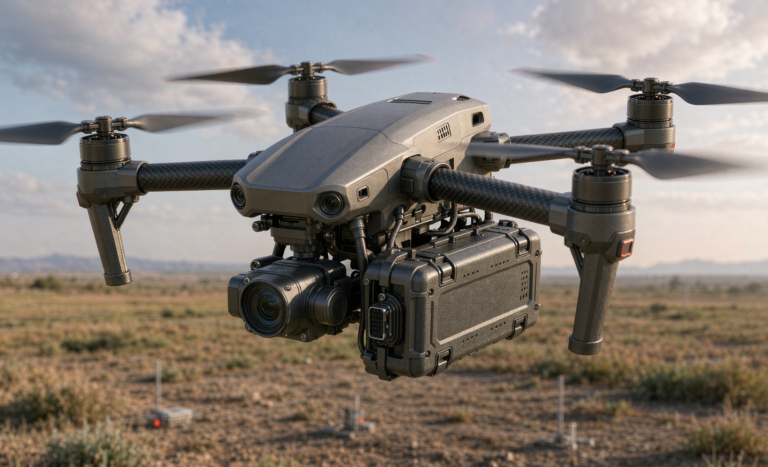
As a lithium battery engineer who has spent more than a decade building packs for industrial UAVs, I have learned to respect one operating environment above nearly all others for how brutally it treats a drone battery: the open-pit mine. When a survey team asks me to spec a drone battery for mining site survey and stockpile volume work, the conversation is never just about flight time. It is about airborne dust that works its way into everything, ambient heat that would cook a laptop in an hour, vibration from nearby blasting, corrosive leachate in the air, and the hard requirement that every single flight produces photogrammetry data accurate enough to bill a client for millions of tonnes of ore. In this article I will walk through how we engineer a drone lithium battery to survive the pit and deliver the consistent endurance that volumetric stockpile surveys depend on.
Why Mining Surveys Are a Different Stress Test
Most industrial drone jobs are hard. Mining surveys are uniquely punishing because three failure modes stack at once. First, the air is full of fine, often conductive, dust — silica, iron ore fines, coal dust, and crushed aggregate that behaves like liquid sandpaper. A pack that is merely “weatherproof” will ingest particles through every seam and vent over a shift. Second, open pits are heat traps: ambient temperatures of 40–50 °C are routine in tropical and desert operations, and a black drone sitting on a truck bed in direct sun can exceed 60 °C before it even takes off. Third, the survey has to be repeatable. A stockpile volume calculation is only meaningful if this week’s flight matches last week’s flight line, altitude, and overlap — which means the lithium battery has to deliver the same voltage, same endurance, and same power headroom on demand, not just on a good day.
There is also a data-integrity angle that non-survey operators miss. RTK-GNSS fixes, IMU measurements, and LiDAR timing all depend on a clean, stable supply rail. If the pack sags under a hover burst, you do not just lose altitude — you can corrupt the georeferencing of an entire dataset. So the power platform itself becomes part of the survey instrument.
Mission Profile — Photogrammetry Grids and Stockpile Volumetrics
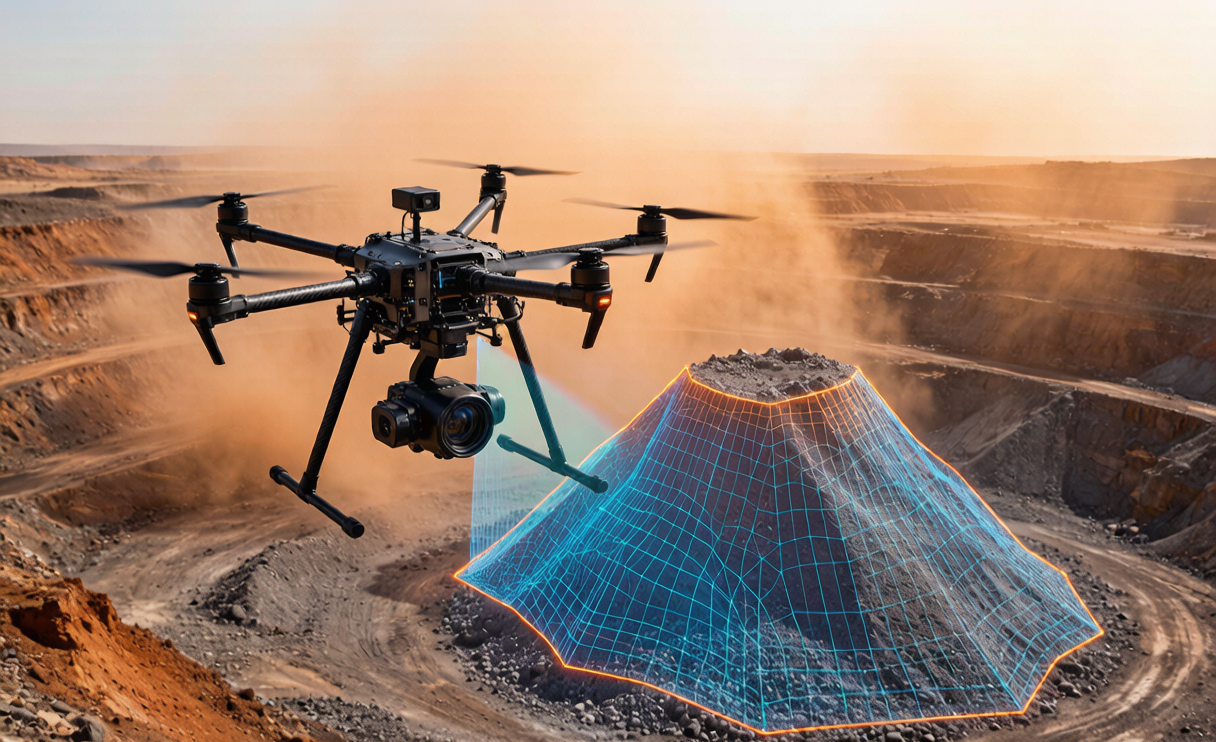
A typical open-pit survey covers 1–5 km² of pit floor, benches, and haul roads, flown as a lawn-mower grid at 60–120 m above ground level. Over a stockpile, the pilot tightens the pattern: 75–80% forward overlap and 60–65% side overlap are standard for photogrammetry that resolves volume to within 1–3% accuracy. That overlap requirement slows the aircraft and lengthens the mission, which raises the energy budget.
Here is the watt-level breakdown I use when sizing a pack for this work:
- Hover / station-keep: 1.5–2.2 kW (needed for RTK re-lock and oblique captures over a pile).
- Forward cruise: 0.8–1.4 kW at 4–8 m/s grid speed.
- Payload draw: RGB mapping camera 5–15 W, LiDAR 15–40 W, multispectral 8–20 W, RTK-GNSS 5–12 W, and onboard compute 10–25 W.
- Gust overhead: +10–25% for wind funnelling through the pit walls.
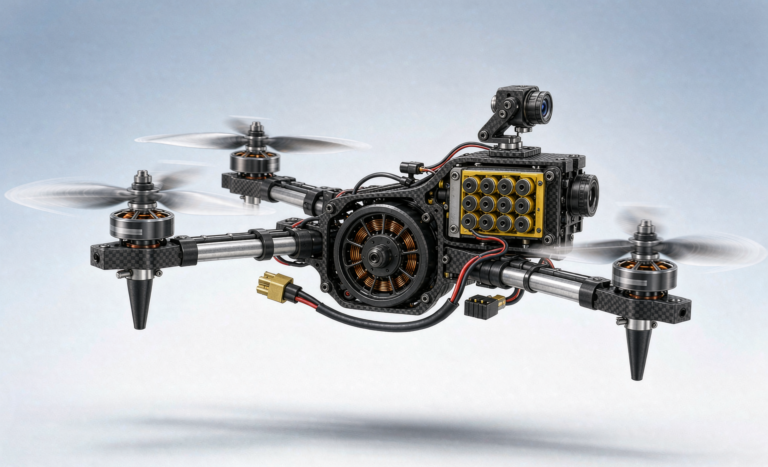
To deliver a 25–45 min mapping sortie with a 30% reserve for unexpected climb-outs or BVLOS margin, you need roughly 0.30–0.60 kWh usable. That lands on a 6S 22 Ah pack or, for heavier LiDAR rigs, a 12S 14–18 Ah pack. The same flight lines must be repeatable, so we track per-pack capacity and internal resistance and retire any pack that drifts outside tolerance before it touches a survey aircraft.
Chemistry Choice — NMC vs LFP in Dust and Heat
For mining survey drones the chemistry decision is a genuine trade-off, not a default. NMC (nickel-manganese-cobalt) gives 200–250 Wh/kg and 500–1,000 cycles — the energy density that lets a small airframe carry LiDAR and still fly 35 minutes. LFP (lithium-iron-phosphate) gives only 120–160 Wh/kg but 2,000–4,000 cycles and a far wider thermal safety window, which matters when packs live in 45 °C shade.
In practice we see two patterns. Lightweight photogrammetry airframes that must maximize endurance run NMC with aggressive thermal design and strict charge gating. Heavy-lift mapping platforms that share a small fleet of packs across a shift increasingly run LFP, because the cycle-life and safety margin offset the weight penalty when the aircraft is already payload-class. The key engineering point is that capacity does not fall in heat the way it does in cold — it actually rises slightly — but calendar aging and internal resistance climb fast above 35 °C, so a pack that lives hot dies young regardless of chemistry. That is why thermal management, not chemistry alone, decides field life.
Sealing, Dust, and Thermal Management for the Pit
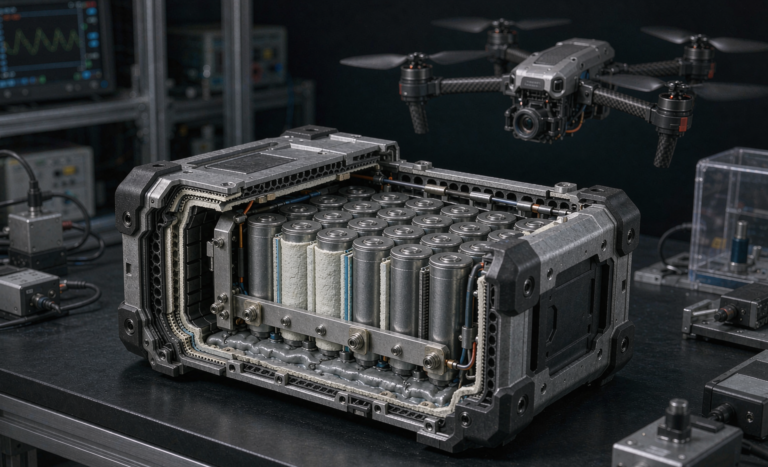
Dust sealing starts at IP6X for solid particles, not the IP5X you might accept for rain. We conformal-coat every PCB, pot the cell stack, and run a desiccant charge that we replace on a ~50-flight cycle. Critically, we avoid cooling fans entirely — a fan is just a dust pump. Heat is moved by conduction to the airframe and shed passively, with the BMS derating charge above a 40–45 °C gate and flight above a 50–55 °C gate.
Vibration from pit traffic and blasting is handled with potting, strain-relieved busbars, and positive cell retention so nothing walks loose over a season. Corrosion gets its own treatment: we use 316L stainless or nickel-plated terminals and a conformal barrier against acidic mist from leach pads. A custom battery solution for a specific mine is mostly these unglamorous details — the cell is the easy part.
A Stable Power Platform Protects Data Quality
I mentioned that survey data depends on clean power. The practical design choice is the voltage platform. A 12S pack pushes lower current than a 6S pack for the same power, which cuts I²R loss in the harness and gives the avionics a steadier rail during hover bursts. We also run a low-noise DC-DC for the flight controller and a separately regulated rail for the payload — RTK and LiDAR are sensitive to ripple, and a noisy supply shows up as jitter in the point cloud.
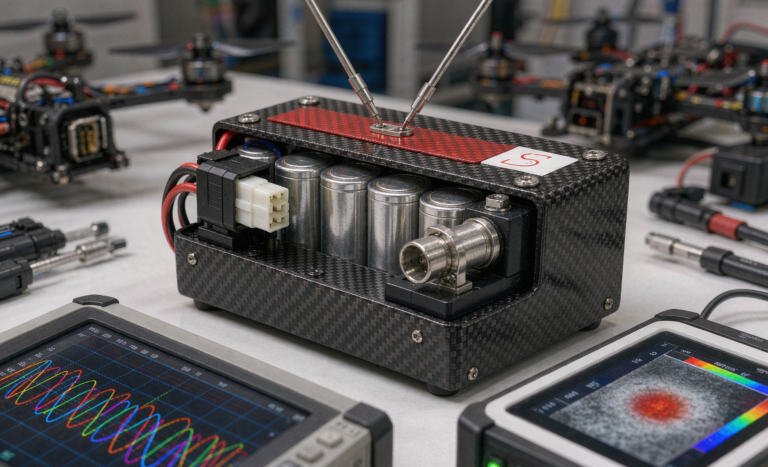
Cell balancing is kept tight (±5–10 mV) with a delta alarm at 20–30 mV, because an unbalanced pack sags earliest right where you can least afford it: the slow, high-overlap orbit over a stockpile. Good BMS telemetry turns “the data looked off today” into “pack 7 is drifting, pull it” before the flight even launches.
Field Charging and Logistics at a Remote Mine Site
Most pits are off-grid or grid-unreliable, so charging runs off solar plus a diesel genset. We budget ~1 kW per charging channel and run 6–12 channels at 1C–2C, which keeps a shift’s worth of packs turning over. The discipline that actually matters is rotation: FIFO by cycle count, storage at 3.80–3.85 V/cell in a shaded, ventilated container, and a hard rule against charging any pack above 40 °C.
Fleet sizing for a single survey aircraft is typically 8–14 packs so one drone can fly all shift while others charge. We retire a pack at 80% of nameplate capacity, 2× its baseline internal resistance, a sustained 50 mV cell delta, or any puffing — and we log that retirement so the client’s audit trail stays clean.
Compliance and Safe Transport to Site
Getting the packs to a remote site is its own engineered process. Every unit ships under UN38.3 (tests T.1–T.8), is built to IEC 62133-2:2017, and travels at ≤30% state of charge per IATA rules, with carry-on compliance to FAA/EASA 100–160 Wh limits where air legs are involved (UN3480/UN3481 as applicable). Mine sites add their own hazardous-materials transport procedures, and we supply the MSDS and transport declarations as a matter of course.
For open-pit stockpile work the atmosphere is unrated, but if the same custom drone battery program extends to confined or gassy underground sections, we move to IECEx/ATEX-rated pack construction — often an inert-gas-filled enclosure — because a single spark in a methane-rated zone is not a warranty event, it is a catastrophe. Specifying that boundary up front is part of the engineering, not an afterthought.
Frequently Asked Questions
How long should a drone battery last for a full stockpile survey?
For a typical 1–5 km² pit with 75–80% photogrammetry overlap, plan on 25–45 minutes of usable flight, which means 0.30–0.60 kWh of pack capacity after a 30% reserve. The reserve is not optional — open-pit wind funnels and unexpected climb-outs will eat it.
Does dust really get inside a sealed battery pack?
Yes, if the seal is merely “weatherproof.” Mining fines are fine and conductive, so we design to IP6X with conformal coating, potting, and no cooling fans, plus a desiccant charge on a replacement schedule. Anything less ingests dust within a shift.
Should I choose NMC or LFP for mining survey drones?
Lightweight photogrammetry airframes that must maximize endurance usually run NMC (200–250 Wh/kg). Heavy-lift or shared-fleet mapping platforms often run LFP (120–160 Wh/kg) for the 2,000–4,000-cycle life and wider thermal safety margin. Thermal management decides field life either way.
How do you charge packs at a remote, off-grid mine?
Off solar-plus-diesel, at 1C–2C across 6–12 channels at roughly 1 kW each, with FIFO rotation, 3.80–3.85 V/cell storage, and a hard no-charge-above-40 °C rule. A single aircraft typically needs 8–14 packs to fly a full shift.
What certifications does a mining survey drone battery need?
UN38.3 (T.1–T.8), IEC 62133-2:2017, IATA 30% SoC transport, and FAA/EASA 100–160 Wh carry-on compliance, plus mine-site hazardous-materials procedures and supplied MSDS. For gassy underground use, add IECEx/ATEX-rated construction.
Conclusion
A drone battery for mining site survey and stockpile volume work is less a flight pack and more a field instrument. The engineering that earns client trust is dust sealing, heat discipline, a stable 12S power platform that protects RTK and LiDAR data, and a logistics loop that keeps packs turning safely at a remote site. If your operation is planning a survey program, talk to us about a custom battery solution built around your specific aircraft, payload, and pit conditions — because in mining, the pack that survives the environment is the one that delivers the data.