Drone Battery Performance for Racing Drones: How a Full
I have spent the last eleven years designing and validating high-discharge packs for FPV racing, and the question I get most often at trackside is not “which pack is fastest out of the box?” It is a quieter, more expensive question: why does the pack that won in March feel dead in August? Almost every pilot I work with buys on peak numbers, then races on decayed numbers. Understanding drone battery performance for racing drones across a full season is the difference between a consistent podium program and a bin full of puffed packs.
This article is the season-decay handbook I wish someone had handed me in my first year on the bench. I will show you what actually degrades in a racing drone battery, how I quantify it with equipment most teams already own, what our own 120-cycle test data looked like, and which habits genuinely slow the curve down. Everything here comes from repeat-tested packs, not marketing sheets.
What “Performance” Actually Means After Cycle 50
On a race weekend, performance is not capacity. Nobody loses a heat because a pack held 1240 mAh instead of 1300 mAh. Races are lost to voltage under load. A 6S 1300 mAh pack that sags to 18.6 V during a full-throttle punch out of a split-S is delivering roughly 12–14% less electrical power to the motors than a fresh pack holding 21.2 V at the same current, even though both may still register acceptable static capacity.
So when I evaluate a drone battery for a race program, I track four numbers, in this order of priority:
- Loaded voltage at 80 A and 120 A — the practical proxy for punch.
- DC internal resistance (DCIR) per cell — typically 1.4–2.2 mΩ per cell when new on a genuine 100C-class pack, drifting upward with age.
- Peak cell temperature and post-flight delta — a rise from 42 °C to 58 °C on the same course is a resistance story, not a weather story.
- Cell-to-cell divergence at rest — anything beyond 30 mV after a settling hour tells me the weakest cell is now setting the pack’s ceiling.
Capacity fade is the fifth metric, and honestly the least useful for racing. In our data, a lithium battery pack loses roughly 8–12% capacity by cycle 100 under aggressive use, but loses 25–35% of its punch in the same window. Resistance grows far faster than capacity shrinks. That asymmetry is the single most important fact in this article.
The Four Decay Mechanisms I Measure Across a Season
Season-long decay in a drone lithium battery is not one process. It is four, and they respond to different countermeasures.
1. Growth of the solid electrolyte interphase (SEI)
Every cycle thickens the passivation layer on the anode. This is the slow, unavoidable baseline: it consumes lithium inventory and raises resistance. High temperature accelerates it roughly exponentially — as a working rule I use, storage or operation at 45 °C ages a cell about twice as fast as at 25 °C.
2. High-rate mechanical fatigue
Racing packs live at 60–120C bursts. Repeated fast lithium insertion and extraction causes particle cracking and delamination in the electrode coating. This is why a pack cycled gently at 10C for 100 cycles will still measure healthy while a race pack at the same cycle count is finished. Cycle count without a duty-cycle context is a meaningless spec.
3. Electrolyte depletion and gassing
The visible symptom is puffing. Gas generation from electrolyte decomposition raises internal impedance and physically separates layers, so the electrode stack loses contact area. Once a pouch has meaningful swelling, the performance is gone and no “recovery” charge cycle brings it back — and it becomes a safety item, not a performance item.
4. Tab, lead and connector degradation
This one is chronically ignored. A tired XT60 contact or a partially fatigued nickel tab weld can add 2–4 mΩ to the total path. On a 100 A punch, 3 mΩ is 0.3 V lost and 30 W dumped as heat inside your connector. I have restored what pilots called “dead” packs simply by replacing a connector and reflowing lead joints.
My Bench Protocol: Turning Lap Feel Into Numbers
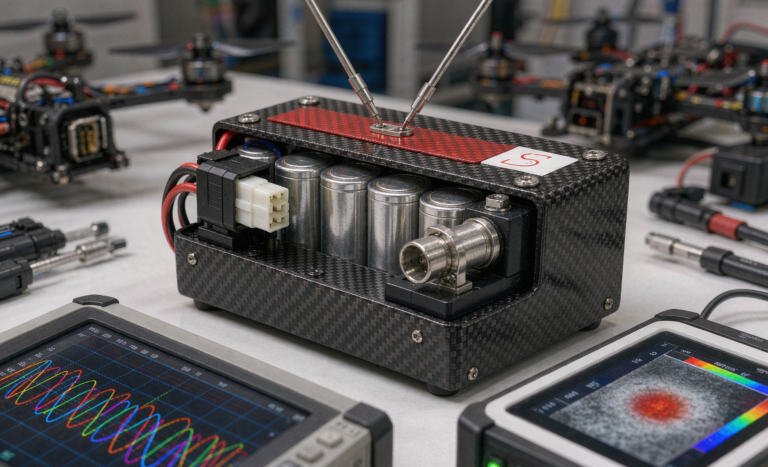
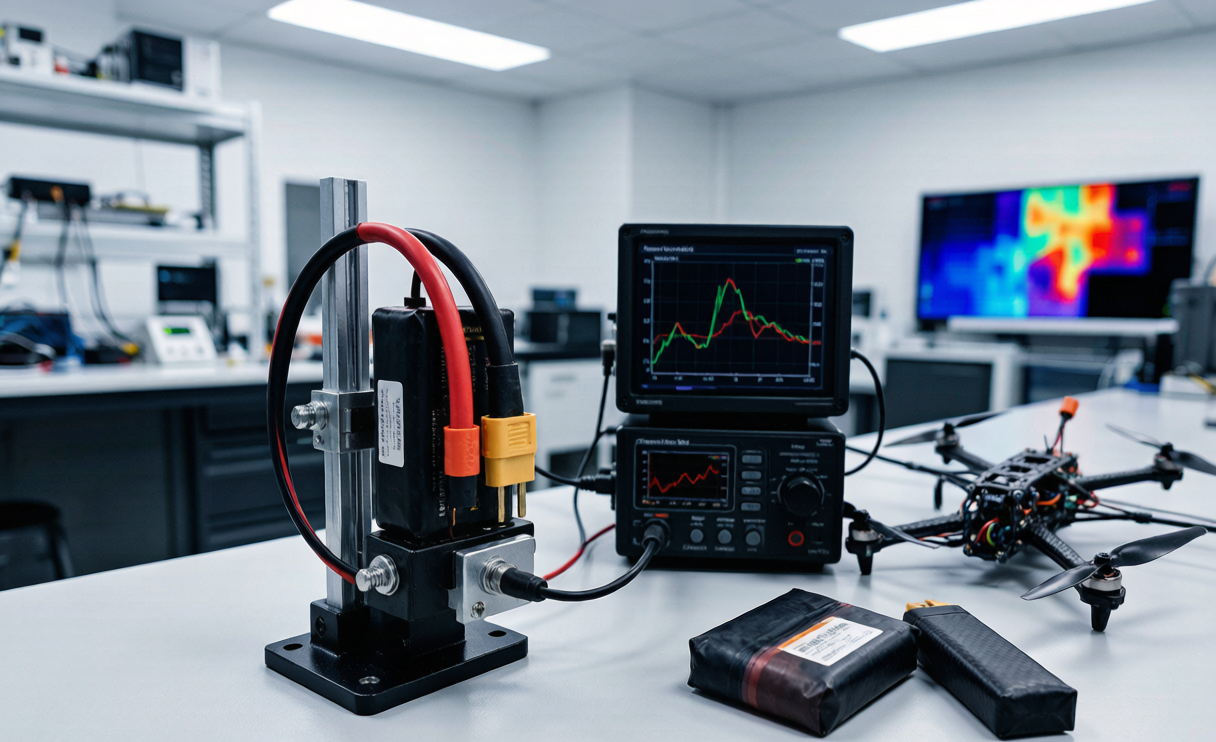
Subjective “it feels soft” reports are impossible to act on. Here is the repeatable four-step protocol I run on every pack in a fleet at intake, then every 20 cycles. It takes about 25 minutes per pack.
- Step 1 — Rest and baseline. Let the pack settle at 22 ± 2 °C for at least 60 minutes. Log per-cell open-circuit voltage to 1 mV resolution.
- Step 2 — DCIR pulse. Apply a 10-second load pulse at 1C and a second at approximately 20C, and compute resistance from the voltage delta. Same fixture, same leads, every time — the absolute value matters less than the trend on identical hardware.
- Step 3 — Constant-current discharge. Discharge at a fixed 30 A to a 3.5 V/cell floor, logging voltage and surface temperature at 1 Hz. I record voltage at 20%, 50% and 80% depth of discharge.
- Step 4 — Punch simulation. Three 3-second bursts at 80 A separated by 20-second rests, at 50% state of charge. Minimum loaded voltage in burst three is my headline performance number.
Plot that headline number against cycle count and you get a decay curve for each individual pack. In practice, decay is not linear: there is an early settling drop, a long stable plateau, then a knee where resistance climbs sharply. Finding the knee early is the entire point of the exercise.
Season Data: What 120 Cycles Did to Our Test Packs
Last season we ran a controlled fleet of twelve 6S 1300 mAh packs from three suppliers, all rated 100C, all flown on the same 5-inch airframes by the same three pilots to remove throttle-style bias. Charging was standardized at 2C with a 15-minute forced cool-down before every charge. Ambient across the season ranged from 8 °C to 34 °C.
The aggregate result, averaged across the fleet:
- Cycle 1: DCIR 9.8 mΩ pack-level; minimum punch voltage 19.9 V; static capacity 1305 mAh.
- Cycle 40: DCIR 11.6 mΩ (+18%); punch voltage 19.3 V; capacity 1268 mAh (−2.8%).
- Cycle 80: DCIR 14.9 mΩ (+52%); punch voltage 18.5 V; capacity 1204 mAh (−7.7%).
- Cycle 120: DCIR 21.3 mΩ (+117%); punch voltage 17.4 V; capacity 1121 mAh (−14%).
Read those columns side by side and the asymmetry is stark: capacity fell 14% while punch voltage fell 2.5 V and resistance more than doubled. A pilot judging pack health by a capacity check at cycle 120 would conclude the pack was “86% healthy.” Measured by what actually wins races, it was closer to 60%.
The second finding was variance. The best three packs in the fleet were still at 18.9 V punch at cycle 120; the worst two had crossed below 17 V by cycle 70. Same rating on the label, same nominal chemistry, radically different aging behavior. Cell sourcing, tab welding quality and internal lead gauge explain most of that gap — which is exactly why I push serious teams toward a specified custom battery solution rather than whatever is in stock.
Charging and Storage Habits That Genuinely Slow the Curve
Of all the variables we tested, three interventions produced measurable, repeatable improvements. Everything else was noise.
- Never charge a hot pack. Charging above about 45 °C cell temperature was our single biggest accelerant. Enforcing a cool-down to under 35 °C added roughly 25–30 usable cycles across our fleet.
- Storage voltage discipline. Packs parked at 4.20 V/cell for a week between events showed 2–3× the resistance growth of packs discharged to 3.80–3.85 V/cell. This is free performance; it costs only a habit.
- Respect a real voltage floor. Landing at 3.40 V/cell under load is fine. Repeatedly pulling packs down to 3.0 V/cell resting caused irreversible knee-point damage within 15–20 cycles.
Two things that did not help, despite being popular: high-rate 4C+ “fast” charging showed no performance benefit and cost cycle life, and so-called balance-recovery cycles did nothing measurable for packs that had already diverged.
Ambient Temperature, Warm-Up and Cold-Weather Racing
Cold is a performance thief that many pilots mistake for pack failure. At 5 °C, a lithium battery cell’s internal resistance can be 2–3× its 25 °C value, because electrolyte ionic conductivity and charge-transfer kinetics both fall off sharply. The result is dramatic sag on the first punch and, worse, a real risk of lithium plating if you charge below 0 °C — which causes permanent, irreversible damage and a genuine safety hazard.
My cold-day routine is simple: keep packs in an insulated bag with a passive heat source until they read 20–25 °C, fly the first 20 seconds at moderate throttle to self-heat the cells, then race. Never charge below 5 °C cell temperature. On the hot end, the opposite discipline applies: above 40 °C ambient I extend cool-down intervals and accept fewer heats per pack rather than cooking the fleet in a single weekend.
Retirement Criteria, Safety and Compliance
Performance decay eventually becomes a safety question, and a race program needs a written retirement rule rather than a vibe. Mine has four triggers, any one of which retires the pack immediately:
- Pack-level DCIR exceeds 2× its intake baseline.
- Punch voltage falls below 17.5 V on a 6S pack in the burst test.
- Visible swelling greater than about 5% of original thickness, or any pouch deformation.
- Resting cell divergence above 50 mV after a full charge and one-hour settle.
Compliance matters here too. Every cell we qualify must have UN 38.3 transport test documentation covering altitude simulation, thermal cycling, vibration, shock, external short circuit and overcharge, and we specify pack-level construction against IEC 62133-2 for rechargeable lithium systems. Aged packs are also a transport problem, not just a flight problem: damaged or defective cells are barred from normal air transport, and both FAA and EASA guidance requires lithium batteries in carry-on baggage with terminals protected and, for spares above defined watt-hour thresholds, explicit operator approval. A 6S 1300 mAh pack is about 28.9 Wh, comfortably under the 100 Wh threshold — but a team travelling with forty of them still needs to check the carrier’s quantity limits before the airport, not at it.
From Spec Sheet to Race Reality: Specifying a Better Pack
When teams ask us to build a drone battery that survives a season instead of a month, the specification conversation focuses on aging resistance, not headline C-rating. The levers that actually matter are internal lead gauge and length, tab weld quality and count, cell matching tolerance at intake, pouch compression and the connector choice. Tightening cell matching to under 5 mΩ DCIR spread and specifying heavier internal leads typically costs a few grams and buys 20–30% more usable cycles before the knee.
That is the value of an engineered custom battery solution for a competitive program: it is not about a bigger number on the label, it is about a flatter decay curve. If you fly forty race packs a season, a design that pushes the knee from cycle 70 to cycle 110 is a meaningful budget line, not a nicety.
Frequently Asked Questions
How many cycles should a racing drone battery actually last?
For competitive 5-inch racing at 60–120C bursts, expect 80–150 usable cycles from a good pack before punch voltage degrades noticeably. Manufacturer figures quoting 300+ cycles are almost always measured at far gentler discharge rates, so treat them as chemistry potential rather than a racing expectation.
Does capacity testing tell me if my pack is still fast?
No, and this is the most common diagnostic mistake I see. Capacity fades slowly while internal resistance climbs quickly. A pack can pass a capacity check at 90% of rated while having lost a third of its punch. Measure loaded voltage under a burst test or track DCIR instead.
Is puffing always a reason to retire a pack?
Any measurable swelling means electrolyte decomposition and gas generation have already occurred, impedance has risen, and the failure mode is progressive. Once swelling is visible, retire the pack. Discharge it to a safe low voltage and dispose of it through a proper lithium recycling channel — do not attempt to flatten or vent a pouch cell.
Does storage voltage really change season-long performance?
Yes, and it is the cheapest improvement available. In our fleet, packs stored at 3.80–3.85 V/cell between events showed roughly a third of the resistance growth of packs left fully charged. If a pack will sit more than 48 hours, put it at storage charge.
Can I mix packs of different ages in the same race day rotation?
You can fly them, but do not compare tuning results across them, and never parallel-charge packs with different resistance and state of charge. Mixed-age parallel charging pushes uneven current into the weakest pack, which accelerates its decay and creates a thermal risk. Group packs into age-matched sets and rotate the sets, not individual packs.
Closing Notes from the Bench
Season-long drone battery performance is a resistance story with a capacity subplot. If you measure only capacity, you will retire packs too late and blame your tune for a problem that lives in your electrode coating and your connectors. Build a 25-minute intake and 20-cycle re-test habit, enforce cool-down and storage-voltage discipline, write a retirement rule and hold to it, and specify aging resistance when you commission packs. Do those four things and the pack that won in March will still be respectable in August — and you will know precisely when it is not.