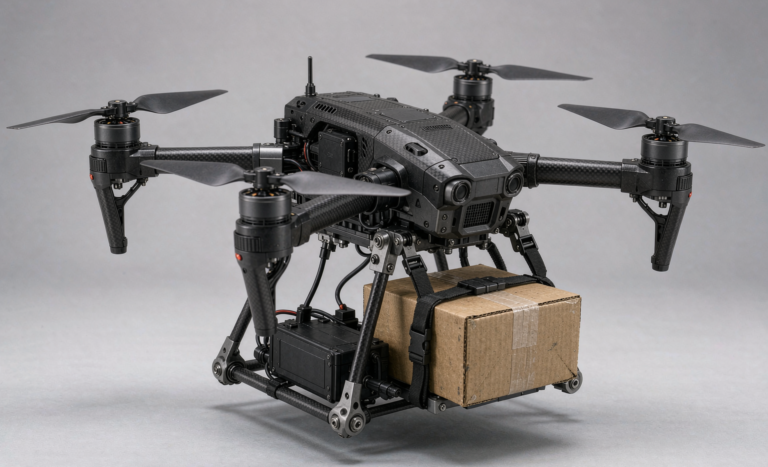
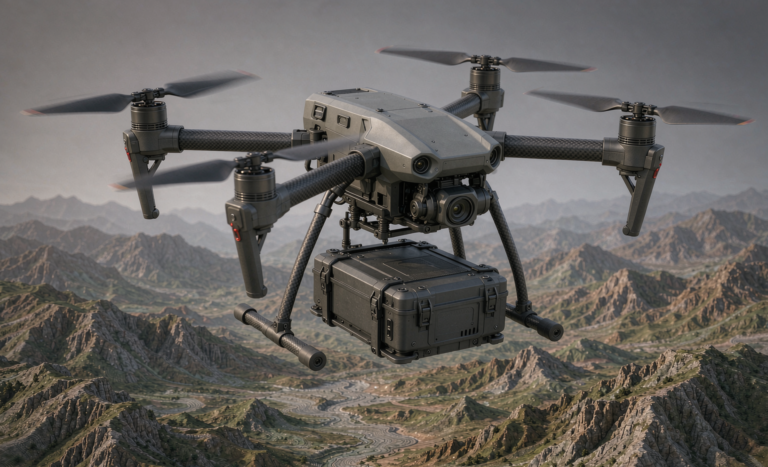
Drone Battery Manufacturing for Mapping UAVs (Guide)
Why Mapping Packs Demand Manufacturing Precision, Not Just a Good Design
When I brief a new survey customer at Horizon Power, the first thing I tell them is that the CAD file is the easy half. A mapping UAV battery lives an energy-limited life — cruise draws of 0.5–1.5C, with the real value measured in hectares mapped per charge and the integrity of the RTK fix, not in burst power. But a beautiful pack design means nothing if the production line cannot reproduce it, pack after pack, within a tolerance the airframe can actually fly. For a mapping fleet the product is not a single clever pack; it is consistency. Two packs wearing the same label but separated by a 5% capacity spread or a 30 mV internal-resistance delta will fly two different missions: one finishes a 250-hectare block with 30% reserve, the other drops RTK lock on the final leg and forces a re-fly. That is why, for us, the manufacturing plan is a tolerance budget, not just a bill of materials. Every step below exists to keep a drone battery batch interchangeable across an entire survey fleet.

Incoming Cell Grading — The Foundation of Fleet Interchangeability
Mapping packs are built from graded cells, never from a random carton. On incoming inspection every cell — pouch or cylindrical — is scanned on a 1 kHz ACIR bridge, capacity-checked at 0.5C, and measured for thickness at a rested 3.80–3.85 V/cell. We then bin: a ±2% capacity window and a ±5% DCIR window inside any one pack, with a cell-to-cell ACIR delta below 30 mV and a thickness delta under 2%. This is the step most catalog pack builders skip, and it is the single biggest reason survey fleets see unexplained range scatter. Tight grading keeps the pack DCIR low so voltage sag stays under 8% during the 3C/10 s climb pulses, and it keeps usable energy inside spec so reserve predictions actually hold on the last leg of a long survey grid. A real custom battery solution for mapping starts here — graded to the survey mission, not pulled from a generic bin.
Welding the Busbars — Holding Interconnect Resistance Under 1.8 mΩ
The busbars are laser-welded to the cell tabs in a fixtured jig that holds geometry constant, with ultrasonic bonding used where foil pouch terminals are too thin for a clean weld. Our resistance budget is unforgiving: interconnect resistance must stay under 15% of total pack DCIR. With a pack target of under 10 mΩ at 1 kHz, that means every joint is verified below 1.5–1.8 mΩ on a micro-ohm meter, and any joint reading above 1.8 mΩ is rejected and reworked. The reason this matters for mapping is thermal: we raise voltage before current, so a 6S topology moved to 12S halves the current and quarters the I²R loss (144 W down to 36 W), letting the busbars run cool through a full day of climb-cruise cycles. The removable pack uses an AS150 or XT150 connector with 8 AWG gold-over-nickel plating rated for 500–1000 mate cycles — because a survey depot swaps packs 8–12 times a day, and a connector that degrades is a connector that heats.
In-Line Functional Test — Verifying DCIR Sag Before the Pack Leaves the Line
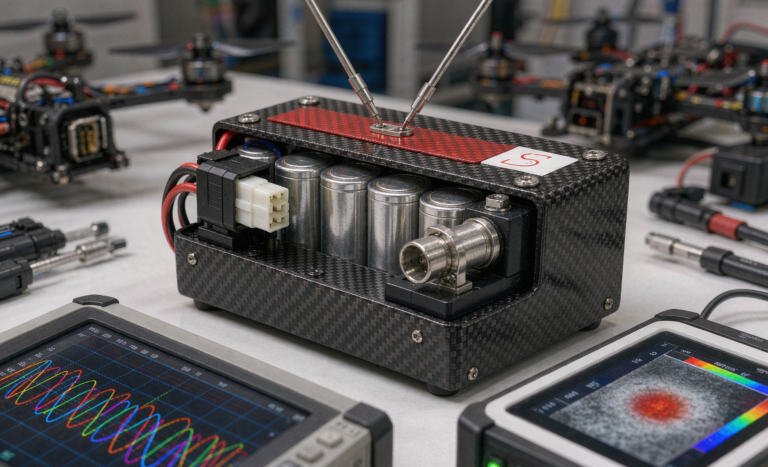
Every finished pack runs an automated end-of-line functional test before it is ever labeled. We apply a 3C/10 s pulse and measure pack DCIR at 1 kHz plus the resulting voltage sag; the pass gate is sag under 8% and DCIR under 10 mΩ. We then capacity-check at the 0.5C mapping duty and record usable watt-hours against the spec, confirm the cell-to-cell balance is within ±2–5 mV, and run a thermal-uniformity scan that must show a 3–5°C gradient across the pack — anything above an 8–15°C hotspot fails. This test exists for one reason: it catches the pack that looks perfect on the bench but would blur the gimbal on the last leg of a survey block. A drone lithium battery that cannot pass its own duty profile has no business leaving the building.
BMS Flashing and Calibration — Locking the Fuel Gauge to the Real Cells
The BMS is not a commodity part we snap on at the end. Each board is flashed with mission firmware that is version-locked, and its fuel-gauging model is calibrated to the exact graded cell batch that went into that pack. Balance thresholds and protect limits — over/under voltage, over-temperature — are set to the chemistry we actually built, not to a default. State-of-charge accuracy is not a nicety for mapping; a pilot plans a 250-hectare block on a single charge with a 25–30% reserve under FAA Part 107 / EASA SORA rules, and a 5% SOC error means a missed leg or a forced return-to-launch. The BMS is the only thing standing between a cold cell and a dropped RTK fix, so calibration is a production gate, never a checkbox. When a customer needs a custom drone battery tuned to a specific sensor payload, this is the step where the tuning is burned in.
Encapsulation on the Line — Conformal Coating, Potting, and IP Sealing
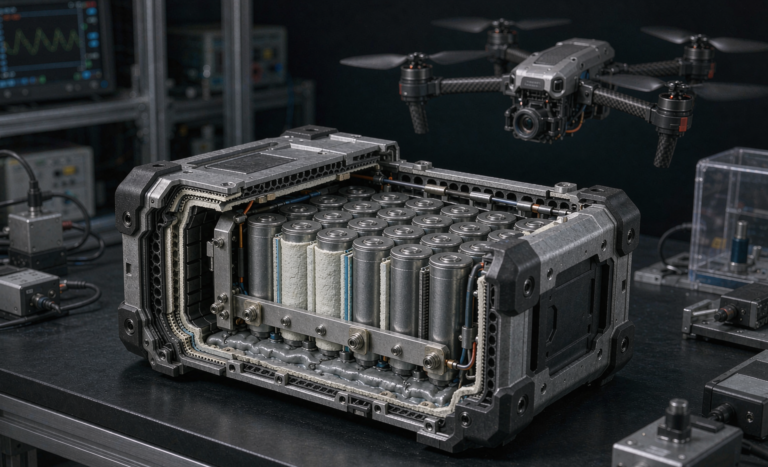
Mapping happens in fog, dust, coastal spray, and temperature swings no lab enjoys. On the line, dosing robots apply conformal coat and potting to protect against humidity and vibration, and the pack is sealed to IP5X–IP6X with 316L stainless hardware and a desiccant pack — deliberately with no fan, because a sealed composite fuselage has nowhere for convection to go and the thermal path is conduction to an aluminum tray bolted to the skin. Thermal-pad placement is fixtured so every pack carries the same conduction path, which is what keeps cell temperatures predictable across a fleet. For cold-climate survey work we bond a 5–15 W pad heater active from 10–25°C, recovering roughly a third of the cold fade we measure as 100% capacity at 25°C dropping to 85% at 0°C, 70% at −10°C, and 55–60% at −20°C. This is where a field-grade lithium battery earns its service life.
Serialization and MES Traceability — Every Pack Has a Data Twin
Consistency you cannot prove is consistency you do not have. A QR code and serial baseline are etched at cell intake, and our MES logs every graded value, every weld resistance, every functional-test result, and the BMS version for each pack. That data record travels with the pack for its whole life, so a fleet manager can rotate stock FIFO by serial and we can root-cause any outlier straight back to the cell lot. We track field returns against a target below 50 PPM, because for a survey operator the trust that pack #447 flies identically to pack #001 is the entire value proposition. Traceability is also what lets us stand behind a graded, documented custom battery solution years after the line moved on to the next batch.
From Prototype to Production — Process Capability and First-Pass Yield
A one-off prototype that flies beautifully is an engineering demo; a line that ships 500 identical packs is a manufacturing system. We hold Cpk on weld resistance and pack DCIR, run gauge R&R on the micro-ohm station so the numbers mean something, and use poka-yoke fixtures that physically prevent a reversed or half-seated mate. First-pass yield targets sit above 98%, and the 2% rework loop is exactly where a custom drone battery either scales cleanly or falls apart. Process capability — not heroics, not hand-selection — is what lets a survey customer reorder 200 more packs next season and trust they will match the first 200.
Shipping the Spec Forward — UN38.3 and IATA at Line End
Before a pack is cartoned it is discharged to the IATA 30% state-of-charge required for air and road transport, and the UN38.3 T.1–T.8 and IEC 62133-2:2017 qualifications already earned at the design stage are attached as documentation pulled straight from the MES. We respect the FAA / EASA 100–160 Wh per-pack ceiling on every mapping pack and generate the transport label and test summary from the same data record that proved the pack passed. The pack leaves the line not merely built, but built to a tolerance, tested to its duty, and documented to compliance — which is the only kind of drone battery a professional survey fleet should fly.
Frequently Asked Questions
How tight does cell matching need to be for a mapping drone battery?
We bin to a ±2% capacity window and a ±5% DCIR window inside each pack, with a cell-to-cell ACIR delta under 30 mV. That level of grading is what keeps pack DCIR low, voltage sag under 8% during climb pulses, and usable energy inside the reserve prediction a pilot flies on.
Why laser weld the busbars instead of soldering them?
Laser welding gives a repeatable, low-resistance joint we can verify below 1.5–1.8 mΩ on every pack, where solder is inconsistent and adds resistance that turns into heat during a full day of survey climbs. Fixtured welding also holds geometry constant across hundreds of packs, which hand soldering cannot.
Can the same production line build different mapping pack sizes?
Yes. The graded-cell intake, weld fixtures, in-line functional test, and MES traceability are process blocks we reconfigure per pack envelope. A custom drone battery for a heavy LiDAR airframe and a light RGB mapping quad run through the same quality gates; only the topology, cell count, and BMS firmware differ.
How do you keep cold-weather performance consistent off the line?
Thermal-pad placement is fixtured on every pack, and cold-climate builds bond a 5–15 W pad heater active from 10–25°C that recovers roughly a third of the cold fade measured at −10°C to −20°C. Because the conduction path is identical pack to pack, cold performance stays predictable across the fleet.
What happens to a pack that fails the in-line functional test?
It is quarantined by serial, never shipped. The MES record tells us whether the failure is a graded-cell outlier, a weld-resistance reject, or a BMS calibration miss, and we root-cause it back to the lot before any rework — that is how we hold field returns under 50 PPM.
Closing
A mapping UAV battery is only as good as the line that builds it. Grading, welded interconnects, in-line DCIR verification, calibrated BMS, fixtured encapsulation, and full MES traceability are the difference between one pack that flies and a fleet that flies identically, pack after pack. If you are specifying a survey fleet and need packs that perform the same on pack #001 and pack #500, talk to our engineering team about a graded, documented custom battery solution built to your mission profile.