Drone Battery Testing for Inspection UAVs
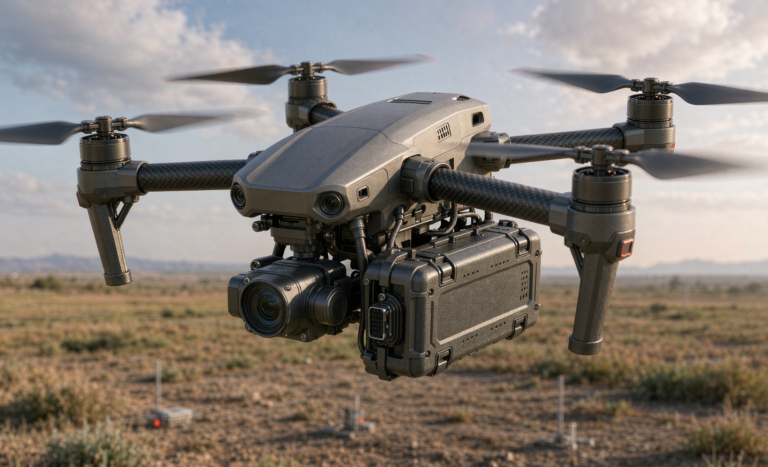
After fifteen years on the lithium cell line, I have learned one hard truth: a drone battery that passes a generic datasheet test can still fail a real inspection flight. Inspection UAVs do not fly like cinematography drones. They climb rooftops, hover against desert wind, descend into quarry pits, and repeat that cycle dozens of times a week. If you are a B2B buyer specifying power for a survey, energy, or asset-inspection fleet, the question is not “is this cell good?” — it is “has this exact drone lithium battery pack been proven against our mission?” This article walks through the test menu my engineering team runs before any pack earns a place on an inspection airframe, and why that evidence should sit at the center of your procurement decision.
Why Inspection UAVs Need a Different Test Menu Than Hobby Drones
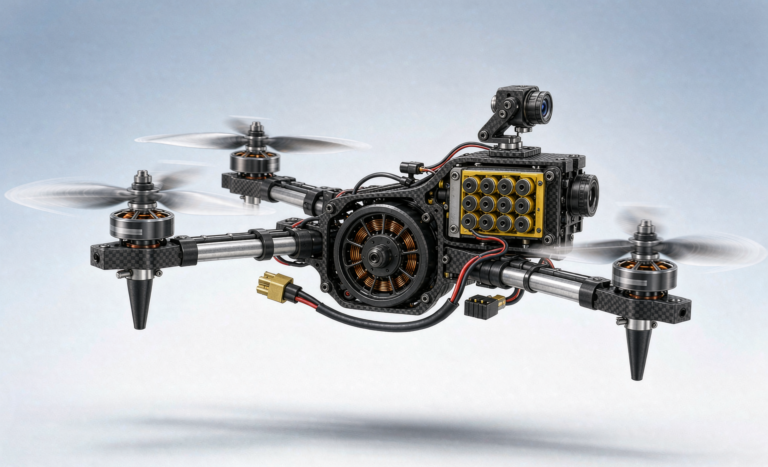
A consumer quadcopter might see three flights a weekend and live in a climate-controlled home. An inspection UAV logs 20 to 40 flights a week across temperature swings of -10 °C to +45 °C, with repeated full-throttle climbs, hard landings, and exposure to dust, salt fog, or concrete dust. The lithium battery inside is subjected to a far harsher duty cycle, yet it is expected to hold calibration-grade stability for the sensors it powers. We therefore split testing into four buckets: electrical performance, environmental stress, electromagnetic compatibility, and safety/transport certification. Skipping any one of them is how fleets end up grounded at month three.
The Mission-Profile Cycle Test: Simulating Real Inspection Flights
The single most valuable test we run is the mission-profile cycle, not a flat 0.5C charge / 1C discharge loop. We record an actual inspection sortie — climb to 80 m, cruise at 12 m/s, hover 90 s over a turbine, descend, repeat — and replay it on the cycler with 1 s resolution. Two numbers matter most to an operator:
- Usable endurance at the payload mass you actually fly. A bare-frame figure of 38 minutes drops to 24–27 minutes once you bolt on a 200 g LiDAR or a 320 g thermal gimbal. We report endurance at your payload, not ours.
- Return-to-Launch (RTL) reserve behavior. We measure how much capacity remains at the 30% state-of-charge (SoC) RTL trigger across cell temperatures, because that buffer is what prevents a dead-stick landing over a live substation.
Across a 500-cycle mission-profile run on a representative drone battery pack, we typically see capacity fall to 80% of initial between cycle 420 and 520, depending on chemistry. That data point — not a marketing “1,000 cycles” claim — is what we hand to your operations planner for total-cost-of-ownership math.
Environmental Stress Screening: Heat, Cold, Dust and Vibration
Inspection sites are unforgiving. Our environmental chamber sweeps -20 °C to +60 °C and we track capacity fade and internal resistance in both windows. At -10 °C a standard NMC drone lithium battery retains roughly 70% of its 25 °C capacity; at -20 °C that figure is closer to 55%. If your inspection work happens in winter or at altitude, we specify either a heated pack architecture (5–15 W trace heating holding cells in a 10–25 °C core window) or an LFP chemistry with a gentler low-temperature knee.
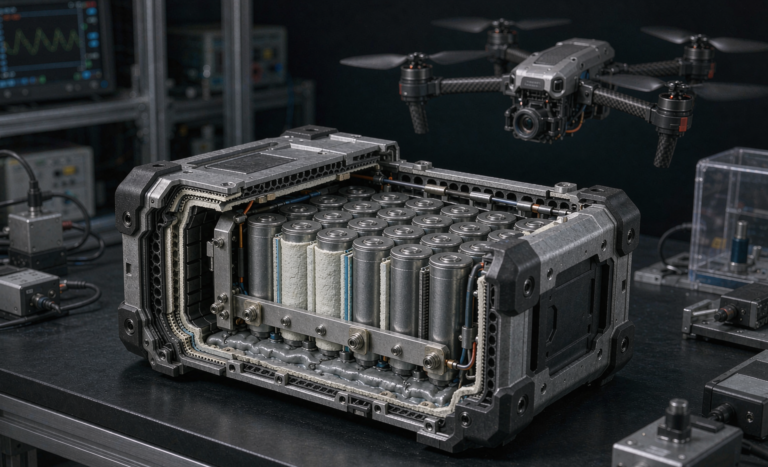
Vibration and shock are equally decisive. We mount packs on a shaker table and reproduce the 6–12 g takeoff jolt and the broadband 20–500 Hz rotor vibration of a typical airframe, then X-ray the weld bonds. A lithium battery that loosens a busbar weld after 200 flights is a latent failure, not a cosmetic one. Dust ingress is screened to IP54 for land-based inspection and IP67 where the UAV works near spray or washdown.
Electrical and EMC Validation for Avionics-Safe Power
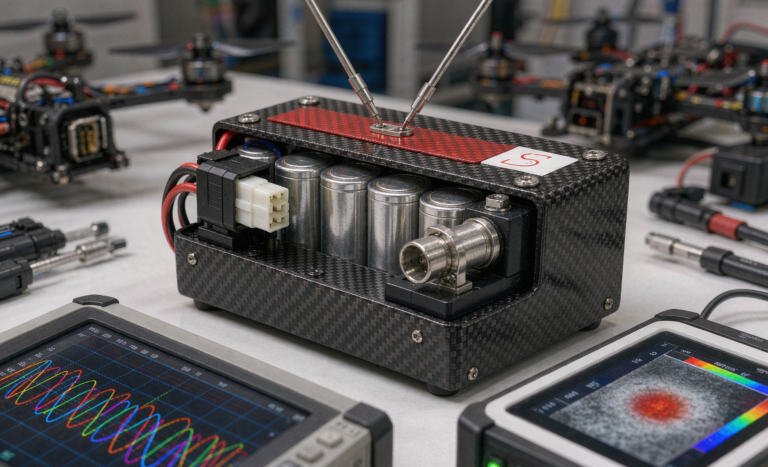
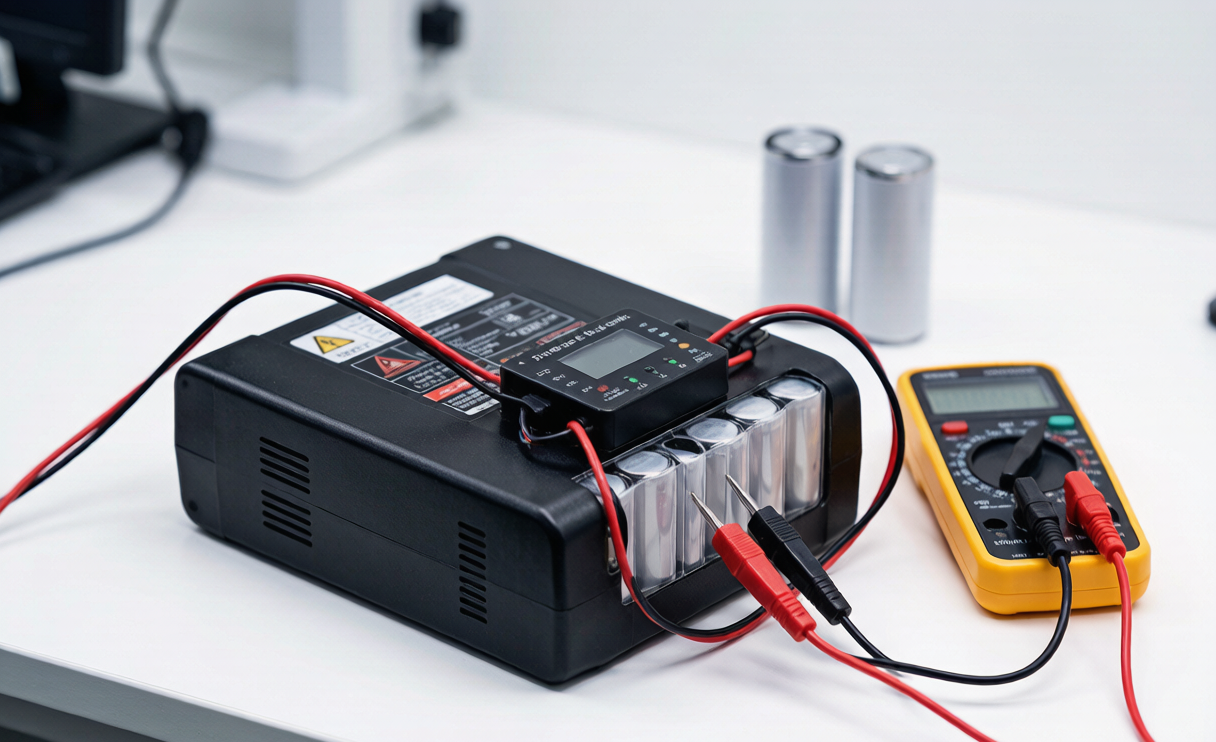
An inspection UAV carries a flight controller, GNSS, a radio link, and often a sensitive payload — all drawing from the same drone battery. We validate the battery’s DC-IR under pulsed 20–40 A loads (typical for aggressive climbs) and confirm the BMS holds voltage sag below 3.3 V/cell at peak. Then comes electromagnetic compatibility: we measure conducted and radiated emissions against the airframe’s avionics noise floor. A pack whose switching BMS spurs GNSS can quietly degrade your positioning to 2–3 m — fatal for crack-level inspection. We never ship a pack that has not passed an EMC bench screening on the actual airframe class.
Acceptance Criteria: What “Pass” Actually Means for Your Contract
A test is only useful if it has a pass line written down before the pack is built. For inspection UAV programs we define hard, auditable thresholds: capacity retention at or above 80% through 500 mission cycles, internal resistance rise no greater than 30% from the baseline, zero weld fracture at the 12 g shock level, BMS overcurrent cutoff engaging within 200 ms, and an enclosure rated to at least IP54. We publish these into the release specification so your own QA team can independently re-verify a sample at incoming inspection rather than trusting a supplier’s summary. This is also where a custom battery solution protects you: thresholds are tuned to your specific failure modes. A wind-turbine inspection fleet cares far more about cold-start recovery than a warehouse-roof surveyor does, so we weight the test matrix accordingly and document the rationale for every limit so an auditor can trace it back to a concrete flight risk.
Safety and Transport Certification (UN38.3, IEC 62133, FAA/EASA)
No inspection program should fly uncertified cells. Every pack we release carries the documentation buyers need:
- UN38.3 (T.1–T.8): altitude simulation, thermal, vibration, shock, external short, impact, overcharge, and forced discharge. This is the baseline for legally moving drone lithium battery packs by air or road.
- IEC 62133-2:2017: the cell- and pack-level safety standard covering internal-short, overcharge, and temperature abuse — what most enterprise buyers’ compliance teams ask for by name.
- FAA / EASA rules: packs between 100 Wh and 160 Wh are carry-on only with operator approval; we label energy in watt-hours and stage shipments at 30% SoC for transport, matching IATA provisions UN3480/UN3481.
I tell every procurement manager the same thing: if a supplier cannot show you a current UN38.3 test summary and an IEC 62133-2 report keyed to your exact pack configuration, that is your stop sign. Certification is not paperwork — it is the difference between a pack that fails safe and one that fails catastrophically at 120 m.
From Test Data to a Custom battery solution for Your Fleet
The real output of all this testing is not a number on a report; it is a specification. Once we have your mission profile, payload mass, ambient range, and RTL policy, we translate the test evidence into a custom battery solution: the right cell chemistry (NMC for energy density, LFP for cycle life and safety margin), the right series-parallel count to hit your voltage platform, a BMS tuned to your current pulses, and a mechanical envelope that survives your landing surface. For one grid-inspection client we moved them from a 6S NMC pack to a 12S LFP design after the cycle test showed the NMC pack crossing 80% capacity before their 18-month replacement window — the test data paid for itself in avoided mid-contract swaps.
If you run mixed airframes, we build a family of packs sharing one BMS firmware and one charger protocol, so your field team carries one charger and one spare doctrine. That interoperability is only possible because the test program is documented per platform and cross-referenced in our release notes.
How long does a full inspection UAV battery qualification take?
A complete program — mission-profile cycling, environmental screening, EMC, and certification review — runs six to ten weeks for a new pack, longer if we are qualifying a novel chemistry. A minor variant on an existing qualified platform can be turned around in two to three weeks because much of the envelope data is reused.
What cycle life can I expect from a tested inspection drone battery?
For a typical NMC drone battery flown at 80% depth-of-discharge on inspection profiles, plan on 400–520 cycles to 80% capacity. LFP variants we test for the same duty usually reach 800–1,200 cycles. The precise figure comes from your mission-profile run, not a catalog claim.
Do inspection drone batteries need UN38.3 even for domestic flights?
Yes. Carriers and most national aviation authorities apply UN38.3 as the transport safety baseline regardless of border crossing, and enterprise sites (utilities, refineries, ports) increasingly require it for on-site induction. We treat UN38.3 plus IEC 62133-2 as non-negotiable for any lithium battery we ship.
How do I verify a supplier’s test report is genuine?
Ask for the test lab’s accreditation (ISO/IEC 17025), the report’s unique reference, and confirmation it is keyed to your exact pack configuration rather than a generic cell datasheet. A credible supplier will also share the cycler raw data or a redacted excerpt — we do, and we encourage buyers to request it before signing.
Testing is where a custom battery solution earns its name. If you are specifying power for an inspection fleet, send me your typical mission profile and ambient range, and my team will build the test matrix and the pack around the evidence — not the other way around.