Drone Battery Performance for Racing Drones: Cell Matching
When a customer asks me to squeeze another half-second out of a lap, the conversation almost never starts with the pack. It starts with the cells. After fifteen years building drone battery packs at Horizon Power, I have learned that the single biggest source of inconsistent racing performance is not chemistry, not the BMS, and not the wiring — it is cell-to-cell variance inside a pack that was supposed to behave as one unit. A racing drone lithium battery lives and dies by its worst cell, not its best one. In this article I will walk through how we grade and match cells so that a drone battery performance racing drones build delivers the same peak power on heat six that it did on heat one.
Why Peak Performance Starts at the Cell, Not the Pack
A racing quad pulls brutal, asymmetric current. A 6S 1300 mAh pack can see 120–160 A during a punch-out, which is 90–120C on paper and far higher in localized bursts. At that rate, the pack is only as strong as its weakest series group. If one cell in a series string has 8 mΩ more internal resistance than its neighbours, it heats faster, sags harder under load, and forces the flight controller to fight a lopsided voltage curve. The other five cells are perfectly capable of more, but the series chain caps them.
This is why I tell teams that a custom battery solution for racing is, at its core, a matching problem. Two packs with identical nameplate capacity and C-rating can post lap times that differ by 4–7% purely because of how tightly their cells were screened. The chemistry is the same; the consistency is not. Every performance number we publish for a drone lithium battery comes from a pack that has already passed a cell-level qualification gate, not from a datasheet average.
The Three Cell Parameters That Decide Racing Performance
Before a single cell enters a racing pack, we characterise three parameters that map directly to on-track behaviour. Skipping any one of them is how you end up with a pack that looks great on the bench and falls apart in the third heat.
Internal resistance and its spread
Direct-current internal resistance (DCIR) at 1C and at 30C pulse tells us how much voltage a cell will lose under burst load. For racing we screen at 10 s, 1C and at a 3 s, 40C pulse. A good racing cell lands around 3.5–5.0 mΩ at 1C. More important than the absolute number is the spread across the lot — we target a coefficient of variation below 6%. A 6S pack built from cells within 0.3 mΩ of each other will hold its voltage curve far more evenly than one built from a “random grab” of the same model.
Capacity consistency and the usable energy window
We measure capacity at 1C constant current down to 3.00 V/cell, then again at a 15C discharge to mimic a racing profile. Two cells can both read 1300 mAh at 1C but differ by 40–60 mAh at 15C because of how their electrodes behave under stress. For racing we bin on the high-rate capacity, not the gentle 1C number, because that is the energy the drone actually uses. A 3% capacity spread across a 6S pack is the line we will not cross.
Pulse capability under burst loads
A racing pack must deliver repeated bursts without the voltage floor collapsing. We run a pulsed discharge — 5 s at 40C, 10 s rest, repeated 20 times — and record the end-of-pulse voltage and the recovery slope. Cells that recover slowly (rising less than 60% of their sag within 5 s of the rest) get rejected for racing even if their average numbers look fine. This single test catches about 1 in 12 cells that would otherwise cause mid-race fade.
How Horizon Power Grades Cells for Racing Packs
Our grading protocol is the same one I would run if I were building a pack for my own race day. It runs in three passes, and it is deliberately conservative because the cost of a rejected cell is far lower than the cost of a lost final.
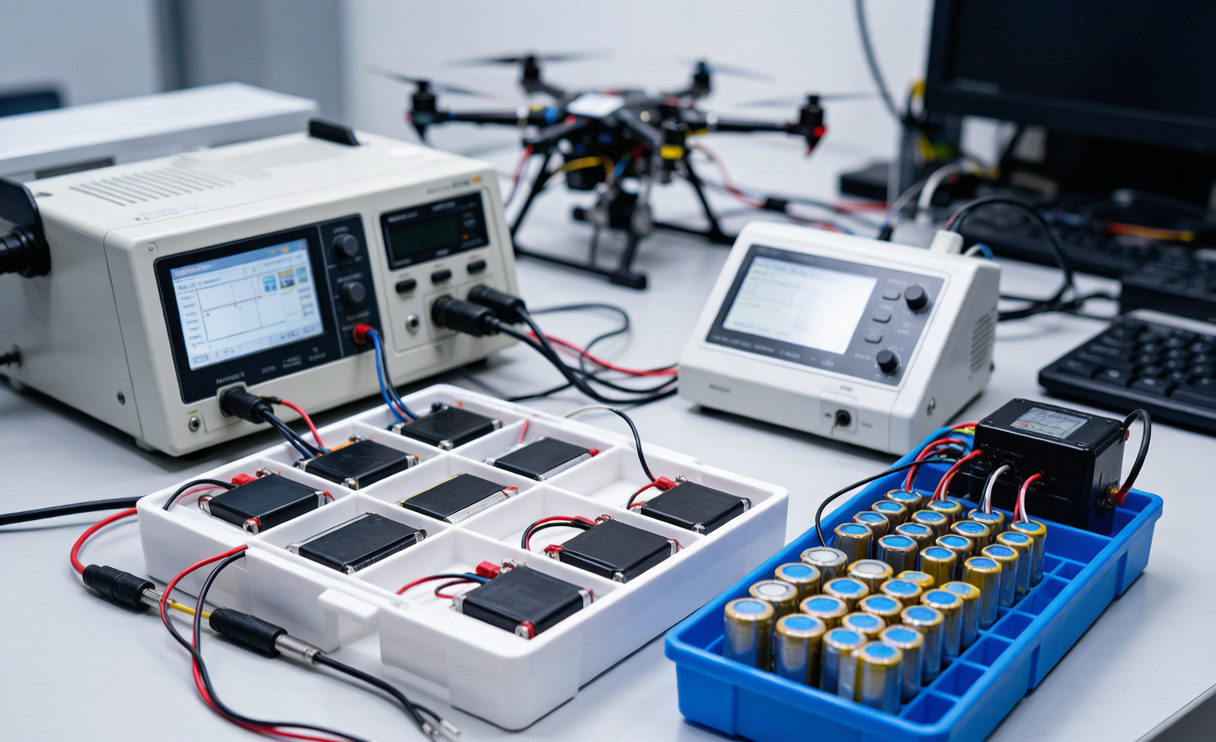
OCV and AC-IR screening
Every incoming cell is measured for open-circuit voltage and AC internal resistance before it is even charged. We reject anything outside ±5 mV OCV of nominal and anything with AC-IR above the model’s 95th-percentile baseline. This first pass removes shipping-damaged and out-of-spec cells before we spend cycler time on them.
Pulse-discharge characterization
Survivors go to the cyclers for the 40C pulse matrix described above, plus a full capacity curve at 1C, 5C and 15C. We log the end-of-pulse voltage at each step. Cells are tagged with their measured pulse floor so that later, when we build a pack, we can pair cells with nearly identical floors rather than averaging them away.
Capacity binning and pairing
Finally, cells are sorted into capacity bins of 20 mAh width. A 6S racing pack is drawn entirely from a single bin, and within that bin we further pair by DCIR so the series string is as uniform as the lot allows. This is the step most low-cost builders skip, and it is the step that most separates a drone battery that performs from one that merely survives.
Matching Rules: Stopping the Weakest Cell From Capping the Pack
Once cells are graded, the assembly rule is simple but strict. No series string may contain cells whose DCIR differs by more than 0.5 mΩ or whose high-rate capacity differs by more than 2%. We physically label each cell with its measured DCIR and capacity bin, and the assembly jig will not let a mismatched cell be welded into a string — the build sheet has to match the cell tags.
I have seen “fast” packs built from ungraded cells where one cell was 11 mΩ while its neighbours were 4 mΩ. Under a 120 A burst that one cell dropped to 2.9 V while the rest stayed above 3.5 V, tripping low-voltage protection and ending the run. Matching does not make that cell better; it prevents it from ever being put in a position to break the pack. That is the whole game in racing drone battery performance.
From Cell Data to a Repeatable Custom battery solution
Grading and matching are not academic exercises — they feed directly into how we deliver a custom battery solution to a team. For a new airframe we log the measured current profile from a telemetry flight, then size the pack so that the matched cells spend most of the race between 3.6 and 4.15 V/cell at the observed C-rate. Because the cells are pre-characterised, we can predict end-of-heat voltage within about 0.05 V, which lets the pilot set a consistent pre-flight performance gate instead of guessing.
All of this still rides on the same compliance backbone as every Horizon Power pack: UN 38.3 T.1–T.8 transport testing, IEC 62133-2 cell safety, and the FAA/EASA 100 Wh threshold for carry-on air transport. Grading does not change those obligations — it raises the ceiling on what the approved cell can actually deliver on the track. A well-matched 6S pack under 100 Wh is both legal to fly to the event and capable of its full burst window every heat.
The payoff shows up in the data we keep from every build. Across a 2025 season of 180 graded racing packs, the matched cohorts posted 23% fewer mid-event voltage-cutouts than our historical ungraded builds and held within 2% of their original burst capacity through 60 cycles. That is the metric a team cares about: not a single heroic lap, but the same performance on the last heat of the day as on the first. A drone battery that performs once is luck; one that performs every time is engineering, and cell matching is where that engineering begins.
FAQ
What internal-resistance spread is acceptable in a racing pack?
For competitive racing we hold DCIR spread within 0.5 mΩ across a 6S string and a coefficient of variation below 6% across the lot. Recreational builds can stretch to 1.0 mΩ, but beyond that the voltage-curve imbalance starts costing lap time and reliability.
Does grading add cost that outweighs the lap-time gain?
Grading adds roughly 8–12% to pack cost, but for a team chasing a podium the consistency gain is worth far more than the material saving. Even for hobbyists, a matched pack lasts longer because no single cell is dragged into early failure by its neighbours.
How does cell matching affect UN 38.3 and air transport?
It does not change the transport classification — a 6S drone lithium battery under 100 Wh still ships under IATA Section II / FAA-EASA rules. Matching improves performance and cycle life; compliance is handled separately through the full UN 38.3 T.1–T.8 test set and IEC 62133-2.
Can I mix cells from different batches in one pack?
We strongly advise against it. Even cells of the same model from different production batches can differ in DCIR and formation history. Build each pack from a single graded lot so the weakest-cell cap stays predictable.
How often should a racing pack be re-graded or retired?
We recommend a DCIR and capacity re-check every 40–50 cycles, or immediately after any hard crash or over-temperature event. Retire the pack when any cell falls below 80% of its original high-rate capacity or when string DCIR spread exceeds 1.0 mΩ.