Drone Battery Testing for Racing Drones: Abuse and
Most of the drone battery testing conversations I have with racing teams stop at three numbers: capacity, internal resistance and voltage sag. Those numbers tell you how fast the aircraft will be. They tell you almost nothing about what happens when a 6S pack takes a 20 m/s hit into a gate post, or when a tired charger walks a cell up to 4.5 V while nobody is watching the bench. I am Karl Huang, Senior lithium battery Engineer, and after eleven years of building high-power packs I can say the most valuable data set my team owns is not a discharge curve. It is the failure envelope.
This article is the third layer of a complete test programme for racing drones. The first layer is bench characterisation. The second is track-side validation on race day. This layer is deliberately destructive: we drive samples past their limits, under control and under instrumentation, so we know exactly where those limits sit. That is what lets me set a real cut-off voltage instead of a guessed one, choose a barrier material with evidence behind it, and write handling rules a pilot will actually respect.
Why Abuse Testing Belongs in Every Racing Drone Battery Testing Plan
A racing pack is the most abused lithium battery in civil aviation, full stop. A 6S 1300 mAh LiPo delivering 120 A bursts is running at roughly 90C. It gets charged while still at 45°C between heats, it lives at full charge in a pit bag, and it gets crashed on a regular schedule. No other drone battery category combines that many stress vectors in a single week of service, which is why racing drones deserve a harsher test programme than the airframes they share cells with.
Performance testing measures the design point. Abuse testing measures the distance between the design point and the failure point, and that distance is the only definition of safety margin that means anything. Without it, every safety decision on the programme is somebody’s opinion. With it, you can argue numbers: this pack vents at 4.68 V per cell, we charge to 4.20 V, therefore we hold 0.48 V of headroom against a single-point charger fault.
People assume a certification report already covers this. It does not, and the distinction matters. UN 38.3 tests T.1 through T.8 — altitude simulation, thermal cycling, vibration, shock, external short circuit, impact and crush, overcharge and forced discharge — are pass/fail transport gates. IEC 62133-2 works the same way for the cell level. They confirm the sample survived. They never tell you whether it survived by 3°C or by 40°C. We rebuild those tests with our own instrumentation specifically to recover the margin the pass/fail result throws away.
Building a Test Cell That Fails Safely
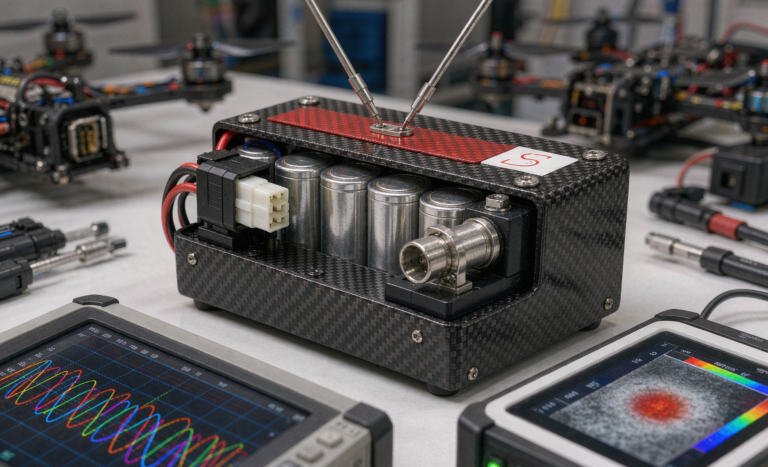
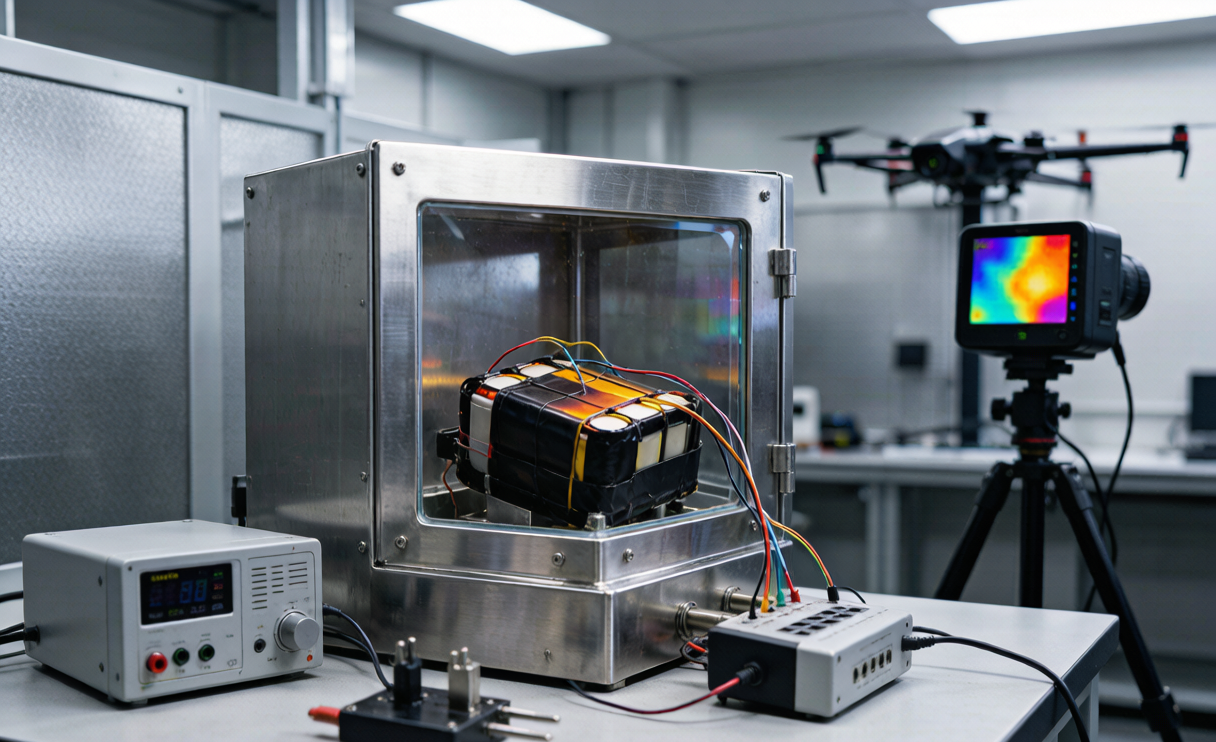
Nothing in this article is safe on a kitchen table. Our abuse station is a welded steel enclosure with a polycarbonate viewing window, a 1.2 mm mild-steel liner, extraction ducted outside the building, and a sand bucket plus dry-powder extinguisher within arm’s reach of the door — never water near a lithium battery event. Everything runs remotely from behind a wall with a minimum 3 m standoff. During overcharge, short-circuit and thermal ramp tests, the room is empty.
Instrumentation decides whether a destroyed sample produced data or just smoke. Our minimum channel set is four type-K thermocouples (two bonded to the hottest cell face, one on the positive tab, one measuring ambient), per-cell voltage logged at 100 Hz, a current shunt with at least 500 A of headroom, an infrared camera at 30 fps, and two video angles. Gas and smoke detection is wired in as a trigger, not just a record.
Abort logic must be hardware, not human judgement. A contactor drops the load or supply automatically if any cell exceeds 200°C, if pack voltage collapses more than 0.5 V in 10 ms, or if smoke is detected. Critically, logging continues through and past the abort. The five seconds after the abort are usually the most informative part of the entire run, because that is where you see whether the event self-arrests or keeps climbing on stored energy alone.
The Five Abuse Tests That Earn Their Bench Time
We have tried longer matrices. Five tests deliver almost all of the useful margin data for a drone lithium battery in racing service, and each one answers a design question we would otherwise be guessing at.
Controlled overcharge
Charge at 1C past the design ceiling with per-cell logging. On recent high-power 6S pouch samples we saw first measurable swelling at 4.42 V per cell, audible vent at 4.68 V, and a 68°C surface temperature rise. That gives the charger fault margin directly.
Over-discharge and forced discharge
Take samples to 1.8 V per cell and rest them. Below roughly 2.5 V the copper current collector starts to dissolve, and the damage is invisible from outside. Our samples came back with DCIR up 38% and two of six developed a soft internal short after a single recharge cycle.
External short circuit
A 6S 1300 mAh pack with 15 mΩ total resistance implies a theoretical fault current near 1,500 A. Measured peak was 780 A, limited by contact and lead resistance, with tab temperature hitting 145°C in 12 seconds. That is the number that sizes your fusible link and connector.
Crash impact and crush
UN 38.3 T.6 drops a 9.1 kg mass from 61 cm onto a 15.8 mm bar. Racing adds an oblique, partially restrained impact the standard never models, so we add a sled test representing a 20 m/s gate strike with the pack in its normal mount.
Thermal ramp and propagation
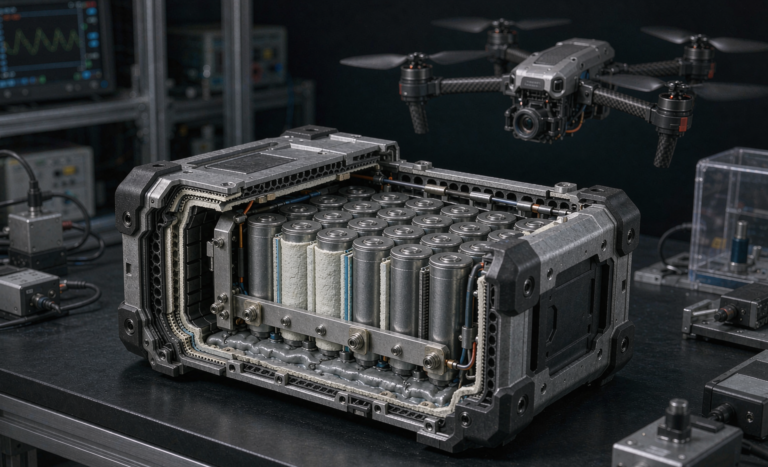
Heat a single cell in a stack at 5°C per minute. Polyethylene separators shut down near 130°C; self-heating onset on our samples appeared around 92°C, with runaway between 160°C and 180°C. Cell-to-cell propagation in an unbarriered 6S stack took 11 seconds.
Turning the Failure Envelope into Design Margin
Data that does not change a drawing is decoration. Each abuse result maps onto a specific, defensible design or firmware setting. Vent at 4.68 V per cell becomes a hard charger cut at 4.20 V with a 4.25 V alarm — 0.43 V of margin against a single-point failure. Self-heating onset at 92°C becomes a telemetry warning at 55°C and an automatic power de-rate at 65°C, holding 27°C of thermal margin at the worst point in a heat.
The propagation result drove a materials decision I could not have justified otherwise. Adding 0.3 mm mica between cell pairs pushed cell-to-cell propagation from 11 seconds to no propagation at all in three of three samples. The cost is 9 g on a 205 g pack, a 4.4% mass penalty. In a sport where every gram is contested, that trade only survives a design review because there is a measured propagation time on the table, not a feeling about safety.
Over-discharge data produced our retirement rule. Any pack that logs below 3.00 V per cell under load, or 2.50 V at rest, is retired regardless of how it looks or how it capacity-tests afterwards. A 38% DCIR rise and hidden copper damage are not conditions you inspect your way out of. This is exactly the reasoning I bring to a custom battery solution: the retirement threshold is an output of the abuse programme, not a number copied from a datasheet.
From Test Data to Handling Rules, Shipping and Customer Evidence
Abuse results should end up in three documents. First, the pilot-facing SOP: store at 3.80–3.85 V per cell, never charge a pack above 40°C, charge in a fire-resistant bag and never unattended, and quarantine any pack involved in a crash for a 24-hour open-circuit voltage watch before it flies again. Every one of those rules traces to a measured threshold above.
Second, the compliance file. A 6S 1300 mAh pack is about 28.9 Wh, so it sits comfortably under the 100 Wh carry-on band that FAA and EASA guidance permits without airline approval, with 100–160 Wh requiring approval. That does not exempt the product: shipments still need a UN 38.3 T.1–T.8 test summary, cells and batteries move as UN 3480 or UN 3481 with Class 9 labelling, and standalone lithium-ion consignments ship at no more than 30% state of charge. Consumer-facing SKUs additionally need IEC 62133-2, while larger industrial packs fall under IEC 62619.
Third, the customer package. When we quote a custom battery solution for a team or an OEM, we hand over the abuse report with the margins visible — vent voltage, self-heat onset, propagation time with and without barriers — not just a certificate that says “pass”. Buyers who understand drone battery engineering ask for exactly that, and the ones who do not are usually the ones who later discover their supplier never measured it.
Frequently Asked Questions
Do I need abuse testing if my cells already have a UN 38.3 report?
Yes, because the report certifies a cell or pack configuration as transport-safe, not your specific mechanical design, mount, connector and firmware limits. Pack-level behaviour, especially propagation between cells and tab heating under a real short, depends entirely on your build. A cell-level pass tells you nothing about whether your 6S stack self-arrests.
How many samples does a meaningful abuse test need?
Three per test condition is our working minimum, five if the result will set a safety limit. Abuse events have wide scatter — vent voltages on nominally identical pouch cells spread 100–150 mV in our data. A single sample gives you an anecdote, and you cannot set a de-rate threshold on an anecdote.
Can any of this be done safely outside a proper lab?
Only the non-energetic parts. Capacity, DCIR and thermal profiling under normal operation are fine on a well-equipped bench. Overcharge, external short, crush and thermal ramp on a high-power lithium battery must be run in a rated enclosure with extraction and remote operation. If you do not have that, buy the test from a laboratory rather than improvising it.
What temperature should trigger a de-rate on a racing pack?
Work backwards from your own measured self-heating onset with a margin of at least 25°C. On our samples that meant warning at 55°C and de-rating at 65°C. If you have no measured onset, treat 60°C as a practical ceiling for a racing drone battery and stop pushing current above it — but understand you are borrowing someone else’s margin.
Does a crashed pack that looks fine really need to be retired?
Not automatically, but it needs a defined quarantine. Our rule is 24 hours of open-circuit voltage monitoring; a drift greater than 20 mV on any cell, any swelling, or any temperature rise at rest means retirement. Internal separator damage from an oblique impact frequently produces no visible external evidence at all.
How does abuse data actually change a custom pack design?
On a drone lithium battery programme it changes fuse sizing, connector selection, barrier material, cell spacing, firmware cut-offs, de-rate curves and retirement rules — six or seven concrete decisions per programme. When a client asks why we specified a particular fusible tab or a 0.3 mm mica layer, the answer is a measured number from a destroyed sample, which is a far stronger position than a design rule of thumb.
Abuse testing is the least glamorous and most decision-dense part of a drone battery testing programme. It consumes samples, bench time and nerve, and it produces no marketing numbers at all. What it produces instead is the right to make confident claims about a pack — and in racing, where the operating point is already deep into the corner of the envelope, knowing precisely where that envelope ends is the whole job.