Drone Battery Performance for Racing Drones: Matching the
As a senior lithium battery engineer at Horizon Power, I have lost count of how many pilots blame a “weak” drone battery when the real problem was a mismatch between the pack and the rest of the powertrain. A racing drone battery does not make power in isolation. It sits at one end of a coupled electrical-mechanical chain: cells, welds and busbars, the electronic speed controller (ESC), the brushless motor, and finally the propeller. If you size or select that drone lithium battery without measuring the motor-propeller load line, you will chase ghosts – watching voltage sag, overheat the ESC, and never understand why two packs with the same stamped “100C” rating fly completely differently.
Why a Racing Drone Battery Is Only Half the Performance Story
When a customer asks me to tune drone battery performance for a racing airframe, the first thing I do is stop talking about the battery. The pack’s job is to present a voltage that stays high while it pushes current. But how much current, and at what voltage, is decided entirely by the motor and prop. A 5-inch tri-blade propeller at 25,000 rpm might pull 45 A at 22.2 V on one motor, and 70 A on a different motor with a different KV. That same lithium battery that looks heroic on the first combo will sag and cook on the second. Performance is a system property, not a cell property.
This is why a custom battery solution for a racing team always starts with the thrust stand, not the cell datasheet. We characterize the load first, then engineer the pack to serve it.
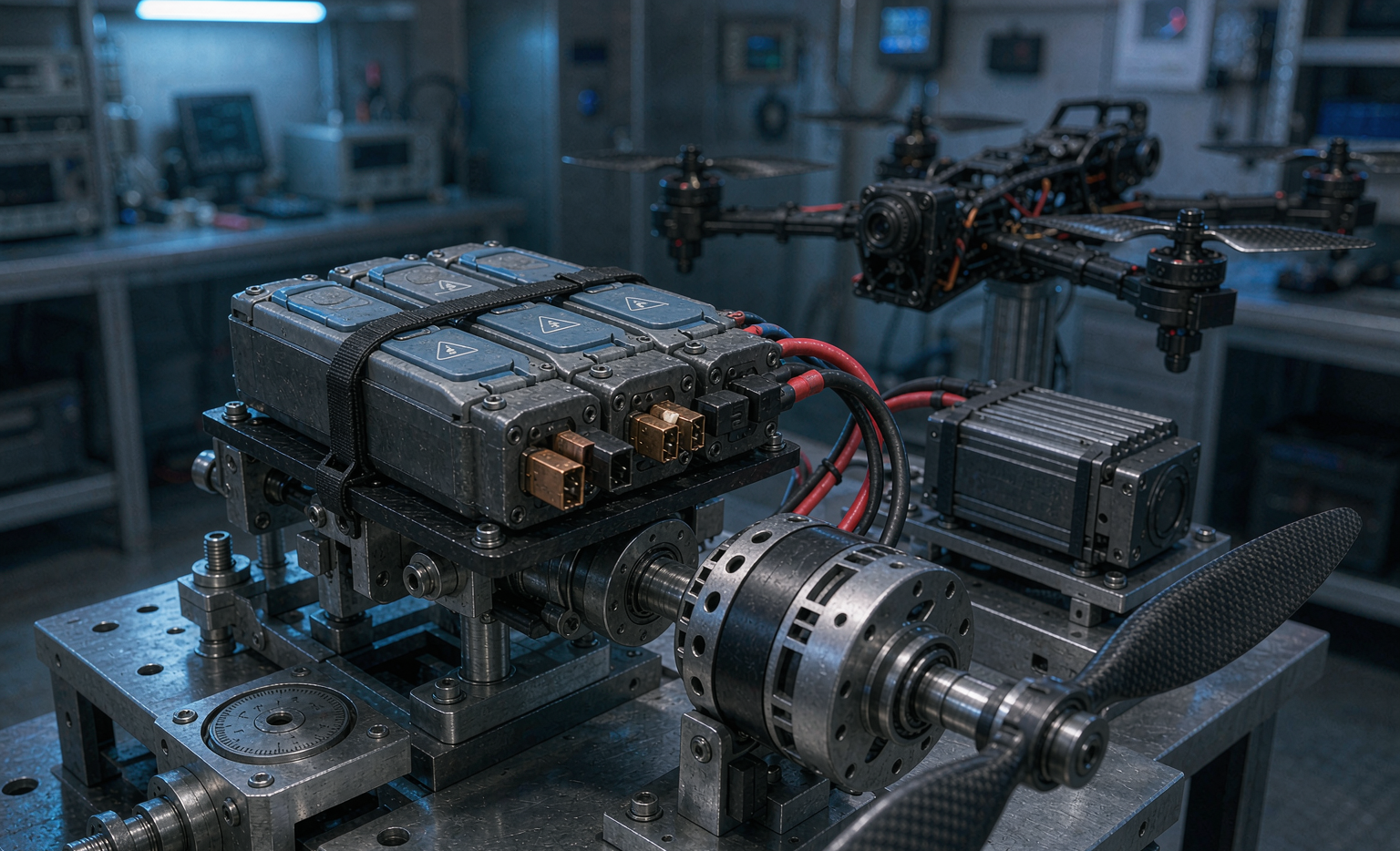
Drawing the Motor-Propeller Load Line on a Thrust Stand
The “load line” is simply the current the motor draws as a function of throttle or RPM for a fixed propeller. We measure it with a calibrated thrust stand: a strain-gauge load cell for thrust, an optical tachometer for RPM, and a 4-wire Kelvin shunt for true current. For a representative 5-inch FPV racer running a 5149 tri-blade prop, the curve is steep and nonlinear. At 50% throttle the motor pulls roughly 18 A; at 80% it is already at 38 A; and a full punch-out to 100% spikes to 55-60 A for the first 1-2 seconds before settling toward 42 A as RPM climbs.
That transient matters. A racing lap is a sequence of punch-outs, so the peak current – not the cruise current – defines the thermal and sag budget of the drone battery. We log the whole throttle trace, not a single number, because the duty cycle is what ages the pack and what the ESC must survive.
What the ESC Does to the Picture
The ESC is not free. At 50-60 A phase current, a good 4-in-1 ESC runs 92-95% efficient, but a cheap one can drop to 85%, dumping the missing 7% as heat right next to the flight controller. Worse, the ESC’s switching ripple adds AC heating inside the drone lithium battery that a DCIR measurement never sees. So part of “performance” is choosing an ESC whose efficiency and ripple profile match the pack’s AC impedance.
The Pack’s Voltage-Current Characteristic and Where the Two Curves Meet
Every lithium battery has its own V-I curve: terminal voltage equals open-circuit voltage minus current times internal resistance (V = Voc – I x R_int). A fresh 6S 1300 mAh high-discharge pack might show an open-circuit voltage of 25.2 V at full charge and a DCIR of about 7 mOhm measured by the 4-wire method. Under a 120 A punch, the bus sags to 25.2 – (120 x 0.007) = 24.4 V – roughly a 3% drop. That sounds small, but at the motor it translates directly into lost headroom: less RPM, less thrust, slower corner exit.
The actual operating point of the aircraft is the intersection of the pack’s V-I curve and the motor-prop load line. Move either curve and the intersection moves. A lower internal resistance pushes the intersection to higher voltage and higher current – more power delivered. A heavier prop pushes it the other way, into sag and heat. This is the single most useful diagram I draw for any racing team, and it explains why “C-rating on the label” is nearly useless without knowing R_int.
4S vs 6S: Why Cell Count Changes the Whole Efficiency Picture
Here is the lens most pilots miss. For the same propeller and the same shaft power, a 6S pack runs at lower current than a 4S pack because power equals voltage times current. Lower current means lower I-squared-R loss in every wire, weld and cell, so the ESC and the drone battery both run cooler. On a 5-inch racer we measured the same prop pulling 58 A on 4S versus 39 A on 6S to deliver identical thrust – a 47% drop in copper loss.
The catch is KV matching. You cannot just bolt a 6S pack onto a motor wound for 4S; the motor will overspeed. The correct custom battery solution pairs a higher cell-count pack with a lower-KV motor so the load line lands in the efficient part of the motor’s map. Done right, you get a cooler, longer, faster lap. Done wrong, you burn the motor. This is exactly the kind of trade-off we lock down in a custom battery solution spec sheet before a single cell is graded.
Sizing for Sag, Not for the Label C-Rating
The label “100C” on a racing drone battery is a marketing number. What I spec against is sag at peak current. My rule of thumb: choose a pack whose DCIR keeps bus sag under about 8% at the measured peak current, and whose capacity supports the race duration at the measured average current. For a 5-inch racer with a 55 A peak and 22 A average, a 1300 mAh 6S pack gives roughly 2.8 minutes at full throttle and about 4.5 minutes in a mixed racing profile – and if the pack sags more than 1.0 V per cell at punch-out, it is undersized for that prop and I step up capacity or cell count.
We also watch DCIR drift. A pack that ages past +30% internal resistance, or shows a cell-to-cell spread above 40 mV, gets retired from the race pool even if it still “holds charge.” A sagging pack does not just fly worse; it heats the ESC and risks a voltage collapse mid-corner.
System Wh per Lap: Measuring Real Operating-Point Efficiency
The metric that actually tells you whether a drone battery is performing is energy per lap, in watt-hours. We log per-lap voltage and current, integrate to get Wh/lap, and compare configurations. On one 5-inch build we shifted from a 4S 1500 mAh pack to a 6S 1300 mAh pack with a lower-KV motor and saw lap energy drop from 11.2 Wh to 9.4 Wh – a 16% efficiency gain with no loss of top speed, simply by moving the operating point into the efficient region of both the motor and the ESC.
This is where drone battery performance becomes a design lever rather than a guess. You can trade that 16% for longer races, or reinvest it as extra punch. Either way, the number comes from measurement, validated against UN38.3 transport safety (T.1-T.8) and IEC 62133-2 cell requirements, and the pack stays inside the 100 Wh air-transport ceiling under FAA and EASA rules.
Frequently Asked Questions
Does a higher C-rating always mean better racing performance?
Not by itself. A higher rated C-rating usually means lower internal resistance, which reduces sag – but only if the rest of the powertrain is matched. A low-resistance drone lithium battery on a mismatched high-pitch prop can still sag and overheat. Measure R_int and the load line; ignore the label.
Why choose 6S over 4S for the same racing drone?
For the same propeller thrust, 6S runs lower current, cutting I-squared-R loss in the pack and ESC so both run cooler and the lap uses less energy. You must pair it with a lower-KV motor so the motor does not overspeed. It is a system decision, not a battery decision.
How do I know if my drone battery is undersized for my prop?
Log bus voltage during a punch-out. If sag exceeds about 1.0 V per cell (roughly 8% on a 6S pack) at peak current, or if the pack gets hot to the touch after a short mixed run, step up capacity or cell count. Capacity that “lasts” is not the same as a pack that delivers power cleanly.
What internal resistance should a healthy racing pack show?
A fresh 6S high-discharge pack typically measures 6-9 mOhm total by the 4-wire Kelvin method. Retire packs that climb past +30% of that baseline or develop more than 40 mV cell-to-cell spread, even if they still hold charge – sag and heat, not capacity, end a race pack’s life.
Can a custom battery solution really change lap times?
Yes. By matching cell count, capacity, internal resistance and connector resistance to the measured motor-prop load line and ESC, we have recorded 10-16% lower lap energy and measurably cleaner punch-outs. A custom battery solution turns the pack from a commodity into a tuned part of the powertrain.