Drone Battery Testing for Delivery Drones
When a logistics operator asks me to qualify a drone battery for a delivery fleet, the conversation is never about how far the aircraft can fly. It is about whether the pack will survive the ugliest part of the delivery duty cycle: not one long cruise, but dozens of brutal vertical take-offs, every single hour, against a clock. A mapping survey drains a pack gently; a delivery drone punishes it with a 6–9C launch spike up to 120 times a day. If your test program was built around energy-limited missions, it will pass a pack that fails in week three of real depot service. This is the playbook my team at Horizon Power uses to qualify a drone lithium battery for 80 sorties a day before a single parcel ever leaves the ground.
Why Delivery Drone Batteries Need a Different Test Than Anything Else
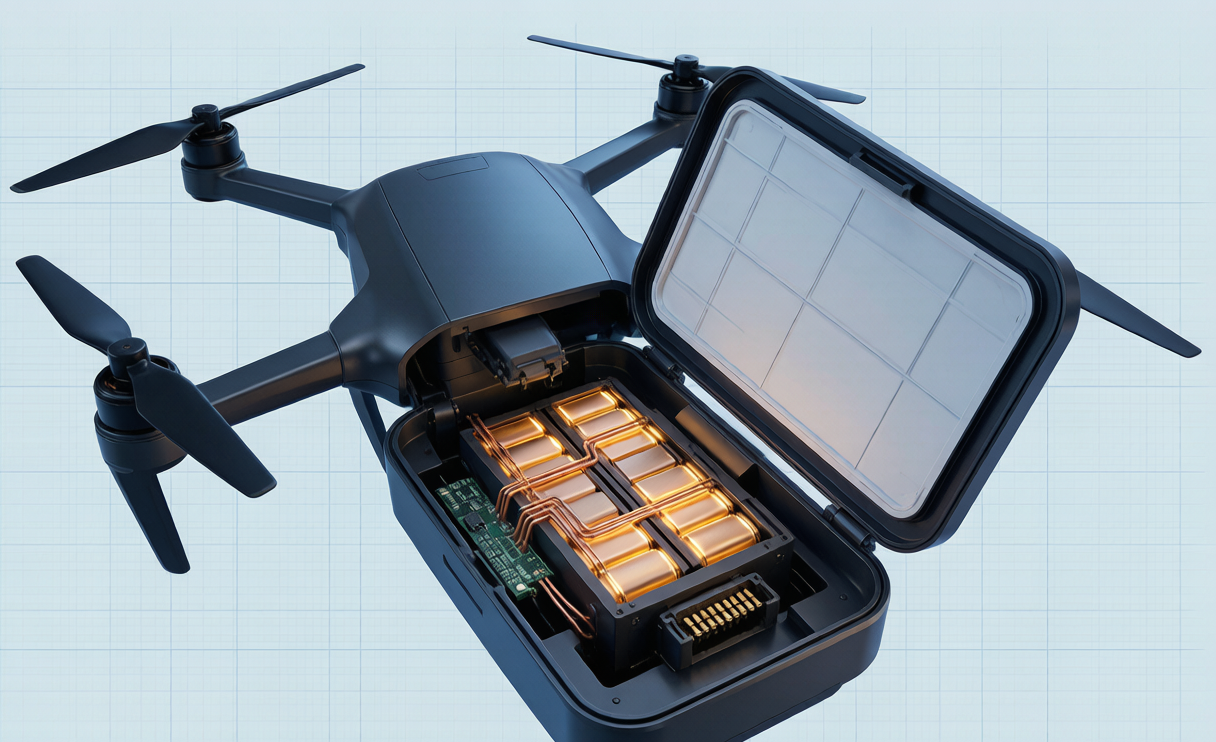
The defining feature of drone battery testing delivery drones is pulse-power cycling, not endurance. A delivery quadcopter might fly only 8–12 minutes per sortie, but each of those sorties begins with a 3.5–5.0 kW launch transient — roughly 6–9C on a 6S 22 Ah pack — and the aircraft does that 60 to 120 times per day across a depot. That repetition, not the total watt-hours moved, is what ages the cells and grows internal resistance. A test program that only checks capacity at a gentle 0.5C discharge will certify a pack whose direct-current internal resistance (DCIR) climbs 30% after two weeks of real launches. So our qualification flips the priority: we stress the transient first, the energy second.
Incoming Inspection — Building the Serial Baseline
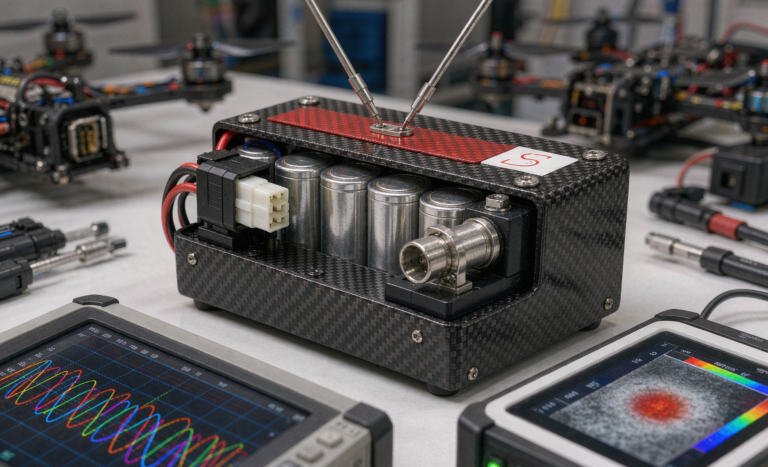
Every qualification starts at the cell level, because a fleet is only as consistent as its weakest pack. Before a single discharge test, we run incoming inspection on every cell and record a serial baseline:
- 1 kHz AC impedance (ACIR) — cell-to-cell delta kept under 30 mV equivalent; a tight pack is a predictable pack.
- Capacity spread — under 2% across the lot; anything wider gets binned out.
- Thickness at 3.80–3.85 V/cell — we measure swell at storage voltage, not at full charge, because that is where puffing shows up first.
- QR / serial identity — every cell, every weld, every pack gets a traceable ID so a field failure can be walked back to a production batch.
This baseline is the reference against which all later aging is measured. Without it, the rest of the test program is guesswork.
The Pulse-Power Cycling Bench Test
This is the heart of delivery qualification. We do not just discharge the pack — we replay the launch transient on a programmable load until the cells beg for mercy. The procedure:
- Apply a 3C / 10-second pulse (the takeoff spike) followed by a low-rate cruise segment, repeated to match a full depot day.
- Measure pack DCIR at 1 kHz before and after; acceptance is under 10 mΩ.
- Verify voltage sag under 8% of nominal at the connector during the pulse — if sag crosses 8%, the ESC sees a collapsing rail and the aircraft triggers a premature return-to-launch with a parcel still onboard.
- Confirm the interconnect resistance is under 15% of total pack resistance, which forces a connector budget of ≤1.5–1.8 mΩ through XT150/AS150 connectors on 8 AWG gold-over-nickel cabling.
We pass a pack only if, after the equivalent of several hundred sorties of pulsed cycling, sag stays under 8% and DCIR has not drifted past spec. I have rejected “high-capacity” packs here that looked perfect on a slow discharge curve but collapsed under the fifth launch of the day.
Hot-Swap and Connector Endurance
Delivery fleets live or die by the connector. A pack that is swapped 8–12 times a day sees 500–1000 mating cycles in a single season, and degraded contacts are the silent killer: a joint that creeps from 0.25 mΩ to 2.5 mΩ dissipates 25 W inside a 5 W-rated housing — it cooks itself. Our endurance test:
- Cycle the connector at 100–160 A rated current for 500–1000 mates.
- Specify gold-over-nickel plating (500–1000 mate life) rather than tin or bare nickel, which oxides and drifts.
- Stop the test if contact resistance more than doubles its baseline, if plating shows transfer, or if the housing shows thermal deformation.
We also run a pre-charge verification on the dock interface: any pack above 8S or 50 V must have a leading resistor contact (10–100 Ω into a 400–2000 µF bank) to kill the >500 A inrush that welds contacts shut on first mate.
Depot Charging Stress Test
A delivery battery spends more time on a charger than in the air. The depot runs 1C–2C charging at a 40 °C gate, and that thermal-and-rate combination is where cycle life is won or lost. We stress-test by:
- Running hundreds of fast-charge cycles on an accelerated cadence (simulating months of depot use in days).
- Confirming the chemistry meets its cycle-life claim under those conditions — NMC/NCA at 500–1000 cycles, or LFP at 2000–4000 cycles for the ground-buffer role.
- Rejecting any pack that shows more than 20% capacity fade before its rated cycle count at 0.5C, 25±3 °C reference conditions.
Operators are often surprised that we test at the depot’s actual 40 °C charge gate, not the lab-friendly 25 °C. The gap is exactly where field returns come from, so we close it on the bench.
Mission-Profile Replay on the Test Bench
After the component stresses pass individually, we replay the whole day as one continuous workload: launch spike, cruise-out, hover-drop, return-to-launch, cooldown, recharge, repeat. The energy budget we validate against is:
- Takeoff + cruise-out + hover-drop + RTL, plus a 25–30% regulatory reserve per FAA Part 107 / EASA SORA.
- For a typical 12S 22 Ah NMC pack delivering ~0.97 kWh installed, only 0.55–0.70 kWh is usable after reserve — and the test confirms the pack still meets its drop cadence at the 95th-percentile parcel mass, not the average.
The replay catches interactions no single test sees: a pack that passes pulse and charge tests separately can still thermal-throttle when both run back-to-back on a hot summer afternoon. We want that failure on the bench, not over a customer’s neighborhood.
Environmental Qualification — Vibration, Temperature, Altitude
Delivery packs endure a punishment tour: hard landings, van transport over potholes, and constant handling. Our environmental qual mirrors it:
- Vibration: DO-160 / MIL-STD-810 profile across 5–2000 Hz, cleared of the rotor and blade-pass bands by a margin >30% so the mount, not the airframe, sets the resonance.
- Temperature: operation from −20 °C to 55 °C, with the well-known cold fade curve — 100% capacity at 25 °C, 85% at 0 °C, 70% at −10 °C, 55–60% at −20 °C. We verify a 5–15 W pad heater recovers the core to a 10–25 °C window so dawn sorties are not capacity-starved.
- Altitude: at 2500 m, power demand rises 8–12% for the same thrust, so we qualify with that headroom baked in.
- Cold-chain isolation: the pack bay is thermally separated from the parcel compartment so a heated battery never cooks a temperature-sensitive payload, and vice versa.
Fleet Acceptance Sampling
Qualification is not just about the hero pack — it is about the lot. At fleet scale we:
- Sample incoming packs per lot and bin by ±2% capacity and ±5% DCIR so every aircraft flies a statistically identical battery.
- Set retirement thresholds: 80% state-of-health, 2× baseline internal resistance, >50 mV cell delta, or >5% puffing.
- Track each pack’s cycle count and IR trend so we retire before a failure, not after.
This is where a custom battery solution earns its keep: we tune the acceptance plan to the operator’s actual sortie count and parcel mass, not a generic template.
Transport and Regulatory Qualification
A delivery fleet charges at a depot, flies a route, and ships packs between hubs — all of which have rules. The test program closes with transport qualification:
- UN38.3 T.1–T.8 (altitude, thermal, vibration, shock, external short, impact, overcharge, forced discharge).
- IEC 62133-2:2017 for portable secondary-cell safety.
- IATA 30% state-of-charge for air transport of packs.
- FAA / EASA 100–160 Wh per pack ceiling, which is why most delivery packs sit in the 100–160 Wh class by design.
When a client needs a pack shaped to a specific airframe or cargo dock, we build a custom drone battery against this same test ladder from day one — the qualification plan is the product, not an afterthought.
How many sorties per day can a qualified delivery drone battery handle?
A well-qualified 12S 22 Ah NMC pack at a depot running 1C charging typically supports 8–12 sorties per aircraft per day, with the pulse-power and connector endurance tests ensuring it does not degrade across that cadence. LFP variants trade some energy for 2000–4000 cycle life and are often used as ground buffers or lower-demand routes.
Why does voltage sag matter more than capacity for delivery drones?
Because the failure mode is a premature return-to-launch, not a dead battery. If pack DCIR climbs and sag crosses 8% during a 6–9C launch, the ESC sees a collapsing rail and the aircraft aborts with the parcel still onboard. Capacity tells you how far you can go; sag tells you whether you can take off at all, repeatedly.
What connector spec prevents hot-swap failures in delivery fleets?
We specify XT150/AS150-class connectors on 8 AWG cable with gold-over-nickel plating rated for 500–1000 mating cycles, holding interconnect resistance under 1.5–1.8 mΩ (under 15% of total pack resistance). Anything less drifts to 2.5 mΩ after a season of swaps and dissipates 25 W inside a 5 W housing.
Do delivery drone batteries need different testing than mapping drones?
Yes. Mapping drones are energy-limited and gentle (0.5–1.5C), so their tests prioritize voltage stability and data integrity. Delivery drones are pulse-power-limited and cycle-count-heavy, so qualification centers on launch-transient DCIR, connector endurance, and depot fast-charge stress. A test plan built for one will miss the other’s dominant failure mode.
How is a lithium battery retired safely in a delivery fleet?
We retire at 80% state-of-health, 2× baseline internal resistance, a cell-to-cell delta over 50 mV, or more than 5% puffing — whichever comes first — and we trend IR monthly so packs are pulled before they fail mid-route. Each retirement is tied back to the serial baseline recorded at incoming inspection.