Home Battery Aquarium and Terrarium Backup Guide
An aquarium is a closed life-support system for fish, corals, and plants. The moment grid power drops, filtration stops, dissolved oxygen falls, and water temperature drifts. In a warm room a tropical tank can lose heat fast; in summer a chiller-less setup can overheat. I have seen a 200 liter freshwater tank go from clear to cloudy within 18 hours of a blackout because the canister filter and air pump both went silent. A home battery aquarium backup is the simplest way to keep that equipment running through an outage. In this guide I explain how to size a battery, which chemistry to choose, why your inverter waveform matters, and how to keep the battery safe in a humid room.
Why an Aquarium Loses Power Faster Than You Think
Filtration and aeration are continuous loads. The beneficial bacteria living in your filter media need oxygen-rich flow to survive; without it the colony crashes and ammonia spikes, poisoning the fish even after power returns. Heaters and chillers are thermostatic, so they cycle, but a cold night can draw steady power for hours at a stretch.
Coral and other sensitive species tolerate only a narrow band. A few degrees of temperature swing or a few hours without flow causes stress that turns into disease or death a week later. Compare this with a fridge: a fridge tolerates a half-day outage with little harm, but a reef tank tolerates the same window with far more lasting biological damage.
As a real example, during a 6 hour winter outage a 300 liter reef tank lost 4 degrees Celsius. The return pump and heater alone drew about 180 W on average. Without a battery, that tank would have needed manual bubbling and battery air pumps to survive the night.
Calculating Your Aquarium Backup Load
Start by listing every device you want to keep alive, with its typical wattage. Typical values I use when sizing a home battery aquarium system are:
- Canister or hang-on-back filter: 15 to 60 W
- Air pump: 3 to 12 W
- Circulation or wave pump: 8 to 30 W
- Heater (thermostatic, duty about 30 to 60 percent): nameplate 50 to 300 W
- Protein skimmer: 20 to 45 W
- LED light: 20 to 80 W (usually skipped during an outage to save power)
- Chiller: 50 to 150 W
- Auto top-off pump: 5 to 15 W
For thermostatic loads, multiply the nameplate by a duty cycle: roughly 0.4 for a heater and 0.3 for a chiller in a moderate climate. Then compute the energy you need with this formula: watt-hours required equals average watts times target hours divided by usable depth of discharge.
As a worked example, filter 40 W plus air 8 W plus circulation 20 W plus heater average 80 W plus skimmer 30 W gives 178 W average. For 8 hours at 80 percent depth of discharge on an LFP pack: 178 times 8 divided by 0.8 equals 1780 Wh. Round up to a 2.0 kWh pack. Add another 20 to 30 percent margin for inverter losses near 10 percent and for cold-temperature capacity loss in a winter room.
Choosing the Right Home Battery Chemistry
LFP, or lithium iron phosphate, is the right call for aquarium backup. The reasons are practical rather than theoretical. First, cycle life is long, typically 2000 to 6000 cycles at 80 percent depth of discharge, so a pack that sits charged for months between outages still lasts for years. Second, the voltage curve is flat, which keeps pumps running at a steady speed; a lead-acid pack sags as it discharges and visibly slows the flow.
Third, LFP is a safe chemistry. It is stable at room temperature with a low risk of thermal runaway, and packs built to spec pass UN38.3 transport testing and IEC 62133-2 safety requirements. Fourth, it tolerates a partial state of charge extremely well. Aquarium loads are small, steady draws, so the pack often rests at 50 to 80 percent state of charge between outages, which is exactly where LFP is happiest.
Lead-acid, whether AGM or gel, is cheaper upfront but short-lived if left at high state of charge, needs maintenance, is far heavier, and its voltage sag affects pump performance. I do not recommend it for unattended backup. NMC cells offer higher energy density but are less tolerant of partial state of charge and carry a higher risk profile, which is overkill for a home aquarium.
Why a Pure Sine Wave Inverter Matters for Pumps
Most aquarium equipment runs on AC: filter motors, air pumps with AC adapters, skimmers, heaters with controllers, and chillers with compressors. A modified sine wave inverter produces a stepped waveform that makes AC induction motors run hot, buzz, and lose efficiency. I have measured a canister filter motor drawing 18 percent more current on a modified sine inverter and running 12 degrees Celsius hotter at the housing than on grid power.
A pure sine wave inverter matches grid quality, so pumps start cleanly and run at rated speed. It also protects the sensitive control boards inside chiller electronics and LED drivers. Choose an inverter rated at least 1.5 times your continuous load, with low no-load draw under 15 W, so it does not quietly drain the battery while the tank is on mains and the inverter is merely idling.
Keeping the Battery Safe in a Humid Room
Aquarium rooms often run at 60 to 90 percent relative humidity, with occasional splashes and salt aerosol from marine tanks. Corrosion is the real enemy: terminals and the battery management board can corrode if the pack sits inside the splash zone. A well-planned home battery aquarium setup treats the battery as electrical equipment, not tank furniture.
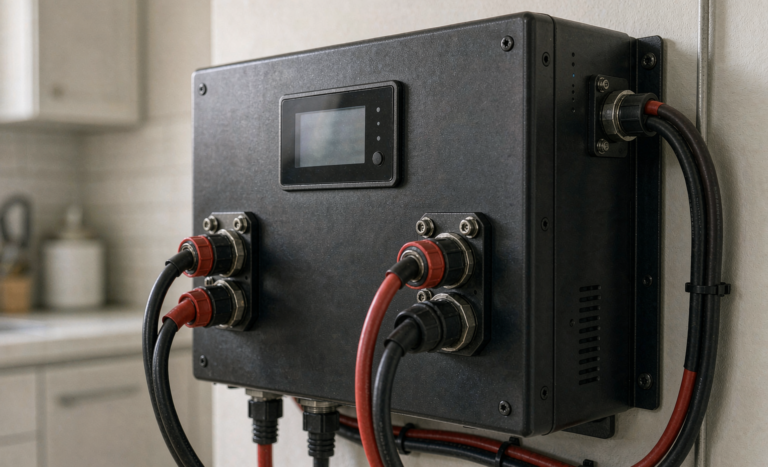
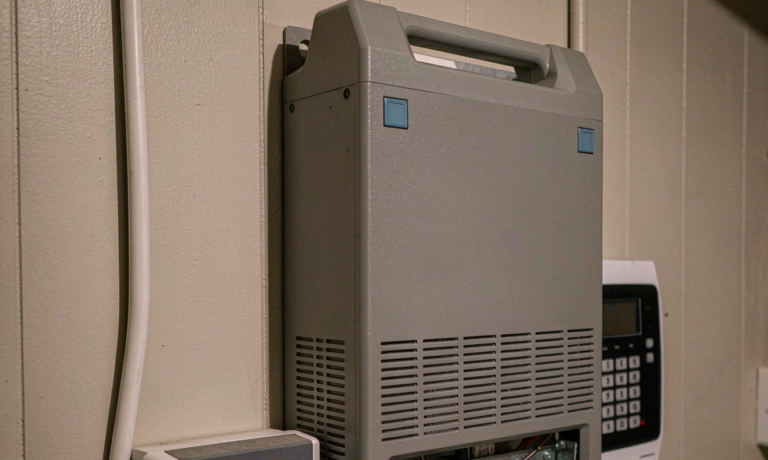
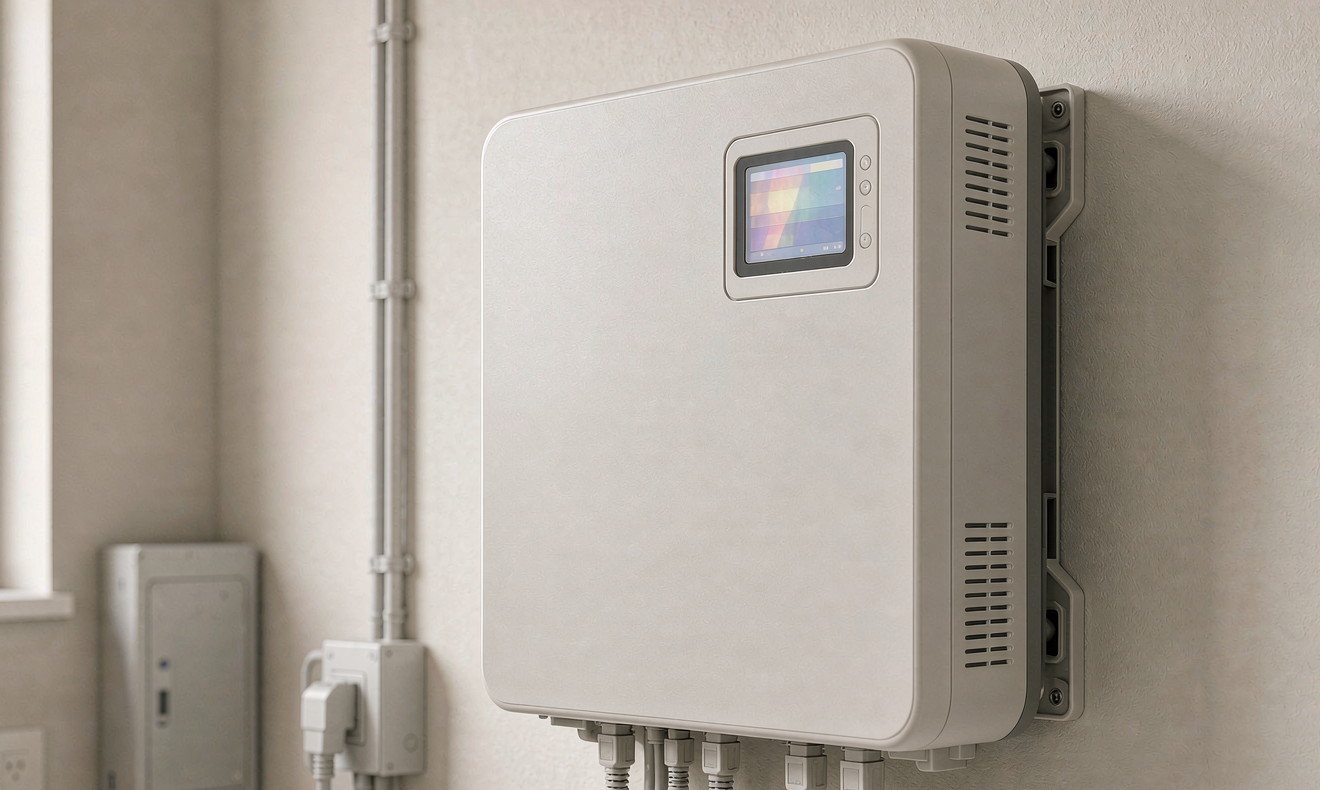
Follow a few placement rules. Keep the battery at least 1 meter from the tank, and never mount it above or directly beside an open top. Use a sealed, ventilated enclosure rated IP54 or higher, wall-mounted in a dry corridor or inside a cabinet with passive vents. Do not seal it airtight; LFP does not off-gas, but trapped condensation still needs a path to escape. For marine setups, choose a cabinet with a corrosion-resistant coating and keep the management display readable from outside.
Seamless Transfer and Runtime Monitoring
Fish do not notice a 10 millisecond blink, but some AC pumps stall or need a manual restart after a hard switch. Use a transfer switch or an inverter-charger that transfers in under 20 milliseconds so the load never sees a gap. Even better, run the critical DC loads, circulation pumps and air pumps, on 12 V or 24 V DC directly from the battery through a DC-DC converter, skipping the inverter entirely for those loads. This removes transfer delay and avoids inverter losses.
Monitoring keeps you honest about runtime. A simple voltage alarm or a Bluetooth battery management app shows remaining runtime and warns you before the pack hits its cut-off. Set the inverter low-voltage cut-off at 11.0 V for a 12 V system or 22.0 V for a 24 V system to protect the cells and give yourself time to act. When grid power returns, the charger should refill the pack automatically and hand the loads back to mains.
Monthly Maintenance and State of Charge Habits
Test the system monthly by switching to battery for 10 to 15 minutes and confirming the pumps start and the management board reports a healthy voltage. Keep the pack between 50 and 80 percent state of charge during normal standby; LFP prefers a partial charge and will outlast a pack kept at 100 percent constantly. Top up to 100 percent once every two or three months, then discharge back to 80 percent, to balance the cells.
Inspect terminals for corrosion and the enclosure for moisture ingress every quarter. Replace the battery when capacity drops below 80 percent of nameplate or when runtime shortens without a change in load. Keep a written load list so you can re-size quickly if you add a larger tank or a second aquarium later.
Frequently Asked Questions
How long will a home battery run my aquarium during an outage?
It depends on your average load and pack size. A 2.0 kWh LFP pack at 80 percent usable depth of discharge delivers about 1600 Wh. If your filtered, heated, aerated tank averages 178 W, that is roughly 9 hours of runtime. Skip the lights and chiller to extend it further. Size from your real measured load, not from the tank volume alone.
Can I connect a home battery directly to my aquarium DC pumps?
Yes, and it is often the most efficient path. Run 12 V or 24 V circulation pumps and air pumps straight from the battery through a regulated DC-DC converter, avoiding the inverter entirely. This removes transfer delay and inverter losses, and it keeps the most critical life-support loads alive even if the inverter fails.
What size battery do I need for a 100 gallon reef tank?
A 100 gallon reef (about 380 liters) with a return pump, circulation pump, skimmer, heater, and auto top-off typically averages 150 to 220 W. For 8 hours of backup at 80 percent depth of discharge you need roughly 1500 to 2200 Wh. I would specify a 2.5 kWh LFP pack to leave margin for winter heater duty and inverter losses, then verify with a real load measurement.
Is a pure sine wave inverter necessary for aquarium equipment?
For motor loads like filter and circulation pumps, yes. Modified sine wave output makes AC motors run hot and buzz, shortening their life and wasting battery. Pure sine wave output matches grid quality so pumps start cleanly and run at rated speed. Only small resistive loads like a basic heater are forgiving of a poor waveform.
Will humidity from the tank damage the backup battery?
Only if you place it poorly. Keep the battery at least 1 meter from the tank inside a ventilated IP54 enclosure, never above an open top. LFP cells themselves are sealed, but terminals and the management board corrode in sustained humidity. With the right enclosure and a quarterly inspection, humidity is not a problem.
How should I maintain an aquarium backup battery?
Test it monthly with a short battery-only run, keep standby state of charge between 50 and 80 percent, and do a full 100 percent top-up every two or three months to balance cells. Inspect for corrosion and moisture each quarter, and replace the pack when runtime drops below 80 percent of its original capacity.
A home battery aquarium backup turns a blackout from a life-threatening event into a quiet, uneventful afternoon. Size it from your real average load, choose LFP chemistry, use a pure sine inverter, and keep the pack dry and monitored. With a small monthly test and sensible standby state of charge, the system will be ready on the day the grid does not show up. For bespoke residential and light-commercial storage, a custom battery solution from Horizon Power can be matched to your exact tank and room layout.
Further Reading
References