Home Energy Storage Integration for Apartments
Over the last decade as a senior lithium battery engineer at Horizon Power, I have designed battery energy storage systems for drones, industrial cabinets, and grid-scale sites. The fastest-moving segment I now see is one many people assume is impossible: home energy storage integration in apartments. For years the residential battery conversation belonged to homeowners with garages and rooftop solar. Apartments were dismissed as too small, too shared, and too risky. That assumption is now out of date.
The reason is economic and technical at once. Electricity prices in several markets climbed 20–40% between 2021 and 2024, and apartment residents—who rarely control building-level energy procurement—feel it first. At the same time, modular home battery storage has shrunk dramatically. A 5 kWh wall-mounted lithium battery is now about the size of a small suitcase and weighs under 50 kg, light enough for a balcony bracket or a utility-closet shelf. What used to need a garage now fits a hallway. Successful home energy storage integration for apartments is no longer a contradiction; it is an engineering problem we solve every week.
Why Apartments Are the Next Frontier for Home Energy Storage
The core value of any residential battery is self-consumption. A typical apartment with a small balcony solar array or a community solar allocation still draws expensive grid power in the evening, exactly when the sun is down. Without storage, most self-generated energy is exported at a low feed-in tariff—often a third or less of the retail rate. With a home battery storage system, that energy is captured and discharged during peak evening hours, lifting solar self-consumption from roughly 30% to 70–80% in well-designed setups.
Apartments also benefit from resilience. In dense buildings, a single grid fault can darken dozens of units. A correctly specified residential battery paired with a safe, code-compliant transfer setup keeps a fridge, router, lights, and medical devices running through an outage. For renters and owners alike, that independence is the real selling point of home energy storage—not just bill savings, but control.
Space-Constrained Design: Wall-Mounted and Balcony Battery Units
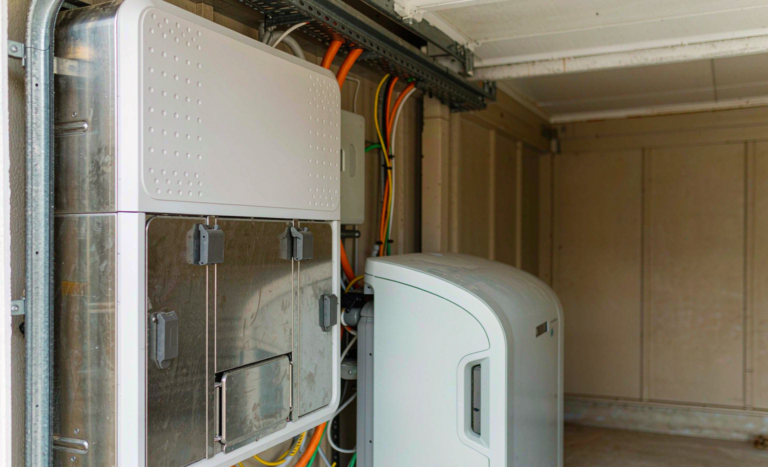
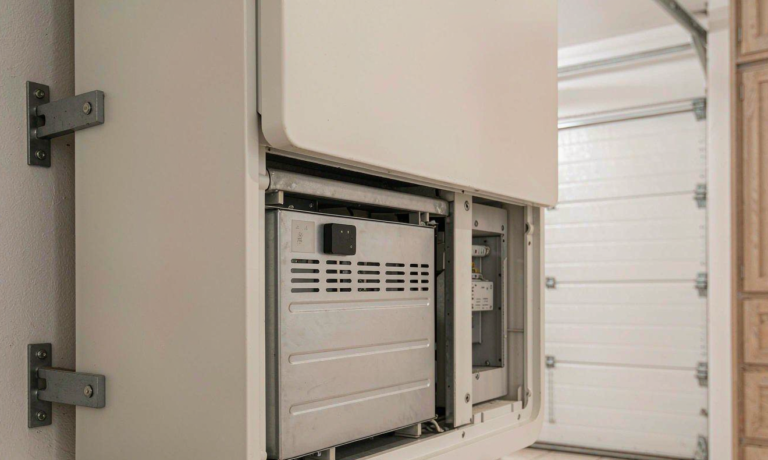
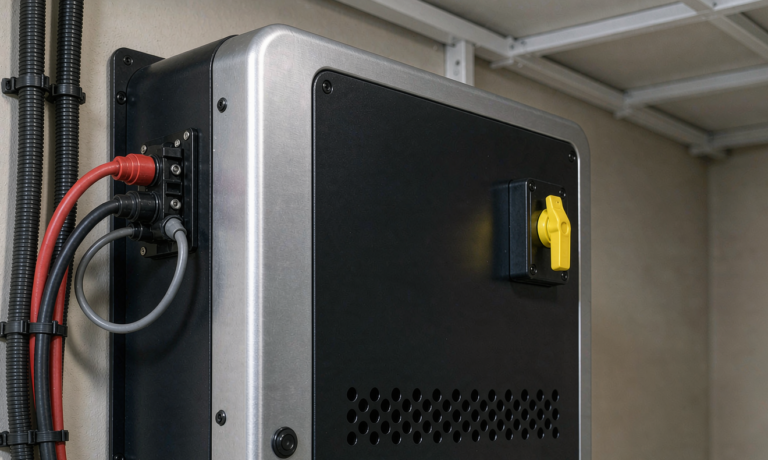
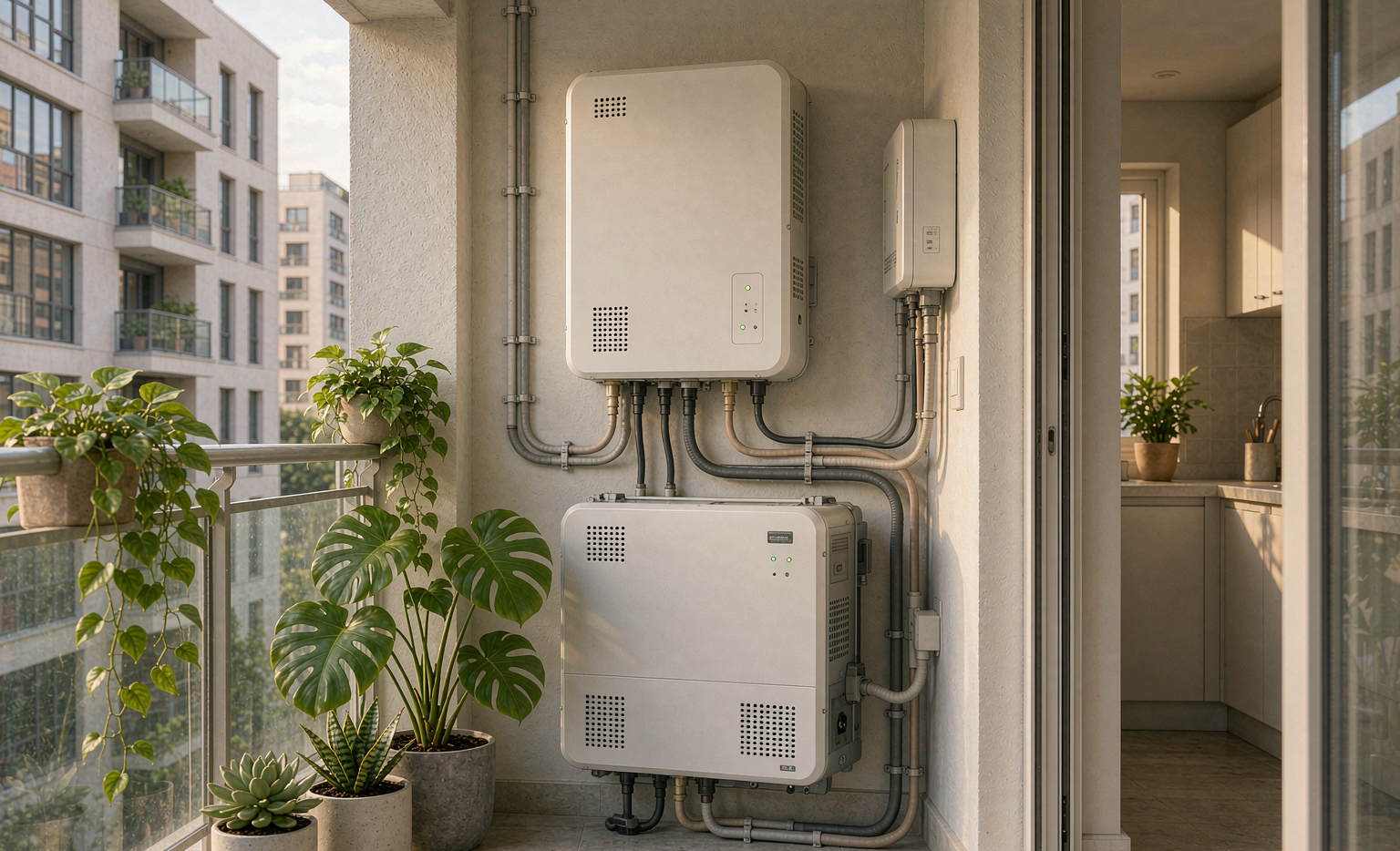
Integrating home energy storage in apartments starts with footprint. The two proven form factors are wall-mounted cabinets and balcony boxes. Wall-mounted units use a 48V nominal architecture (51.2V for LiFePO4 16-cell strings) and deliver 5–10 kWh in a package 40–60 cm wide. Balcony units are smaller, often 1–3 kWh, and plug into a dedicated circuit near the meter.
From an engineering standpoint, thermal management matters more in apartments than in garages because the enclosure is closer to living space. We specify lithium battery cells with stable chemistry—lithium iron phosphate (LiFePO4)—because its onset of thermal runaway sits near 270°C, far above the ~150°C typical of nickel-manganese-cobalt (NMC). For a shared wall, that margin is not a luxury; it is the design basis. A modern residential battery should also report cell-level voltage and temperature to the inverter so the system can derate before any cell strays out of bounds.
- Wall-mounted cabinet: 5–10 kWh, 48V nominal, under 60 kg, ideal for utility closets.
- Balcony plug-in box: 1–3 kWh, simpler permitting, lower cost, modular expansion.
- Stackable modules: add capacity in 2–3 kWh steps as budget or needs grow.
The Safety Standards You Cannot Skip
No home energy storage integration project should proceed without verifying the relevant certifications. These are the standards I check before a single unit ships:
- UL 9540 — the overarching safety standard for energy storage systems and equipment installed in buildings. It covers the system as a whole, not just the battery.
- UL 1973 — safety for stationary batteries used in residential and commercial storage; confirms the lithium battery enclosure, cells, and BMS meet fire and electrical thresholds.
- IEC 62619 — the international benchmark for industrial and stationary battery safety, increasingly required for cross-border shipments and insurance.
- UN 38.3 — mandatory transport testing for lithium cells and batteries; proof the unit survived altitude, thermal, vibration, and shock testing before it ever reached your building.
- IEC 62133 — secondary-cell safety for portable applications, relevant for any smaller balcony or backup module.
In practice, a certified solar battery storage unit carries documentation mapping each cell batch to these tests. If a vendor cannot produce UL 1973 or IEC 62619 paperwork, that is a stop sign, not a footnote. Apartment boards and insurers will ask for it, and your custom battery solution must be defensible on paper as well as in performance.
Pairing Solar Battery Storage With the Grid
A battery energy storage system does not live in isolation; it negotiates with the grid. In North America, IEEE 1547 governs how distributed energy resources interconnect, setting anti-islanding and ride-through rules so your system disconnects safely during a grid fault instead of back-feeding a dead line. European and Asian markets have their own grid codes, but the principle is identical: the inverter must handshake with the utility.
For apartments, the interconnection question is usually simpler than for houses because most renters use an AC-coupled, behind-the-meter unit rather than a full rooftop tie-in. The battery charges from whatever the apartment already draws or from a balcony panel, then discharges locally. This avoids touching the building’s main service and keeps the installation inside the tenant’s own meter boundary—a detail that dramatically simplifies landlord approval.
Sizing a Residential Battery: A Practical Calculation
Sizing is where home energy storage integration for apartments either pays off or disappoints. I use a straightforward method with clients. First, list your essential evening loads: fridge (~150W), internet and lighting (~100W), a laptop or medical device (~60W). That is roughly 310W of continuous load. If you want eight hours of backup, you need about 2.5 kWh of usable energy. Apply an 85% depth-of-discharge and ~92% round-trip efficiency, and a 3.2 kWh nameplate residential battery covers it comfortably.
For daily solar shifting rather than backup, size to your surplus generation instead. If your balcony array exports 4 kWh on a sunny afternoon that you would otherwise lose to a low tariff, a 5 kWh home battery storage bank captures it and returns it at peak rate. Round-trip efficiency of a quality LiFePO4 system runs 90–95%, so you keep most of what you store. The economics sharpen further when time-of-use tariffs separate day and night pricing by 2–3x.
Getting Landlord and Building-Management Buy-In
The single biggest blocker to home energy storage in apartments is not technology—it is permission. My advice to clients is to lead with safety paperwork, not savings. Present the UL 9540 and UL 1973 certificates, the fire-rating of the enclosure, and a one-page installation plan showing the unit sits inside your own meter boundary. Building managers respond to risk language they already understand.
Where the landlord remains hesitant, start with a 1–2 kWh balcony plug-in box. It is reversible, requires no building wiring changes, and demonstrates the concept with almost no structural footprint. Once a manager sees a quiet, certified residential battery running for a season without incident, approval for a larger solar battery storage expansion becomes far easier.
Future-Proofing With a Modular, Custom battery solution
Apartment needs change: a new EV, a home office, a baby, a heat pump. The cheapest path is a modular architecture where the inverter and first module are installed now and capacity is added later. At Horizon Power we routinely deliver a custom battery solution that starts at 5 kWh and scales to 20 kWh by stacking compliant modules on the same 48V bus. The BMS aggregates state-of-charge across modules so the system behaves as one bank.
This modular thinking is also what makes home energy storage integration apartments viable for renters who may move. A portable stack can be unplugged and taken to the next home, preserving the investment. That portability is a genuine differentiator versus a built-in house battery bolted to a garage wall.
Frequently Asked Questions
Can I install home energy storage in a rented apartment?
Yes, in most cases with a balcony plug-in or behind-the-meter wall unit that stays inside your own meter boundary. Lead with safety certifications and a reversible installation plan, and many landlords will approve a small residential battery. Avoid any setup that requires modifying the building’s main electrical service.
How much does a residential battery cost?
Installed costs vary by market, but a 5 kWh home battery storage system typically lands in a range where payback arrives in 5–9 years under time-of-use tariffs and self-consumption gains. Smaller 1–3 kWh balcony boxes cost less and pay back faster on backup value alone. A custom battery solution scales the price with the capacity you actually need.
Is home battery storage safe in apartments?
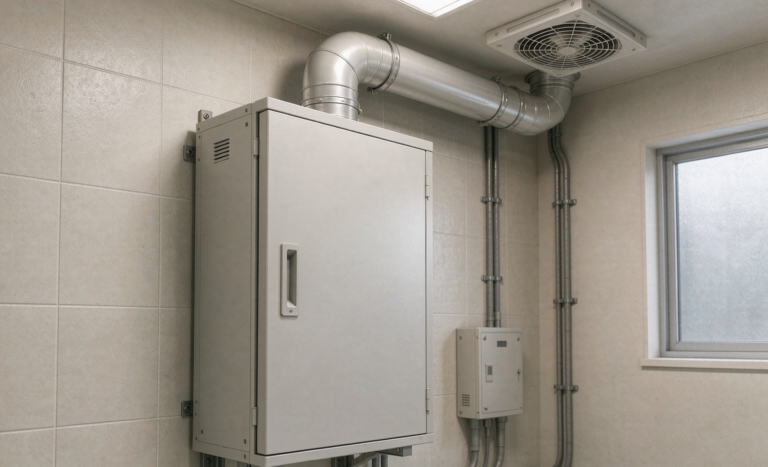
When built on certified lithium iron phosphate cells with UL 9540 and UL 1973 compliance, a residential battery is safer than many common appliances. The key is verified certification, a BMS that monitors each cell, and ventilation consistent with the manufacturer’s clearance diagram. Never install an uncertified unit against a shared wall.
What maintenance does a home energy storage system need?
Very little. A battery energy storage system with a quality BMS is largely self-managing. Check the enclosure quarterly for dust or obstruction, keep software and inverter firmware updated, and avoid sustained 100% state-of-charge in hot locations. Expect 6,000+ cycles from LiFePO4 at 80% depth-of-discharge—often a decade or more of service.