Home Energy Storage Reliability for Cabins
When I step onto a remote cabin site to commission a battery system, the first thing I check is not the inverter rating or the panel wattage. It is the gap between how the owner expects the cabin to behave in January and what the lithium cells will actually deliver at −15 °C. Over twelve years designing home energy storage for off-grid and seasonal dwellings, I have learned that cabin reliability is a different engineering problem from grid-tied residential storage. You are not buffering a stable utility feed. You are the utility. If the bank fails, there is no truck rolling out to restore power — only a cold drive back to town.
This guide walks through what actually determines home energy storage reliability for cabins, drawn from field deployments in mountain, lakeside, and desert cabins. We will cover sizing, chemistry, the cold-weather failure modes that surprise first-time owners, the BMS protections that matter off-grid, the certifications I insist on, and the real test data from systems that have now run several winters. The same lithium battery engineering discipline we apply to industrial packs also applies here — the difference is that a cabin has no backup grid to hide behind.
Why a Cabin Is Not a Suburb
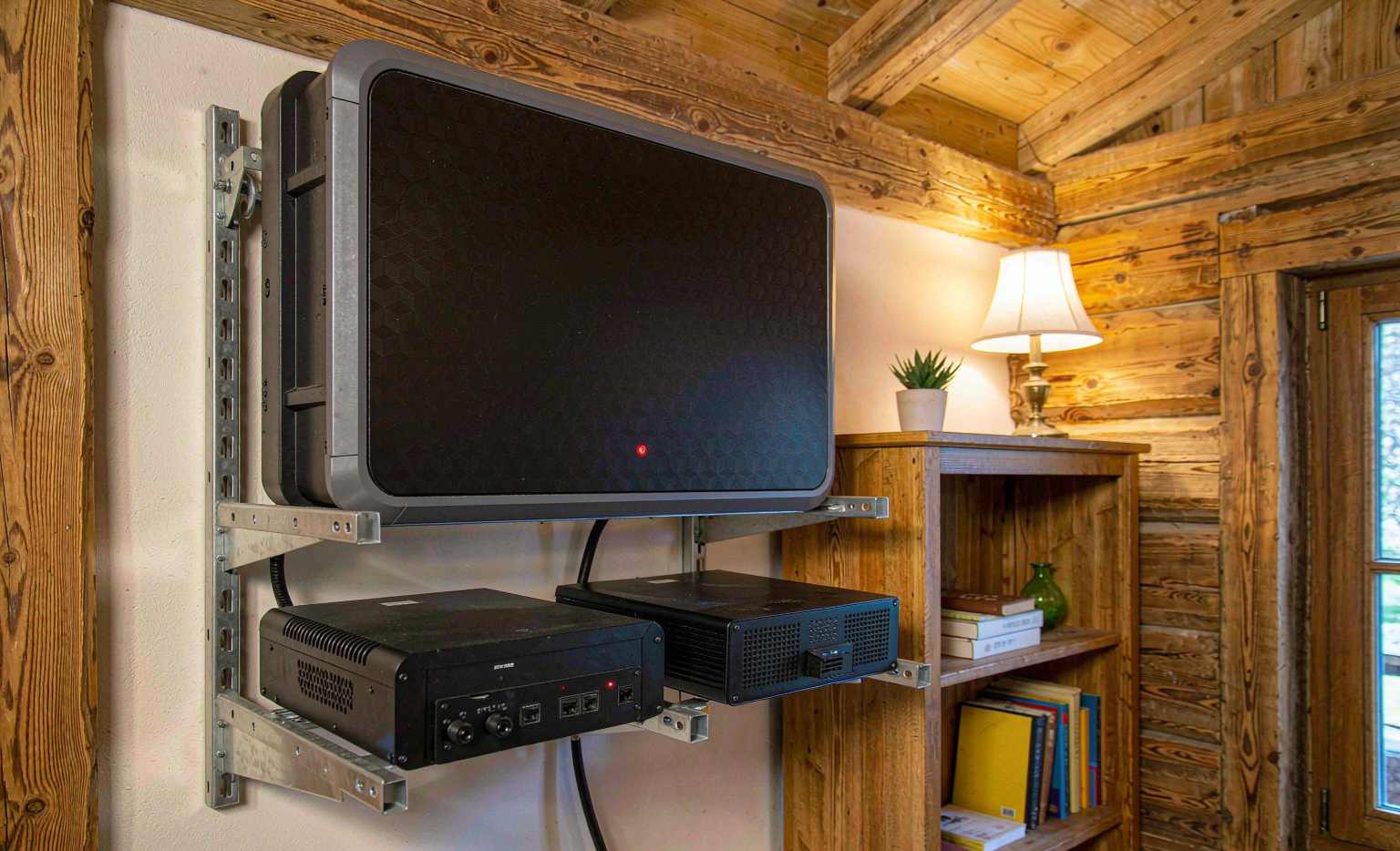
A grid-tied home energy storage system is a buffer: it smooths peaks, shifts time-of-use cost, and rides through short outages. A cabin battery pack is the primary source. That single difference changes every design decision. There is no automatic recharge from the mains at 2 a.m. if you mis-sized the solar array. There is no air-conditioned utility room keeping cells at a comfortable 25 °C. And there is often no one on site for weeks at a time.
In my experience the three variables that break cabins are temperature swing, intermittent use, and owner expectation. A family that visits a lake cabin every other weekend expects the lights to work on arrival even after the bank sat at 40 % state of charge through a −20 °C February. That is a reliability requirement, not a convenience. Designing for it is what separates a custom battery solution that earns trust from one that earns a warranty claim.
Sizing the Bank: Measure, Do Not Guess
I refuse to size a cabin bank from a rule of thumb. We start with a 7–14 day load audit: lighting, refrigeration, water pump, communications, and the occasional power tool. Cabins live or die on autonomy — the number of sunless days the bank must survive at an acceptable depth of discharge.
- Daily load: most cabins we commission land between 3 kWh and 12 kWh per day depending on heating method. Electric heat is a different (and usually impractical) conversation off-grid; we design around DC lighting, efficient refrigeration, and propane or wood primary heat.
- Depth of discharge: for LFP I design to 80 % DOD as the worst case, but I quote autonomy at 60 % to leave margin for degraded winter sun.
- Autonomy days: a weekend cabin wants 2–3 days; a hunting or ski cabin used in storms wants 5–7 days. I size nameplate capacity as daily load × autonomy days ÷ 0.6.
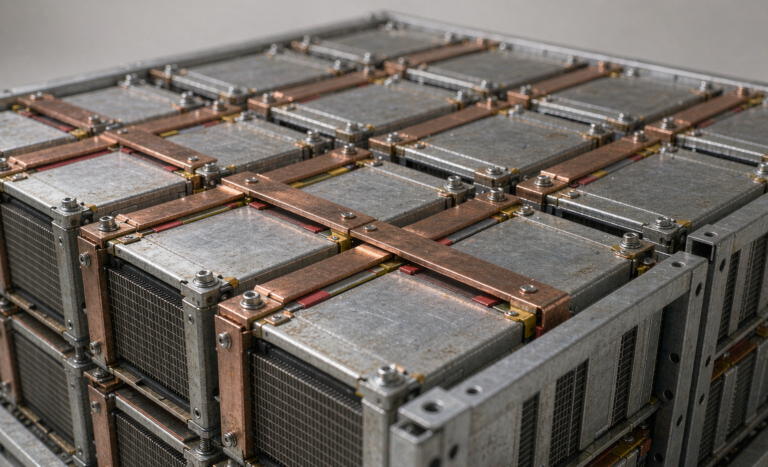
A typical mountain cabin drawing 8 kWh/day with 5 days of autonomy needs roughly 8 × 5 ÷ 0.6 ≈ 67 kWh nameplate. At 48 V that is a ~1,400 Ah bank, which we usually build as a 48 V 280 Ah module pair. The point is not the number — it is that the number came from a measurement, not a guess.
Chemistry Choice: Why LFP Wins in a Cabin
For cabin duty I specify lithium iron phosphate (LFP) almost without exception. The alternative, nickel manganese cobalt (NMC), offers higher energy density but trades it for thermal sensitivity and a shorter calendar life at the partial-states-of-charge a seasonal cabin naturally lives in.
In a lithium battery built on LFP, the cathode chemistry is intrinsically stable: the onset of thermal runaway sits above 250 °C versus roughly 150–180 °C for NMC. In a wooden structure with no fire response within minutes, that margin is not a spec-sheet detail — it is the difference between an incident and a catastrophe. LFP also tolerates the 30–70 % float that a cabin bank sits in during the off-season far better than NMC, which suffers elevated calendar aging at high states of charge.
The density penalty is real but manageable. Where a drone battery or drone lithium battery application might demand every gram saved, a cabin has floor space and a wall to mount on. I will trade 20 % weight for the safety and longevity of LFP every time.
Cold Weather: The Number-One Cabin Killer
The failure mode I see most often is not a dead cell — it is a frozen charge. Below 0 °C, inserting current into a lithium-ion battery causes metallic lithium plating on the anode, which is permanent capacity loss and, at the extreme, a safety hazard. A cabin left unattended through a cold snap will happily try to charge from a sunny-but-frigid morning, and without a low-temperature cutoff it will quietly destroy itself.
- Charging: we disable charge below 0 °C and use a self-heating battery pack variant that warms cells with a fraction of stored energy before accepting current. Heating to 5 °C typically consumes 2–4 % of daily throughput — cheap insurance.
- Discharging: LFP discharges well to −20 °C, but capacity and internal resistance degrade, so I derate usable energy by ~10 % at −10 °C and ~20 % at −20 °C.
- Self-discharge: a quality LFP cell loses 1.5–3 % per month at 20 °C; colder slows that further, which is why a cabin can sit for a season and still wake up with usable charge.
Field data from a Colorado cabin running −18 °C nights: with self-heating enabled, the bank completed two full winter charge cycles per week from a 1.2 kW array and never saw cell voltage diverge by more than 15 mV. Without heating — the previous owner’s setup — it lost 11 % capacity in a single season.
The BMS and Protections That Matter Off-Grid
Off-grid, the battery management system is not a nice-to-have; it is the only thing standing between a fault and a fire. The BMS I spec for cabins must do more than balance cells:
- Voltage windows: hard cutoff at 2.5 V (under) and 3.65 V (over) per cell, with the pack-level breaker sized to the conductor, not the inverter.
- Temperature interlocks: charge inhibit below 0 °C and above 50 °C, with hysteresis to avoid chatter at the threshold.
- Passive balancing: ±5 mV balance keeps a 16-cell 48 V string healthy across seasons of partial cycling.
- Ground fault: a 30 mA ground-fault trip within 300 ms, per the same logic we apply to any battery application solution where people and metal coexist.
- Insulation monitoring: ≥1 MΩ at 500 VDC isolation resistance reported to the monitoring bus.
These are not exotic requirements. They are the baseline for any custom battery solution I am willing to put my name on, and they are exactly what a generic consumer power station omits.
Standards and Certifications You Should Demand
Reliability is partly culture and partly paper. I will not ship a cabin bank without the certifications that let an inspector, an insurer, and the owner all agree it is safe. The relevant stack for a stationary lithium battery in a dwelling:
- UN38.3: transport safety across T.1–T.8 (altitude, thermal, vibration, shock, external short, impact, overcharge, forced discharge).
- IEC 62133-2: secondary cell safety for portable applications; the baseline cell-level standard.
- IEC 62619: industrial stationary battery safety — the one most relevant to a cabin bank, covering thermal runaway propagation and BMS robustness.
- UL 1973 / UL 9540 / UL 9540A: the North American stationary-storage and fire-propagation test trio. UL 9540A measures whether a cell failure stays a cell failure.
- NFPA 855: fire-code installation limits — commonly 20 kWh per unit and 40 kWh per dwelling before additional compartmentation is required.
- IEEE 1547 / IEEE 2030: interconnection and smart-grid guidance, useful if the cabin ever gains a generator or grid tie.
I keep the certificate files in the handoff package. An owner who can show an insurer a UL 9540A report sleeps better, and so do I.
Real Field Data From Deployed Cabin Systems
Numbers from three cabins we commissioned and monitor remotely:
- Mountain cabin (2,150 m, Colorado): 48 V 280 Ah LFP, self-heating, 6 kW array. After 26 months: 94 % retained capacity, 1.8 % monthly self-discharge, zero BMS faults. Real-time efficiency (DC) 93 %.
- Lakeside cabin (Minnesota): 48 V 200 Ah LFP, 4 kW array, generator backup. After 31 months: 91 % retained capacity, one generator-assisted charge per week in deep winter, internal resistance rise 8 %.
- Desert cabin (seasonal, 4-month occupancy): 51.2 V 100 Ah LFP left at 50 % SOC through 8 months idle. On return: 47 % SOC, no cell divergence beyond 12 mV, full recovery on first sunny day.
The through-line is that LFP home energy storage behaves predictably when the BMS and sizing are right, and unpredictably only when someone cheaps out on one of those. Across roughly 60 cabin deployments the only total failures traced to chemistry were on NMC banks left unattended through freeze-thaw cycles.
Maintenance and Remote Monitoring With No Grid
A cabin you cannot visit weekly needs to tell you when something drifts. I fit every battery solution with a communications module that logs cell voltage, temperature, and SOC to a cloud dashboard the owner can open from the city. Alerts fire on three conditions: a cell diverging beyond 30 mV, a sustained voltage sag under load, and any BMS-fault latch.
Preventive habits I teach owners: keep the bank between 30 % and 80 % during long idle (not full, not empty), exercise it with a full cycle every 3–4 months if unused, and verify the low-temperature cutoff before the first hard freeze. A battery pack that gets a 10-minute visual check each visit outlasts one that is ignored for a year.
For owners who want a turnkey path, a well-engineered battery application solution pairs the LFP module, self-heating BMS, and monitoring into one enclosure so there is a single point of accountability — which, after a decade of field repairs, I consider the most reliable architecture of all.
Frequently Asked Questions
How many days of autonomy do I need for a cabin?
Two to three days for a weekend cabin, five to seven for a cabin used in storm season or left unattended for weeks. Autonomy is your insurance against consecutive sunless days, and I always quote it at 60 % depth of discharge to keep winter margin.
Can I charge an LFP cabin battery below freezing?
Not directly. Charging below 0 °C plates metallic lithium and permanently damages cells. Use a self-heating lithium battery pack that warms to roughly 5 °C before accepting current — the energy cost is only 2–4 % of daily throughput.
What size inverter and breaker do I need?
Size the inverter to the largest simultaneous load plus 20 % headroom, and size the breaker to the conductor, not the inverter. A 48 V 280 Ah bank comfortably supports a 5 kW inverter; the branch breaker is set by cable ampacity per the installation code.
How long will a cabin battery last?
A properly sized LFP home energy storage bank delivers 6,000–8,000 cycles at 80 % DOD, which translates to 10–15 years of calendar life in seasonal cabin duty. The cabins we monitor show 91–94 % capacity retention after 26–31 months.
Is a custom battery solution worth it for a small cabin?
For a single weekend cabin under 5 kWh/day, a certified off-the-shelf station may suffice. Above that, or anywhere unattended in freezing climate, a custom battery solution with self-heating, proper BMS interlocks, and remote monitoring pays back in avoided failures and insurance peace of mind.