Home Energy Storage Storm Season Preparedness: An Engineer’s Field Guide
I have spent the better part of fifteen years designing and validating lithium battery packs, and nothing teaches you more about real-world reliability than a hurricane. In September 2023 I flew to a coastal client site two days after a Category 2 storm made landfall. Of the eleven residential systems we had commissioned in that neighbourhood, nine rode through the outage without a single fault. Two did not. Both failures traced back to design decisions made months earlier — not to the storm itself. That trip reshaped how I approach home energy storage storm season preparedness, and most of what follows comes directly from field notes rather than a datasheet.
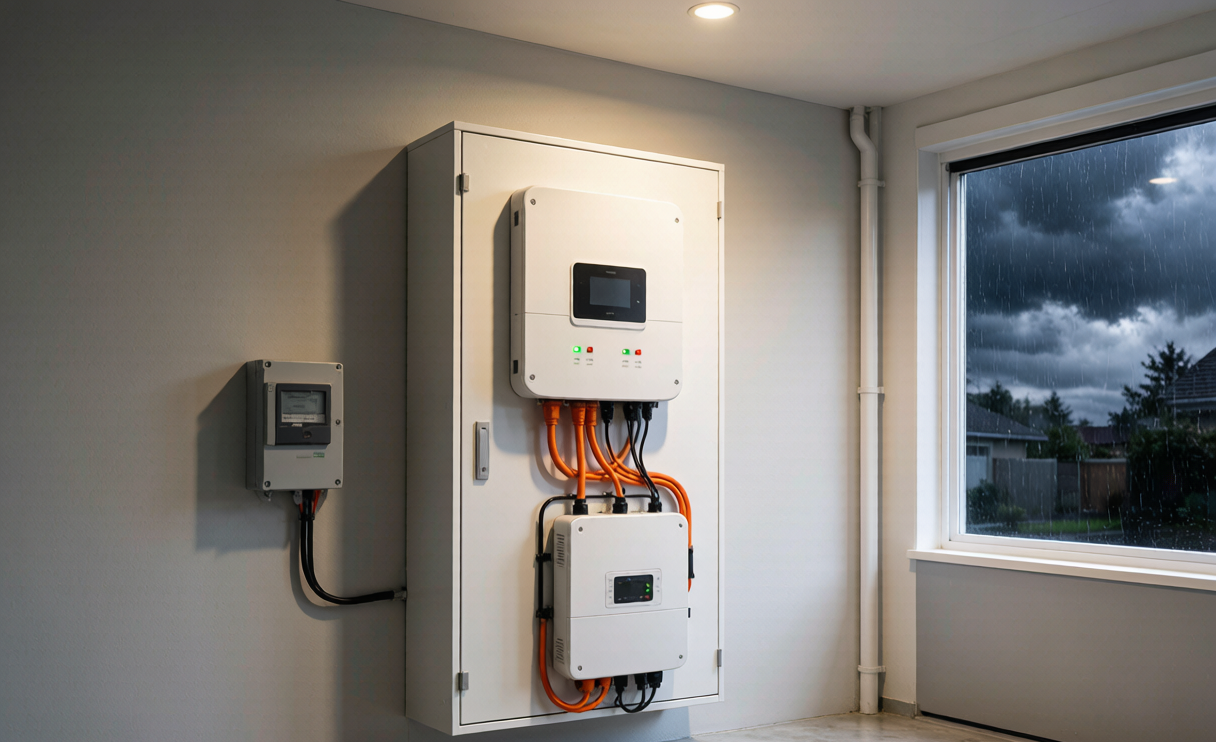
Storm season is the one period when a home energy storage system stops being an economic optimisation tool and becomes life-safety equipment. Refrigerated insulin, a sump pump, a CPAP machine, a well pump — these are the loads that matter at 3 a.m. on day three of an outage. This guide walks through how I size, configure, protect and maintain a residential lithium battery system so it actually delivers when the grid is gone.
Why Storm Outages Break Systems That Pass Every Bench Test
A home energy storage system that performs flawlessly for eleven months of grid-tied cycling can still fail in its first real outage. The reason is that normal operation and storm operation stress completely different parts of the design.
During grid-tied cycling, the pack typically moves between roughly 20% and 90% state of charge, discharges at a gentle 0.2C to 0.3C, and the inverter always has a stiff AC reference to synchronise against. During a storm outage, three things change at once. The pack is asked to run down to its true low-voltage cutoff, sometimes repeatedly. Discharge current spikes as motor loads start with no grid to absorb inrush. And the inverter must form the grid itself, holding voltage and frequency alone.
The two failures I mentioned earlier were textbook. The first was a BMS that tripped on a low-cell-voltage fault at 18% displayed SoC because cell balancing had drifted over eight months of shallow cycling — the pack had never been driven deep enough for the balancer to converge. The second was an undersized critical-loads subpanel: the homeowner had a 3/4 HP well pump with a locked-rotor current the inverter could not support, so every pump start collapsed the output and latched an overload.
Neither was a cell problem. Both were system-integration problems, and both were preventable during design.
Sizing for Real Outage Duration, Not Daily Cycling
Most residential systems are sized for time-of-use arbitrage: enough capacity to shift an evening peak, typically 10 to 15 kWh. Storm resilience is a different calculation entirely, and I always run it separately.
Start with a critical load audit measured in watt-hours per day, not watts. In my experience a well-triaged critical loads list for a typical single-family home lands between 4 and 8 kWh per day:
- Refrigerator and freezer: 1.2–2.0 kWh/day combined, heavily dependent on ambient temperature and door discipline
- Sump pump: 0.3–1.5 kWh/day, but with a locked-rotor surge of 15–30 A that dominates inverter sizing
- Well pump: 0.5–2.0 kWh/day, the single most common cause of inverter overload in my commissioning reports
- Lighting, networking, phone charging: 0.3–0.6 kWh/day with LED fixtures
- Medical equipment: highly variable; a CPAP with humidifier disabled runs 0.3–0.5 kWh/night
- Gas furnace blower or boiler circulator: 0.8–2.5 kWh/day in cold-climate storm scenarios
Then apply three derates that bench calculations routinely miss. Usable capacity is not nameplate capacity: a LiFePO4 pack rated 15 kWh typically offers 13.5 kWh usable at 90% depth of discharge, and I reserve a further 10% as a BMS margin, leaving about 12 kWh. Inverter conversion efficiency costs another 4–8%. And low ambient temperature matters — at 0 °C a LiFePO4 cell delivers roughly 85–90% of its 25 °C capacity, and charge acceptance drops far more sharply than discharge capability.
Working backwards from a 72-hour design target and 6 kWh/day of critical load, you need about 18 kWh delivered, which means roughly 21–22 kWh of nameplate lithium battery capacity if solar recharge is unavailable. With a functioning 6 kW PV array, that same 72-hour target can often be met with 13–15 kWh nameplate, because you are recharging 8–20 kWh per day depending on cloud cover. This is why I always ask about roof orientation before quoting a resilience-focused custom battery solution.
Inverter and Subpanel Architecture That Survives Motor Loads
Capacity keeps the lights on for days. Inverter architecture determines whether they come on at all in the first ten seconds.
The specification that matters most is surge capability, not continuous rating. A 6 kW hybrid inverter that can only deliver 7.5 kW for 100 ms will not start a 3/4 HP well pump drawing 32 A locked-rotor at 240 V. I look for inverters rated for at least 2× continuous power for 5 seconds, and I verify the number in the certification report rather than the brochure.
Three architectural choices I now consider mandatory for storm-prone sites:
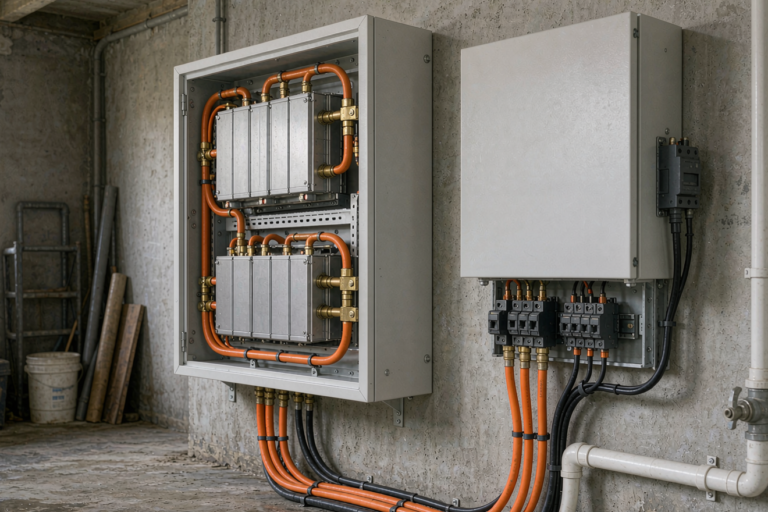
- Dedicated critical loads subpanel. Whole-home backup is attractive but exposes the battery to every load in the house, including a 5-ton air conditioner someone switches on out of habit. A subpanel enforces the triage you did on paper.
- Soft-start device on every large motor load. A soft starter on a well pump or air handler typically cuts inrush by 60–70%, often letting a 6 kW inverter do work that would otherwise demand 10 kW.
- Verified transfer time. Automatic transfer under 20 ms keeps most electronics and networking gear alive. Anything above 40 ms will drop sensitive equipment, which matters if the homeowner relies on a cellular gateway for emergency communication.
Grid interaction rules still apply during and after the event. In North America, IEEE 1547-2018 and UL 1741 SA/SB govern how the inverter behaves at the point of common coupling, including anti-islanding — the function that guarantees your system is not backfeeding a line a utility crew is working on. I have never accepted a site as commissioned without physically witnessing an anti-islanding test.
Standards, Certification and What Actually Protects a Home
Certification marks are not marketing. During storm conditions they map directly onto failure modes I have seen in the field, and I treat the following as non-negotiable for any residential lithium battery installation.
UN 38.3 covers transport safety through eight tests (T.1 altitude simulation through T.8 forced discharge), including thermal cycling between −40 °C and +75 °C, vibration, shock and external short circuit. It tells you the pack survived getting to the house.
IEC 62133-2 is the cell and battery safety baseline for portable and small stationary lithium systems, covering overcharge, forced discharge, crush and thermal abuse.
IEC 62619 is the standard I care about most for stationary industrial and residential storage. It adds propagation testing — verifying that a single cell going into thermal runaway does not cascade through the pack. In a flooded basement or a garage at 45 °C, that single requirement is worth more than any spec-sheet cycle-life number.
UL 1973 covers batteries for stationary and motive auxiliary power, and UL 9540 covers the complete energy storage system including inverter and controls. UL 9540A is the large-scale fire propagation test method that authorities having jurisdiction increasingly require to approve indoor or garage installations, and it drives the separation distances written into NFPA 855.
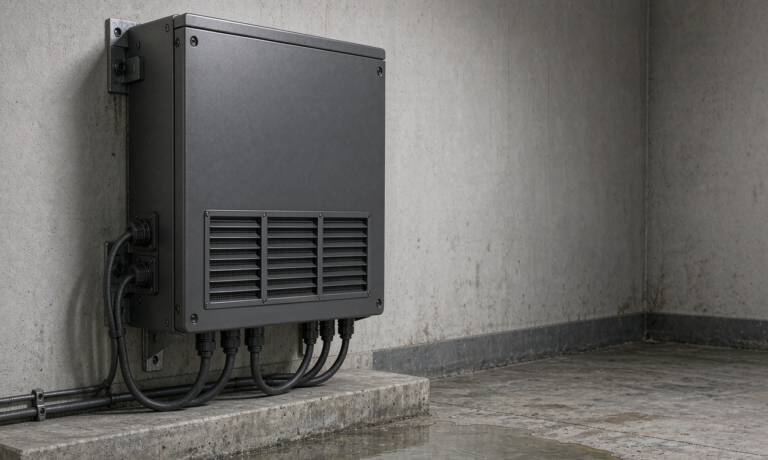
Ingress protection deserves specific attention for storm work. An outdoor-mounted enclosure should be IP65 minimum under IEC 60529 — dust-tight and protected against water jets. IP65 does not mean submersible. If a site has any flood history, the enclosure belongs above the historical high-water line, full stop. I have replaced two packs that were technically IP65 and technically underwater.
Pre-Storm Commissioning and the 48-Hour Checklist
The most valuable work happens before the forecast cone even appears. Here is the protocol I hand to every homeowner in a storm-exposed region.
Annual, before season start:
- Run one full calibration cycle — charge to 100%, allow the BMS to complete top balancing, then discharge to the low cutoff under a controlled load. This resolves the SoC drift that caused the premature trip I described earlier. Cell delta after balancing should sit under 30 mV; above 50 mV I investigate.
- Torque-check every DC termination. Thermal cycling loosens lugs, and a loose 200 A connection generates serious heat. I use a thermal camera on a loaded pack and flag anything more than 10 °C above its neighbours.
- Perform a live blackout test. Open the main breaker and run the house on battery for at least an hour with the well pump and refrigerator cycling. Simulations are not evidence.
- Verify firmware is current on both the BMS and inverter, and confirm the system retains its configuration through a full power-down.
48 hours before a forecast storm:
- Override any time-of-use schedule and charge the pack to 100%. Economic optimisation is irrelevant when the grid is about to fail.
- Raise the reserve SoC floor — I set it to 100% so the system will not sell or self-consume the buffer.
- Clear PV panel debris and confirm the array is producing to expectation.
- Confirm the homeowner can find the manual disconnect and knows the LED fault codes without an app, because cellular networks fail early in major storms.
- Photograph the installation and log meter readings. Insurance claims move faster with a timestamped baseline.
Thermal Management, Flooding and Post-Event Inspection
Storms bring temperature extremes as well as water. LiFePO4 chemistry is tolerant but not indifferent: charging below 0 °C causes lithium plating, which is permanent capacity loss and a latent safety risk. Any pack installed in an unconditioned garage in a cold climate needs either integrated cell heaters with BMS-enforced charge lockout, or a policy that solar recharge is inhibited until cell temperature clears 5 °C. I specify heaters. A homeowner three days into an outage should not be managing a temperature policy.
At the other extreme, summer storms leave humid, hot conditions and no air conditioning. A garage can reach 50 °C. LiFePO4 will operate there, but calendar ageing roughly doubles for every 10 °C above 25 °C. If a site regularly runs hot, I mount the cabinet on a north-facing interior wall and leave the manufacturer’s clearances intact — the 100–150 mm gaps in the installation manual are convective cooling paths, not suggestions.
After the event, inspection is mandatory before returning to normal operation. Look for water staining or corrosion at cable entries, check that the BMS event log contains no over-temperature or over-current entries, re-read cell voltage spread, and compare measured capacity against the pre-season baseline. A pack that shows more than 3% capacity loss across a single storm cycle has something wrong with it beyond normal ageing.
One habit I picked up from aviation work carries over well here. In drone battery engineering, every pack has a flight log and any anomaly grounds it until resolved. I apply the same discipline to residential storage: every storm event gets logged, and any fault code gets root-caused rather than cleared. That mindset is the difference between a system that works once and a system that works for a decade.
Frequently Asked Questions
How much home energy storage capacity do I need for a three-day storm outage?
For a typical critical-loads list of 5–7 kWh per day and no solar recharge, plan on 20–24 kWh of nameplate lithium battery capacity to cover 72 hours after depth-of-discharge limits, BMS reserve and inverter losses. With a working 6 kW PV array, 13–15 kWh nameplate is usually sufficient because you recover 8–20 kWh daily depending on cloud cover. Always size from a measured watt-hour audit rather than a rule of thumb.
Can a home energy storage system charge from solar while the grid is down?
Only if the inverter supports grid-forming island operation, which is a specific capability and not universal. Many grid-tied string inverters shut down entirely without an AC reference for anti-islanding compliance. Confirm the system is a hybrid or AC-coupled design with documented islanding capability, and witness the behaviour during commissioning rather than trusting the datasheet.
Is it safe to keep a lithium battery at 100% state of charge before a storm?
Yes for the days-long window that storm preparedness requires. LiFePO4 tolerates full charge far better than NMC chemistry, and a few days at 100% has negligible effect on calendar life. What you should avoid is leaving the system permanently at 100% year-round; return the reserve floor to its normal 20–30% setting once the event has passed.
What happens to my battery if the installation area floods?
Treat any submerged pack as compromised and do not attempt to re-energise it. Water ingress into a lithium battery can create internal short circuits with delayed thermal events, sometimes days later. Isolate the DC disconnect if it is safe to reach, keep people away, and have the manufacturer or installer perform the assessment. This is exactly why enclosure placement above the historical flood line matters more than an IP rating.
How often should storm-readiness testing be performed?
Once annually before the local storm season for the full protocol — calibration cycle, torque check, thermal scan and live blackout test — plus the 48-hour pre-event checklist whenever a storm is forecast. For sites with medical loads I recommend a quarterly abbreviated blackout test as well, because a system that has not been exercised in a year is a system nobody has actually verified.
Storm resilience is not a product you buy; it is a set of design decisions, a certification baseline and a maintenance discipline that hold together under stress. If you are specifying a system for a storm-exposed site and want the sizing reviewed against your actual load profile, that is the kind of custom battery solution work our engineering team does every week.