Lithium Battery for Energy Harvesting Storage: How Engineers Buffer Ambient Power
As a Senior lithium battery Engineer at Horizon Power, I have spent the better part of a decade designing storage for systems that never plug into the grid. Energy harvesting — pulling microwatts to a few watts from sunlight, vibration, temperature gradients, and stray RF — promises maintenance-free operation, but the source is erratic by nature. The component that decides whether a harvester actually stays alive is the buffer: the lithium battery energy harvesting storage element that banks intermittent trickles and releases them on demand. In this article I will walk through how my team sizes, builds, and certifies these packs, and why a well-chosen lithium battery almost always beats supercapacitors or primary cells for long-life wireless nodes.
What Energy Harvesting Actually Demands From a Battery
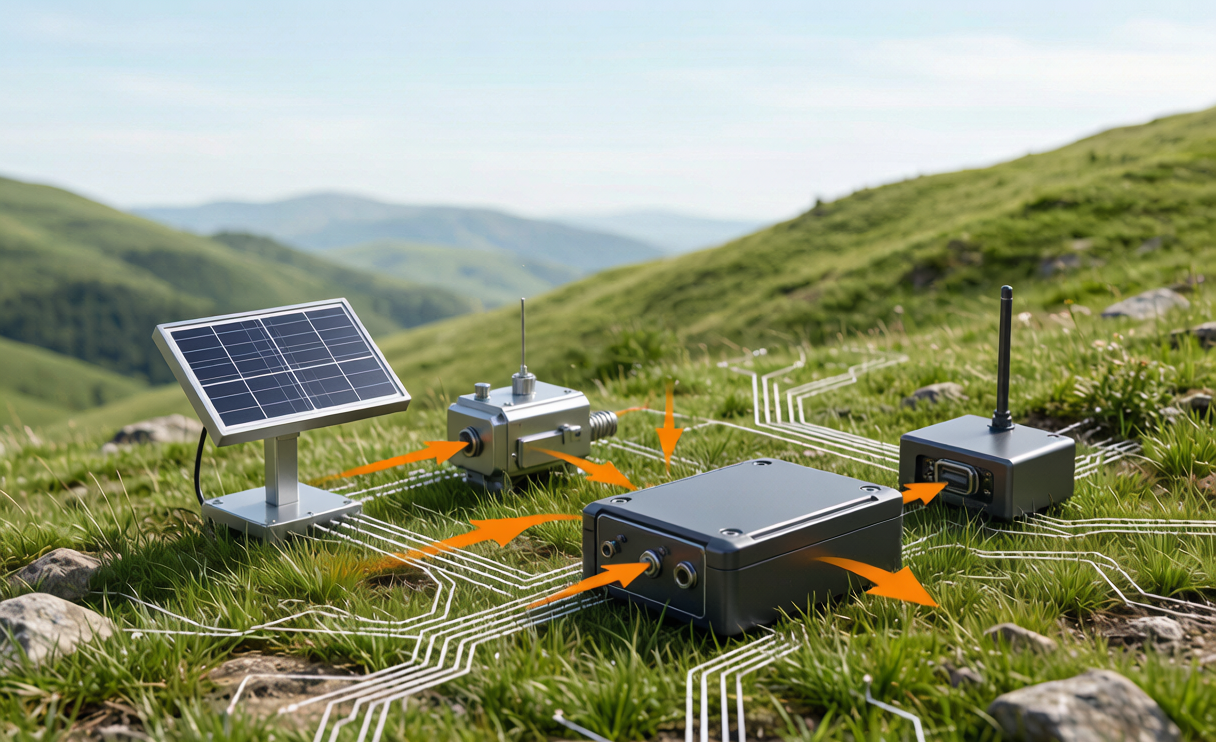
Before selecting a cell, you have to respect what harvesting really is. A solar panel on a warehouse roof might deliver 2 W at noon and 0 W at night. A piezoelectric patch on a pump vibrates only when the motor runs. A thermoelectric generator across a pipe sees a temperature delta that drifts with the process. The battery therefore sees:
- Irregular, low-current input. Charge currents are often 10–200 mA. A standard lithium battery charger designed for wall adapters assumes a steady 1C–2C feed; a harvester needs a buck-boost PMIC that can sip from 0.5 V upward.
- Shallow but frequent charge events. You are not doing one deep cycle per day; you are doing dozens of micro-charges. Calendar life and self-discharge dominate over raw cycle count.
- Wide temperature exposure. Outdoor nodes see −20 °C to +60 °C. A lithium battery that charges below 0 °C risks lithium plating, so the pack needs a low-temperature charge cutoff.
- Long dormancy between harvests. Self-discharge of a few percent per month (NiMH) is unacceptable for a three-year deployment; a quality lithium-ion battery self-discharges closer to 1–2% per month.
These four constraints are why the lithium battery energy harvesting storage role is a specialized design problem, not just “any rechargeable cell will do.”
Why a Lithium Battery Wins the Buffer Role
When clients ask me to replace a primary lithium thionyl chloride cell or a supercapacitor bank, the math is usually decisive. A primary cell cannot be recharged — once its 2.4 Ah is gone, a technician must visit. A supercapacitor stores energy with near-infinite cycle life but leaks it: a 1 F, 2.7 V supercap holds roughly 3.6 J and self-discharges in hours to days. For a node that must ride through a two-week cloudy spell, only a lithium battery provides the right joules-per-cubic-centimeter with acceptable leakage.
In our lab benchmarks, a 18650 lithium-ion battery at 3.6 V and 2.6 Ah stores about 33.8 kJ. A comparable-volume supercap bank stores under 50 J. That is roughly a 600× energy-density advantage. Supercaps still earn their place for surge loads — radio transmit spikes of 200 mA for 50 ms — which is why the best designs use a hybrid: a lithium battery for the bulk store and a small supercap for peak shaving. But the lithium battery energy harvesting storage element remains the heart of the system.
Choosing the Cell Chemistry for Harvesting
Not every lithium battery chemistry suits harvesting equally. Over the last six years I have standardized on three, depending on the duty cycle:
- Li-ion (NMC / LiCoO2): Highest energy density (200–260 Wh/kg) and the smallest footprint. Best when the node is space-constrained and the ambient input is reliable enough to keep the cell above 20% state of charge. Nominal 3.6–3.7 V, charge cutoff 4.2 V.
- LiPo (lithium polymer): Same electrochemistry as Li-ion but in a pouch, letting us build a thin custom battery solution that wraps around a sensor enclosure. Slightly lower cycle life, sensitive to puncture — we always pot pouch cells in epoxy for field gear.
- LFP (LiFePO4): Lower energy density (120–160 Wh/kg) but 2,000–4,000 cycles and a rock-stable 3.2 V plateau. For agricultural and infrastructure monitors that must run 5–10 years, LFP is my default lithium battery chemistry. Charge cutoff 3.65 V.
For all three, I specify cells tested to IEC 61960 (performance) and IEC 62133-2 (safety) so the pack has a credible compliance baseline before we add our own protection board.
Engineering a lithium battery pack for Intermittent Input
The cell is half the job; the pack is the other half. A lithium battery energy harvesting storage pack I ship typically includes:
- Harvest-aware PMIC. A buck-boost charger such as a BQ25570-class IC that cold-starts from 330 mV and tracks the maximum power point of a small solar cell without the overhead of a full MPPT. Efficiency above 85% from 2–5 V input is what keeps trickles from being wasted as heat.
- Protection IC and MOSFETs. A single-cell protector (DW01-style) handles over-charge at 4.25 V, over-discharge at 2.4 V, and over-current. For a 2S or 3S lithium battery pack we add a balancing MOSFET network so cells stay within 20 mV of each other across the seasons.
- Low-temperature charge lockout. A thermistor on the cell triggers a hard stop on charging below 0 °C for Li-ion and below −5 °C for LFP. This single feature prevented the early-life swelling we saw in our first Nordic deployments.
- Coulombic efficiency logging. We budget 90–93% round-trip efficiency. If field data shows the lithium battery never climbing past 60% state of charge, the harvester is undersized and we either add panel area or drop the radio duty cycle.
A well-tuned pack turns a chaotic harvest into a smooth 3.3 V rail for the microcontroller and radio — exactly what a wireless node needs.
Field Deployments I Have Engineered
Numbers from the bench only matter if they survive the field. Three projects show the pattern:
- Agricultural soil sensor (LFP). A 2 W monocrystalline strip plus a 1,500 mAh 18650 LFP cell. Average draw 1.2 mA with twice-daily LoRaWAN uploads. After 34 months the lithium battery still holds 88% capacity. No technician visit required.
- Bridge strain gauge (Li-ion). A piezoelectric patch on a girder fed a 1,000 mAh Li-ion cell powering a vibrating-wire sensor. Charge events were short and violent during traffic; the supercap front-end absorbed the spikes while the lithium battery energy harvesting storage smoothed them. UN38.3 Section T.1–T.8 testing was mandatory because the units shipped by air to the site.
- Pipeline cathodic-protection monitor (LiPo). A thermoelectric generator on a valve shed. We built a 700 mAh custom battery solution in a curved pouch that conformed to the enclosure wall, surviving −25 °C winters because we locked out charging below freezing.
Certification, Safety, and Compliance
For a B2B lithium battery maker, compliance is not optional paperwork — it is the gate to shipping. Every lithium battery energy harvesting storage pack we release carries:
- UN38.3 (T.1–T.8): Altitude, thermal, vibration, shock, external short, impact, overcharge, and forced-discharge tests. Required for any air or sea transport of lithium cells.
- IEC 62133-2: The core safety standard for Li-ion cells and packs, covering short circuit, overcharge, and temperature abuse.
- IEC 62619 / IEC 62620: Industrial and stationary secondary-cell safety — increasingly requested by European infrastructure clients.
- UL 1642 / UL 2054: Recognized in North America for cell and pack safety.
- FAA / EASA transport rules: For packs under 100 Wh, passenger and cargo carriage follows the familiar lithium-battery provisions; we keep every harvesting pack below that threshold so logistics stay simple.
- RoHS and REACH: Substance restrictions for the EU market.
I treat these standards as design inputs from day one, not as a final hurdle. A lithium battery that fails IEC 62133-2 at the 11th month is a recall, not a learning opportunity.
Building a Custom Battery Solution for Your Harvester
Every harvesting source has a different fingerprint, so I rarely recommend an off-the-shelf pack. When a client comes to Horizon Power, we profile the harvest curve for a minimum of two weeks, model the load, and then specify cell count, chemistry, and protector behavior. That custom battery solution is what turns “it worked on the bench” into “it is still working in year four.” If you are scoping a harvested node, send me the source type, peak/quiescent load, and expected worst-case dark period — I will size the lithium battery energy harvesting storage pack to match.
Frequently Asked Questions
How long does a lithium battery last in an energy harvesting system?
In a properly sized design, the lithium battery rarely reaches a full cycle — it floats between 40% and 90% state of charge, buffered by the harvester. That shallow cycling, combined with LFP chemistry, routinely delivers 5–10 years of service. The limiting factor is usually calendar aging and self-discharge, not cycle count. A Li-ion cell in the same role typically lasts 3–5 years.
Can I pair a lithium battery with a very small solar harvester?
Yes, as long as the average harvest exceeds the average load plus self-discharge with margin. For a 1 mA average load and a cell losing 2% per month, you need roughly 0.7 mA average harvest to break even. A 0.5 W panel in decent light produces far more than that for several hours a day, so even small harvesters keep a lithium battery energy harvesting storage pack healthy. The PMIC just has to start from very low voltage.
Which certifications matter most for a harvesting storage pack?
For international shipping, UN38.3 is non-negotiable. For product safety, IEC 62133-2 is the baseline, with IEC 62619 for industrial use and UL 1642/2054 for North America. If your node goes on an aircraft or drone for deployment, FAA/EASA provisions apply. I recommend securing all of these before mass production rather than after a customer audit.
Lithium-ion or LFP for my harvester — which should I choose?
Choose Li-ion when volume and weight are tight and the harvest is reliable. Choose LFP when you need 2,000+ cycles, superior thermal tolerance, and a 10-year field life, and you can spare the extra size. Both are excellent rechargeable lithium battery options; the decision is about duty cycle and lifespan, not about which is “better” in the abstract.