Semi-Solid State Battery for Marine and Underwater Use: Engineering for Pressure, Corrosion, and Reliability
Over the past eight years at Horizon Power, I have spent more hours than I care to count troubleshooting lithium battery packs that failed in the field — and nowhere are field failures more expensive or more dangerous than underwater. When a power source dies at 400 meters below the surface, you do not just lose a dive; you risk losing an autonomous underwater vehicle (AUV) worth six figures and, occasionally, a diver’s entire working day. As a senior lithium battery engineer, I have come to view marine and underwater platforms as the ultimate stress test for any cell chemistry. That is exactly why the semi-solid state battery has moved from a laboratory curiosity to a serious contender for AUVs, remotely operated vehicles (ROVs), and seabed sensor nodes.
Why Marine and Underwater Applications Push Conventional Lithium Batteries to the Limit
The ocean is hostile to electronics in ways most people never consider. A conventional lithium battery designed for consumer drones or e-bikes is built for atmospheric pressure, controlled humidity, and modest temperature swings. Drop that same pack into a subsea enclosure and three problems appear almost immediately.
First, pressure. Every 10 meters of seawater adds roughly one bar (14.5 psi). At 1,000 meters, the external load on a housing exceeds 100 bar. If the battery enclosure is not perfectly balanced, the casing can deform, separator layers can shift, and cell impedance climbs. I have seen pouch cells bulge simply from a 0.3-bar differential during a pressure-cycle test.
Second, corrosion. Saltwater is an electrolyte in its own right. A single compromised O-ring or a galvanic couple between dissimilar metals can start a creep-corrosion path that reaches the battery management system (BMS) within weeks. In my lab we run salt-fog chamber tests to IEC 60068-2-52, severity 5, precisely because field returns taught us the hard way.
Third, thermal management. Water is far denser than air, so a submerged pack sheds heat efficiently — until it is inside an insulated pressure housing, where heat can actually accumulate. A solid-state battery chemistry with a wider safe operating window reduces, but does not eliminate, this risk. The point is that marine duty cycles expose every weakness in a cell’s mechanical and electrochemical design.
What Makes a Semi-Solid State Battery Different
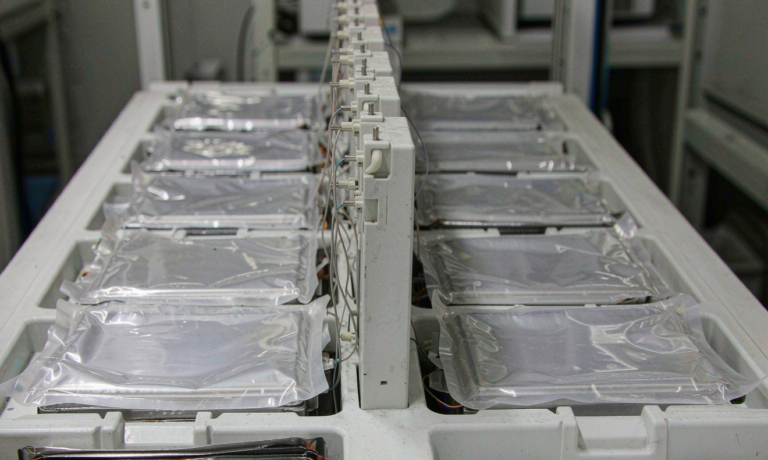
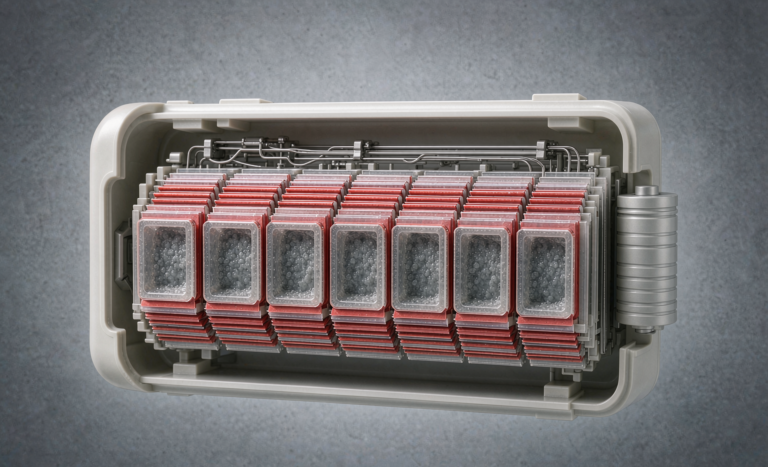
A true solid state battery replaces the liquid electrolyte entirely with a solid separator, usually a ceramic or sulfide layer. A semi-solid state battery keeps a small amount of gelled or quasi-solid electrolyte — enough to maintain ionic contact at lower resistance, but far less free liquid than a conventional lithium-ion cell. In our Horizon Power marine builds we typically land in the 300–360 Wh/kg range, versus roughly 200–250 Wh/kg for the best sealed NMC pouches we used five years ago.
For underwater use, that energy-density gain is not a marketing number — it is payload. Every kilogram of battery you save is a kilogram of science instrument, ballast control, or endurance you can add. I have personally specced semi-solid cells that extended an AUV’s mission profile from 14 hours to just over 21 hours on the same hull volume, simply by swapping the chemistry and re-balancing the pack.
The quasi-solid electrolyte also reduces the flammable solvent load. Under a crush or puncture event, there is less volatile material to vent. That matters enormously when a pack is sealed inside a pressure-rated canister with a human diver potentially nearby.
Pressure Resistance and Sealing: Designing for the Deep
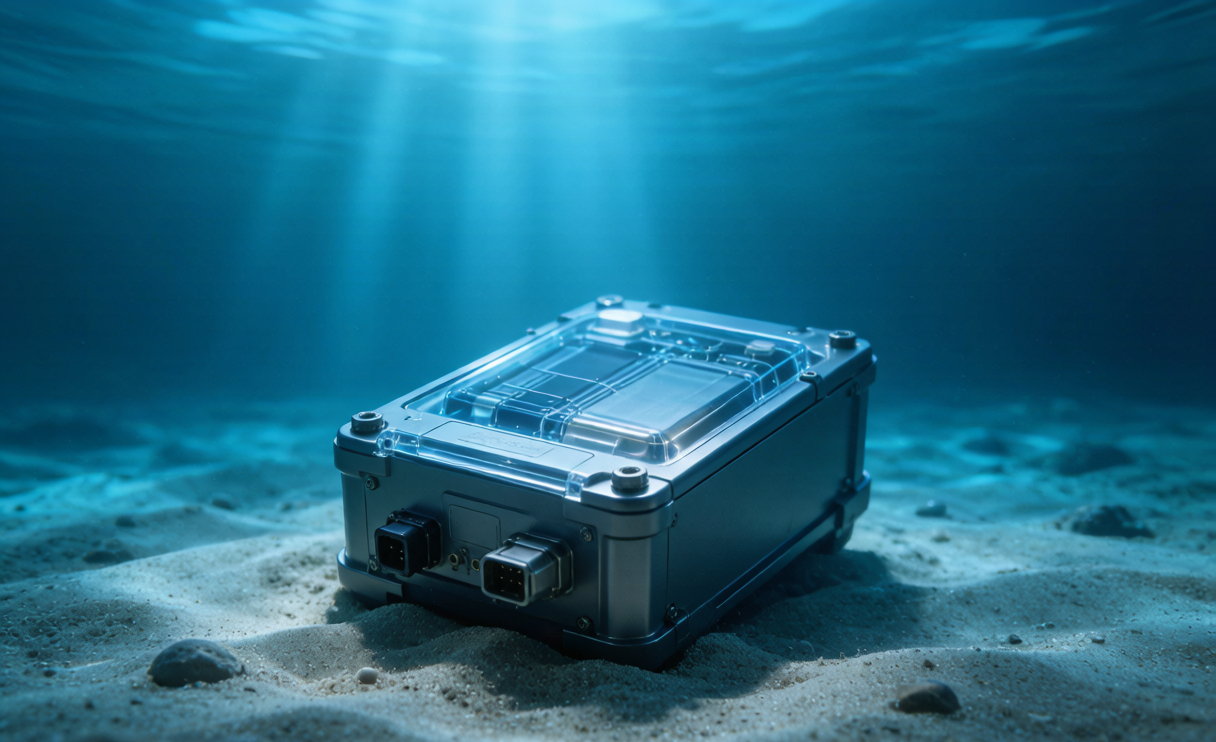
We do not rely on the cell alone to survive depth. The pack sits inside a pressure-compensated or hermetically sealed enclosure rated to the target operating depth, with a documented factor of safety. For a 600-meter rated ROV, I specify housings validated to 900 meters static plus a dynamic surge allowance.
Two design rules I enforce on every marine custom battery solution we ship:
- Pressure balancing: For shallow and mid-depth systems we use an oil-filled, flexible bladder compensation so external pressure equalizes internally. This removes the differential load on cell casings entirely.
- Hermetic termination: All pass-through connectors use glass-to-metal seals or polymer-isolated feedthroughs rated to the full depth. No epoxy-only joints, ever. Epoxy creeps under sustained hydrostatic load.
We validate every new enclosure with a pressure-cycle test — typically 500 cycles between surface and rated depth — before it earns a production release. A pack that passes our bench cycle test but fails at cycle 380 in the tank goes back to the drawing board.
Corrosion, Saltwater, and Thermal Stability
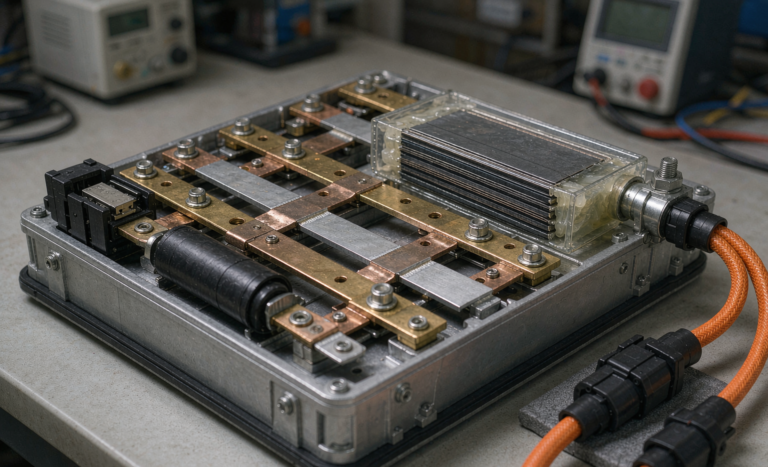
Material selection is where most subsea battery failures are won or lost. We use titanium or anodized 6061-T6 aluminum for external structures, with isolation washers between any steel fasteners and the aluminum frame to prevent galvanic corrosion. Internal busbars are nickel-plated copper, and every weld is dye-penetrant inspected.
Thermally, semi-solid cells give us a wider comfortable band — in our testing we hold stable discharge from −10°C to +55°C at the cell level, with the BMS tightening that to a conservative 0°C to +45°C for the pack. Underwater, the surrounding water helps with top-end cooling, but I always spec a BMS with redundant temperature sensing on at least three cells per series group. A single frozen sensor reading has ended more missions than I would like to admit.
Real Deployment Scenarios: AUVs, ROVs, and Buoy Sensors
The same semi-solid state battery chemistry serves very different duty cycles, and the pack design has to follow the mission:
- AUVs need sustained, moderate discharge over many hours with strict weight and volume budgets. We prioritize specific energy and low self-discharge, because these vehicles may sit dormant between surveys.
- ROVs are tethered and power-hungry, with high peak currents for thrusters. We size the bus for pulse capability and add cell-level fusing so a thruster stall cannot cascade.
- Seabed sensor nodes and buoys want years of dormant life with a tiny trickle draw. Here we tune for calendar life and self-discharge below 2% per month at 20°C.
Across all three, the common thread is reliability under conditions no one can easily service. A battery on a desk is easy to swap; a battery 800 meters down is effectively permanent for the life of the deployment.
Certification and Safety Standards You Cannot Skip
Marine and underwater batteries are shipped, handled, and often flown as cargo, so compliance is non-negotiable. Every Horizon Power marine pack we build is validated against:
- UN38.3 — the lithium battery transport test suite (altitude simulation, thermal, vibration, shock, external short, impact, overcharge, forced discharge). No pack leaves our dock without the full test report.
- IEC 62133 — safety requirements for portable sealed secondary cells and batteries containing alkaline or non-acid electrolytes. This is our baseline for cell-level construction and internal short-circuit protection.
- IEC 62619 — the industrial secondary battery safety standard, which adds requirements for large-format cells, thermal runaway propagation resistance, and BMS functional safety that consumer standards miss.
- FAA / EASA guidance — for any unit that travels by air as cargo, we document state-of-charge limits (typically ≤30% SoC for transport) and packing compliance so our logistics partners clear customs without drama.
I treat these standards as a design floor, not a checkbox. When a client asks me to “just make it lighter,” I show them the UN38.3 altitude and vibration margins first, because a pack that passes the lab but fails a rough ferry crossing is a liability, not a saving.
Choosing the Right Custom battery solution for Your Platform
If you are specifying a battery for a subsea vehicle, start from the mission, not the catalog. I ask every new client four questions before we draw a single cell:
- What is your maximum operating depth, and what safety factor do you require?
- What is your continuous and peak current profile over a typical mission?
- What is your acceptable weight and volume envelope?
- How will the unit be serviced — and if it cannot be, what calendar life do you need?
From those answers we select cell format, electrolyte strategy, enclosure material, and BMS topology. A well-specified lithium battery built on semi-solid chemistry routinely delivers 1,200–2,000 cycles at 80% depth of discharge in our validation data, with capacity retention above 80% at 1,000 cycles under a simulated AUV profile. That is the number I put in the proposal, and it is the number our field logs confirm.
FAQ
Can a semi-solid state battery be fully submerged without a pressure housing?
No, and I would never recommend it. Even with a sealed cell, the pack electronics, BMS, and connectors need a pressure-rated enclosure. The battery chemistry improves safety and energy density; it does not remove the need for proper subsea engineering. We always pair the cells with a validated housing.
How deep can your marine battery packs operate?
Our standard production range covers surface to 600 meters, with custom housings validated to 1,000 meters and beyond on request. Depth rating is set by the enclosure and feedthroughs, not the cells, so the limiting factor is almost always the mechanical design rather than the electrochemistry.
What is the difference between a solid state battery and a semi-solid state battery for this use case?
A full solid state battery removes liquid electrolyte completely, maximizing safety but currently costing more and offering higher internal resistance at low temperature. A semi-solid state battery keeps a small quasi-solid electrolyte, which gives us better low-temperature performance and lower cost while still cutting the flammable solvent load dramatically. For most marine AUV and ROV programs today, semi-solid is the pragmatic, field-proven choice.
How do you handle shipping a marine battery pack internationally?
Every pack ships with a current UN38.3 test summary, IEC 62133 and IEC 62619 documentation, and — for air freight — state-of-charge limited to 30% or less per FAA and EASA cargo guidance, in compliant packaging. We prepare the documentation package before manufacture so logistics is never the bottleneck.
What is a realistic service life for an underwater deployment?
For continuously cycling AUV and ROV packs, plan on 1,200–2,000 cycles at 80% depth of discharge. For dormant seabed sensors, calendar life of 3–5 years is typical at low self-discharge. The actual number depends on temperature and how aggressively the pack is discharged, which is why we model the specific mission before quoting.