Lithium Battery Pack Manufacturing
As a senior lithium battery engineer, I have walked through more pack assembly lines than I can count—from compact workshop cells in Shenzhen to fully automated Gigafactory-style lines. If there is one lesson B2B buyers keep relearning the hard way, it is this: two packs that look identical on a spec sheet can behave completely differently in the field. The difference is almost always hidden inside the lithium battery pack manufacturing process. When you source a battery pack at volume, you are not buying cells and a box; you are buying a process discipline that decides whether your product survives warranty claims, shipping audits, and real-world abuse.

Why the Manufacturing Process Defines Pack Reliability
A Li-ion cell is only as good as the weakest link in how it is assembled. In my experience, roughly 70% of early field returns we investigate trace back not to cell chemistry but to manufacturing variance: inconsistent welds, mismatched internal resistance, poor thermal interface material, or BMS firmware that was never validated against the actual pack topology. A robust lithium battery pack manufacturing flow controls these variables at every station, not just at final test.
The buyers who get burned are usually the ones who compared only price per watt-hour and lead time. The buyers who stay profitable treat the factory as a process partner and verify the steps below before they ever sign a volume PO.
Cell Grading and Matching: The Foundation Most Buyers Miss
Every cylindrical or prismatic cell leaving a cell plant carries a distribution of capacity, internal resistance (DCIR), and self-discharge. Reputable lithium battery pack manufacturing does not just accept a batch; it grades and matches cells into tight bins before assembly.
- Capacity window: I specify ±30 mAh or better within a single pack for NMC packs, and ±50 mAh for LFP where the flatter voltage curve tolerates slightly wider bins.
- Internal resistance: Keep DCIR spread under 5% across the pack. Mismatched resistance forces the BMS to balance constantly and accelerates capacity fade.
- Self-discharge: Cells that leak current silently kill pack shelf life and confuse state-of-charge (SOC) estimation.
Ask the supplier for the actual grading report from your production lot, not a generic datasheet. A factory that cannot show binning data is almost certainly skipping the step. This is exactly the kind of diligence that separates a dependable lithium battery program from a lottery.
Welding and Busbar Quality: Where Most Field Failures Start
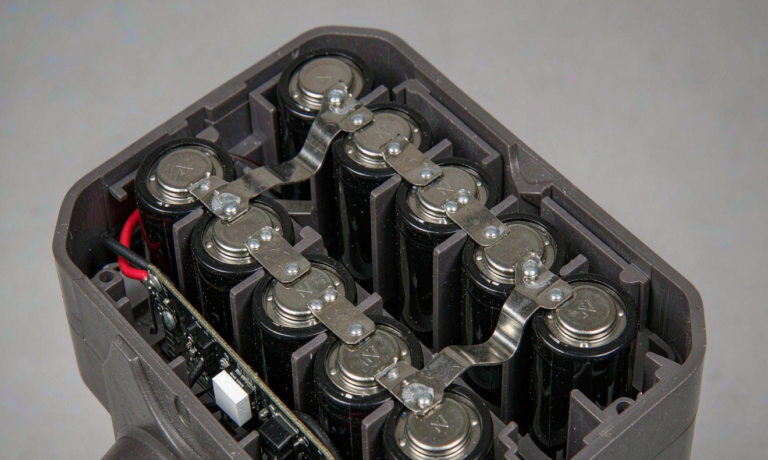
The electrical connection between cells is where packs live or die. In lithium battery pack manufacturing, the two common methods are nickel-strip spot welding for cylindrical cells and laser welding for busbars on prismatic modules. I have seen beautifully designed packs fail because a weld nugget was shallow and the joint micro-cracked after 200 thermal cycles.
- Weld validation: Require peel/pull test records (typically >50 N per weld for 0.2 mm nickel strip) on a per-lot basis.
- Busbar design: Verify current rating with margin—I design for 1.5× the continuous discharge and 3× the peak for <10 s.
- Thermal path: Potting, gap filler, or insulated metal substrate must be specified so heat from one cell does not cascade.
If your application is high-discharge, insist on a thermal runaway propagation test (the UL 2580 / GB 38031 style nail and oven tests). A pack that isolates a single fault instead of chain-failing is worth a premium.
BMS Integration and Firmware Validation
The battery management system is the brain, and lithium battery pack manufacturing is incomplete without validating it against the real pack, not a bench simulator. I review three things with every new supplier:
- Cell balancing: Passive balancing above 50 mA is adequate for LFP; active balancing matters when you mix aged modules.
- Protection thresholds: Overvoltage, undervoltage, overcurrent, and short-circuit cutoffs must be set for your chemistry. NMC tops out near 4.20–4.25 V/cell; LFP near 3.65 V/cell. A mis-set threshold silently caps your usable capacity.
- Communication: SMBus, CAN, or RS485 must be documented with a register map so your firmware team can integrate without reverse-engineering.
We once caught a supplier whose BMS reported SOC with a 12% error because the firmware used a generic NMC model on an LFP pack. That single oversight would have voided a fleet deployment. Firmware validation is not optional.
Certifications You Must Verify: UN38.3, IEC 62133, and Transport Rules
No B2B shipment of a Li-ion pack leaves the building without the right paperwork, and lithium battery pack manufacturing must be judged on certifications as much as on hardware. The core set I verify:
- UN38.3: Mandatory for air and sea transport. It covers altitude simulation, thermal, vibration, shock, external short, impact, overcharge, and forced discharge. Your MSDS and a UN38.3 test summary are required at the border.
- IEC 62133: The international safety standard for portable sealed secondary cells and batteries containing alkaline or non-acid electrolytes. For the US market, the equivalent is UL 2054 / UL 1642; for E-bike-style systems, UL 2271; for stationary, UL 1973 / UL 9540A.
- FAA / EASA transport rules: Spare and installed batteries follow strict state-of-charge and watt-hour limits. Packs above 100 Wh need operator approval; above 160 Wh are generally forbidden in passenger baggage. EASA and FAA align closely here, so one compliant declaration usually covers both.
- CE / FCC: For the BMS and any wireless comms so the pack clears EMC rules in the EU and US.
Request the actual certificate numbers and validate them with the test lab. Counterfeit certs are sadly common; a five-minute check saves a container stuck at customs.
Traceability, QA Documentation, and Factory Audit Checklist
The final pillar of trustworthy lithium battery pack manufacturing is traceability. Every pack we accept carries a serial that links to cell lot, weld parameters, BMS firmware version, and test results. When a field failure appears, we trace it in minutes instead of guessing.
Before committing volume, run this minimum audit:
- Cell incoming inspection and grading records for your lot.
- Weld pull-test and HIPOT/insulation resistance reports.
- Full charge/discharge formation and capacity grading data per pack.
- BMS functional test logs (protection, balancing, comms).
- Valid UN38.3, IEC 62133, and market-specific certificates.
- A documented corrective-action process (CAPA) for non-conforming units.
If a supplier resists sharing any of the above, treat it as a red flag. The best factories are proud to show their data because their process earns it.
Frequently Asked Questions
How do I verify a manufacturer actually uses Grade A cells?
Request the cell lot’s original mill certificate plus the supplier’s own incoming inspection and grading report. Cross-check the cell batch code with the cell maker’s system if possible, and ask for the DCIR and capacity bin ranges applied to your order. A trustworthy lithium battery pack manufacturing partner will provide lot-level data without hesitation.
What certifications are mandatory for shipping lithium battery packs by air?
At minimum you need a valid UN38.3 test summary and an MSDS, plus correct UN packaging and labeling per IATA/ICAO rules overseen by FAA and EASA. Above 100 Wh per pack, carrier approval is required; above 160 Wh, passenger-air transport is generally prohibited. Market safety marks like IEC 62133, UL 2054, or UL 1642 depend on your destination.
LFP or NMC — which chemistry should my lithium battery pack use?
Choose LFP when you prioritize cycle life, safety, and cost per cycle—ideal for stationary storage, industrial, and many robotics packs. Choose NMC when energy density and light weight dominate, such as long-endurance drones or portable medical devices. The right lithium battery pack manufacturing line should handle both, with chemistry-specific welding, BMS thresholds, and formation profiles.
How can I audit a battery pack factory without visiting on-site?
Start with a video walkthrough of the line, request digital QA records (grading, weld pull tests, formation data), and validate certificate numbers with the issuing labs. For volume programs, hire a third-party inspection (e.g., SGS or TÜV) for a pre-shipment audit. Process transparency is the real signal of manufacturing maturity.
At the end of the day, lithium battery pack manufacturing is a discipline of controlled variance. Verify the grading, the welds, the BMS validation, and the certifications—and you turn a risky purchase into a predictable, warranty-friendly supply line. That is the difference between a pack that merely powers your product and one that protects your brand.