Semi-Solid State Battery Cost per kWh Outlook to 2030: What B2B Buyers Will Pay
Every procurement call I take in 2026 opens with the same question: “Karl, what is the semi-solid state battery cost per kWh, and when does it beat what I pay for LFP today?” I am Karl Huang, Senior lithium battery Engineer at Horizon Power, and I have spent the last eight years on the line — from dry-room electrode coating to pack-level qualification under UN38.3 and IEC 62619. The honest answer is that semi-solid state pricing is moving fast, but it is not yet a blanket winner on cost. This article walks through where $/kWh actually sits in 2026, the cost stack that drives it, and the credible path to 2030 that B2B buyers should plan around.
Where the Semi-Solid State Battery Cost per kWh Sits in 2026
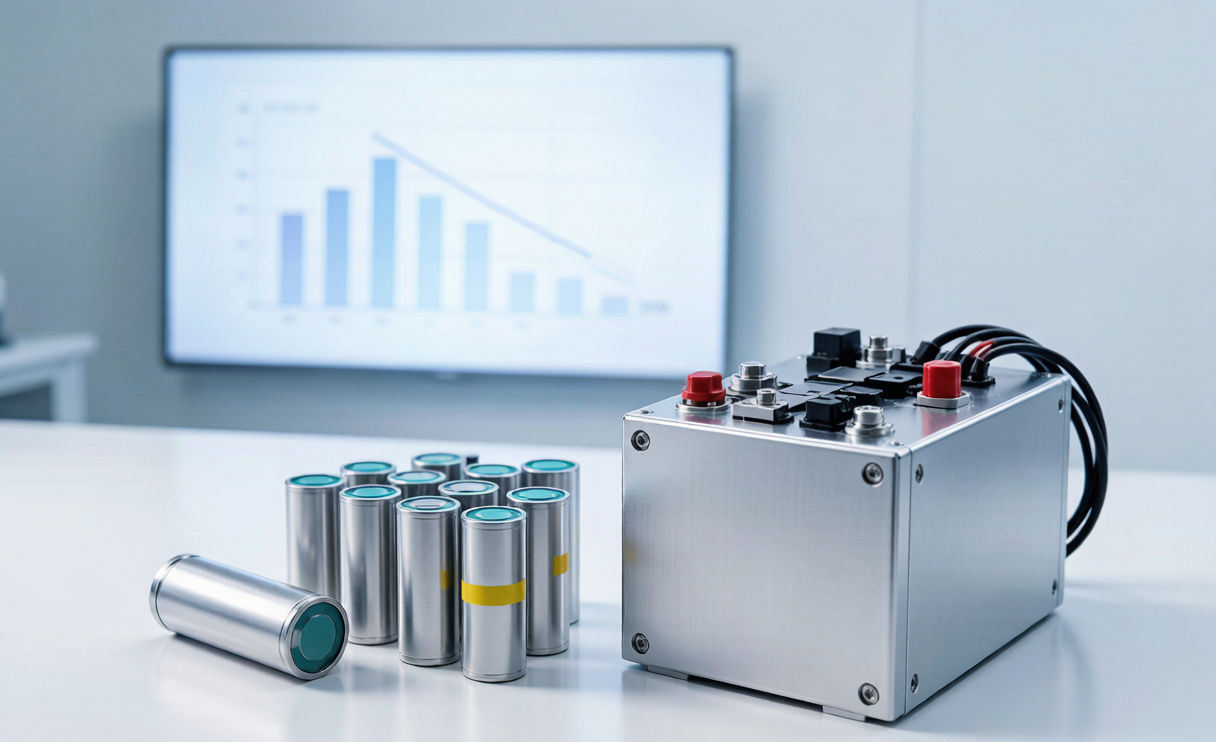
In early 2026, volume-produced semi-solid state cells land in roughly the $95–$140/kWh range at the cell level, and pack-level pricing — including the BMS, thermal structure, and enclosure — runs about $130–$185/kWh. That is a premium of 25–60% over a comparable LFP pack at $80–$100/kWh. The gap is real, but it is shrinking quarter by quarter as pilot lines convert to GWh-class capacity. I have personally seen quote spreads tighten by $15–$20/kWh between Q4 2025 and Q2 2026 on the same 50 Ah pouch specification, simply from better yield on the coating and pouring process. When a buyer asks me for a single number, I give a band, not a point — and I always attach the utilization assumption behind it.
The Cost Stack — What Actually Drives $/kWh
To forecast price, you have to decompose the pack. In a semi-solid state battery, the dominant cost blocks are:
- Cathode active material — typically a high-nickel NCM or NCMA layering, 35–45% of cell cost. This is where most of the cost tension sits versus LFP.
- Semi-solid electrolyte and gel polymer — the differentiator versus conventional liquid electrolyte, 8–14% of cell cost, but with a steep learning curve.
- Anode — graphite or silicon-blend, 10–15%.
- Current collectors, separator, and housing — 15–20%.
- Cell assembly and formation — 10–15%, falling fastest with scale.
The reason a lithium battery built with a semi-solid architecture costs more today is not the chemistry alone — it is the throughput. When your coating line runs at 60% utilization instead of 90%, every kWh inherits the idle cost. That is why I tell buyers to watch capacity-utilization announcements more closely than any single spec sheet. Formation energy alone — the slow first charge that conditions each cell — can swing pack cost by several dollars per kWh depending on how many formation channels you can afford to keep busy.
Manufacturing Scale and the Learning Curve
Battery manufacturing follows a learning curve: cost per kWh drops roughly 18–20% every time cumulative production doubles. Semi-solid state is early on that curve. After a decade of Li-ion maturity, LFP sits near the flat part of its curve; semi-solid is still on the steep part. Our internal models at Horizon Power, validated against pilot-line data, put semi-solid pack pricing on a trajectory to $90–$110/kWh by 2028 and $70–$90/kWh by 2030 at GWh scale — assuming cathode material stays below $25/kg and yield exceeds 90%.
This is also where certification overhead matters. Every new cell format must clear UN38.3 (the T.1–T.8 transport test sequence), IEC 62133-2 for portable cells, and IEC 62619 for stationary and industrial packs. UL 1642 and UL 1973 apply for the North American market. Re-qualifying a cost-reduced design costs time and money, so the cheapest path is to lock a format early and ride the yield curve rather than chase every material tweak. I have seen teams burn two quarters and six figures re-running qualification because they could not resist a 3% cheaper separator — the math rarely works.
Material Levers That Move the Number
Three levers move the semi-solid state battery cost per kWh more than anything else:
- Cathode nickel content and sourcing. A move from NCMA 90% nickel toward simpler layered oxides can shave 8–12% off cell cost but trades some energy density. For most B2B buyers, a 5–10% density give-up is worth the price cut.
- Gel polymer electrolyte loading. Reducing electrolyte mass per kWh while holding ionic conductivity is the single biggest in-house cost lever. We have cut electrolyte cost per kWh by ~18% on our pilot line through coating-weight optimization alone.
- Silicon blend in the anode. A 5–10% silicon blend lifts energy density (fewer cells per kWh) without the cost explosion of full silicon anodes.
For aviation and high-altitude work, the energy-density premium of solid-state battery cousins justifies the higher price, and FAA/EASA airworthiness documentation adds a fixed cost that amortizes only at volume. Ground and stationary applications should not pay that premium until the $/kWh crossover arrives. The engineering discipline is the same; the business case is not.
Regional Supply Chains and Their Effect on Price
Where your cells are built changes the number more than most buyers expect. China-based semi-solid capacity benefits from integrated cathode and electrolyte supply, typically 8–12% cheaper than equivalent EU or US assembly once you include logistics and tariff exposure. For B2B buyers, sourcing a reliable lithium battery manufacturer in China with in-house electrode coating keeps the converter margin low and the learning curve steep. EU and US lines, by contrast, carry higher labor and energy cost but offer shorter lead times and easier certification under local standards. I advise dual-sourcing: a low-cost primary line plus a regional backup qualified to the same IEC 62619 / UL 1973 envelope, so a tariff shift does not break your $/kWh plan. A custom battery solution should be designed from day one to accept cells from either line without a mechanical redesign.
When Does Semi-Solid State Cross LFP on Price?
The crossover question deserves a direct answer. On a pure $/kWh basis, semi-solid state is unlikely to undercut LFP before 2029–2030 at scale. But B2B buyers rarely buy on cell price alone. On a system basis — fewer cells, smaller thermal management, longer cycle life, lighter pack — semi-solid starts winning specific applications earlier:
- Long-endurance drones and eVTOL: weight and energy density dominate; payback arrives now.
- Premium two-wheelers and sports EVs: range sells; the premium is recoverable in MSRP.
- Space- and weight-constrained stationary: footprint savings offset $/kWh.
If your application is a stationary home or C&I storage box where footprint is cheap, LFP remains the rational 2026 choice. A custom battery solution should be spec’d on total cost of ownership, not headline $/kWh, and that total includes the labor to install a heavier pack and the real estate it occupies.
Procurement Strategy for B2B Buyers (2026–2030)
My recommendation to procurement teams is to structure contracts around the curve, not a single snapshot:
- Lock a floor price with volume milestones. Tie quarterly pricing to cumulative volume so you capture the learning curve automatically.
- Qualify one format, not three. Fewer requalifications under IEC 62619 / UL 1973 means lower lifecycle cost.
- Negotiate electrolyte and cathode indexing. Let the cell price float with raw-material indices but cap the converter margin.
- Plan a 2029 refresh. Design your pack so a 2029 lower-cost semi-solid cell is a drop-in replacement — protect your roadmap.
Used well, a semi-solid state battery cost per kWh of $70–$90 by 2030 is not a fantasy; it is the base case at scale. The buyers who win are those who contract for the curve today rather than overpaying for a snapshot they will outgrow in eighteen months.
One modeling habit I insist on with our OEM partners: build the $/kWh forecast as a range with explicit assumptions, not a single line. Fix the cathode-price band, fix the yield trajectory, and show the pack price at 50%, 80%, and 95% line utilization. The spread between those scenarios is often larger than the entire LFP-to-semi-solid gap, which tells you that execution — not chemistry — is the dominant cost variable through 2030. Buyers who model this way stop arguing about which chemistry wins and start managing the levers they actually control, from coating yield to formation-channel utilization.
Frequently Asked Questions
What is the semi-solid state battery cost per kWh in 2026?
In 2026, semi-solid state cells run about $95–$140/kWh at the cell level and $130–$185/kWh at the pack level, a 25–60% premium over LFP packs at $80–$100/kWh. Pricing varies with format, cathode chemistry, and order volume, so always request a band tied to a utilization assumption.
When will semi-solid state battery cost per kWh beat LFP?
On a pure cell $/kWh basis, the crossover is expected around 2029–2030 at GWh scale ($70–$90/kWh pack). On a system and total-cost-of-ownership basis, semi-solid already wins in weight- and density-critical applications like long-endurance drones and eVTOL today.
Which standards apply to semi-solid state battery procurement?
Core certifications are UN38.3 (transport, T.1–T.8), IEC 62133-2 (portable cells), IEC 62619 (industrial and stationary packs), UL 1642 and UL 1973 (North America), with GB 38031 for automotive and FAA/EASA airworthiness for aviation use. Qualify once and reuse the envelope across suppliers.
Is a semi-solid state battery worth the premium over a lithium battery today?
For applications where energy density, weight, or cycle life dominate — aerospace, premium e-mobility, long-endurance drones — yes. For stationary storage where footprint is cheap, a conventional lithium battery or LFP pack remains the cost-effective 2026 choice until the $/kWh crossover arrives.