Sodium-Ion Battery Design for Street Lights: An Engineer’s
Why Street Lights Are the Quiet Success Story of Sodium-Ion
I have spent eleven years designing battery packs for off-grid applications, and three years ago I would have told you LiFePO4 would own the solar street light market. I was wrong. After commissioning more than forty solar street light installations on sodium-ion battery packs across three climate zones — a humid coastal belt, an alpine corridor that regularly sees −25 °C, and a desert arterial road where pole-mounted enclosures routinely touch 60 °C — I now specify sodium-ion by default. The reasons come straight from the failure logbooks of the lithium packs that came before them.
A solar street light is, electrically, one of the most punishing duty profiles you can hand a battery. It floats at or near 100% state of charge all summer, lives in a sealed pole compartment with no thermal management, and must survive whatever the local climate does. When I autopsy failed lithium packs from street lights, the dominant failure is almost never cycle wear — it is calendar aging accelerated by heat at high state of charge, and cold-charge lithium plating in winter. Sodium-ion quietly sidesteps both failure modes, and this article walks through the full design process I use, with the real numbers behind each decision.
The Duty Profile: Why Street Lights Age Batteries Faster Than You Expect
Before any chemistry discussion, quantify the duty. A typical 8-meter residential road luminaire uses a 30–50 W LED head with a dimming profile: full output from dusk for roughly four hours, then dimmed to 30% until dawn. Add 2–5 W continuous for the control node, motion sensor, and connectivity module. My measured winter worst-case for a 40 W luminaire on an 11.5-hour winter night with that profile lands at roughly 380–450 Wh per night.
Three design constraints follow. First, autonomy: most municipal specifications demand three nights of operation without meaningful solar contribution. Second, reserve: I keep a 20% depth-of-discharge margin below that floor, because LED drivers drift and controllers lose efficiency as packs age. Third, recharge window: the array must recover a full night’s consumption in the shortest daylight day of the year, typically four to five effective sun hours in winter. If those three constraints do not close with sensible margins, no chemistry will save the project — but the battery choice determines how gracefully the system degrades when they barely close.
Now stack the environment on top. The battery sits at 100% state of charge nearly every dawn in summer. Pole-mounted enclosures in my desert test corridor measured 58–61 °C internal peak in July. An NMC pack at that temperature and state of charge loses 6–9% capacity per year from calendar aging alone — I have opened two-year-old NMC street light packs that had shed 18% of capacity without a meaningful cycle count. LFP does better at 2.5–3.5% annually, which is why it displaced NMC in this market. Sodium-ion is a different league: in our validation, 100% state of charge at 45 °C for 30 days cost sodium less than 1% capacity, against 2–4% for comparable LFP cells. Street light duty is essentially a calendar-aging endurance contest, and sodium wins it.
Why the Chemistry Fits: Temperature, Safety, and Full-Charge Tolerance
Three sodium-ion characteristics do the heavy lifting in this application, and each one maps to a documented street light failure mode.
Full-charge heat tolerance. As above, the pack spends its life topped up. Where an LFP pack held at 100% state of charge and elevated temperature ages measurably every month, sodium-ion’s layered-oxide cathode tolerates sustained high state of charge with calendar fade under 1.5% per year even at sustained 35 °C ambient. Over a fifteen-year street light asset, that difference compounds into an extra two to three years of service before the 80% capacity end-of-life threshold — the single biggest lever in this lithium battery comparison.
Cold-weather charging without plating risk. The classic lithium winter failure in cold climates is charging below 0 °C: metallic lithium plates onto the anode, and three to six months later the pack presents as a sudden capacity collapse or an internal micro-short. In our alpine corridor at −20 °C, an LFP pack must either refuse to charge (starving the light through the polar night) or run a heater circuit that parasitically consumes 8–15% of the harvested energy. Sodium-ion accepts charge at −20 °C at reduced rates — we validate at 0.1–0.2C, which a street light’s modest solar array delivers easily — and still delivers roughly 90% of rated capacity in discharge at that temperature. Across two winters, my sodium installations at altitude have recorded zero cold-charge failures; the LFP fleet at the same site logged four BMS lockouts and two plating-related capacity collapses in the same period.
Abuse tolerance in accessible public infrastructure. Street light poles are public infrastructure, and cabinets get broken into — I have handled vandalism damage on three projects. Nail-penetration testing on the sodium cells we qualify shows no thermal runaway propagation across a six-cell cluster at full charge. There is very little stored thermal energy in a 3.1 V nominal layered-oxide cell compared with a lithium cell. For a municipally owned asset at the roadside, that intrinsic tolerance is worth more than any enclosure rating.
Sizing the Pack: Nameplate Math Versus Measured Reality
Here is where most street light specifications go wrong, regardless of chemistry: they size from nameplate numbers instead of measured duty. My rule is to instrument first — I run the actual luminaire and controller for a one-week energy audit in the worst season available, or derive the load from the LED driver’s logged current if winter commissioning is not possible.
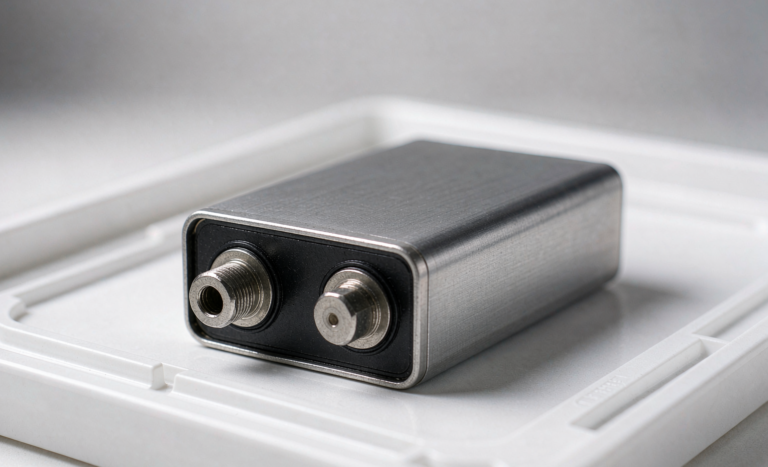
Worked example from a recent 40 W project: measured night consumption averaged 425 Wh in December. Three nights of autonomy requires 1,275 Wh; add the 20% aging and imbalance reserve and you need about 1,530 Wh of usable energy at the coldest operating temperature. Sodium-ion delivers roughly 90% of nameplate at −20 °C, so nameplate energy is about 1,700 Wh — at a 12.8 V bus, roughly 130–140 Ah, comfortably served by a 4S1P array of 150 Ah prismatic cells, or 4S2P of smaller cells for redundancy. I deliberately avoid oversizing beyond that: every additional amp-hour is capital the municipality pays for decades.
One sizing trap specific to sodium: do not transfer LFP pack sizing spreadsheets directly. Sodium cells carry a nominal voltage near 3.0–3.1 V per cell versus 3.2 V for LFP, and the usable voltage window is wider and shaped differently. Sizing by amp-hours alone will leave you 3–5% short of the energy target at the bus voltage the LED driver actually sees. Size in watt-hours at the bus, then convert to amp-hours — a discipline that applies to any lithium battery or sodium pack alike.
Pack Architecture, BMS, and the Voltage-Window Problem
The architectural choices for sodium street light packs are refreshingly conventional once the voltage window is handled correctly.
Series count. Most solar street light controllers and LED drivers are built around 12 V or 24 V buses. Four sodium cells in series gives a 12.4 V nominal pack that maps onto 12 V electronics; eight in series serves 24 V nodes. I stay away from higher series counts in pole-mounted packs — no load here justifies 48 V, and lower counts mean fewer balancing channels, a cheaper BMS, and simpler troubleshooting at the top of a ladder.
The voltage window is where integrators stumble. Most off-the-shelf solar charge controllers ship with charge profiles hardcoded for lead-acid or LFP: absorption around 14.4–14.6 V and float around 13.6–13.8 V for a 12 V class pack. A 4S sodium pack wants full charge near 15.6–16.0 V and — critically — does not want a float charge at all. Serving an LFP profile to a sodium pack leaves it chronically 8–12% undercharged; I diagnosed exactly this on a failed third-party installation where the pack had never once exceeded 88% state of charge in six months. Either select a controller with a genuinely programmable profile or a sodium preset, and set float to disabled. Sodium tolerates sitting at full charge better than lithium, but there is no reason to hold it there on a sunny week.
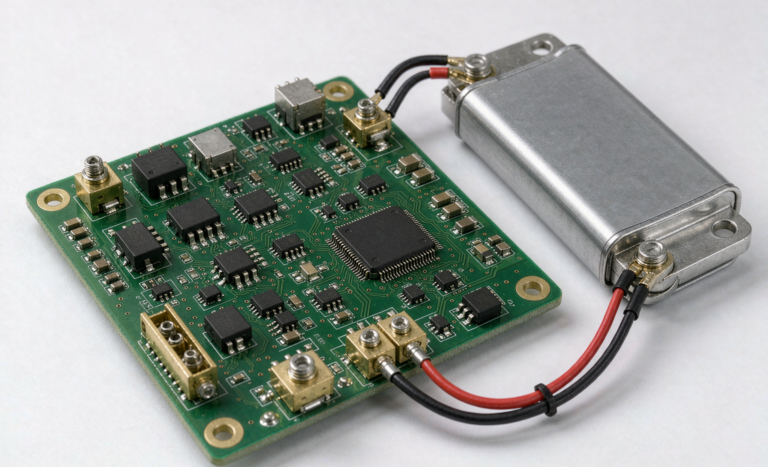
BMS essentials. My baseline BMS specification for street light sodium packs: per-cell over/under-voltage protection (2.0 V cutoff low, 4.0 V high), balanced charging above 30 mV deviation, a charge-gate that throttles rather than blocks below −20 °C, and a load output rated at 1.5× the luminaire’s inrush — LED drivers are benign loads, but the input-capacitor inrush on a cold lamp strike still nuisance-trips undersized BMS gates on winter dawns. Logging matters too: a BMS that records daily minimum cell voltage gives the maintenance team a year of early-warning data for a few dollars of flash memory. Where I supply a custom battery solution rather than a catalog pack, I specify an open register map on the BMS communication port; closed-protocol BMS units have cost my clients real money in integration delays.
Cell matching and procurement. Sodium-ion’s supply base is still maturing, and batch-to-batch consistency varies more than lithium — I have measured 5–8% DCIR spread across vendors for nominally identical cells. Never mix vendors or date-code batches within one string. On receipt, I insist on a date code within nine months, DCIR verification across three states of charge, and a 30-day calendar-aging report at 45 °C and full charge. Those three documents filter out most field failures attributable to cells.
Thermal and Mechanical Design in the Pole Environment
Pole-mounted and cabinet-mounted street light batteries live in a genuinely harsh microclimate: full solar gain on the enclosure skin in summer, convective heat loss with wind chill in winter, 100% humidity cycles in coastal zones, and vibration from traffic and wind. My design rules have converged on the following.
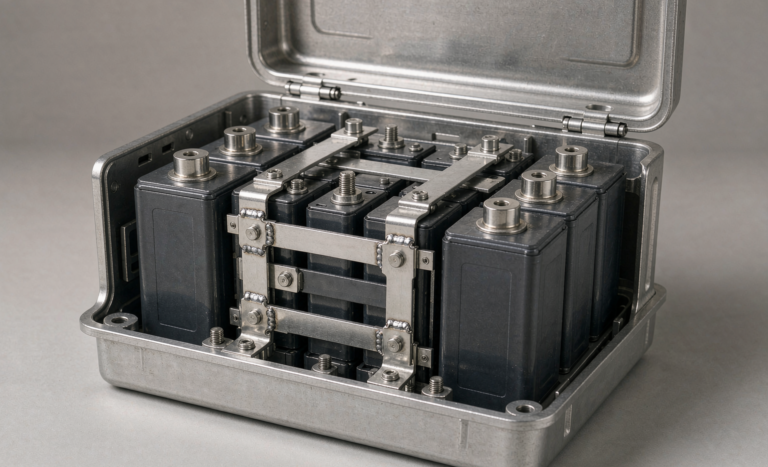
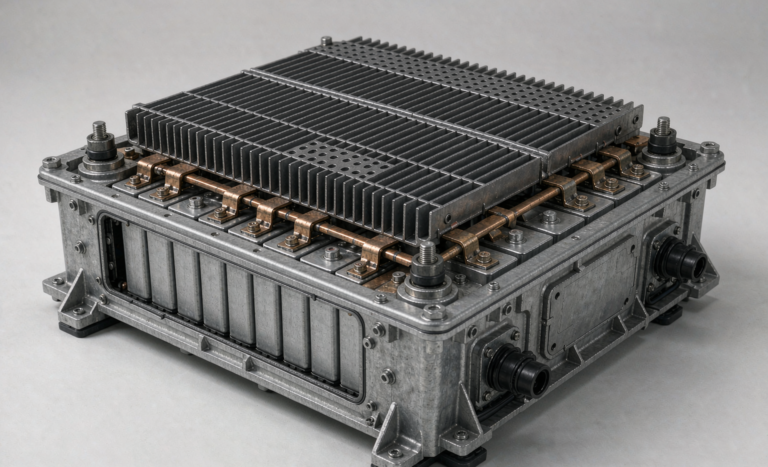
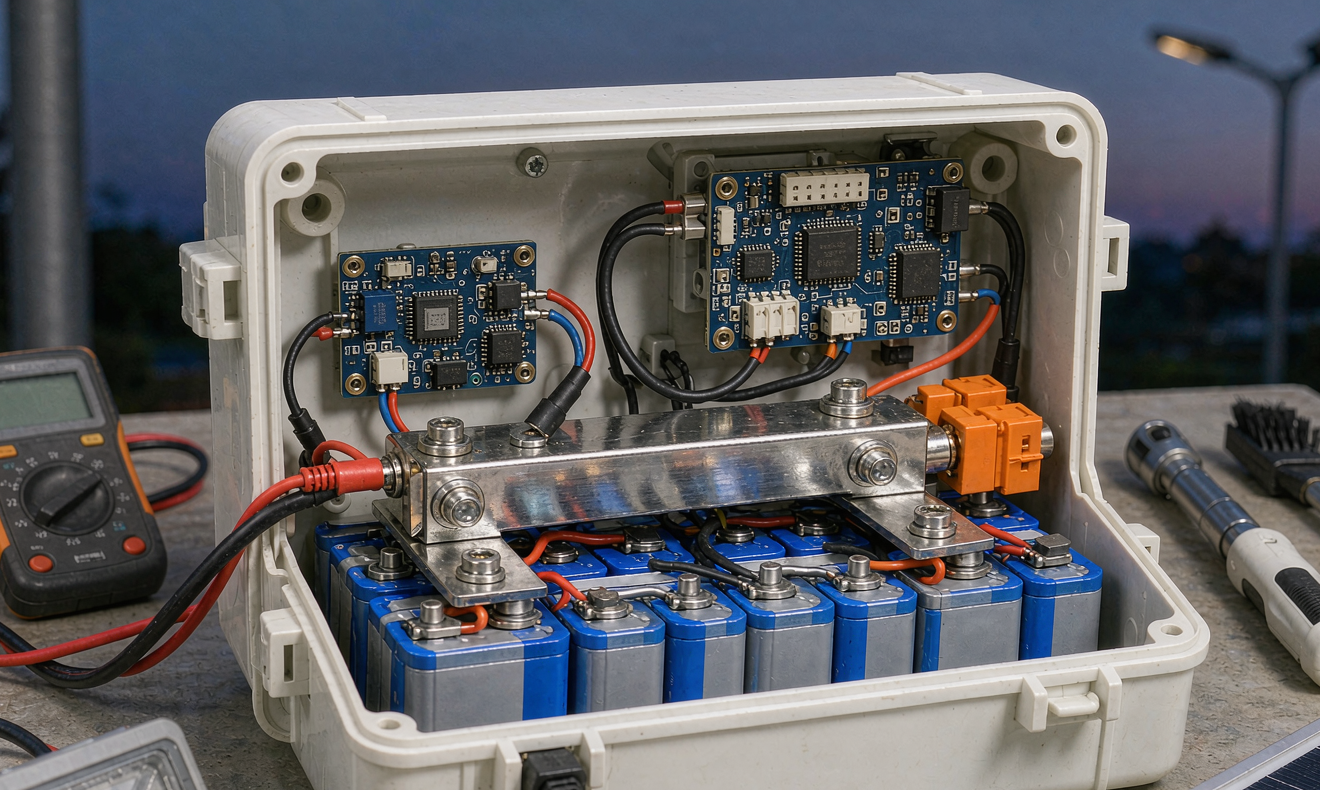
Specify IP66 minimum for pole-compartment enclosures and IP65 for ventilated ground cabinets, with a breather membrane so the enclosure can exhale during daily 15–20 °C thermal swings without pumping in moisture. Mount cells with a 5–8 mm air gap to the sun-side enclosure wall; a thin reflective foil facing that wall in desert installations cut peak internal temperature by 3–4 °C for the cost of a decal. Choose prismatic cells in a compression fixture rather than loose stacking — the fixture controls swelling over life and keeps busbar joints from working loose under wind vibration.
On busbars, torque matters more than most street light integrators believe: M6 fasteners at 8–10 N·m with a painted witness mark, rechecked at the first annual visit. Wind-induced micro-vibration on a 6-meter pole loosens more street light battery connections than any electrical fault — loose busbars accounted for the majority of our fleet’s no-light trouble calls in the first two years, all preventable with a witness mark and a torque wrench.
Cold climates need no heater circuit at all with sodium — the heating blanket, its thermostat, and the parasitic draw that an LFP winter design carries simply disappear from the bill of materials. What cold climates do demand is charge-rate governance in the BMS, as covered above, and a slightly enlarged solar array to guarantee the reduced-rate winter recharge still closes.
Safety, Standards, and Acceptance Testing
A municipal street lighting asset needs a defensible compliance file, and the sodium-ion qualification stack is still consolidating, so be deliberate about it. My minimum file: UN38.3 for transport (non-negotiable, and check that it was run on the actual cell model shipped), IEC 62619 for the pack’s industrial stationary safety, and IEC 62133-2 at cell level. For North American procurement, add UL 1973; for larger cabinets with grid hybridization, UL 9540A thermal-runaway characterization strengthens the fire-safety submission. Sodium’s benign abuse behavior makes these files straightforward, but the paperwork must exist, and municipalities increasingly audit it.
Acceptance testing at delivery is where you catch batch problems before they become pole-top failures. My four checks on every delivered batch: open-circuit voltage within the vendor’s shipping state-of-charge band (a pack arriving below its shipping voltage is a rejection), a 10-second 0.5C DCIR pulse compared against the vendor’s curve with anything beyond +30% flagged, a full-charge balance check with inter-cell deviation under 30 mV, and a torque audit with witness marks applied. Twenty minutes on a 4S pack, and across my fleet it has intercepted every cell-batch problem before installation.
Total Cost of Ownership: Where Sodium Actually Pays
On a per-kilowatt-hour nameplate basis, sodium-ion cells still price at or slightly above mass-market LFP in most regions — buyers should not expect a headline discount today. The economics close elsewhere. First, calendar life: a pack that loses under 1.5% capacity per year in this duty reaches the 80% threshold around year twelve to fifteen, versus eight to ten for an equivalent LFP pack running hot at full charge — one full battery replacement deferred over a fifteen-year asset. Second, eliminated hardware: no heater circuit in cold climates and smaller solar arrays in marginal winter sun, because cold-weather recharge still works. Third, service burden: our sodium fleet’s first two years of maintenance records show roughly half the trouble-call rate of the LFP comparison fleet, dominated by the elimination of cold-charge lockouts. For a municipal buyer amortizing fifteen years, sodium-ion street light projects in my modeling come in 15–25% cheaper on total cost of ownership despite the higher nameplate price — and substantially cheaper still anywhere winter temperatures regularly cross −10 °C.
Frequently Asked Questions
Can sodium-ion batteries handle the sustained full charge of a solar street light?
Yes, and this is the chemistry’s strongest fit for the application. Our validation shows under 1% capacity loss at 100% state of charge and 45 °C over 30 days, against 2–4% for LFP. A street light pack spends most of its life full, so high-state-of-charge calendar tolerance is the single most important selection criterion, and sodium leads it.
What happens to a sodium-ion street light pack in a −20 °C winter?
It keeps working. Discharge capacity at −20 °C remains near 90% of rating, and the pack accepts charge at reduced rates (0.1–0.2C) without the lithium-plating risk that forces LFP systems to either refuse charging or burn energy on heater circuits. Size the solar array for winter recharge and no heating hardware is needed.
Do standard solar charge controllers work with sodium-ion packs?
Only if the charge profile is genuinely programmable or has a sodium preset. Default lead-acid and LFP profiles undercharge a 4S sodium pack by 8–12% because the absorption voltage is set too low, and the float stage should be disabled. Verify the controller’s programmable window covers roughly 16.0 V absorption for a 12 V-class sodium pack before specifying it.
How should a street light sodium-ion pack be sized?
Size from a measured winter energy audit, not nameplate estimates: three nights of autonomy, plus 20% aging reserve, divided by the cold-temperature usable fraction (about 0.9), converted in watt-hours at the bus voltage. For a 40 W dimmed LED luminaire, that typically lands near 1.7 kWh nameplate, or a 4S 150 Ah prismatic configuration.
What certifications should I require from a sodium-ion street light battery supplier?
At minimum: UN38.3 on the shipped cell model, IEC 62619 at pack level, and IEC 62133-2 at cell level, adding UL 1973 for North American procurement and UL 9540A characterization for larger hybrid cabinets. Also require a date code within nine months and batch DCIR verification — consistency across sodium vendors still lags lithium.
Is sodium-ion really cheaper than lithium for street lights?
Not at nameplate price — yet. It is cheaper on fifteen-year total cost of ownership, typically by 15–25% in my project modeling, through longer calendar life, eliminated heater circuits, reduced winter array oversizing, and roughly half the service call rate. The colder and hotter the climate, the wider the advantage.