Sodium-Ion Battery Hard Carbon Anode
As Karl Huang, Senior lithium battery Engineer at Horizon Power, I get asked one question more than any other about sodium-ion technology: “If sodium is so cheap and abundant, why did it take so long to reach the market?” The honest answer sits inside the anode. A sodium ion battery cannot simply copy the graphite anode that made lithium-ion a trillion-dollar industry, because sodium ions are simply too large to fit where lithium goes. The workaround that finally made sodium-ion commercially real is hard carbon, and in this article I will explain what it is, how it stores sodium, and what the numbers mean for you as a buyer or product designer.
Why Sodium-Ion Needs a Different Anode Than Lithium
The core problem is geometry. A lithium ion has an ionic radius of about 0.76 Å. A sodium ion is noticeably bigger at roughly 1.02 Å. Graphite, the standard anode in virtually every lithium-ion lithium battery, stores lithium by slipping ions between neatly stacked graphene sheets — the famous stage-1 intercalation that delivers about 372 mAh/g. Sodium tries to do the same thing and the structure simply refuses. The graphite interlayer spacing (~0.335 nm) is too tight, and sodium barely intercalates, yielding only around 30–35 mAh/g. That is a non-starter for any product.
This is why a sodium-ion battery lives or dies by its anode material. The industry settled on hard carbon precisely because its disordered, “turbostratic” structure leaves gaps and closed nanopores that sodium can occupy. In my lab, the difference is dramatic: swap a graphite anode for a good hard carbon anode in an otherwise identical cell, and usable capacity jumps roughly tenfold. Hard carbon is the reason sodium-ion moved from journal papers to shipping containers.
What Hard Carbon Actually Is
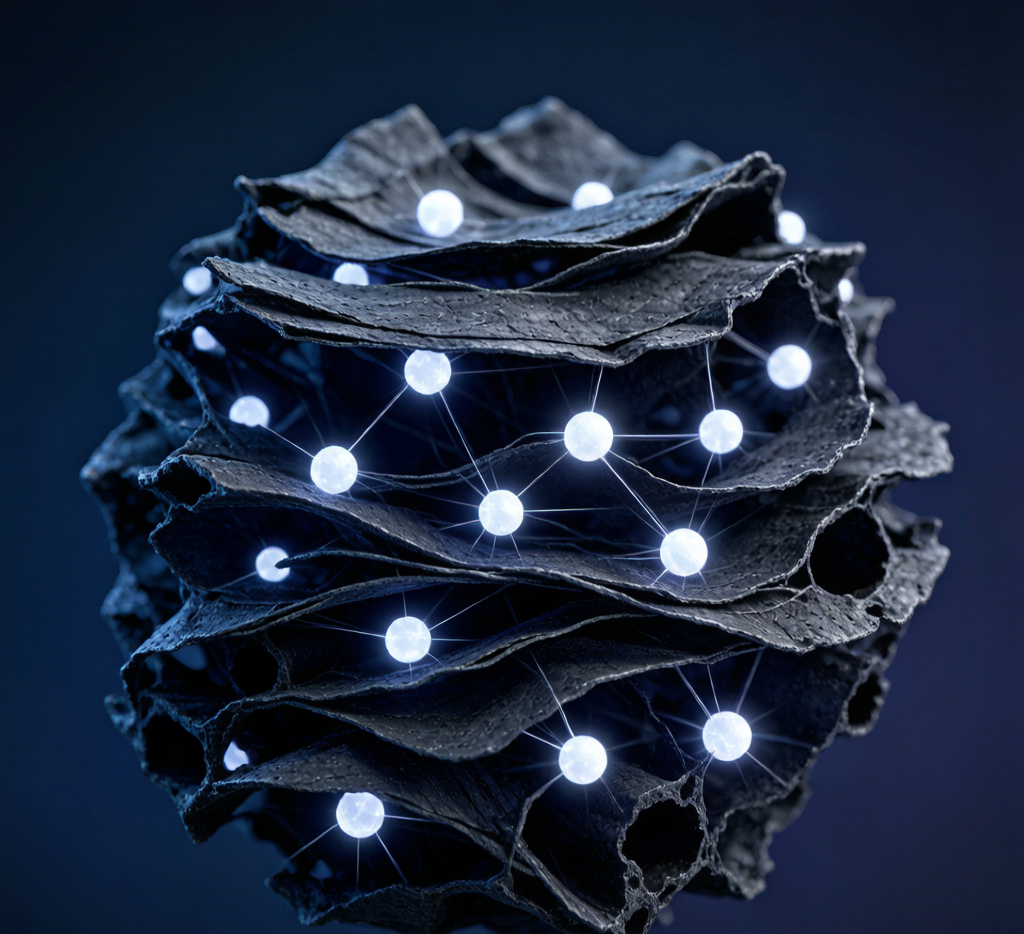
Hard carbon — sometimes called non-graphitizable carbon — is a carbon form that, even when heated to high temperature, refuses to crystallize into ordered graphite. We make it by pyrolyzing precursor materials such as biomass (coconut shell, straw, wood), coal-tar pitch, or engineered polymers at roughly 1000–1500 °C in an inert atmosphere. The result is a tangled, layered architecture: short graphene-like sheets stacked at random angles, with voids, curved layers, and sealed internal nanopores in between.
That disorder is the feature, not the bug. The randomly oriented layers and the closed pores create storage sites that do not exist in ordered graphite. The quality of the hard carbon — its specific surface area, pore size distribution, and the degree of graphitization — is set almost entirely by the precursor and the heat-treatment temperature. I tell every procurement team the same thing: two “hard carbon” datasheets that look identical on paper can behave very differently in a cell, because the microstructure is everything.
How Sodium Stores in Hard Carbon: Intercalation vs Pores
If you plot sodium-ion anode voltage against capacity, you see a characteristic shape with two regions, and understanding them tells you a lot about real-world performance. The first region is a sloping curve at higher voltage (roughly 0.1–1.2 V vs Na+/Na), where sodium adsorbs onto defective sites, pore surfaces, and the edges of the carbon layers. The second region is a long, flat plateau near ~0.1 V, where sodium intercalates between the disordered graphene sheets and fills the closed nanopores.
In practice, the low-voltage plateau delivers the bulk of the reversible capacity — often 200 mAh/g and up — while the sloping region contributes a smaller but still useful share. A well-designed hard carbon for a sodium-ion battery will give 250–350 mAh/g of reversible capacity, with the closed-pore “fill” mechanism being the active research frontier that is steadily pushing those numbers higher. The exact split between adsorption and intercalation also dictates the cell’s voltage curve, which matters when you are matching the battery to a DC-DC converter or an inverter.
Hard Carbon Performance Numbers Buyers Should Expect
Let me put real figures on the table, because buyers should be quoting these in RFQs. A good hard carbon anode delivers:
- Reversible capacity: 250–350 mAh/g, versus ~30–35 mAh/g for graphite with sodium.
- First-cycle efficiency: typically 80–90%, limited by solid-electrolyte-interphase (SEI) formation that consumes sodium irreversibly on the first charge.
- Rate capability: hard carbon generally handles moderate C-rates well; high-rate designs need tuned pore structures and thinner coatings.
- Cycle life: competitive anode-level stability, with full sodium ion battery cells now demonstrating thousands of cycles at the pack level.
The first-cycle efficiency point deserves attention. Because sodium is consumed building the SEI, the cell needs a sodium surplus — often supplied by a slightly sodium-rich cathode or a sacrificial additive. If a vendor’s hard carbon shows very high capacity but poor first-cycle efficiency, the effective, deliverable energy may be lower than it looks. I always qualify anode candidates on usable capacity after formation, not the headline number.
Manufacturing Hard Carbon Anodes for Sodium-Ion
Here is the good news for scaling: hard carbon anodes are made on the same coating lines used for lithium-ion. We mix hard carbon powder with a binder and solvent into a slurry, coat it onto a current-collector foil, dry it, calender it to the target density, and slit it. The process is familiar to any lithium lithium battery factory.
One elegant cost advantage: sodium does not alloy with aluminum at low potential the way lithium attacks copper. That means a sodium-ion battery can use inexpensive aluminum foil as the anode current collector instead of copper. Across millions of square meters of electrode, that is a real material saving on top of the cheap sodium raw material. In our pilot lines we routinely run hard carbon on Al foil without the corrosion headaches copper collectors avoid but cost more to buy. For buyers, it is a quiet reason sodium-ion packs can undercut lithium on price at scale.
Hard Carbon vs Graphite: The Real Tradeoffs
It is tempting to frame this as hard carbon versus graphite, but the honest comparison is about the whole cell. Hard carbon gives lower anode energy density than graphite (250–350 vs 372 mAh/g), and a sodium-ion cell runs at a lower average voltage (~3.1–3.3 V vs ~3.6–3.7 V for NMC lithium). So on a pure watt-hour-per-kilo basis, sodium-ion with hard carbon trails lithium iron phosphate and NMC.
What hard carbon buys you is different. Sodium raw material is abundant and geopolitically stable compared with lithium, nickel, and cobalt. Hard carbon from biomass is cheap and sustainable. And sodium chemistry shows genuinely better low-temperature behavior, because sodium ions desolvate more easily than lithium ions, so the cell keeps delivering capacity at -20 °C and below where lithium packs sag. For stationary storage, e-mobility in cold regions, and cost-sensitive volume products, that tradeoff is often exactly right.
Where Hard Carbon Anode Cells Win in the Field
At Horizon Power we see hard carbon anode sodium-ion cells gaining fastest in applications where cost and cold tolerance beat peak energy density:
- Stationary and residential storage — weight is irrelevant, price and safety dominate.
- Cold-climate and off-grid systems — sodium’s low-temperature edge keeps banks alive through harsh winters.
- Low-speed e-mobility and e-bikes — volume pricing matters more than range per kilogram.
- Telecom and backup — long idle periods and temperature swings suit sodium’s stability.
None of these need the absolute energy density of a premium lithium battery. They need a pack that is cheap to build, safe to ship, and predictable for a decade. Hard carbon anode sodium-ion is purpose-built for that profile.
Standards, Safety and What It Means for Buyers
Because a sodium ion battery is still a high-energy cell, transport and safety compliance are not optional. Every pack we ship must pass UN38.3, the international test manual covering altitude simulation, thermal, vibration, shock, external short circuit, impact, overcharge, and forced discharge — the baseline for air and ground shipment worldwide under IAVTA and IATA/ICAO rules. For the cells themselves, IEC 62133-2:2017 remains the reference for safety of portable secondary lithium cells and batteries, and sodium-ion cells are increasingly qualified against the same abuse-test philosophy as lithium.
On the standards front, sodium-ion is maturing fast: China’s GB/T traction-cell standards and the evolving IEC 62660 family already cover sodium cells in many practical respects, and dedicated sodium-ion safety and performance standards are converging through 2025–2026. My advice to buyers is to require UN38.3 passage and a documented cell-level abuse test report in every RFQ, and to confirm the specific standard your target market recognizes. A certified sodium-ion battery with a hard carbon anode is a finished, shippable product — not a laboratory curiosity.
Frequently Asked Questions
Why can’t a sodium-ion battery just use graphite like lithium-ion?
Sodium ions are too large (~1.02 Å vs 0.76 Å for lithium) to intercalate into graphite’s tight interlayer spacing. Graphite stores only about 30–35 mAh/g with sodium, versus ~372 mAh/g with lithium. Hard carbon’s disordered structure with nanopores is what actually stores sodium at useful capacity.
What capacity does hard carbon deliver as a sodium-ion anode?
A good hard carbon anode provides roughly 250–350 mAh/g of reversible capacity, with the low-voltage plateau (sodium filling closed nanopores and intercalating between layers) supplying most of it. First-cycle efficiency typically lands at 80–90% because some sodium is spent forming the SEI.
Is hard carbon more expensive than graphite?
Usually less. Hard carbon can be made from low-cost biomass or coal-tar pitch precursors, sodium raw material is abundant and cheap, and a sodium-ion cell can use aluminum instead of copper as the anode current collector. At volume, that combination undercuts lithium anode cost.
Does a hard carbon anode handle cold weather better?
Yes. Sodium ions desolvate more easily than lithium ions, so hard carbon anode sodium-ion cells retain more capacity at -20 °C and below, where lithium packs lose significant range. This is a key reason sodium-ion is attractive for cold-climate and off-grid storage.
What certifications should I require for a sodium-ion battery with hard carbon?
At minimum, UN38.3 for transport and a documented cell-level safety/abuse test aligned with IEC 62133-2 and the emerging sodium-specific IEC 62660-family and GB/T standards. Confirm which standard your target market (EU, US, China) officially recognizes before procurement.