Sodium-Ion Battery Supply Chain Security: An Engineer’s
When people ask me why Horizon Power keeps investing in sodium-ion alongside lithium, I usually point at the map before I point at the spec sheet. A sodium-ion battery does not need lithium, cobalt, or nickel. That single fact removes the three raw materials that keep most energy-storage supply chains awake at night. But “no cobalt” does not mean “no risk.” After running material qualification for several sodium-ion programs, I can tell you the real exposure sits elsewhere — in hard carbon, in sodium carbonate purity, and in a supplier base that is still thin compared with the mature lithium world. This guide walks through how we engineer sodium-ion battery supply chain security, from mine to cell, with the same discipline we apply to UN38.3 and IEC 62133 compliance.
Why Sodium-Ion Changes the Supply Chain Equation
The headline advantage of sodium-ion is resource geography. Lithium, cobalt, and nickel are concentrated in a handful of countries, and their prices swing with policy as much as with demand. Sodium is everywhere — it is the sixth most abundant element in the Earth’s crust, and sodium chloride, ordinary salt, is a cheap, stable, globally available feedstock. For a battery manufacturer, that means the raw material for the cathode and the electrolyte salt is effectively commodity-priced and domestically producible in most industrial regions.
In one industrial program I supported, switching the stationary storage cells from LFP to a sodium-ion battery chemistry cut the bill-of-materials exposure to geopolitically sensitive minerals from four down to zero. The cell cost did not drop overnight, because the manufacturing process and the hard carbon anode still carry real cost, but the supply risk profile changed completely. That is the point: supply chain security is about variance and continuity, not just unit price.
The Core Raw Materials and Where They Come From
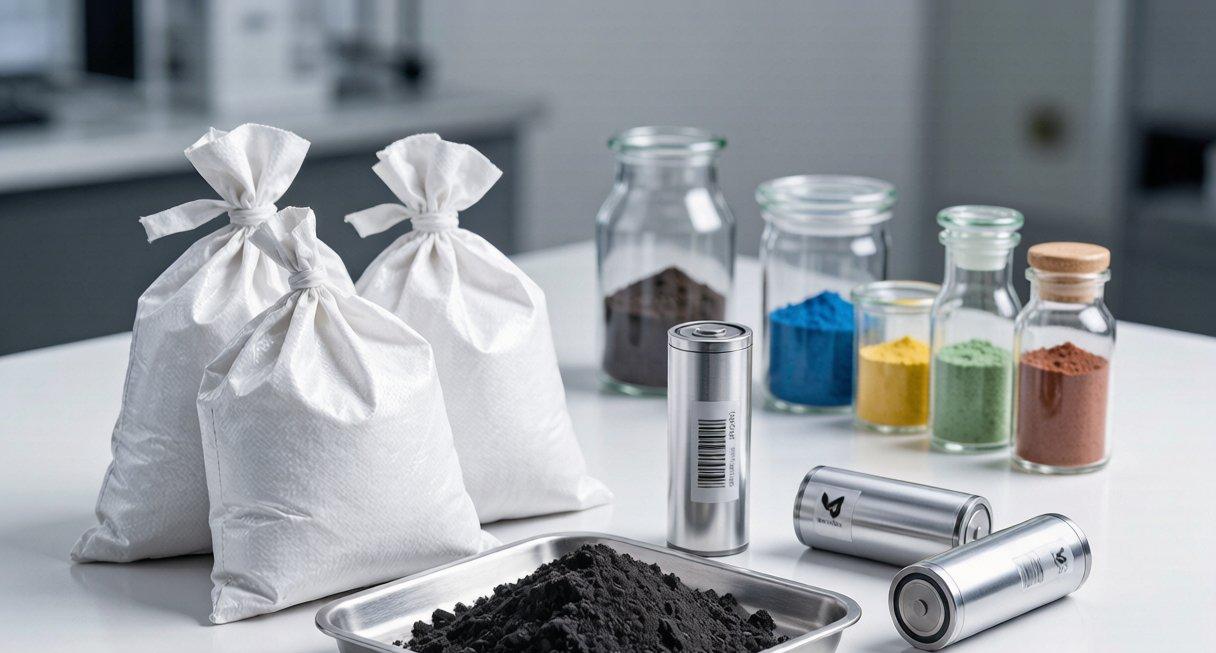
A sodium-ion battery uses a surprisingly short list of active materials:
- Sodium carbonate (soda ash) or sodium chloride as the sodium source
- A cathode active material — layered oxide, polyanion (such as NaFePO4 or Na3V2(PO4)3), or a Prussian blue analogue
- Hard carbon for the anode
- An aluminum current collector on both electrodes (no copper needed, unlike graphite lithium cells)
- An electrolyte built on a sodium salt such as NaPF6
The first thing to notice is that none of these are “critical minerals” under most regulatory definitions. Soda ash is produced at scale in the United States, China, and Europe. Aluminum is a mature global commodity. That removes the single biggest source of lithium-supply-chain anxiety.
What it does not remove is quality risk. Sodium carbonate for batteries needs high purity — we typically specify at least 99.5% Na2CO3 with tight limits on calcium, magnesium, and chloride, because those impurities poison the cathode during high-temperature sintering. I have seen a single off-spec batch of soda ash shift a whole campaign’s first-cycle efficiency by several points. A “commodity” feedstock still demands battery-grade qualification, and we treat it exactly like any other incoming cell material.
Hard Carbon Anodes — The Real Bottleneck
If there is one material that keeps sodium-ion battery supply chains honest, it is hard carbon. Graphite, the default lithium anode, has a deep, optimized, decade-old supply base. Hard carbon for sodium-ion is newer, and the precursor mix varies widely: biomass such as coconut shell or peanut shell, petroleum coke, coal tar pitch, and resin-derived carbons all work, but they do not perform the same.
From an engineering standpoint, hard carbon defines the energy density and the rate capability of the cell. From a supply-chain standpoint, it is the longest lead-time item and the most fragmented supplier base. We qualify at least two hard-carbon sources per program and keep a rolling inventory buffer of 8 to 12 weeks, because a single biomass harvest cycle or a coking furnace shutdown can move delivery dates by a month.
I tell procurement the same thing I tell the lab: do not let price drive the first sourcing decision. A hard carbon that is 10% cheaper but 15% higher in defect density will cost far more in scrap and warranty. We score suppliers on a weighted matrix — consistency first, defect rate second, lead time third, and only then price.
Cathode Chemistries and Critical-Mineral Exposure
Sodium-ion gives you chemistry choices that directly change your mineral exposure:
- Layered oxides (NaNiMnFeO2-type) — high energy, but may still use nickel or manganese
- Polyanion compounds — excellent thermal stability and cycle life, iron- and phosphorus-based
- Prussian blue analogues — ultra-low cost, iron- and carbon-based
For most stationary and industrial programs, we steer customers toward polyanion or iron-rich layered cathodes precisely because they avoid nickel and cobalt entirely. A sodium battery built on a NaFePO4 or Fe/Mn layered cathode has essentially the same conflict-mineral profile as an LFP lithium cell, but without the lithium. That is a strong story for customers who must file conflict-minerals reports or meet the EU Battery Regulation’s due-diligence requirements.
The trade-off is density. Sodium is heavier than lithium, so even a well-optimized sodium-ion battery lands below LFP on gravimetric energy. For a floor-standing storage cabinet that barely matters; for an aerial drone it matters a great deal. Matching the chemistry to the duty cycle is where the engineering judgment lives.
How We Qualify and Dual-Source Materials
Our raw-material qualification process mirrors cell-level reliability work. Every incoming material lot goes through four gates:
- Certificate-of-analysis review against the written specification
- Independent lab verification of key impurities (ICP-MS for metals, titration for carbonate purity)
- A small-batch coin or pouch cell build to confirm electrochemical performance
- Lot-to-lot consistency tracking in our manufacturing execution system
We never qualify a single source for a critical input. For hard carbon and cathode precursors, we maintain at least two qualified suppliers on different continents. When a customer asks for a custom battery solution, the sourcing plan is part of the deliverable, not an afterthought. I have walked OEM customers through our dual-source map, and the reaction is always the same: relief that someone treated the bill of materials as a reliability problem rather than just a purchasing problem.
Dual sourcing is only useful if the second source is truly independent. We check that the two suppliers use different precursor routes and different processing lines, so a single regional disruption cannot take out both at once. That independence is the actual insurance policy.
Compliance, Traceability and ESG Documentation
Supply chain security in 2026 is as much about paperwork as it is about physics. The EU Battery Regulation (2023/1542) now requires due diligence on raw materials, a carbon footprint declaration, and eventually a digital battery passport. Transport rules still apply: sodium-ion cells must pass UN38.3 for air and ground shipment, and we document IEC 62133 (or IEC 62619 / IEC 62620 for stationary) test reports for customers in regulated markets. FAA and EASA rules govern how we ship prototype and production cells by air.
We build the documentation package alongside the cell, not after it. For every sodium-ion battery we ship, the lot record carries material origin, test results, and supplier certificates. That traceability is what lets a customer answer a customs or ESG audit in days rather than months. If you are building a custom battery solution for an EU or North American customer, plan the passport early — retrofitting traceability after the fact is painful and expensive.
Cost Dynamics: Why Stability Beats Spot Price
The most underrated benefit of sodium-ion is price predictability. Lithium carbonate swung from under USD 6,000 to over USD 80,000 per tonne and back within a few years, and every swing re-priced the cells on the shelf. Soda ash has moved in a far tighter band because the supply base is large and the demand is spread across glass, detergents, and chemicals, not just batteries. A sodium battery program can therefore quote a stable price to a customer for longer, which matters enormously for multi-year storage tenders.
Stability is not the same as cheapness. Today a sodium-ion battery still carries a manufacturing-cost premium from lower yield and immature scale. But for a procurement manager who has been burned by lithium volatility, the ability to forecast cost twelve months out is itself worth money. I advise customers to model total cost of ownership over the contract life, not the day-one cell price.
When Sodium-Ion Is the Right Call
After all the chemistry talk, the practical question is simple: when should you specify sodium? My rule of thumb: choose a sodium-ion battery when your application is stationary or low-energy-density-tolerant, when supply continuity is a board-level concern, or when you must demonstrate a conflict-mineral-free bill of materials. Choose lithium when mass and energy density dominate — aviation, portable tools, and high-performance mobility. For many of our industrial and storage customers, the answer is a portfolio, not an either-or, and a well-designed custom battery solution will mix both chemistries by duty cycle.
Frequently Asked Questions
What raw materials does a sodium-ion battery actually need?
At minimum: sodium carbonate or salt, a cathode active material (layered oxide, polyanion, or Prussian blue), hard carbon anode material, aluminum current collectors, and a sodium-based electrolyte salt such as NaPF6. None are classified as critical minerals, but all still require battery-grade qualification.
Is sodium-ion really free of conflict minerals?
For iron- and phosphorus-based cathodes, yes — there is no cobalt, nickel, or lithium in the active materials, which removes the 3TG conflict-mineral exposure that complicates lithium supply chains. The remaining diligence is about supplier labor and environmental practices, which we document through standard ESG audits.
Why is hard carbon harder to source than graphite?
Graphite anode supply is mature and globally distributed. Hard carbon for sodium-ion is newer, with fragmented suppliers using very different biomass and pitch precursors. Lead times are longer and consistency varies more, so we dual-source and hold larger buffers.
How do you reduce supply chain risk for sodium-ion production?
We qualify at least two independent suppliers per critical material, verify every lot in an independent lab, track lot-to-lot consistency in our MES, and build the compliance documentation in parallel with the cell rather than after.
Does sodium-ion still need UN38.3 and IEC certification?
Yes. A sodium-ion battery must still pass UN38.3 for transport and IEC 62133 (or IEC 62619 / IEC 62620 for stationary systems) for market access. FAA and EASA rules govern air shipment of both prototypes and production cells.
When should I choose sodium-ion over lithium for my application?
Choose sodium when the duty cycle is stationary or density-tolerant, when supply continuity is a priority, or when you need a conflict-mineral-free bill of materials. Choose lithium when mass and energy density are the deciding factors.