Sodium-Ion Battery Cycle Life Expectations for Buyers
When a buyer sits across the table and asks me, “How many cycles will this sodium-ion battery actually deliver?”, the honest answer is always the same: it depends entirely on how you define the end of life. I’m Karl Huang, a senior lithium and sodium battery engineer, and over the last few years I’ve watched sodium-ion move from a lab curiosity to a procurement line item that real B2B buyers now have to qualify. Cycle life is the single spec that gets abused the most in sales decks, so this guide is my field-tested breakdown of what you should expect, how vendors measure it, and where the numbers quietly lie.
What “Cycle Life” Actually Measures (and What It Hides)
A cycle is one full charge and discharge. Simple enough. But the headline number — say “4,000 cycles” — is meaningless without the test conditions glued to it. In our validation lab we rate the lifecycle of a sodium-ion battery at 80% state of health (SOH) retention for most stationary packs, and sometimes 70% for cost-driven applications. The moment a vendor drops that retention threshold to 60%, the advertised cycle count jumps, and it no longer describes a pack you would actually keep in service.
I tell every procurement manager the same thing: ask for the retention definition first, the cycle count second. A 4,000-cycle claim at 80% SOH is a completely different product from a 6,000-cycle claim at 60% SOH. Both can be technically true on paper, and only one survives contact with a real duty cycle.
Realistic Numbers Buyers Should Expect in 2026
Based on cells we have validated and qualified this year, here is the range I give clients as a planning baseline, all at 80% SOH and room temperature (25°C) with a 0.5C charge / 1C discharge routine:
- Hard-carbon anode with layered-oxide cathode: 3,000 to 4,000 equivalent full cycles
- Polyanionic (e.g., NFPP) cathode chemistries: 4,000 to 6,000 equivalent full cycles, at the cost of lower energy density
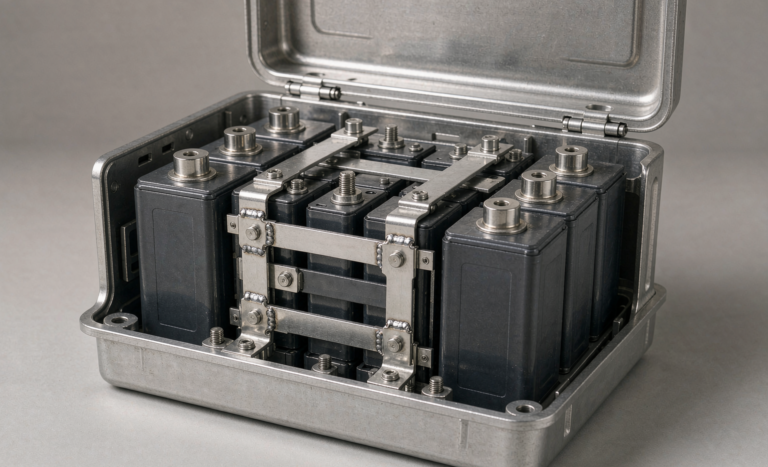
- Prismatic LFP-class sodium packs for stationary storage: 3,500 to 5,000 cycles depending on depth of discharge
These figures assume a 100% depth of discharge (DoD) per cycle. The practical trick every experienced engineer uses is partial-cycling. If you cap DoD at 80%, most sodium packs gain 20 to 35% more calendar cycles before hitting the 80% SOH floor. A well-specified custom battery solution that bakes in a DoD limit at the BMS level will outlast a cheaper pack run to 100% every day, even when both share the same cells.
How Chemistry and Cathode Choice Shape Longevity
Not all sodium-ion battery cells age the same way, and the cathode is the dominant variable. Layered-oxide cathodes give you the best energy density (around 140 to 160 Wh/kg in current production cells) but are more sensitive to moisture and structural fatigue over thousands of cycles. Polyanionic cathodes, particularly sodium iron phosphate (NFPP), trade density for rock-solid cycle stability — often 6,000+ cycles with minimal capacity fade.
For buyers, the decision is a triangle: energy density vs cycle life vs cost. If your application is a telecom backup cabinet cycled daily, polyanionic chemistry is the rational pick because you will hit the replacement interval on the calendar, not on capacity. If you are weight-constrained on a two-wheeler, layered oxide wins despite the slightly shorter cycle life. I have steered more than one client away from the “highest cycle count” cell simply because its weight killed the product’s range target.
Operating Envelope: The Silent Cycle-Life Killer
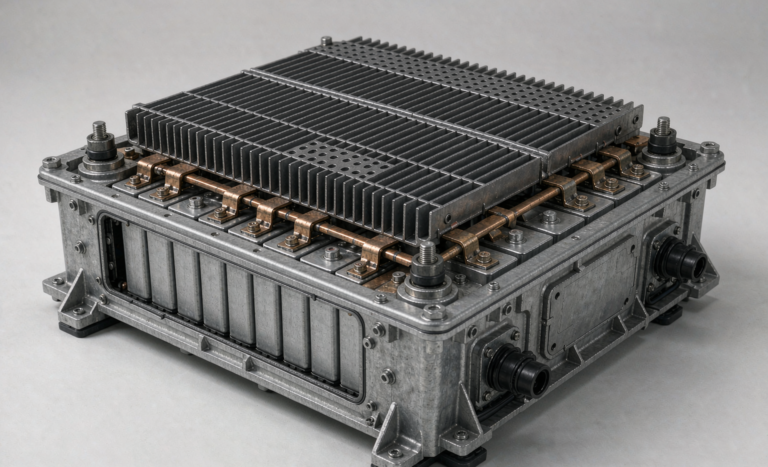
The single biggest reason field cycle life underperforms the datasheet is the operating envelope. Sodium-ion’s headline advantage is cold-weather tolerance — it keeps working where lithium sulks — but that does not mean it loves extremes. Every 10°C above 35°C roughly doubles the rate of parasitic side reactions that permanently eat capacity. We have seen packs rated for 4,000 cycles at 25°C collapse to under 2,000 when parked in a sealed cabinet at 50°C with no ventilation.
The flip side is why many buyers choose sodium in the first place: at -20°C it still delivers 80 to 90% of rated capacity, versus 50 to 60% for LFP. But cold charging is where you must be disciplined. Charging a sodium-ion battery below 0°C without current limiting accelerates anode plating and quietly shortens life. Any credible custom battery solution for cold regions must include a low-temperature charge cutoff or a self-heating layer in the BMS.
How We Validate Cycle Life Before Volume Production
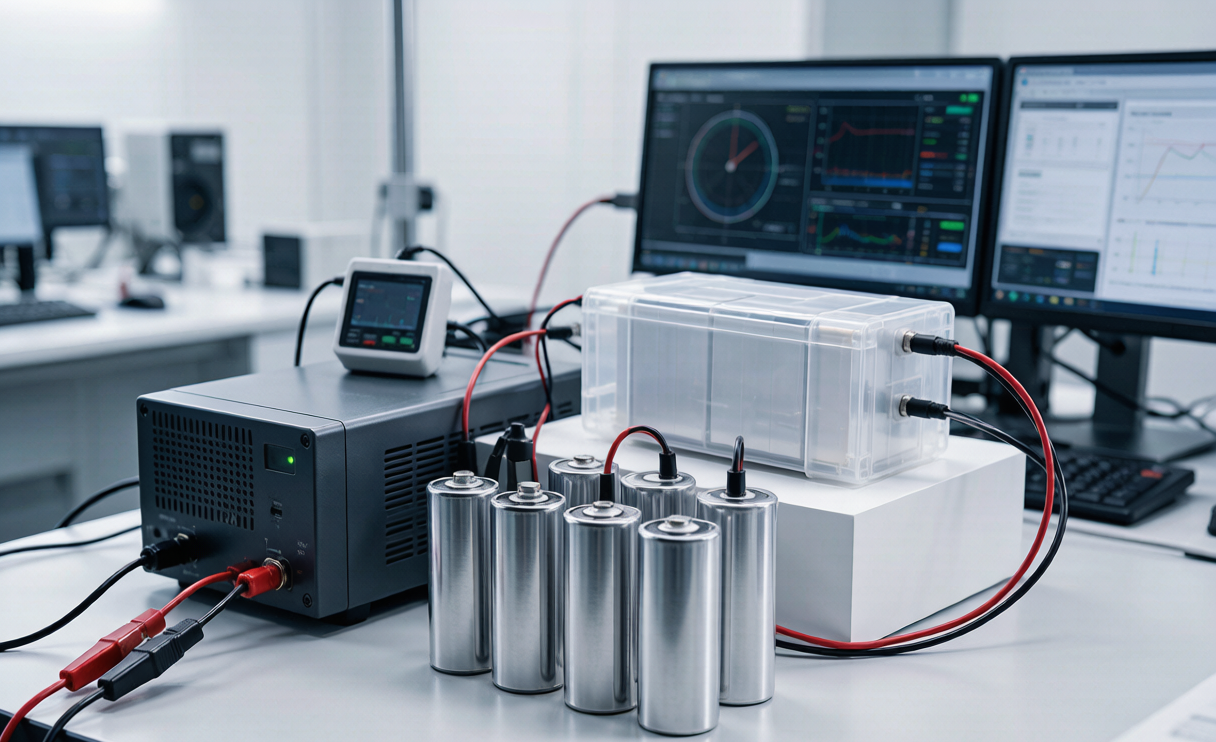
Spec sheets are marketing; samples are evidence. Before I sign off on a volume order, we run a three-stage validation that mirrors IEC 62620 (industrial sodium cells) and IEC 62619 (industrial battery safety) where applicable, plus the UN38.3 transport test for the shipping qualification:
- Sample aging: 8 to 16 cells at 25°C, 45°C, and at the customer’s expected DoD, logged to 80% SOH. This alone takes 4 to 9 months, which is why rush qualifications are a red flag.
- Edge-condition abuse: overcharge, short-circuit, and thermal stress per IEC 62133-2 style protocols to confirm the pack fails safe, not dramatically.
- Lot qualification: a capacity and internal-resistance histogram on the first production lot to catch cell-mixing before it reaches the field.
I also insist on a capacity-check procedure in the incoming inspection, because a buyer who cannot verify real mAh at the dock has no defense when a pack fades early. For air-shipped samples, we keep the UN38.3 test summary on file and align labeling with IEC 62133 and the relevant FAA / EASA provisions so the logistics chain never stalls.
Reading a Sodium-Ion Datasheet: The Fine Print
When you receive a sodium-ion battery quote, scan for these details before you trust the cycle number:
- The SOH threshold used (80% vs 70% vs 60%)
- Test temperature and DoD per cycle
- Charge / discharge C-rates during the cycling test
- Whether the figure is per-cell or per-pack (pack-level BMS overhead usually costs a few hundred cycles)
- The warranty frame: a 10-year calendar warranty is not the same as a 4,000-cycle warranty
If a vendor cannot produce the cycling curve — capacity vs cycle count, with the test conditions printed on it — treat the headline number as a wish, not a spec. In my experience the suppliers worth partnering with are the ones who volunteer that curve unprompted.
Building Cycle Life Into Your Procurement RFQ
The cheapest way to protect your lifecycle is to write it into the contract, not discover it in the field. I recommend buyers specify a minimum cycle count at a defined SOH, temperature, and DoD, with a first-tier capacity-verification clause and a defined replacement threshold. Pair that with a realistic operating envelope — ventilation, charge-temperature limits, DoD cap — and a sodium-ion battery that was quoted at 4,000 cycles will very often deliver 4,000 cycles.
Where the application is unusual, a co-engineered pack pays for itself. A properly tuned custom battery solution lets you trade the chemistry’s strengths against your real duty cycle instead of a generic lab routine, and that is where sodium-ion’s value finally shows up on the balance sheet rather than just on the spec sheet.
Frequently Asked Questions
How many cycles should a good sodium-ion battery deliver in 2026?
For stationary and mild-duty applications, expect 3,000 to 5,000 equivalent full cycles at 80% SOH and 25°C. Polyanionic cathode packs can exceed 6,000 cycles. Always confirm the SOH definition and test DoD before comparing vendors.
Does sodium-ion really beat lithium on cycle life?
Not universally. Sodium-ion’s edge is cold-weather retention and raw material resilience, not a blanket cycle-life win. Polyanionic sodium chemistries can match or exceed LFP on cycles, but layered-oxide sodium cells may trail premium LFP. The right comparison is chemistry-to-chemistry under your own duty cycle.
Why does my real-world cycle life fall short of the datasheet?
Temperature is the usual culprit. Operation above 35°C accelerates permanent capacity loss, and charging below 0°C without current limiting damages the anode. Datasheet cycles are measured at a controlled 25°C with capped DoD; field packs rarely get that luxury without active thermal management.
What standards apply to sodium-ion cycle-life validation?
We validate against IEC 62620 for industrial sodium cells and IEC 62619 for battery system safety, with UN38.3 covering transport, and IEC 62133-2 style abuse testing for safe failure modes. Regional certifications such as GB/T 36276 also apply for the China market.
Can a custom battery solution extend sodium-ion cycle life?
Yes. A co-engineered pack can cap depth of discharge at the BMS, add low-temperature charge protection, and tune the cooling envelope to your site. Those controls routinely add 20 to 35% more usable cycles versus a generic pack run to 100% DoD every day.
Is a 10-year warranty the same as a 4,000-cycle warranty?
No. A calendar warranty covers time on the shelf; a cycle warranty covers usage. A pack in float standby may outlive a 10-year calendar term with few cycles, while a daily-cycled pack can exhaust its cycle budget inside five years. Read both limits in the quote.