Home Battery Backup Critical Loads vs Whole-House
When a homeowner calls me about a home battery backup system, the first question is almost never “which battery?” It is “should I back up the whole house, or just the critical loads?” I am Karl Huang, Senior lithium battery Engineer at Horizon Power, and I have spec’d both topologies for everything from a 900 sq ft cabin to a 6,000 sq ft villa with three HVAC units. After a dozen field deployments and more than a few late-night support calls during grid outages, I can tell you the answer is rarely “whole house” by default. It is a function of your load profile, your inverter ceiling, and your budget.
In this guide I will walk through how our engineering team at Horizon Power decides between a critical-loads sub-panel design and a full whole-house backup, with the real numbers we use to size each one. If you are a homeowner, an installer, or a procurement lead, this should save you from the two most expensive mistakes I see: oversizing the inverter and under-sizing the battery.
A quick field note. Last winter I visited a lakeside home that had been quoted a 30 kWh whole-house system at nearly double the budget. When we logged the actual loads for a week, the truly essential circuits drew just 1.8 kW average. We shipped a 14 kWh home battery backup critical-loads kit instead, and the owner rode out a 19-hour ice-storm outage with the fridge, heat, and internet never blinking. Same peace of mind, half the spend. That is the mindset this article is built on.
What “Critical Loads” Actually Means in a Backup Design
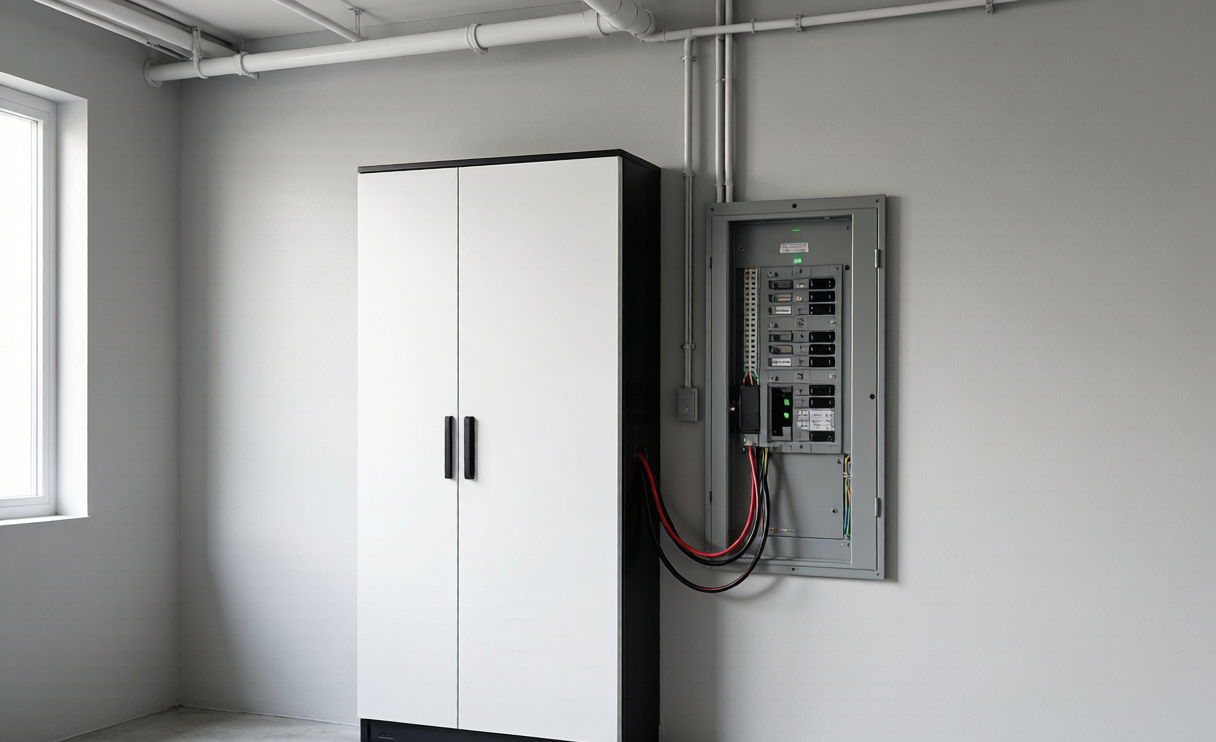
A critical-loads panel is a second electrical sub-panel that carries only the circuits you cannot live without during an outage: refrigerator, internet router, a few lights, furnace circulator, sump pump, and maybe one medical device. Everything else—the EV charger, electric range, and second HVAC—stays on the main panel and goes dark when the grid drops.
The advantage is simple math. A typical North American home peaks at 5–8 kW, but the critical-loads subset is usually 1.2–2.5 kW. That lets us specify a 3–5 kW inverter and a lithium battery bank of 10–15 kWh instead of a 12 kW whole-house unit with 30+ kWh of storage. For a B2B buyer or an installer, that is roughly half the bill and a far simpler permit.
- Refrigeration: 150–400 W running, 8–12 compressor starts per day.
- Lighting: 100–300 W if you have already moved to LED.
- Furnace circulator / boiler: 300–800 W.
- Sump pump: 800–1,200 W starting surge.
- Internet + router: 20–50 W.
Whole-House Backup: The Engineering Reality
Whole-house backup means the inverter connects at the service entrance and feeds the entire main panel. When the grid fails, an automatic transfer switch (ATS) or a supervised interlock isolates the home from the utility and the battery takes over everything.
The appeal is obvious: zero lifestyle change during an outage. But the engineering cost is real. To cover a full modern home you typically need a 10–14 kW continuous inverter and 20–40 kWh of home energy storage. That is a much larger lithium battery pack, more wall space, and often a service feeder upgrade in older homes with 100 A entry.
I tell clients straight: whole-house only pays off if you have already electrified—heat pump, induction range, EV at home. If your heavy loads are still gas, a critical-loads design will cover 90% of your real needs for a fraction of the cost. Do not buy whole-house just because it sounds safer; buy it because your load profile demands it.
How We Size Each Approach (With Real Numbers)
Our standard Horizon Power sizing worksheet starts from a 24-hour autonomy target at the expected outage load, then adds a solar-recharge factor if PV is present. Here is the rule of thumb we hand to installers:
- Critical loads only: 1.5–2.5 kW average draw × 24 h would be 36–60 kWh/day if run flat. But because most outages are 2–8 hours, we size 10–15 kWh of usable home battery backup capacity, which covers overnight critical loads plus one recharge cycle.
- Whole house: 4–7 kW average × 24 h. We size 25–40 kWh usable, almost always as a stackable custom battery solution because a single wall unit rarely fits the wall or the budget.
A detail that surprises people: usable capacity is not the nameplate. At Horizon Power we rate LFP packs to 90% depth of discharge, but we recommend 80% in daily-cycling backup designs to protect cycle life. So a “15 kWh” module realistically delivers about 12 kWh usable. Always size on usable, never on the label, or your third outage of the winter will teach you the hard way.
Wiring Topology: Sub-Panel vs Service-Entrance Interlock
For critical loads, the cleanest install is a dedicated sub-panel fed by the backup inverter, with the original circuits re-routed into it during installation. This is a one-time electrician job but keeps the main panel untouched and is easy to expand later.
For whole-house, you need either a large ATS at the meter or a line-side tap with a supervised breaker. Both must comply with NEC Article 706 (energy storage systems) and Article 710 where adopted. I have seen DIY whole-house attempts that violated neutral-handling rules and back-fed the transformer—dangerous and illegal. Use a licensed electrician; the battery is the easy part of this project.
Standards and Safety You Cannot Skip
Every Horizon Power home energy storage pack we ship for North American and EU markets is built around the same certification stack we use for our industrial lines:
- UN38.3: mandatory transport safety testing (T.1–T.8) before the pack can be shipped by air or sea. Non-negotiable for any lithium battery.
- IEC 62133-2 / UL 1973: cell- and pack-level safety for stationary and motive applications.
- UL 9540 / UL 9540A: the system-level and fire-propagation standard for energy storage. Many jurisdictions now require it for whole-house installs.
- IEEE 1547 / IEC 62109: inverter interconnection and power-conversion safety.
- NEC Articles 706 & 710: wiring and installation code.
FAA and EASA rules govern air transport of loose cells and prototype packs—less relevant to a permanently installed home unit, but we still apply UN38.3 for any replacement module we air-freight to a service call. The point is that the same discipline protecting a drone fleet protects your basement.
Which Should You Specify? A Decision Framework
If you want the short version from a battery engineer, here it is:
- Choose critical loads if your heavy appliances are gas, your outage pattern is short (minutes to a few hours), and budget matters. Most homes land here.
- Choose whole-house if you are fully electrified, outages last days (wildfire or winter-storm regions), and you want zero behavior change.
- Hybrid: start with a critical-loads custom battery solution and leave busbar space and conduit for a second module plus a larger inverter later. This is what I recommend to roughly 80% of first-time buyers.
A good home battery backup design is not the biggest system—it is the one matched to your load. Get the panel decision right first, and the battery size follows from the math instead of from a sales brochure.
A Real Deployment: 14 kWh Critical-Loads Retrofit
To make the numbers concrete, here is a typical Horizon Power retrofit we completed for a 2,200 sq ft home on a winter-storm grid. The owner wanted whole-house at first; our load log changed the conversation.
- Circuits moved to backup: refrigerator (400 W), furnace fan (600 W), well pump (900 W surge), router + Wi-Fi (40 W), and six LED lighting zones (180 W).
- Measured backup load: 1.6 kW average, 2.1 kW with the well pump starting.
- Pack specified: one 14 kWh LFP module, 80% usable = 11.2 kWh, paired with a 5 kW inverter and a 4 kW PV array.
- Result: 7+ hours of autonomy overnight, recharged by midday sun, through a 19-hour outage with zero manual intervention.
The whole-house alternative would have needed a 12 kW inverter and roughly 30 kWh of home energy storage—about 2.5× the cost for loads the family simply did not use during an outage. This is why we always log before we spec.
Frequently Asked Questions
Can I start with critical loads and expand to whole-house later?
Yes, and I recommend it. Design the sub-panel with spare breaker spaces and run oversized conduit back to the main panel. When you are ready, add a second lithium battery module and upgrade the inverter; the original backup circuit stays exactly where it is. Plan the expansion path on day one and it costs almost nothing extra.
How many kWh do I need for critical loads only?
For most homes, 10–15 kWh usable covers refrigeration, lights, internet, furnace, and sump for a full night plus one solar recharge. Apply the 80% usable rule, so buy a 12–18 kWh nameplate pack to end up with the capacity you actually need.
Will a critical-loads setup run my air conditioner?
Usually not on a small inverter. A 3-ton heat-pump compressor can draw 3–5 kW with a 2–3× starting surge. If cooling is critical, either oversize the inverter or keep the AC on the main panel and rely on a gas furnace fan instead. We can build a custom battery solution with a soft-start controller if air conditioning must be covered.
Does whole-house backup need a bigger inverter or just more battery?
Both, but the inverter is the hard constraint. Whole-house requires an inverter rated for your home’s simultaneous peak—often 10–14 kW—whereas critical loads needs only 3–5 kW. Battery size follows from how long you want to run, not from the topology alone.