Home Energy Storage and Heat Pump Integration
When a homeowner asks me whether a home energy storage heat pump integration project is worth it, I usually answer with a question of my own: “Are you pairing the two, or just bolting them together?” The difference matters more than most spec sheets admit. I’m Karl Huang, a senior lithium battery engineer, and over the last few years I’ve sized, installed, and troubleshooted dozens of residential storage systems that share a roof with an air-source heat pump. The good news: the combination is one of the most efficient ways to cut a heating bill. The catch: heat pumps are a deceptively nasty electrical load, and a storage system that is not engineered around them will either trip, sag, or quietly chew through its battery in a single cold night.
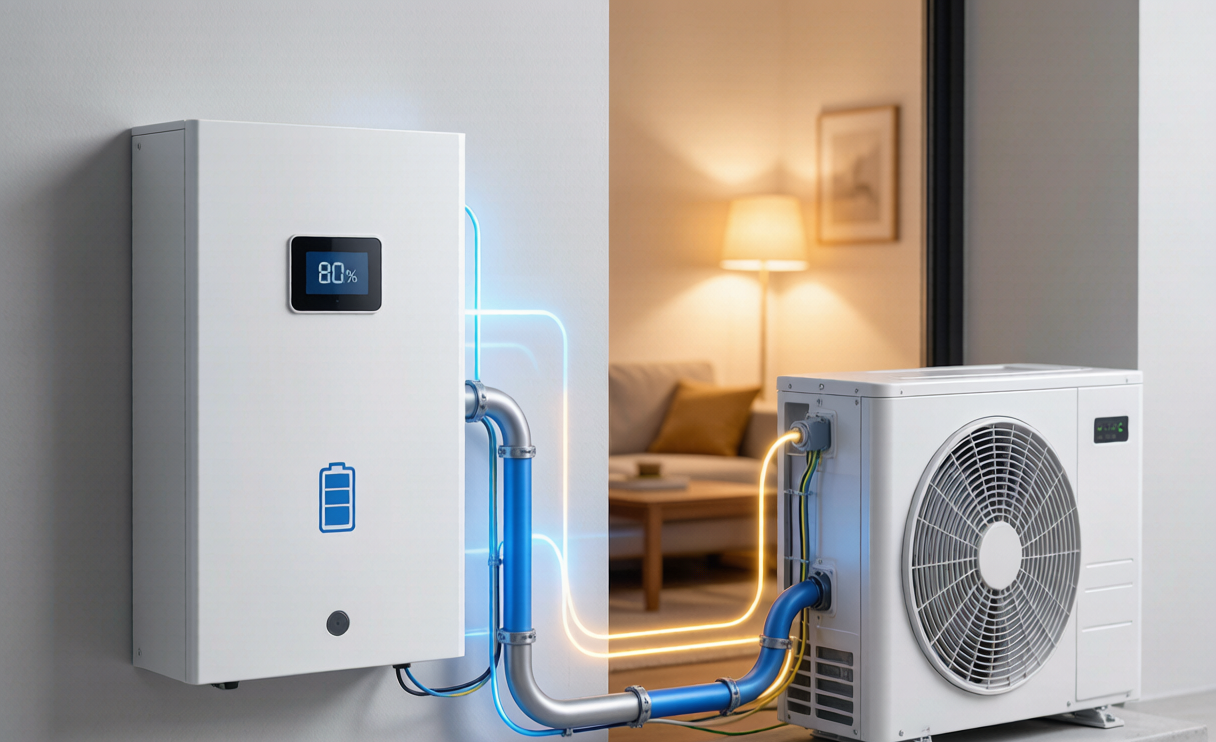
This guide walks through what actually happens when you connect a heat pump to a battery, the surge and sizing numbers I verify on every job, the chemistry and standards that keep it safe, and the control logic that turns two appliances into one smart system.
Why Heat Pumps and Home Batteries Are a Natural Pair
A heat pump moves heat instead of generating it, so it delivers roughly 2.5 to 4 units of thermal energy for every unit of electricity it draws in mild weather. That efficiency is exactly why a home energy storage bank is a good companion: you are feeding a load that stretches every stored kilowatt-hour further than resistance heat ever could. Pair that with rooftop solar and you get the classic loop — charge the battery from midday sun, run the heat pump in the evening, and avoid the most expensive utility rate window entirely.
But “natural pair” does not mean “plug and play.” A heat pump’s compressor is an inductive motor, and motors do two things that batteries and inverters must respect: they draw a sharp inrush current at startup, and they change their appetite with the weather. Miss either one and the integration fails in the field, not on paper.
The Problem Most People Miss: Compressor Surge Current
The single most common failure I see in a home battery backup setup that also runs a heat pump is the inverter dropping the load the instant the compressor kicks on. Here is the physics. A typical 3-to-5 ton air-source heat pump compressor draws maybe 2 to 5 kW while running, but at startup the locked-rotor current can spike to 5 to 8 times that for a few hundred milliseconds to a few seconds. In 240 V terms, that can mean a momentary draw in the 12 to 21 kVA range.
Most hybrid inverters are rated for a surge of about 2x their continuous output for 10 seconds (a spec that traces back to interconnection rules like UL 1741 and IEEE 1547-2018). If you put a 5 kW compressor behind an 8 kW inverter, you have roughly 16 kW of surge headroom — comfortable. Put the same compressor behind a 5 kW inverter and you will nuisance-trip the moment defrost or a cold start hits. My rule of thumb: size the inverter’s continuous rating at least 1.5x the heat pump’s running watts, and confirm the surge rating explicitly with the manufacturer before you buy.
- Running compressor load: 2-5 kW typical residential unit.
- Startup inrush: 5-8x running current for under 3 seconds.
- Inverter surge headroom: verify 2x continuous for 10s (UL 1741 certified).
- Defrost cycles: a reverse-cycle defrost pulls full compressor power every 30-90 minutes in cold, wet conditions.
Sizing Your Home Energy Storage System for a Heat Pump
Sizing is where a home energy storage system lives or dies with a heat pump attached. You have to size for two different things at once: energy (kWh) and power (kW).
Start with duty. A heat pump holding a well-insulated home at a steady temperature in shoulder season might pull 15-30 kWh per day. In a real cold snap, when the coefficient of performance (COP) falls from ~3.5 down toward 1.5 and resistance backup strips engage, that daily draw can triple. Resistance “emergency” heat is the battery killer — it is essentially a 3-5 kW electric heater with no efficiency multiplier. I tell clients: if your climate regularly sees -15 C or colder, plan for the resistance strip, not the COP, when sizing autonomy.
A practical starting point I use: 10 kWh of usable LFP storage runs a mild-weather heat pump for roughly 4-8 hours of continuous operation; 15-20 kWh gets most homes through an overnight shoulder-season cycle on battery alone. If you want true winter resilience, you are looking at 20-30 kWh plus a generator hybrid, not a single wall-mounted cabinet.
Battery Chemistry and Why LFP Wins Here
For a home energy storage battery that cycles every single day and sits inside or adjacent to a living space, lithium iron phosphate (LFP, LiFePO4) is the only chemistry I spec for residential duty. Three reasons grounded in the standards I test against:
- Thermal stability. LFP’s olivine cathode is far less prone to thermal runaway than NCM. That matters because a heat pump mechanical room gets warm, and the battery is often nearby.
- Cycle life. 6,000+ cycles to 80% state of health is routine for graded LFP cells. Daily cycling to support a heat pump means you actually use that lifetime.
- Stationary certification. I require cells and packs that meet IEC 62619 for industrial stationary batteries and UN38.3 (tests T.1-T.8) for transport and handling. A battery without both is not leaving my warehouse.
Round-trip efficiency of a well-designed 48 V LFP rack sits around 90-95%, so very little of your solar or off-peak energy is lost in the charge-discharge loop that feeds the heat pump.
System Architecture: Hybrid Inverter and EMS Control
The cleanest residential builds are a hybrid inverter that blends grid, solar, and battery behind one brain, feeding the heat pump as a normal AC load. Whether you AC- or DC-couple depends on whether the PV already exists (AC-coupled is the retrofit-friendly choice; DC-coupled squeezes a little more efficiency on new builds).
The real magic is the energy management system (EMS). Left dumb, a heat pump will simply run whenever the thermostat calls, draining the battery at the worst time. With a smart EMS you can:
- Thermal-mass buffer. Pre-heat or pre-cool the home using cheap midday solar so the compressor barely runs during the expensive evening peak.
- Defrost-aware scheduling. Hold a small reserve so a cold-morning defrost cycle never pulls the battery below its safe depth of discharge.
- Tariff arbitrage. Charge from off-peak grid power and let the heat pump ride the battery through the peak window — the same time-of-use playbook that pays back a storage investment fastest.
On the compliance side, the inverter must carry UL 1741 (and the newer “smart inverter” SA listing for IEEE 1547-2018 interconnection), and the overall enclosure and wiring fall under NEC Article 706 for energy storage and Article 710 for microgrid-style setups. Inverter safety itself is covered by IEC 62109 / IEC 62477-1, and the complete system by UL 9540 with the fire-propagation test UL 9540A.
Installation and Safety Realities
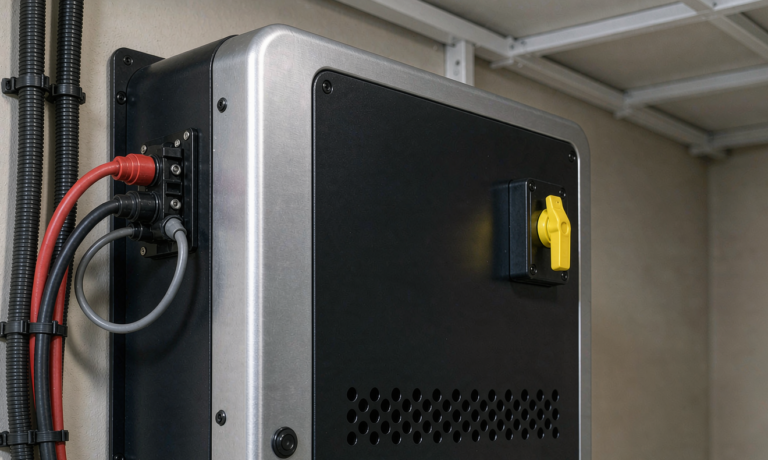
I have crawled into enough mechanical closets to know the install details make or break a residential battery storage project. Two rules I never bend:
- Keep the battery out of the heat pump’s exhaust plume. LFP cells charge happily from 0 C to 45 C but most BMS boards will refuse to charge below 0 C to avoid lithium plating. A battery mounted where the outdoor unit dumps hot defrost air will cook in summer and chill in winter.
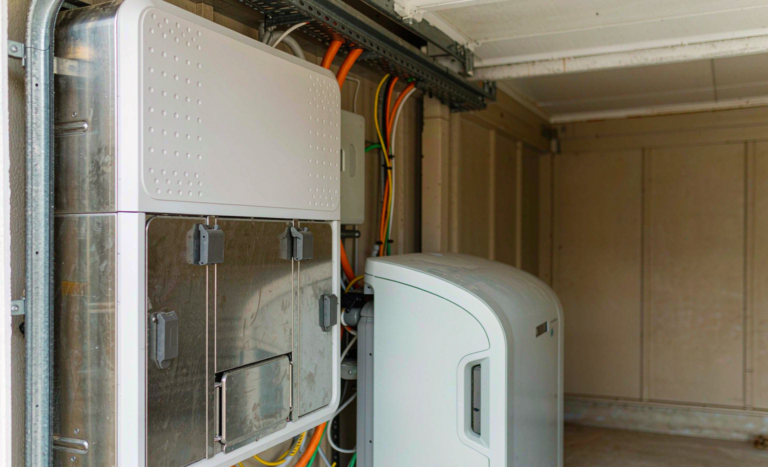
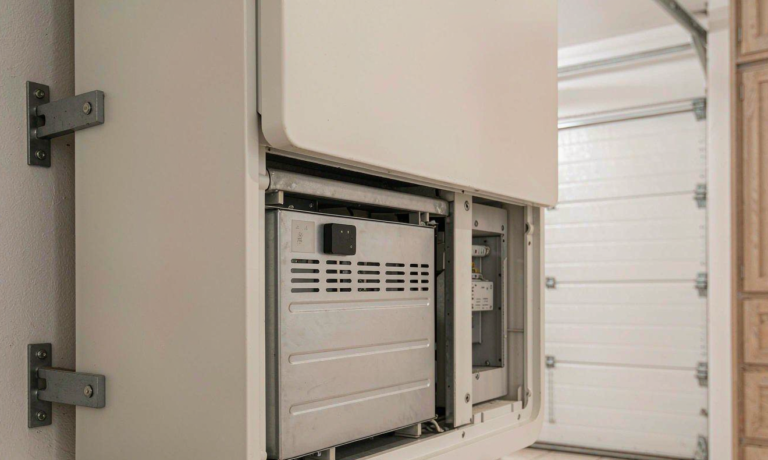
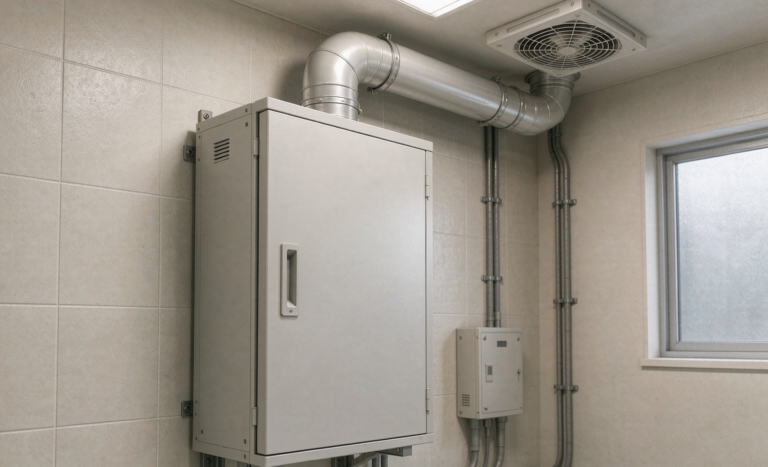
- Conditioned space only. I specify an indoor, ventilated utility room or garage wall away from direct sunlight. Discharge down to -20 C is usually fine; charging cold is not, and a heat pump mechanical room is not “conditioned” by definition.
Also: route the inverter AC output so the heat pump is on the backed-up load panel, not the main panel, unless you explicitly want whole-house backup. Critical-loads configuration keeps the battery focused on the heat pump and essentials instead of a stray dryer cycle draining it.
Frequently Asked Questions
How big a battery do I need to run a heat pump?
For shoulder-season overnight coverage, 10-15 kWh of usable LFP storage is a realistic floor for an average home. For winter resilience where resistance backup engages, plan 20-30 kWh plus a generator hybrid. Always size for the worst-case electrical load (COP near 1), not the nameplate efficiency.
Will my inverter handle the heat pump’s startup surge?
Only if its surge rating covers 5-8x the compressor’s running current for a few seconds. Verify a surge of at least 2x continuous for 10 seconds (UL 1741 certified) and size continuous inverter power at 1.5x the heat pump’s running watts. When in doubt, I spec the next size up — nuisance trips are the most common field failure.
Can I run a cold-climate heat pump off battery in winter?
Yes, but watch the COP and the resistance strip. Below about -15 C many air-source units lean on electric resistance heat that can draw 3-5 kW with no efficiency gain. Your battery autonomy shrinks fast, so budget for it explicitly and keep the battery itself in a conditioned space so it can still charge.
Does running a heat pump shorten battery life?
Not if you size and control it properly. LFP chemistry tolerates daily deep cycling far better than lead-acid or NCM, and a smart EMS keeps depth of discharge in the 80% range. The batteries I’ve seen fail early were almost always undersized and cycled to extinction every night.
Should I AC- or DC-couple the heat pump storage system?
Retrofitting an existing solar array, go AC-coupled — simpler and code-friendly. Building new, DC-coupled recovers a bit more efficiency. Either way the heat pump is just an AC load behind the hybrid inverter; the coupling choice affects losses and cost, not the core integration logic.