Home Energy Storage AC vs DC Coupled
Over the past eight years I have sat across the table from dozens of installers, EPC contractors and homeowners trying to decide between an AC-coupled and a DC-coupled home energy storage design. I am Karl Huang, Senior lithium battery Engineer at Horizon Power, and I have commissioned both architectures in the field — from a 5 kWh apartment retrofit in Shenzhen to a 30 kWh off-grid villa with three-string PV. The coupling question looks like a harmless wiring detail on a one-line diagram, but it quietly decides your round-trip efficiency, your retrofit bill, and which inverters you are legally allowed to deploy under local code.
This guide walks through exactly how each architecture works, where the energy actually disappears, and how to pick the right one for your specific site. If you are specifying a home battery backup and want the math instead of the marketing, you are in the right place.
What “Coupled” Actually Means in a home energy storage system
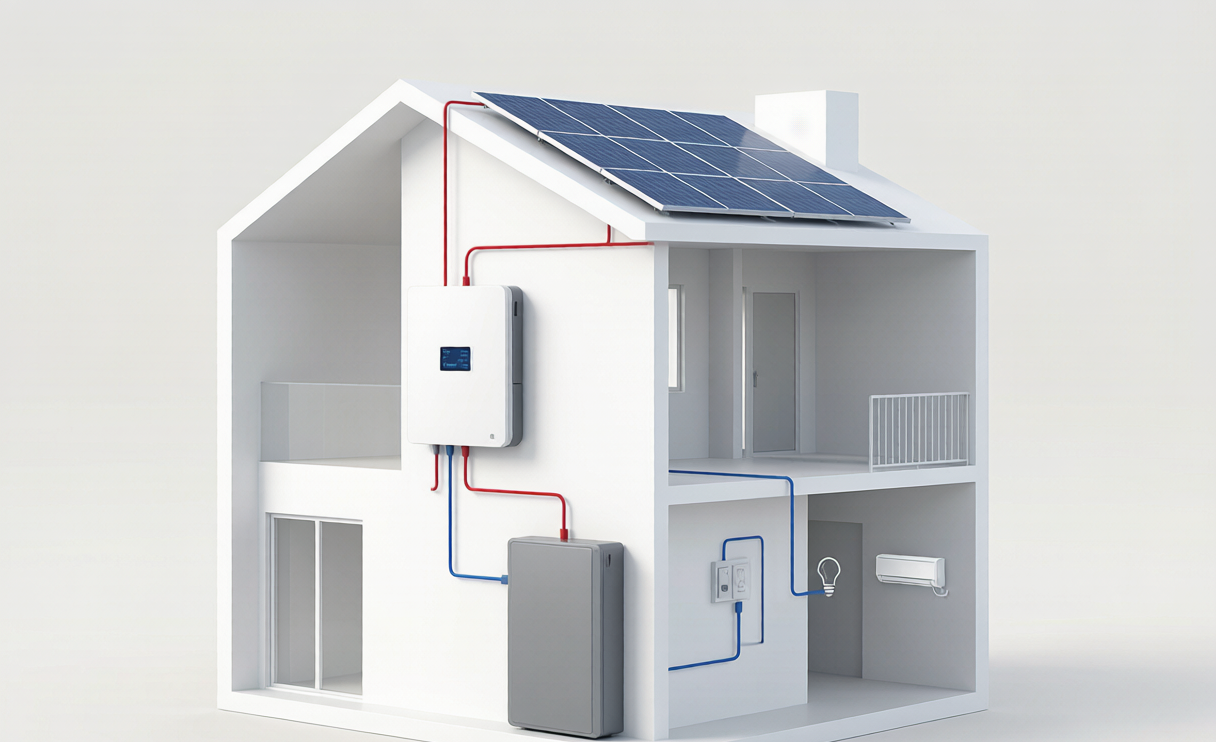
Every residential solar-plus-storage install has three electrical domains: the PV array (DC), the battery pack (DC), and the home loads plus the grid (AC). The word “coupled” simply describes where the battery meets the rest of the system — on the AC bus or on the DC bus. Get this right and the rest of the home energy storage system design falls into place.
- AC-coupled: the battery talks to the house through its own battery inverter, which sits on the AC bus alongside your existing PV inverter.
- DC-coupled: the battery shares the DC bus with the solar, usually behind one hybrid inverter or a DC charge controller, so PV DC flows straight into the battery with no AC step in between.
That single architectural fork changes how many times your energy gets converted, and every conversion costs you 2–3% round-trip. Stack a few of them and you have silently given away a meaningful slice of the kilowatt-hours you paid for.
AC-Coupled Home Energy Storage — How It Works
In an AC-coupled layout, your rooftop PV feeds a standard grid-tied inverter that turns DC into AC. That AC either powers the house, exports to the grid, or feeds a separate battery inverter that turns it back into DC to charge the pack. During an outage, the battery inverter forms its own little island (a “microgrid” in standards language) and keeps selected circuits alive.
The big advantage is simplicity for retrofits. If you already have a string inverter from any brand, an AC-coupled system leaves it untouched — you just bolt a battery inverter onto the AC side. In my experience this is the lowest-friction path when the existing PV inverter is healthy and out of warranty risk.
The trade-off is conversion count. Solar DC → AC (PV inverter) → DC (battery inverter) on the way in, then DC → AC again on the way out. Each stage bleeds 2–3%, so a typical AC-coupled round-trip efficiency lands around 85–90%. Not bad, but not free.
DC-Coupled Home Energy Storage — How It Works
A DC-coupled system puts the battery and the PV on the same DC bus, managed by either a hybrid inverter or a dedicated DC charge controller. PV DC flows directly into the battery with no AC conversion, and the single inverter handles the DC-to-AC step only once, when energy actually reaches the loads or the grid.
This is the architecture I recommend for new builds where there is no legacy inverter to protect. You get one conversion instead of two on the charge path, which pushes round-trip efficiency to roughly 92–96%. On a daily self-consumption cycle that difference compounds: over a year, a DC-coupled 10 kWh pack can deliver several hundred more usable kilowatt-hours than an AC-coupled one of identical cells.
The catch is retrofit complexity. Tying a battery into an existing DC bus usually means replacing or re-configuring the original inverter, which installers are rightly cautious about on a system still under warranty.
Efficiency: Why Coupling Choice Costs You Kilowatt-Hours
Let me put real numbers on it. Assume a quality LFP pack at the core of your home battery backup and a modest 5 kWh/day of solar that gets stored and reused after sunset.
- AC-coupled: 88% round-trip × 5 kWh = 4.4 kWh delivered to loads.
- DC-coupled: 94% round-trip × 5 kWh = 4.7 kWh delivered to loads.
That 0.3 kWh/day gap is about 110 kWh/year — enough to run a fridge for several days or shave a meaningful chunk off a time-of-use evening peak. Multiply across a larger 20 kWh system and you are talking 400+ kWh/year simply from architecture, not from buying bigger cells.
The efficiency story is not only about the inverter. DC-coupled systems also handle partial-state-of-charge buffering beautifully: surplus PV in the morning can top the battery without ever touching the grid, whereas an AC-coupled system routes that energy through two conversions before it lands in the pack.
Retrofit vs New Build — The Decision That Settles It
In practice, the coupling choice is rarely a pure efficiency contest. It is a function of what is already on your wall.
- Existing PV, healthy inverter: AC-coupled wins on labor and risk. You avoid disturbing a warranted inverter and you keep the original equipment manufacturer accountable for the PV side.
- New build or full repower: DC-coupled wins on efficiency and usually on bill of materials, because you consolidate to a single hybrid inverter instead of paying for two.
- Expansion later: AC-coupled scales awkwardly — each added battery often wants its own inverter stack — while DC-coupled scales by paralleling battery strings on the shared DC bus, which is cleaner up to the inverter’s current limit.
I have seen more than one homeowner chase the “more efficient” DC design on a retrofit, only to blow the savings on inverter replacement labor and a re-permit. Match the architecture to the site, not to the brochure.
Safety, Codes and Inverter Standards You Must Clear
Whichever bus you choose, the pack and power electronics must clear the same safety gates. This is where E-E-A-T credibility matters more than spec-sheet watts, because a non-compliant home energy storage system is a liability, not an asset.
- UL 1741 / IEEE 1547-2018: the inverter’s grid-interconnection and anti-islanding behavior. Required for any grid-tied unit in North America.
- UL 9540: the overall energy storage system safety standard covering the battery, inverter and controls as an assembly.
- UL 9540A: the fire-propagation test that many AHJs now demand before sign-off, especially for indoor wall-mounted units.
- NEC Article 706 & 710: wiring, disconnects, and overcurrent protection for stationary storage.
- IEC 62619 / IEC 62109 / IEC 62477: the international equivalents for stationary battery safety, inverter safety, and power-converter-system safety — what we verify before any Horizon Power pack leaves the line.
- UN38.3: the transport test sequence (T.1–T.8) every lithium cell must pass before it ships, regardless of coupling type.
One field note: AC-coupled islands can be simpler to certify for backup because the battery inverter’s transfer switch is a well-understood, standardized component. DC-coupled backup depends more heavily on the hybrid inverter’s seamless transition logic, so I always validate the transfer time against the load — medical or server loads are unforgiving of a 50 ms gap.
Cost and Scalability Over 10 Years
Up front, AC-coupled often looks cheaper on a retrofit because you add one box. Over ten years the picture shifts. DC-coupled’s higher daily yield means you buy fewer grid kilowatt-hours, and a single hybrid inverter has one set of firmware and warranties to manage instead of two. On the other hand, if your original PV inverter dies at year six, an AC-coupled design lets you replace just the PV inverter without touching the battery side — a modular failure mode I have come to appreciate.
For most homeowners I advise this simple rule: if solar is already paid for and working, go AC-coupled and protect your warranty; if you are drawing a fresh one-line diagram, go DC-coupled and bank the efficiency. Either way, size the pack to real load data, not to a round number, and verify the certifications above before you sign.
Frequently Asked Questions
Is AC-coupled or DC-coupled better for an existing solar array?
For an existing, healthy PV inverter, AC-coupled is almost always the lower-risk and lower-labor choice because you add a battery inverter to the AC side without disturbing the original equipment. Choose DC-coupled only if you are replacing the inverter anyway or building new.
Which architecture gives higher round-trip efficiency?
DC-coupled, typically 92–96% versus 85–90% for AC-coupled, because solar DC charges the battery without an intermediate AC conversion. The annual energy gain is real but modest — on the order of a few hundred kilowatt-hours for a 10 kWh system.
Can I mix AC and DC coupling in one home?
Yes. A common hybrid design uses DC-coupled charging for new PV and AC-coupled for an existing array or a second battery stack. It adds complexity to commissioning and to the one-line diagram, but it is a legitimate way to merge legacy and new equipment on one site.
What certifications should I verify before purchase?
At minimum UL 1741 / IEEE 1547 for the inverter, UL 9540 for the system, UL 9540A where the AHJ requires fire testing, and IEC 62619 plus UN38.3 for the cells. Confirm the specific listing marks on the exact model you are buying, not the vendor’s general catalog.