Home Energy Storage Coastal Humid Climate: How to Spec a Battery That Survives Salt Air
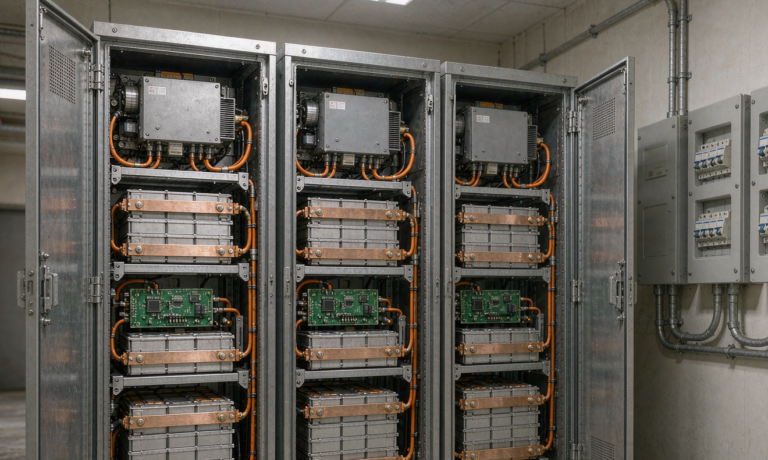
I have lost count of how many battery enclosures I have pried open on the coast only to find terminals crusted in white salt bloom and a BMS board quietly corroding from the inside. If you live within a few kilometers of the sea, or anywhere the relative humidity sits above 70% for months at a time, your home energy storage system is fighting a different battle than the one the brochure describes. The chemistry does not change, but the housing, the cooling path, the connector plating, and the certification assumptions absolutely do. In this guide I walk through what we actually specify, test, and field-repair on coastal installs, and how you can keep a home battery backup alive for its full warranty instead of watching it rust out in year four.
Why Coastal and Humid Air Breaks Batteries Differently
The enemy is not heat alone. It is a combination of three things that compound each other: salt aerosols carried on wind, high ambient humidity that never lets surfaces dry, and daily temperature swings that push enclosures through condensation cycles. Salt is hygroscopic, meaning it pulls moisture onto metal even when the air feels merely “damp.” Once a thin electrolyte film forms on a terminal, you get electrochemical corrosion that can eat plating in a single season.
From an engineering standpoint this matters because most consumer and light-commercial home energy storage system cabinets are rated to IEC 62619 for safety and UL 9540 for stationary installation, but those standards assume a controlled indoor or sheltered environment. They do not by themselves prove the box will survive a salt-spray chamber. We add dedicated environmental qualification on top: IEC 60068-2 salt mist and damp-heat sequences, and for plated parts we reference ISO 9227 neutral salt-spray hours. If a vendor cannot show you a salt-spray report, treat their “marine rated” claim as marketing.
Enclosure Rating: IP, NEMA, and What Actually Stops Salt
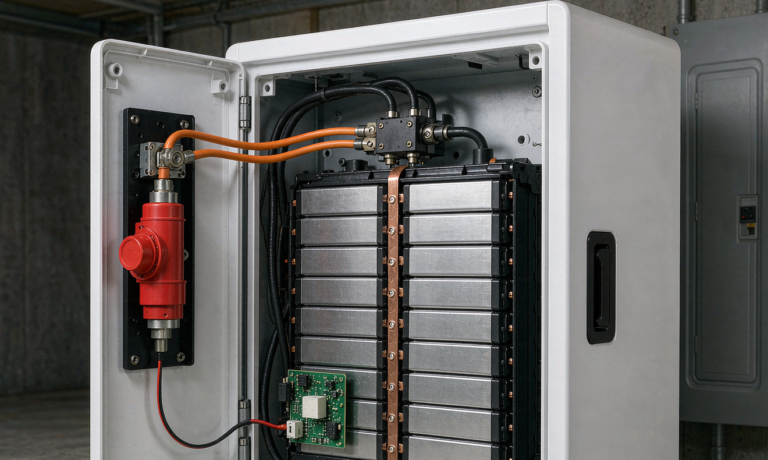
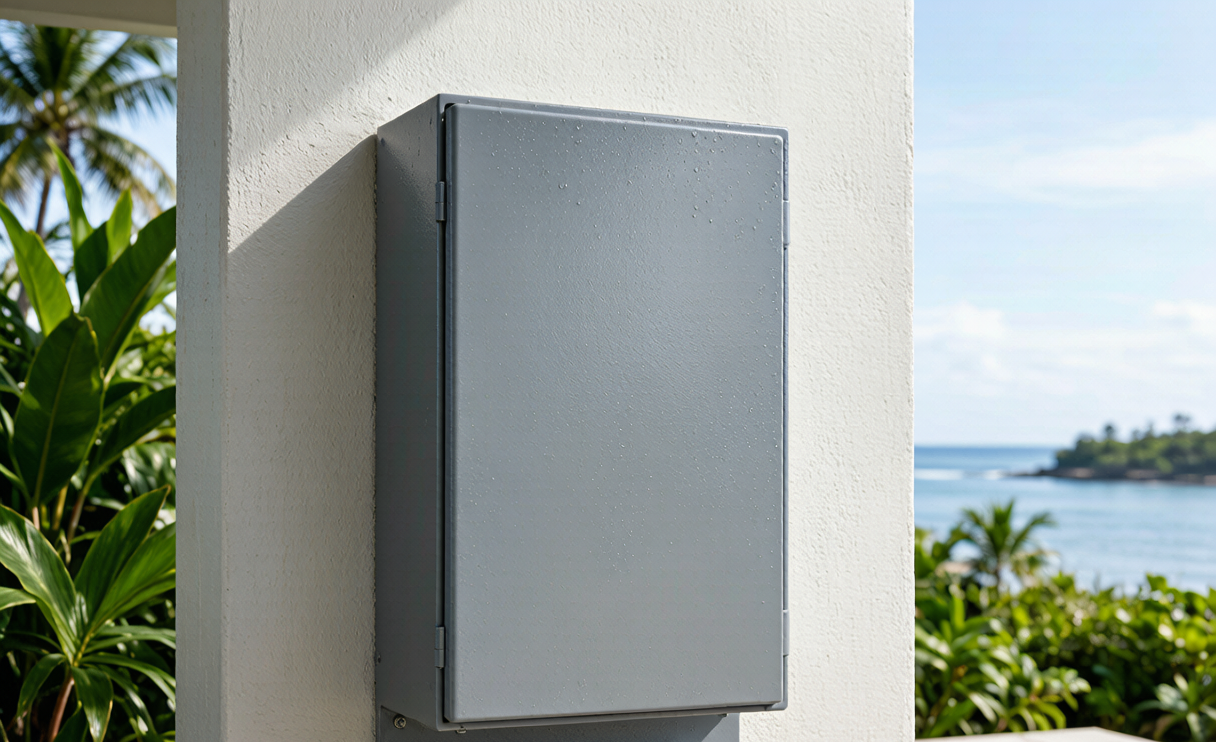
The single most important number on a coastal battery is its ingress protection against the combination of solids and water. For a sheltered wall mount near the sea, I will not specify below IP65. For fully exposed locations, IP66 (high-pressure jet proof) is the floor, and I prefer a NEMA 4X enclosure because that rating explicitly covers corrosion resistance, not just water. Note the distinction: IP stops water; NEMA 4X stops water and resists the corrosion salt causes. On a residential battery storage unit that lives outdoors year-round, that difference is the difference between a ten-year asset and a four-year liability.
- IP54 – indoor only, light dust. Never on a coast.
- IP65 – dust-tight, low-pressure water jets. Acceptable for covered carports.
- IP66 – dust-tight, high-pressure jets. Minimum for open coastal walls.
- NEMA 4X – IP66-class sealing plus corrosion-resistant construction. My default for exposed sites.
We also seal the cable glands with stainless or non-metallic fittings and use desiccant breather valves so the enclosure can equalize pressure without sucking humid air inside during cool nights.
Terminal and Connector Plating: Where the Cheap Systems Die
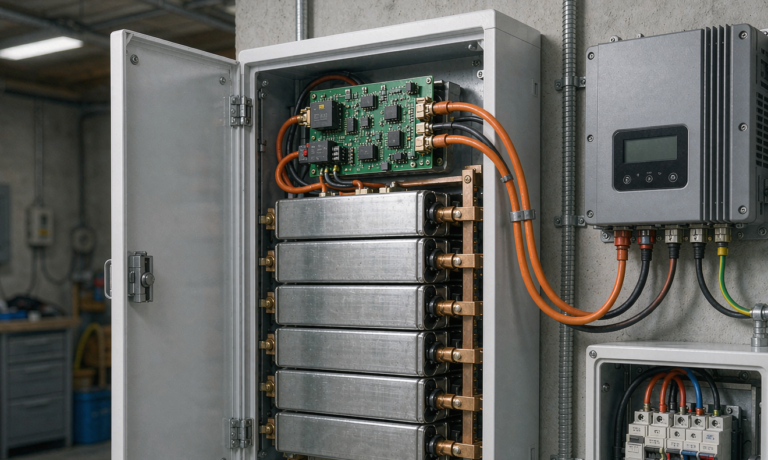
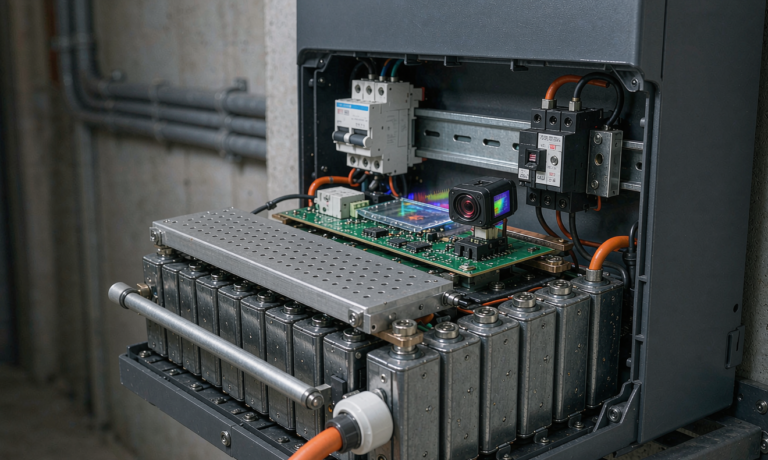
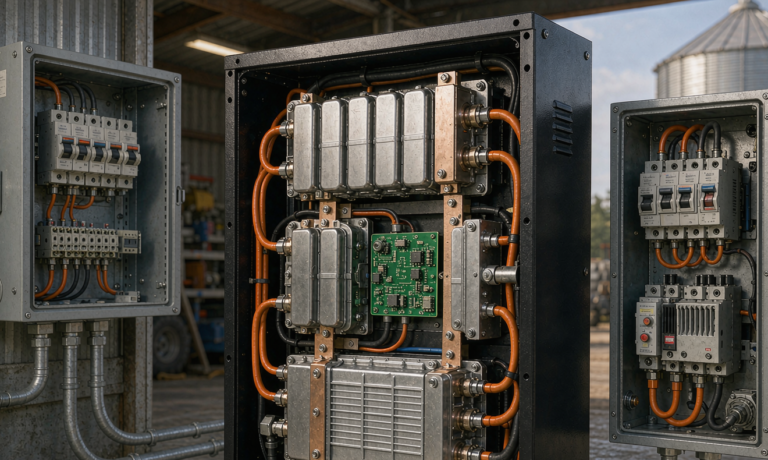
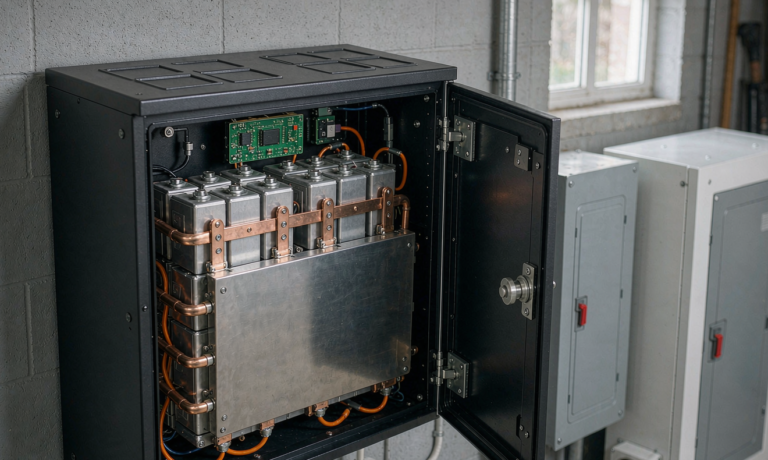
Inside the box, the first components to fail in humidity are usually the ones nobody photographs: busbar joints, communication connectors, and the BMS sensing wires. Tin plating is fine in a dry lab; in salt air it forms tin whiskers and corrodes fast. We specify gold-flashed or nickel-under-plated tinned copper for sensing links, and for power busbars we use either nickel-plated copper or tinned copper with anti-oxidant compound. I have pulled apart a competitor’s home battery backup that looked pristine outside but had green copper sulfate crawling up the internal sense wires after eighteen months on a barrier island.
Conformal coating on the BMS PCB is non-negotiable in these climates. A proper acrylic or parylene coating rated to IPC-CC-830 stops creep corrosion on the board. If the battery management electronics are uncoated, the unit does not belong within ten kilometers of the ocean.
Thermal and Condensation Management in High Humidity
Condensation is the silent killer. When a battery cycles and warms during the day, then the ambient drops at night, any unsealed air inside the enclosure reaches its dew point and drops water on the electronics. The fix is twofold: keep the internal atmosphere dry with a breather desiccant, and design the thermal path so the enclosure skin does not fall below dew point. On larger residential battery storage banks we add a small thermostatically controlled heater pad that holds the interior a few degrees above ambient, which sounds counterintuitive for efficiency but prevents condensation far more cheaply than replacing a corroded pack.
For passive-cooled designs, ventilation must be engineered so air enters through a desiccant filter, not a bare louvre. I have seen “ventilated” cabinets that were essentially salt-injection systems.
Certification and Code Checklist for Coastal Installers
The electrical code side does not relax near the water, it tightens. In the United States the relevant stack is NEC Articles 706 and 710 for storage, UL 9540 and UL 9540A for the system and fire propagation test, UL 1973 for the battery cells/modules, and IEEE 1547-2018 for grid interconnection. NFPA 855 sets the fire separation distances that matter even more in tightly packed coastal housing. On the inverter and power-conversion side we want IEC 62109 and IEC 62477-1. Note that UN38.3 (T.1–T.8) is the transport test and FAA/EASA rules govern air shipment, not stationary home use, so I do not cite them as a coastal-durability proof, only as the baseline the cells already passed to arrive at your door.
- UL 9540 / 9540A – system and thermal-runaway propagation safety.
- UL 1973 – stationary battery cells and modules.
- IEC 62619 – industrial secondary battery safety (the global baseline).
- NEC 706 / 710, NFPA 855 – installation and fire code.
- ISO 9227 / IEC 60068-2 – salt-spray and damp-heat environmental proof.
Specification Checklist: What I Tell Buyers to Request
If you are sourcing a custom battery solution for a coastal or tropical home, put these lines in the purchase spec and make the vendor sign against them. Vague “all-weather” language will not survive a warranty claim.
- Enclosure: NEMA 4X or minimum IP66, with documented salt-spray hours (ISO 9227).
- Internal electronics: conformal-coated BMS board, corrosion-resistant plating on all sense and power links.
- Breathing: desiccant breather valve, not an open vent.
- Condensation control: heater pad or sealed thermal design with dew-point analysis.
- Certifications: UL 9540/9540A/1973 or IEC 62619, plus IEEE 1547-2018 for interconnection.
- Warranty: explicit capacity retention clause that survives coastal installation, not a generic indoor-only warranty.
Siting and Mounting: Distance From the Water Matters More Than You Think
Even the best enclosure has a harder life the closer it sits to breaking surf. As a rule of thumb, every hundred meters of setback from the high-tide line roughly halves the salt-load the unit sees, because the aerosol concentration drops off steeply once you are past the surf zone. I try to site a home energy storage bank at least 300 meters from the shoreline and never on the ocean-facing wall if a sheltered wall exists. North and land-facing walls accumulate far less salt. Mounting height helps too: raising the enclosure 30–60 cm off a concrete pad keeps it out of the salt-laden boundary layer that hugs the ground, and it improves airflow so the skin stays above dew point.
For homes on stilts or piers, I push the battery indoors into a conditioned space rather than fight the environment outside. A home battery backup in a climate-controlled utility room will outlast three generations of “marine-grade” boxes bolted to a piling. The cheapest corrosion control is often just moving the unit behind a wall.
Monitoring: Catch the Failure Before Salt Does
Coastal systems reward remote monitoring because the first sign of trouble is subtle: a slow sense-wire drift, a creeping internal-resistance trend, a BMS temperature that never quite matches ambient. We log cell-level voltage and temperature to the cloud and alert on any channel diverging more than a small threshold from its neighbors. In a humid climate, a single corroding sense connection will show up as one cell reading oddly against the pack long before any capacity loss is visible to the owner. Catching it at that stage is a ten-minute fix; ignoring it for a season can mean replacing the whole module. For a residential battery storage install I consider remote trend monitoring part of the base specification, not an upsell.
Maintenance Reality: What Coastal Owners Should Actually Do
A home energy storage system on the coast is not fit-and-forget. I recommend a six-month visual and electrical check: inspect the enclosure gasket for compression set, verify the desiccant window (replace if saturated), torque-check terminals, and log cell imbalance trends from the BMS. The earlier you catch a drifting sense wire or a weeping gland, the cheaper the fix. In my experience the systems that reach ten years in humidity are the ones whose owners treat the six-month check as sacred, not the ones with the fanciest marketing.
Frequently Asked Questions
Can a standard indoor home battery backup be used in a coastal garage?
Only if the garage is sealed, climate-controlled, and the unit carries at least IP65 with conformal-coated electronics. A “garage-rated” label is not enough near salt water. If the space sees condensation on the walls in the morning, the battery needs NEMA 4X and a desiccant breather, or you should keep it indoors in a controlled room.
How much does salt air shorten battery life?
Unprotected, a standard pack can show terminal corrosion and capacity loss within 2–3 years in a harsh coastal site. With proper NEMA 4X enclosure, coated electronics, and a breather system, we routinely see full 10-year warranties met. The gap is entirely in the housing and plating, not the cells.
Is IP65 enough for a beachfront home?
IP65 is the minimum I accept for a covered, sheltered wall. For an exposed beachfront or pier-side wall, step up to IP66 and NEMA 4X. IP65 will eventually let high-pressure wind-driven spray past the seal, and once salt is inside, corrosion is a clock that is already running.
Does humidity affect the battery chemistry itself?
The sealed cells are largely immune if the enclosure holds. The real damage is external: corrosion of terminals, connectors, and the BMS board, plus condensation-driven shorts. Proper sealing and conformal coating keep humidity away from everything that matters, so the lithium chemistry itself behaves exactly as it would in a dry climate.
What certification proves a battery is coastal-ready?
No single cert does. UL 9540/1973 and IEC 62619 prove electrical safety, not corrosion resistance. The coastal proof is environmental testing: ISO 9227 salt-spray hours and IEC 60068-2 damp-heat cycles, plus a NEMA 4X enclosure rating. Ask the vendor for the salt-spray report specifically.