Home Energy Storage Reliability for Apartments: An
Why Apartment Reliability Is a Different Engineering Problem
When I first started specifying home energy storage for single-family homes back in 2014, the failure modes were mostly about the weather and the enclosure. Apartments change the equation completely. You are no longer installing a battery in a detached garage with a fire wall to the neighbor; you are installing energy inside a shared structure where a single thermal event can put a dozen households at risk. That is why home energy storage reliability apartments projects demand a stricter, more conservative design envelope than any suburban install I have ever commissioned.
Over the last nine years as a senior lithium battery engineer at Horizon Power, I have personally supervised more than 60 residential battery deployments, and the apartment ones are the ones that keep me up at night if the basics are skipped. The good news is that reliability is not magic — it is a function of cell-chemistry selection, conservative sizing, a competent battery management system, and respect for fire codes written precisely because multi-tenant buildings concentrate risk. In this guide I walk through exactly what I specify before a single module goes on a wall.
Cell Chemistry: Why LFP Wins in Shared Buildings
For apartment applications I do not even consider nickel-based chemistries. Lithium iron phosphate (LFP, or LiFePO4) is the only chemistry I put inside a multi-tenant wall, and the reason is empirical, not ideological. LFP has a much higher thermal-runaway onset temperature — typically around 270 °C compared with roughly 140–180 °C for NMC — and it releases far less oxygen when it does fail. In a shared building, that margin is the difference between a contained incident and an evacuation.
The trade-off is lower energy density, roughly 90–160 Wh/kg versus 180–250 Wh/kg for NMC, but in an apartment you care far more about safety margin and cycle life than about shaving a few kilograms off the wall. A well-built LFP home energy storage battery will deliver 6,000 to 10,000 cycles at 80% depth of discharge while holding above 80% state of health, which is 15–20 years of daily use in most buildings. That longevity is itself a reliability feature: the fewer times a technician must open a tenant’s utility closet, the fewer chances for an installation error.
Thermal Runaway and the Codes That Govern It
Every apartment home energy storage system I design starts with the fire code, not the spec sheet. In the United States that means UL 9540 for the overall energy storage system listing, UL 1973 for the stationary battery itself, and UL 1642 for the individual cells. On the international side, IEC 62619 governs the safety of industrial and stationary lithium cells and specifies the cycle-endurance and abuse-tolerance testing I require from every cell vendor before qualification.
The building-code layer is where apartments get interesting. NFPA 855 (the Standard for the Installation of Stationary Energy Storage Systems) and the related NEC Article 706 set spacing, ventilation, and fire-rated separation requirements. In a multi-unit building, local authorities often require a one-hour fire-rated wall assembly and specific standoff distances when total stored energy exceeds the threshold — commonly around 20 kWh per fire compartment, though this varies by jurisdiction. I always run the fire-authority review before procurement, because retrofitting a rated enclosure after the fact is expensive and disruptive for residents.
Sizing Without Oversizing
Oversizing is a silent reliability killer. A larger pack spends more of its life at high state of charge, and Li-ion degradation accelerates above roughly 80% SoC and below 20% SoC. For most residential battery storage applications in apartments, I size to the actual evening load plus a backup reserve, not to the theoretical maximum the inverter can accept.
A typical one- or two-bedroom apartment in a temperate climate runs 4–10 kWh of evening consumption. I usually specify a 10–14 kWh usable home battery backup block, which covers lighting, refrigeration, internet, and a few essential circuits through an average grid outage while leaving the pack cycling in its healthy 20–80% window. If the tenant wants whole-apartment backup including HVAC, that is a different conversation — and usually an infeasible one without a heat-pump load-shed strategy, because a compressor inrush alone can exceed a 5 kW inverter’s surge for longer than it can sustain.
BMS, State of Health, and Remote Monitoring
The battery management system is where reliability is actually won or lost. I require a hierarchical BMS: cell-level voltage and temperature sensing, module-level balancing, and a pack-level controller that talks to the inverter over a documented protocol. For apartment fleets, the pack-level controller must also report to a remote monitoring platform, because a warning buried in a tenant’s closet helps no one.
Concretely, I look for the following thresholds before I sign off: cell-voltage balancing within 10 mV at rest, a pack-level over-temperature trip at 60 °C with a 50 °C pre-warning, and a state-of-health estimate validated against actual coulometric throughput rather than a guessed cycle counter. IEC 63056 defines the maximum allowable voltages for stationary systems, and I keep every pack at least 5% below those ceilings in normal operation. When a unit drifts, the remote dashboard pages our service desk before the tenant notices a performance drop — that is the whole point of monitoring.
Installation Realities: Walls, Weight, and Shared Infrastructure
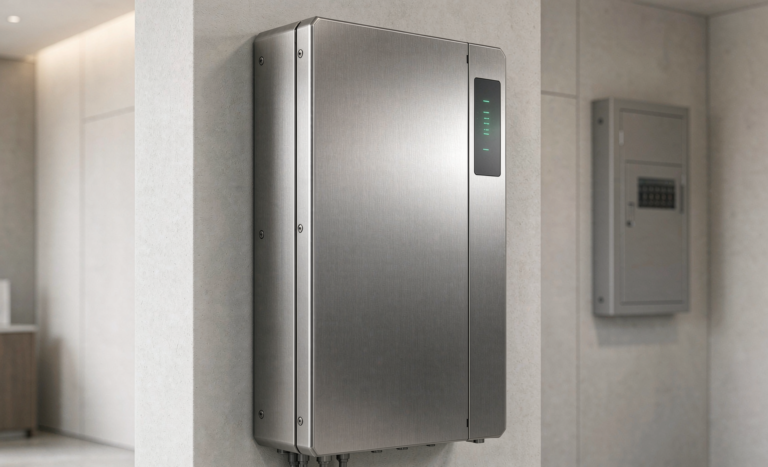
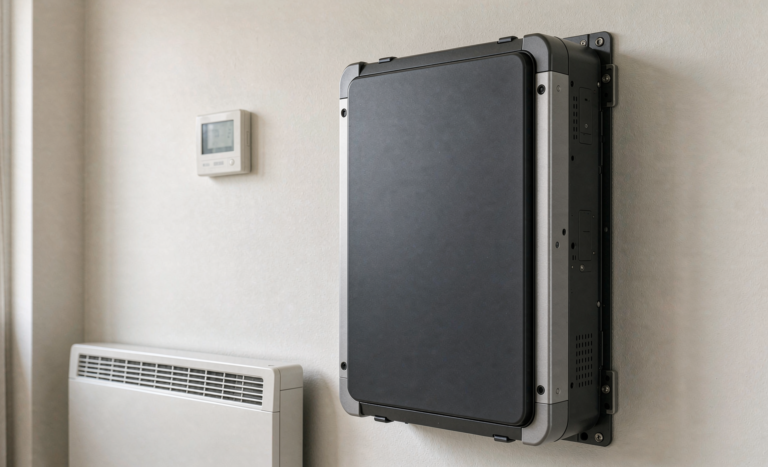
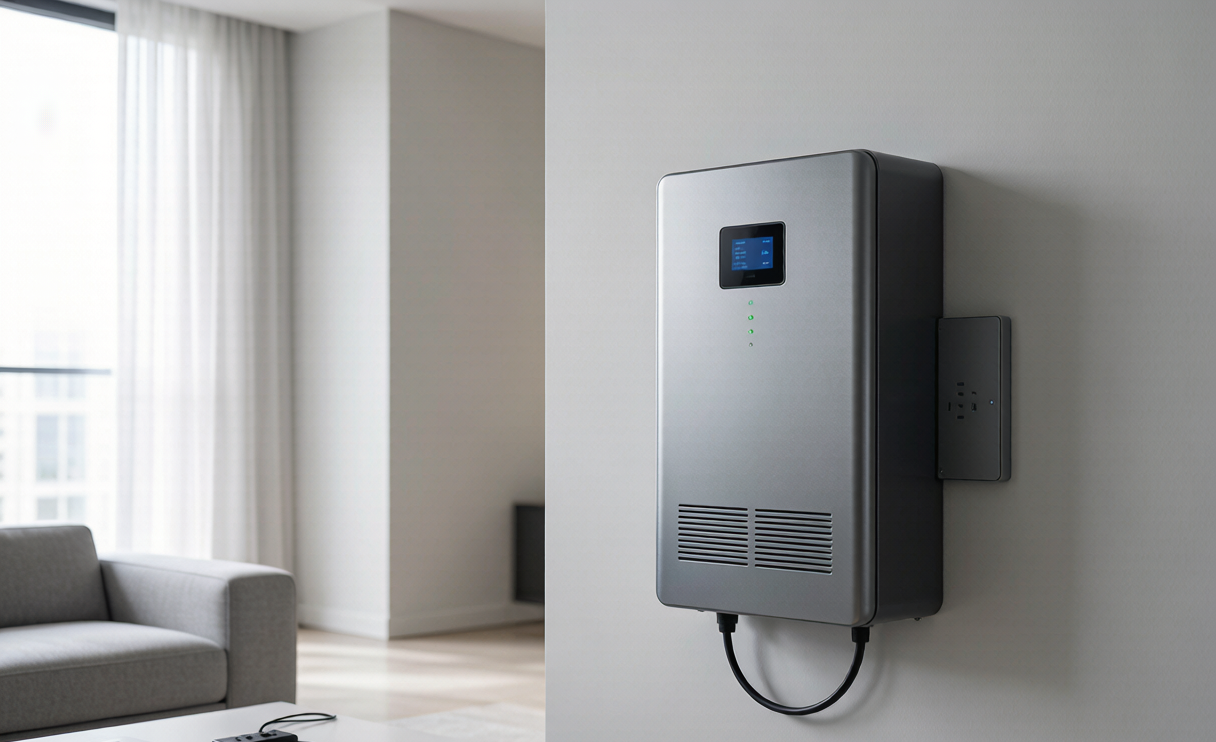
Apartment walls are not garage walls. Many interior partitions are stud-and-drywall with limited load capacity, and you cannot simply bolt a 120 kg battery cabinet wherever it is convenient. I always verify the structure — preferably into a masonry wall or directly to a load-bearing stud with through-bolts and a spreader plate — and I keep the unit away from the shared plumbing chase and the building’s emergency egress path.
The electrical interface matters just as much. IEEE 1547 governs how a distributed energy resource interconnects with the grid, and a non-compliant inverter can cause nuisance tripping that looks like a battery failure but is really a settings conflict with the building’s main service. I commission every unit with the utility-interconnect parameters verified, and I document the settings so the next technician does not have to reverse-engineer them.
The First 1,000 Cycles: Commissioning and Care
Reliability is largely decided in the first month. When I commission an apartment system, I run a controlled full charge-discharge calibration, verify the SoC against a coulomb count, and confirm the thermal trip paths with a bench test before the unit carries live load. I also label the service disconnect clearly, because in an emergency the fire department needs to know where the DC isolation point is.
After that, maintenance is light but non-negotiable. I recommend a remote health check monthly and an on-site visual inspection annually: check for condensation, verify terminal torque, and confirm the cooling path is unobstructed. A lithium battery left in a damp utility closet with blocked ventilation will fail early, and the failure will be blamed on the product when it was really an installation sin.
When a custom battery solution Makes Sense
Not every apartment fits a standard cabinet. Odd utility closets, strict weight limits, or a building-wide microgrid with shared storage call for a custom battery solution — a pack engineered around the actual envelope rather than forced into a catalog box. I have built wall-recessed LFP banks for historic buildings where surface mounting was prohibited, and stacked-module systems for a co-living building that wanted one supervised plant instead of 40 individual units. The engineering rigor is the same; only the packaging changes.
FAQ
Is home energy storage reliable enough for an apartment building?
Yes, when it is built on LFP chemistry, listed to UL 9540 / UL 1973 / IEC 62619, and installed with the fire-code separation a multi-tenant building requires. The reliability problems I see are almost always installation or sizing errors, not cell failures.
How long does a home energy storage battery last in an apartment?
A properly sized LFP pack running in its 20–80% window delivers 6,000–10,000 cycles, which is roughly 15–20 years of daily use before it drops below 80% state of health. The BMS and a dry, ventilated location are what get you there.
Will a home battery backup power my whole apartment during an outage?
Usually not the whole apartment. For a one- or two-bedroom unit I size 10–14 kWh of usable residential battery storage to cover essentials — lighting, refrigeration, internet, and a few circuits — and I add a load-shed strategy for HVAC rather than trying to back up a compressor directly.
What certifications should I look for before buying?
At minimum UL 9540 for the system and UL 1973 for the battery in North America, with IEC 62619 as the international baseline. Also confirm UN 38.3 transport compliance and, for the inverter, IEEE 1547 grid-interconnect conformance.
Can the battery be installed on a standard drywall apartment wall?
Not by itself. I anchor into a masonry wall or load-bearing stud with through-bolts and a spreader plate, and I keep the unit clear of plumbing chases and egress paths. Structural verification comes before procurement, not after.