Drone Battery Warranty, Claims and Failure Analysis
Every drone battery I have ever designed eventually comes back to me. Not all of them, and not most of them — but a small, steady stream of returned packs lands on my failure-analysis bench each month, and those packs teach me more than any qualification report ever will. After fifteen years designing and validating lithium packs for commercial UAV platforms, I have learned that a warranty is not a marketing promise. It is an engineering contract, and the only way to honour it fairly is to know exactly why a cell died.
This article is the process I actually use. It covers what a drone battery warranty should and should not cover, the data that decides a claim in minutes rather than weeks, the teardown workflow that separates a genuine manufacturing defect from field abuse, and the five failure modes that account for the overwhelming majority of returns I see. If you operate a fleet, buy packs at volume, or specify a custom battery solution for an airframe programme, this is the language you want to be speaking with your supplier.

What a Drone Battery Warranty Actually Covers
The single most common dispute I mediate starts with a misunderstanding: an operator believes a twelve-month warranty means twelve months of full capacity. It does not, and no honest manufacturer can promise that, because a lithium battery is a consumable electrochemical device that degrades every time you use it.
A properly written drone battery warranty has two separate clauses, and conflating them causes most of the friction I see:
- Workmanship and defect warranty — typically 12 months from shipment. This covers latent manufacturing faults: a bad weld on a tab, a BMS component failure, a connector that was never crimped to specification, a cell with an internal short that seeded during winding. These failures are binary and they show up early. In my production data, roughly 80–90% of true defect returns surface within the first 30 cycles.
- Capacity retention warranty — expressed as a percentage at a cycle count, measured under defined conditions. For a high-energy NMC or NCA drone pack I will typically warrant ≥80% of rated capacity at 300 cycles, tested at 0.5C discharge, 25 ±3 °C, 100% depth of discharge. For a high-power LiPo racing pack the same threshold might sit at 150–200 cycles because 10C–20C bursts are brutal. For an LFP ground-support or charger-buffer pack, 2,000–4,000 cycles to 80% is realistic.
Notice how much of that definition is test conditions rather than numbers. A capacity claim measured at 2C in a 40 °C hangar will read 8–12% lower than the same pack measured at 0.5C and 25 °C. If the warranty does not state the measurement method, it is unenforceable in both directions. When I write specifications for a custom drone battery, the acceptance test procedure sits in the warranty annex, not in a separate document nobody reads.
Equally important is what a warranty cannot cover. Crash damage, water immersion, over-discharge below the cut-off, charging above the temperature gate, third-party connector modifications, and puncture from a foreign object are all outside the envelope — not because manufacturers want an escape hatch, but because those events physically alter the cell in ways that are forensically identifiable. I will show you how below.
The Data That Decides a Claim
I can resolve about half of all warranty claims without ever opening the pack, purely from data. The other half need a teardown. What separates a two-day resolution from a six-week argument is whether the operator captured the following:
- Pack serial and build traceability. Every pack I ship carries a serial that maps to cell lot, build date, BMS firmware revision, and the outgoing test record — capacity, 1 kHz AC internal resistance, cell-to-cell voltage delta, and thickness at 3.85 V/cell. Without that baseline, “the capacity is low” is an opinion.
- BMS event log. Modern smart packs store cycle count, cumulative amp-hours, maximum and minimum cell voltage ever seen, maximum cell temperature, peak discharge current, and fault flags. This log is the single highest-value artefact in a claim. A pack that logged a 2.4 V/cell minimum has been over-discharged, and no amount of discussion changes that.
- Charger records. Charge current, termination voltage, and pack temperature at charge start. I gate charging at 40 °C for a reason; packs that land at 45–55 °C after an aggressive sortie and go straight onto a 1C charger age two to three times faster.
- Flight logs. Current draw profile, all-up weight, and ambient conditions. A pack rated for 5C continuous flown at 8C because the customer added a heavier gimbal is a specification mismatch, not a defect — and it is a conversation about a different pack, not a refund.
- Storage history. Time at full charge is the quiet killer. A lithium battery parked at 4.20 V/cell and 35 °C for three months can lose 6–10% of its capacity permanently. Storage at 3.80–3.85 V/cell in a 15–25 °C space costs nothing and preserves everything.
My advice to fleet managers is blunt: make log export part of the pre-return checklist and put it in your standard operating procedure. Fleets that do this get claims approved in days. Fleets that ship a pack in a box with a sticky note saying “bad” wait for the teardown queue.
My Failure-Analysis Workflow, Step by Step
When a returned drone lithium battery reaches my bench, it goes through a fixed sequence. The order matters, because each step destroys information available to the previous one.
1. Safe intake and quarantine
Returned packs arrive at ≤30% state of charge, as required for air transport under IATA dangerous goods rules for UN3480 and UN3481 shipments. On arrival the pack goes into a steel containment bin on a non-combustible surface for 24 hours minimum. If it is visibly swollen, hot, or smells of solvent, it never enters the main lab — it is discharged in a fume-extracted cabinet first. I have seen exactly one pack ignite during intake in my career, and that discipline is why it did no damage.
2. Photographic and dimensional record
Six-sided photography, then a digital caliper across each cell face at three points. My swelling threshold is 5% thickness growth over the outgoing record. Between 5% and 10% I treat the pack as end-of-life. Above 10% it is a safety-critical failure and I want to know why. Thickness is the cheapest diagnostic in the entire process and almost nobody measures it.
3. Electrical characterisation, non-destructive
Open-circuit voltage per cell, then internal resistance two ways: 1 kHz AC impedance for a repeatable comparison against the build record, and a DC pulse method (3C for 10 seconds, measure the voltage drop) because that is what the airframe actually experiences. My retirement criteria are consistent across product lines:
- Capacity below 80% of rated at 0.5C, 25 °C
- Internal resistance at or above 2× the outgoing baseline
- Cell-to-cell voltage delta above 50 mV after a full balance charge and one-hour rest
- Thickness growth above 5%
Then a capacity cycle: full charge at 0.5C, rest, discharge at 0.5C to the cut-off, repeat three times and take the median. One measurement is noise; three is data.
4. Thermal imaging under load
A 2C–3C discharge with an infrared camera on the pack face. A healthy pack shows a smooth gradient with 3–5 °C spread across cells. A localised hot spot 8–15 °C above its neighbours points to a high-resistance interconnect or a degraded cell, and it tells me exactly where to cut during teardown.
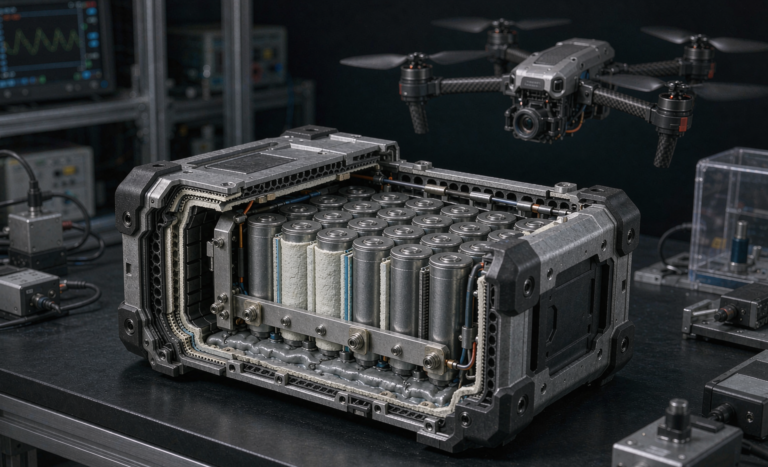
5. Controlled teardown
Discharge to below 2.5 V/cell for safety, then open the enclosure and inspect welds, busbars, sense leads, the BMS board, and the connector interface. I measure interconnect resistance with a four-wire Kelvin setup; my design budget keeps total interconnect resistance under 15% of pack resistance, so on an 8–12 mΩ pack anything above about 1.8 mΩ is a finding. Cell opening happens in a dry room only when I need to see the electrode stack, separator, and jelly-roll alignment.
6. Root cause and corrective action
Every analysis closes with a written cause classification, an 8D-style corrective action if the cause is internal, and an update to the process FMEA. A failure analysis that does not change a process is just an autopsy.
The Five Failure Modes I See Most
Across several thousand analysed returns, the distribution is remarkably stable. These five account for the large majority of everything that comes back.
Over-discharge damage (the most common by far). The signature is unmistakable: a cell that logged below 2.5 V, often below 2.0 V, with elevated internal resistance and low capacity but no swelling. Below roughly 2.0 V the copper current collector begins to dissolve, and on recharge that copper redeposits as dendrites that can pierce the separator. When I run energy-dispersive X-ray spectroscopy on the separator of such a cell, I find copper. This is a hard-fail, non-warrantable outcome, and the pack must be retired — not “nursed back”. Root cause is almost always a pilot flying past the low-voltage warning, or a pack stored for months until self-discharge walked it below the floor.
Charge-side abuse and lithium plating. Charging a cold pack (below 0 °C) or at excessive current drives metallic lithium onto the anode instead of intercalating it. Capacity drops fast, resistance climbs, and the cell gasses and swells. Under teardown the anode shows grey-silver plating that is visible to the naked eye. Cell temperature at charge start is the controlling variable; I specify a 0–45 °C charge window and a 10–25 °C warm-up target for cold-climate operations, using a 5–15 W pad heater where needed.
Interconnect and connector degradation. This one masquerades as a cell problem. A contact that starts at 0.3 mΩ and degrades to 2.5 mΩ after several hundred mating cycles dissipates 25 W at 100 A inside a housing rated for a fraction of that. Symptoms: reduced flight time, voltage sag under throttle, discoloured or deformed connector housing, carbon tracking. Fix: gold-over-nickel plated contacts rated for the actual current, correct wire gauge, crimps qualified to IPC/WHMA-A-620 pull-force values, and a temperature rise limit of 30 K per IEC 61984. This is a workmanship claim if the crimp was ours, and a maintenance issue if the operator has been stacking adapters.
Mechanical damage from crash or vibration. Impact offsets the jelly roll or wrinkles a pouch stack; sustained vibration fatigues sense leads and solder joints. The tell is asymmetric: one cell abnormal, the rest pristine, with matching external deformation or a fractured lead. Packs that fly on high-vibration airframes need conformal coating, potting or foam support, and strain relief anchored within 30 mm of the exit — validated to DO-160 or MIL-STD-810 vibration profiles across 5–2,000 Hz.
Genuine cell manufacturing defects. These exist, and they are the reason the warranty exists. Internal micro-shorts from particle contamination or winding misalignment produce a distinctive pattern: abnormal self-discharge (a cell that drops 30–80 mV over a week when its siblings drop 5–10 mV), normal capacity initially, then rapid divergence. They are screened at incoming inspection with a high-precision open-circuit-voltage decay test over 7–14 days, which is why lot traceability matters so much. When I confirm one, the corrective action is not a replacement pack — it is a quarantine of the entire cell lot.
Abuse or Defect: How the Line Gets Drawn
Operators sometimes assume this judgement is arbitrary. It is not. Physical evidence is durable and specific:
- Copper on the separator → over-discharge. Not a defect.
- Metallic lithium plating on the anode → cold or over-current charging. Not a defect.
- Chloride residue and terminal corrosion → moisture or salt ingress. Not a defect unless the pack was sold with a stated IP rating it failed to meet.
- Electrolyte decomposition products with no over-voltage in the log → sustained over-temperature. Investigate thermal design; potentially shared responsibility.
- Weld porosity, missing spot welds, cold solder joints, incorrect crimp height → workmanship. Fully warrantable.
- Particle inclusion at a short site under microscopy → cell manufacturing defect. Fully warrantable, plus lot containment.
Where evidence is genuinely ambiguous — and roughly one claim in ten is — I split it. A goodwill replacement at partial cost, plus a documented design or procedure change, keeps a fleet flying and keeps the engineering feedback loop honest. Fighting a customer to win a marginal claim is the most expensive way to save money I know.
Building a Warranty Policy That Survives Fleet Scale
A policy that works for a hobbyist buying two packs collapses at 500 packs across four sites. If you are specifying a lithium battery programme at fleet scale, insist on these elements:
- Serialised traceability with outgoing test data for every unit, delivered as a file, not a paper certificate.
- A defined acceptance test procedure with current rates, temperatures, and rest periods stated numerically.
- A two-clause structure separating workmanship from capacity retention, with cycle counts appropriate to the chemistry — 300–600 cycles for high-energy NMC/NCA, 150–300 for high-power LiPo, 2,000–4,000 for LFP support packs.
- An agreed RMA turnaround — I commit to 5 working days for data-only claims and 15 for teardown claims — plus advance-replacement terms so an aircraft is not grounded waiting for forensics.
- A quarterly failure-Pareto review. This is the clause that pays for itself. Reviewing the top three return causes every quarter has, in my experience, cut fleet return rates from 1.5% to under 0.5% within a year, mostly by fixing operator procedures rather than hardware.
- Clear end-of-life and disposal terms. A retired pack is a regulated waste stream, and a good supplier takes it back.
None of this is exotic. It is the same discipline that qualification testing already imposes: every pack I ship is validated to UN 38.3 tests T.1 through T.8 (altitude, thermal cycling, vibration, shock, external short, impact/crush, overcharge, forced discharge) and to IEC 62133-2:2017 for the cell and pack safety envelope. Those tests prove the design is sound. Failure analysis proves the build and the operation are sound — and only the two together give you a pack you can trust over a runway.
Field Practices That Prevent Most Claims
The cheapest warranty claim is the one nobody files. Four habits eliminate most of what I see:
- Respect the low-voltage floor. Land at 20–30% state of charge. Never fly to the cut-off. This single change removes the number-one failure mode.
- Gate charging on temperature. Let packs cool to below 40 °C before charging, and warm them above 0 °C (ideally 10–25 °C) before charging in winter. Charge at 1C, not 2C, unless the mission genuinely requires it.
- Store at 3.80–3.85 V/cell in a 15–25 °C space, and rotate stock first-in-first-out so no pack sits idle for a season.
- Log and inspect. Monthly internal-resistance and thickness checks against the build record catch a failing cell weeks before it strands an aircraft. It takes about 90 seconds per pack.
For operators running mixed airframes or unusual duty cycles, this is also where a custom battery solution earns its cost. A pack designed around the actual current profile, thermal environment, and turnaround schedule of your operation will outlive an off-the-shelf pack by a wide margin — and it will generate far fewer arguments about who owes whom a replacement.
Frequently Asked Questions
How long should a drone battery warranty last?
Twelve months for workmanship and defects is the commercial norm, paired with a capacity-retention clause tied to cycles rather than time. Expect 80% capacity at 300–600 cycles for high-energy NMC/NCA packs, 150–300 cycles for high-power racing LiPo, and 2,000–4,000 cycles for LFP support packs. A warranty stated only in months, with no cycle basis and no test conditions, is a warranty you cannot enforce.
Is a swollen drone battery covered under warranty?
It depends entirely on the cause, which is why we measure. Swelling within the first few cycles with no abuse in the log usually indicates a cell defect and is covered. Swelling after hundreds of hard cycles, after storage at full charge, or with over-discharge or over-temperature events in the log is normal end-of-life or abuse and is not covered. Either way, stop using the pack immediately: growth beyond 5% of original thickness is a retirement criterion, and a swollen pack should be isolated in a non-combustible container.
What data should I send with a battery warranty claim?
The pack serial number, the full BMS event log (cycle count, minimum and maximum cell voltage, maximum temperature, peak current, fault flags), charger settings and pack temperature at charge start, flight logs showing the current profile and all-up weight, storage conditions and duration, and six-sided photographs. With that package I can usually reach a decision without a teardown, which cuts resolution time from weeks to days.
Does over-discharging a drone lithium battery void the warranty?
Yes, and the evidence is forensic rather than a matter of opinion. Below about 2.0 V per cell the copper current collector begins to dissolve, and the copper redeposits as dendrites during the next charge. Elemental analysis of the separator finds that copper directly. The pack must be retired regardless of how it behaves on a test charge, because the internal short risk is permanent.
Can a battery be repaired or re-celled under warranty?
For a genuine workmanship fault on the interconnect, BMS, or connector, yes — I would rather rebuild the harness than scrap good cells. For any cell-level electrochemical damage, no. Mixing a new cell into an aged series string creates a permanent imbalance: the new cell has lower resistance and higher capacity, so the old cells hit their limits first, and the pack becomes less safe than before. Re-celling is only sensible when the entire series string is replaced together.
What internal resistance increase means my pack is finished?
Two times the outgoing baseline, measured the same way it was measured at build — 1 kHz AC impedance for comparability, confirmed with a 3C, 10-second DC pulse for real-world sag. At 2× baseline the pack sags harder under throttle, runs hotter, and delivers noticeably less usable energy even if the nominal capacity test still looks acceptable. Combined with a cell delta above 50 mV or thickness growth above 5%, it is an unambiguous retirement signal.