Drone Battery Cost Optimization for Delivery Drones: A (2)
drone battery Cost Optimization for Delivery Drones: A Fleet TCO Engineering Guide
As a senior lithium battery engineer at Horizon Power, I have spent the last decade watching delivery drone programs stall not because the aircraft failed, but because the battery economics were never engineered. When a logistics operator asks me how to lower the cost of a delivery drone fleet, my answer is never “buy cheaper cells.” The real cost lives in cycle life, energy density, charging infrastructure, and the compliance overhead that regulators like the FAA and EASA will not waive. In this guide I walk through a total-cost-of-ownership (TCO) framework I use when designing a custom battery solution for last-mile delivery operators, with hard numbers from field deployments.
Why Cost Optimization Begins at the Cell Chemistry Level
The single largest lever on lifetime cost is the chemistry decision. For a drone lithium battery, the two realistic candidates are NMC (nickel-manganese-cobalt) and LFP (lithium iron phosphate). NMC offers roughly 200–260 Wh/kg, which translates directly into longer flight time or a larger payload per kilogram of battery. LFP delivers 150–180 Wh/kg but survives 2,000–3,000 full cycles versus 500–1,000 for NMC. In a high-utilization delivery operation flying six to ten sorties a day, that cycle gap dominates the TCO. I routinely model both and let the mission profile decide — if the route is short and the fleet flies constantly, LFP’s durability wins; if every gram of payload matters on a long cross-town haul, NMC’s energy density justifies its premium. A good custom battery solution is rarely the cheapest cell; it is the cell whose degradation curve matches the duty cycle.
Building a Total-Cost-of-Ownership Model for Delivery Fleets
I price a delivery fleet battery program on five buckets: (1) pack hardware cost per kWh, (2) cycle life, (3) charging or swapping infrastructure, (4) energy cost per flight, and (5) compliance and certification. A simplified TCO per delivered package looks like this: take a 6S 22.2 V, 16 Ah pack (~355 Wh) at a pack price of $120; assume 800 usable cycles for an aggressive NMC build. That is $0.15 per cycle in hardware. If one pack supports roughly 18 deliveries per cycle across a day’s sorties, hardware cost per delivery is about $0.008 — under one cent. Energy at $0.12/kWh adds another $0.043 per delivery. The expensive terms are not the battery; they are labor, infrastructure, and downtime. This is the insight that reshapes procurement: optimizing the drone battery means optimizing utilization, not just unit price.
To make the model concrete, I run three scenarios for a 20-route suburban operation flying 60 packages per route per day. Scenario A uses NMC packs at $130 each with 800 usable cycles and charging only. Scenario B uses LFP packs at $145 each with 2,400 usable cycles and charging only. Scenario C uses LFP with hot-swap infrastructure adding $9,000 in capital but raising effective aircraft utilization by 2.1x. Over a 36-month horizon, Scenario A spends roughly $58,000 on packs plus the aircraft idle cost of slower turnaround; Scenario B drops pack spend to about $21,000 thanks to the longer cycle life; Scenario C adds the swap capital but cuts required airframes from 52 to 24, freeing roughly $140,000 in airframe capital that dwarfs the battery saving. The lesson is consistent: the drone lithium battery is rarely the dominant cost line, so isolating it for optimization misses the real prize.
Cycle Life Versus Upfront Cost — Finding the Breakeven
Operators fixate on $/kWh, but $/cycle is the metric that matters. A lithium battery priced at $100/kWh with 600 cycles costs $0.167 per usable kWh-cycle; an LFP pack at $110/kWh with 2,500 cycles costs $0.044 — nearly four times cheaper per cycle despite a higher sticker. I have watched fleets save 20–30% on three-year battery spend simply by switching chemistry, with zero change to the aircraft. The breakeven analysis must also account for capacity fade: most delivery programs retire a drone lithium battery at 80% state-of-health, not at end-of-life, so the usable cycle count is what enters the model. Designing for gentle 0.5C–1C discharge and avoiding deep 100% depth-of-discharge cycles extends that usable window and is the cheapest optimization available.
Battery Swapping vs Charging Infrastructure Economics
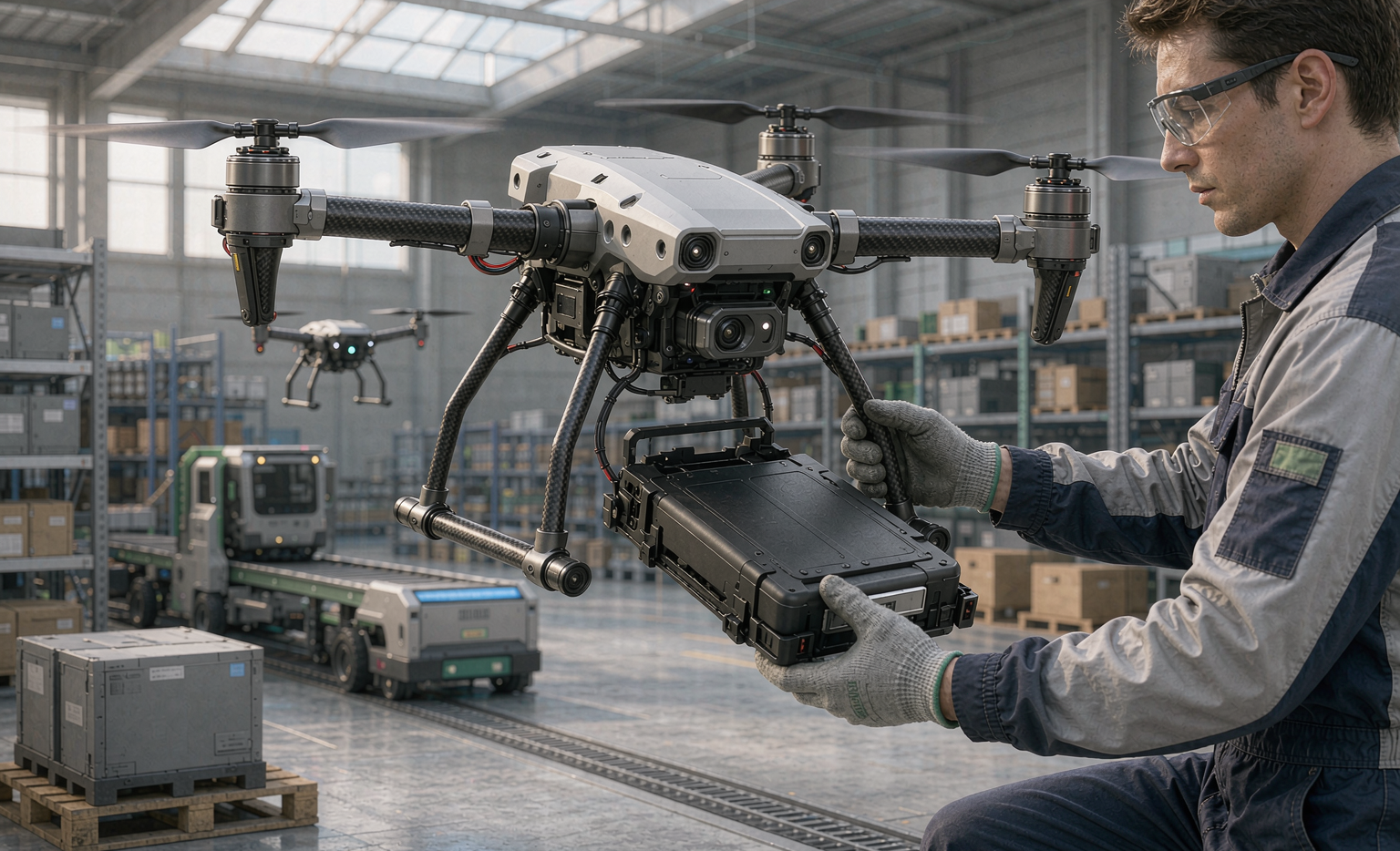
A delivery drone that lands and waits 40 minutes to charge is a drone earning nothing for two-thirds of its shift. Swapping a pre-charged pack in under 90 seconds restores flight immediately. The trade-off is capital: a swap station with a dozen warm packs costs more upfront than a row of chargers, but it multiplies aircraft utilization. In my TCO sheets, I model the “effective fleet size” — with charging, you need 2.5 aircraft to sustain one continuous route; with hot-swapping, 1.2. For a 50-route operation that is roughly 65 fewer airframes to buy. A well-designed custom battery solution standardizes the pack so one swap pool serves the whole fleet, which is where the deepest savings hide.
Thermal Management and the Hidden Cost of Heat
Every 10 °C rise in operating temperature roughly doubles the rate of lithium battery degradation. Delivery drones parked on a sunny tarmac between sorties, or packed into a hot delivery van, silently burn cycle life. I specify passive thermal design — vented packs, phase-change pads, and charge-rate limiting above 35 °C — not as a comfort feature but as a cost control. In one field program, adding a $4 thermal pad and a firmware charge cap cut pack replacement frequency by 18% over a summer. That single change paid for itself in under two months. Thermal discipline is the unglamorous half of drone battery cost optimization.
Compliance Costs You Cannot Engineer Away
No delivery drone leaves the hangar without clearing transport and safety certification, and these carry real cost. UN38.3 is mandatory for air transport of lithium cells and batteries; IEC 62133 governs the cell-level safety construction. In the United States, the FAA imposes strict rules on carrying lithium batteries on aircraft, and in Europe EASA enforces parallel requirements for unmanned operations. Budgeting certification at $8,000–$25,000 per pack family is realistic, and skipping it is not an option — a single non-compliant shipment can ground an entire fleet. The optimization here is to design one certified custom battery solution that scales across multiple aircraft models rather than certifying a new pack for every airframe.
A Practical Optimization Checklist
When a client asks me to cut delivery-drone battery cost, I run this list:
- Match chemistry to duty cycle (LFP for high-cycle, NMC for energy-dense long hauls).
- Model $/cycle, not $/kWh.
- Standardize one pack form factor across the fleet.
- Deploy hot-swap to raise effective aircraft utilization.
- Add passive thermal control to protect cycle life.
- Certify once, reuse across airframes (UN38.3, IEC 62133, FAA/EASA).
- Cap depth-of-discharge at 80–90% to extend usable cycles.
- Source cells with verified cycle data, not just spec-sheet claims.
Telemetry and Data: Measuring Cost in the Field
You cannot optimize what you do not measure. A delivery drone lithium battery should report cell-level voltage, temperature, and cycle count to a fleet management dashboard so cost per cycle is tracked live, not estimated. In my deployments I configure the BMS to log state-of-health at every swap, and I flag any pack dropping below 85% capacity for early retirement before it causes a route failure. This telemetry also feeds the next procurement round: real fade curves from your own fleet are worth more than any vendor spec sheet. A custom battery solution that exposes this data through a standard interface pays back by turning cost optimization into a continuous process rather than a one-time negotiation.
Recovering Residual Value Through Second-Life Use
A pack retired from flight at 80% state-of-health is not waste. Those cells still hold value in stationary roles — warehouse backup, charging-station buffers, or ground-based delivery locker power. I have structured programs where the same lithium battery that flew 2,000 cycles is repurposed for 4–5 more years of low-stress stationary duty, recovering 15–25% of the original pack cost. Accounting for this residual value in the TCO model often flips the preferred chemistry, because the pack that survives the most flight cycles also delivers the most second-life value. It is the final, often overlooked, line in a complete drone battery cost optimization plan.
Frequently Asked Questions
What is the cheapest way to reduce drone battery cost for delivery?
The cheapest lever is utilization. A hot-swap system and disciplined depth-of-discharge management often cut three-year battery spend more than negotiating cell price. Start by measuring $/cycle on your actual duty profile rather than the catalog $/kWh.
Is LFP or NMC better for delivery drones?
It depends on the mission. LFP wins on cycle life and safety for high-frequency short routes; NMC wins on energy density for long, payload-sensitive hauls. A balanced fleet sometimes uses both chemistries across different route types, which is why a flexible custom battery solution matters.
How much does battery certification cost for a delivery fleet?
Plan $8,000–$25,000 per pack family for UN38.3 and IEC 62133 testing, plus regional air-transport compliance under FAA or EASA. Designing one certified custom battery solution across multiple models absorbs this cost efficiently instead of paying it repeatedly.
Does battery swapping really save money?
Yes, by raising effective fleet utilization. Swapping cuts aircraft idle time from roughly 40 minutes per charge to under two minutes, which can reduce the number of airframes needed for a route by more than half and frees capital for expansion.
How does temperature affect delivery drone battery cost?
Heat accelerates degradation; every 10 °C above ambient roughly doubles fade rate. Simple passive thermal controls and charge-rate limiting can cut pack replacement frequency by 15–20% in hot climates, a direct and recurring saving on the drone battery program.
Conclusion
Drone battery cost optimization for delivery drones is not about finding the lowest cell price — it is about engineering the entire ownership cycle. At Horizon Power we design custom battery solutions that balance chemistry, cycle life, swapping, thermal control, and certification so the lowest TCO emerges from the system, not from a single component. If you are scaling a delivery fleet, bring us the mission profile and we will model the numbers with you.