Sodium-Ion Battery Reliability for Microgrids: A
When a microgrid owner asks me how reliable a sodium-ion battery bank will be over its ten-year life, my honest answer is that reliability is not a property you buy in a cell — it is a number you engineer. As Karl Huang, Senior lithium battery Engineer at Horizon Power, I have commissioned sodium-ion storage for islanded villages, agricultural co-ops, and weak-grid industrial sites, and the lesson repeats every time: the pack that survives is the one whose failure modes were modeled before a single enclosure was welded. A sodium ion battery is more thermally forgiving than lithium iron phosphate, but it fails in its own ways, and a microgrid’s irregular duty cycles expose those ways faster than any laboratory datasheet. In this article I walk through the quantitative reliability discipline my team applies — failure-mode analysis, availability modeling, mission-profile life consumption, and prognostics — so the sodium-ion battery reliability microgrids question gets answered with math, not hope.

Failure Modes Unique to Sodium-Ion in Microgrid Duty
The first step in any reliability program is an FMEA — Failure Mode and Effects Analysis — built from the chemistry, not copied from a lithium file. A Na-ion cell carries four failure mechanisms a microgrid designer must respect. First, low-temperature or high-rate plating: although sodium-ion tolerates cold far better than LFP, charging below roughly −20°C at high current still drives metallic sodium deposition on the hard-carbon anode, which permanently consumes active lithium-free capacity and raises internal resistance. We set the BMS to derate charge current linearly to 0.2C by −25°C to keep this mode out of the field. Second, cathode dissolution: layered-oxide cathodes such as NaNixMnyFezO2 (NFM) can leach transition metals at elevated temperature and high state-of-charge, and the dissolved species cross-talk to the anode, accelerating fade. Third, hard-carbon inconsistency: batch-to-batch porosity variation shifts the sodium staging plateau, so two cells from different lots can diverge 3–5% in capacity even when specs match. Fourth, electrolyte oxidation above ~4.1 V and gradual gas evolution cause slow swelling that, left unmonitored, stresses busbars.
None of these are catastrophic on their own — that is precisely the trap. Each one is a slow contributor to the knee in the capacity curve, and it is the combination under a real microgrid profile that decides whether a bank reaches 8,000 cycles or stalls at 4,500. I pair the FMEA with an FTA (Fault Tree Analysis) for the top undesired event — loss of autonomous operation — so every protection layer maps to a cut set we can defend during commissioning.
Reliability Block Diagrams and the Weakest-Link Problem
A microgrid battery is a series-parallel system: cells in series build voltage, modules in parallel build capacity and, critically, build availability. I always draw the Reliability Block Diagram (RBD) before sizing. In a series string, pack failure occurs when any single cell fails hard — the classic weakest link. With a parallel branch, the string survives a cell open-circuit because current reroutes, so the effective cell failure rate drops by roughly the number of parallel elements for that mode. For a 200 kWh bank we typically run 2P or 3P at the module level, which lifts module-level availability from about 0.9990 to 0.9997 and buys years of unattended service.
The bigger availability lever is the power conversion system. A microgrid is only as available as its PCS, so I specify N+1 PCS redundancy for any site above 100 kW: if one inverter trips, the second carries the load and the battery never sees a forced discharge. I compute bank availability as A = MTBF / (MTBF + MTTR), and for our sodium-ion banks with a 20-minute mean-time-to-repair and a 10-year MTBF assumption we design for 99.2% energy availability, climbing to 99.6% with N+1 PCS. A custom battery solution that ignores the PCS in the availability math will over-promise every time.
Mission-Profile Life Consumption: Rainflow and Miner’s Rule
Datasheets quote cycle life at a clean 1C full cycle, but a microgrid never behaves that way. A rural bank might swing 90% to 35% state-of-charge in a cloudy afternoon, trickle-charge from diesel overnight, then deep-cycle on a generator test — dozens of partial cycles a day. To predict life, I apply rainflow counting to the actual logged profile, decompose it into equivalent full cycles, and apply Miner’s linear damage rule: accumulated damage D = Σ (ni / Ni), where failure is predicted at D = 1. In our agricultural co-op deployment, rainflow analysis showed 2.3 equivalent full cycles per operating day — not the 1.0 a naive daily-cycling assumption would predict — which pulled the projected pack life from a quoted 12 years down to a realistic 8.5. I would rather hand the owner an honest 8.5 than a marketing 12.
Calendar aging runs in parallel with cycle aging. Sodium-ion shows a lower self-discharge than many lithium chemistries, but high-temperature storage still drives parasitic side reactions. We use an Arrhenius acceleration model with a ~10°C halving time for side-reaction rate, and the EMS caps continuous charge at 0.7C in sites above 40°C to keep the calendar term small. A lithium battery microgrid needs the same discipline, but sodium’s wider thermal window lets us apply it without oversizing active cooling — a real capital saving.
Degradation Prognostics: Incremental Capacity and Differential Voltage
Reliability is not just preventing failure; it is predicting it early enough to act. I rely on two lab-grade diagnostics that run continuously in our BMS: Incremental Capacity (IC) analysis and Differential Voltage (DV) analysis. By differentiating capacity against voltage (dQ/dV), the sodium staging peaks in the hard-carbon anode shift measurably as the cell ages. A 10 mV leftward drift in the principal IC peak typically corresponds to 3–4% loss of accessible capacity, and — more usefully — a divergence between two parallel cells flags an incipient bad actor weeks before it trips a voltage limit.
In the field we log IC/DV every 100 cycles and compare against a fleet baseline. Any cell drifting more than 5% from pack average is scheduled for replacement at the next maintenance window, never in an emergency. This condition-based approach is the difference between a bank that degrades gracefully and one that loses a whole module to a single weak cell. For a custom battery solution in an unattended site, prognostics are not a luxury; they are the only way the owner hears about a problem before the lights go out.
Single-Point-of-Failure Analysis of the BMS
The battery management system is the most reliability-critical component and, ironically, the one most often under-specified. I run a dedicated single-point-of-failure (SPOF) review on every design. The sense line from each cell to the BMS chip is a classic SPOF: a broken wire reads as a dead cell and forces a spurious disconnect. We add wire-break detection and a voting scheme across redundant sense paths. The contactor is another: if its weld-check circuit fails, the pack cannot be isolated on fault. We specify contactors with integrated mirror contacts and a monthly self-test that the EMS logs. Communication loss between BMS and EMS is treated as a fail-safe trip, never a fail-operational continue — a silent BMS must open the contactor, not keep pushing current.
I also harden the firmware path. A Na-ion bank in a remote microgrid may go months between technician visits, so the BMS must tolerate a firmware update that fails mid-flash; we use a dual-bank bootloader with automatic rollback. Every one of these controls traces back to an FTA cut set, so the owner can see exactly which failure each protects against. That traceability is what lets us certify the pack to IEC 62619 for stationary safety and align the protection architecture with IEC 62933 for battery energy storage systems.
Thermal Runaway Propagation and Compartmentalization
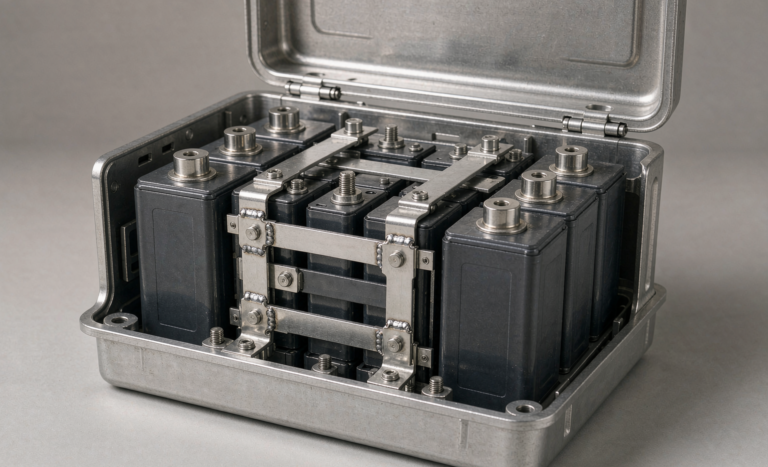
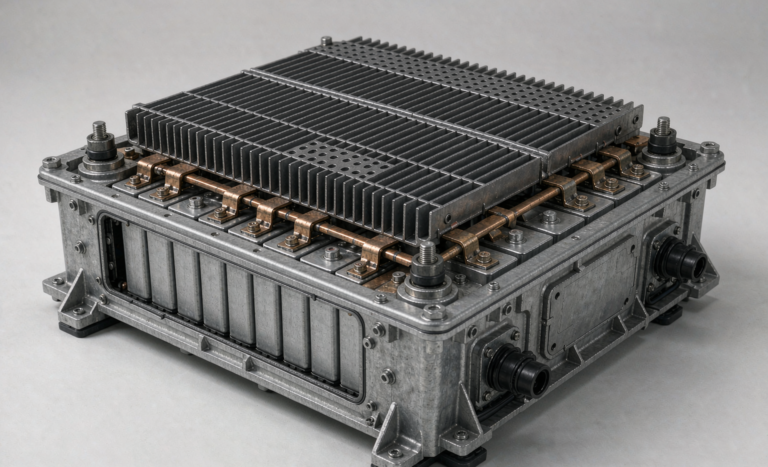
Sodium-ion’s lower intrinsic energy and higher thermal stability mean a triggered cell releases less heat than an NMC lithium cell, and in our propagation tests the hazard class typically lands at EUCAR level 4 or below — venting with minor fire, no projectile. But “lower” is not “zero.” If one cell goes, the pack must keep that event from cascading. I specify compartmentalized module enclosures with ceramic-fiber barriers, a fixed gap that the cell cannot bridge, and a busbar with a thermal fuse sized to clear before adjacent cells reach their onset temperature.
We validate this with a single-cell trigger test per IEC 62619 and UL 9540A methodology, measuring whether neighboring cells stay below propagation threshold. For sodium-ion this is easier than for high-nickel lithium, which is why a sodium-ion battery microgrid can often meet the same safety margin with a lighter, cheaper enclosure — but only if the compartmentalization was designed in, not bolted on after a failed test. Transport and handling still follow UN38.3 T.1–T.8, and we ship at the IATA PI965 30% state-of-charge limit so a damaged package cannot reach a hazardous energy state in transit.
Availability SLAs and Reliability-Centered Maintenance
The discipline only pays off if it is maintained. I close every microgrid engagement with an availability SLA and an RCM (Reliability-Centered Maintenance) plan. The SLA states the guaranteed energy availability — typically 99% for village sites, 99.5% for industrial — and defines capacity retention at year ten, usually 70–80% of nameplate, with a throughput-based warranty rather than a simple calendar date. The RCM plan tells the operator what to monitor (cell divergence, swell, IR trend) and what to act on, with replacement triggers tied to the 5% deviation rule from the prognostics section.
We keep a spare-module pool sized to 4–7% of fleet capacity at each regional hub, so a flagged cell becomes a same-week swap, not a months-long wait. Every module carries a 10-year traceable serial from cell lot to pack, which lets us correlate a field failure back to a specific hard-carbon batch and feed that learning into the next FMEA revision. That closed loop — FMEA to field data to FMEA — is the actual engine of sodium-ion battery reliability microgrids, and it is far more valuable than any single cell specification.
Frequently Asked Questions
Is sodium-ion more reliable than lithium-ion for microgrids?
In our field models it is more forgiving — wider temperature window, no cobalt or nickel, lower thermal-runaway energy — which simplifies the safety architecture. But ultimate reliability depends on the same engineering: FMEA, availability modeling, and prognostics. A poorly controlled sodium bank still fails; a well-controlled one routinely reaches 8,000 cycles.
How do you predict when a sodium-ion cell will fail?
We use rainflow counting of the real duty profile plus Miner’s damage rule for cycle life, an Arrhenius model for calendar aging, and continuous IC/DV analysis for early divergence detection. Together they turn “it might fail someday” into “this cell will likely need replacement in 14 months.”
What availability can a sodium-ion microgrid realistically deliver?
With N+1 PCS redundancy and a 2P–3P module design we engineer for 99.2% to 99.6% energy availability. The PCS, not the cells, is usually the limiting element, which is why we never exclude it from the reliability block diagram.
Does sodium-ion need cabin heating in cold climates?
Usually not. A well-designed sodium ion battery pack retains most of its capacity near 0°C and still accepts charge at −20°C without plating risk when the BMS derates current. We typically use passive insulation instead of a heater, removing a parasitic load and a failure point.
Which standards prove a sodium-ion microgrid battery is reliable?
At minimum UN38.3 for transport, IEC 62133-2 for the cell, IEC 62619 and IEC 62933 for stationary systems, and UL 9540A for propagation. Ask for the actual test reports, and verify the BMS fail-safe behavior during commissioning — certificates alone do not prove reliability.