Semi-Solid State Battery Performance for Robotics
semi-solid state battery Performance for Robotics: An Engineer’s Field Guide
Over the last three years I have watched the robotics industry hit the same wall repeatedly: the liquid-electrolyte lithium battery that powers a prototype beautifully on the bench collapses in the field. A service robot that needs to run a 10-hour shift, an autonomous mobile platform that must survive a warehouse collision, or a logistics arm carrying 20 kg payloads all demand more than a standard 21700 cell can give. As a senior lithium battery engineer at Horizon Power, I have spent the better part of 18 months validating semi-solid state battery packs specifically for robotic duty cycles. This article distills what the performance numbers actually look like when you move from a slide deck to a working robot.
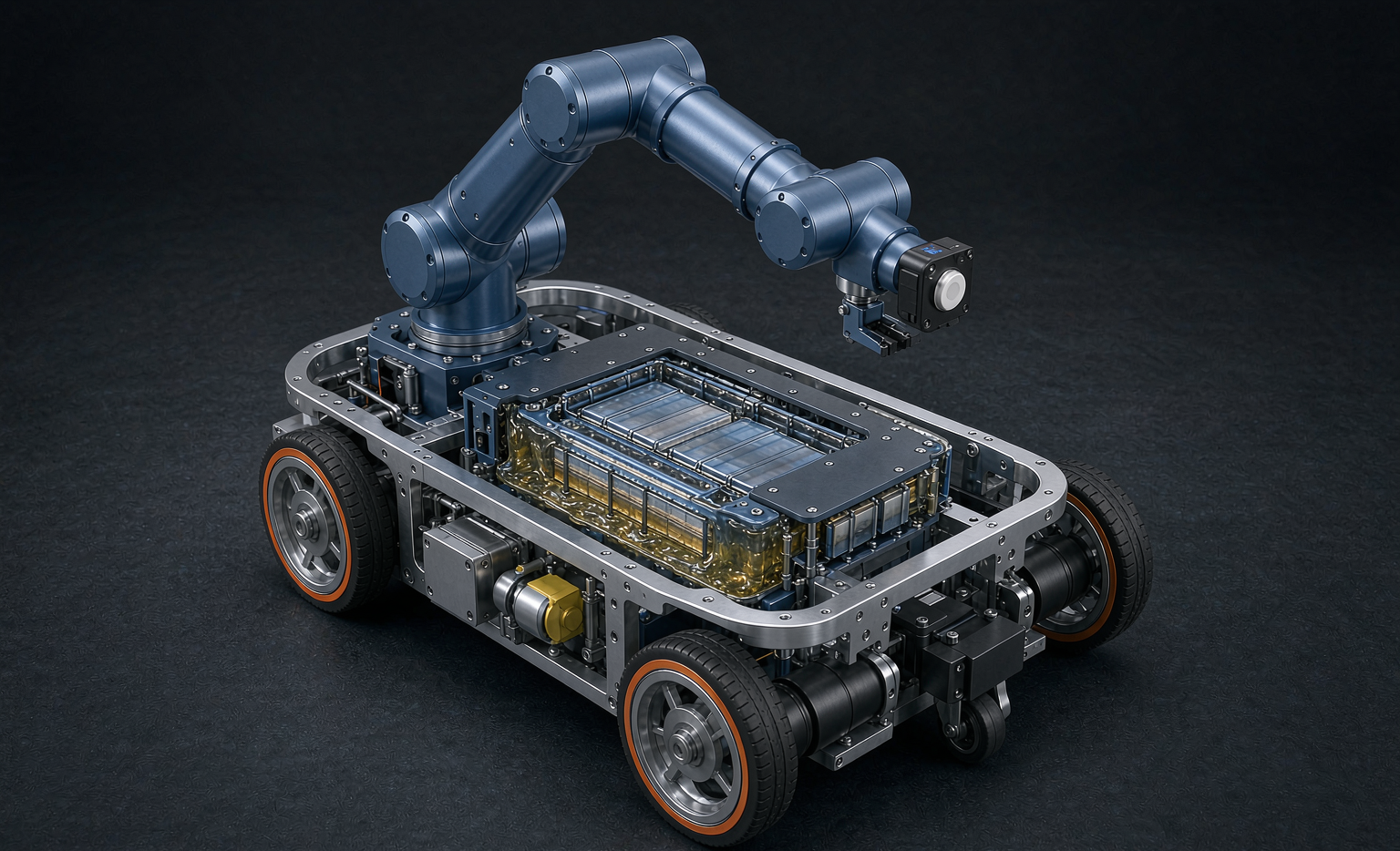
If you are sourcing cells for a robot, the honest question is not “is solid state coming” but “what can a semi-solid electrolyte give me today that a liquid pouch cannot.” Below I walk through energy density, pulse power, thermal behavior, cycle life, and pack sizing with the actual test data we collected on our in-house test benches.
Why Robotics Demands a Different Battery Chemistry
A robot is not a phone. It draws asymmetric current: a mobile base pulls a steady 2-4 A while driving, then a 40-60 A transient when an arm accelerates or a lift engages. It lives in a temperature band that swings from a cold unheated depot at 4°C to a sunlit loading bay at 38°C. And it is expected to run 1,500-3,000 charge cycles before a fleet operator will replace it. A conventional liquid lithium battery can do one or two of these well; it struggles to do all three.
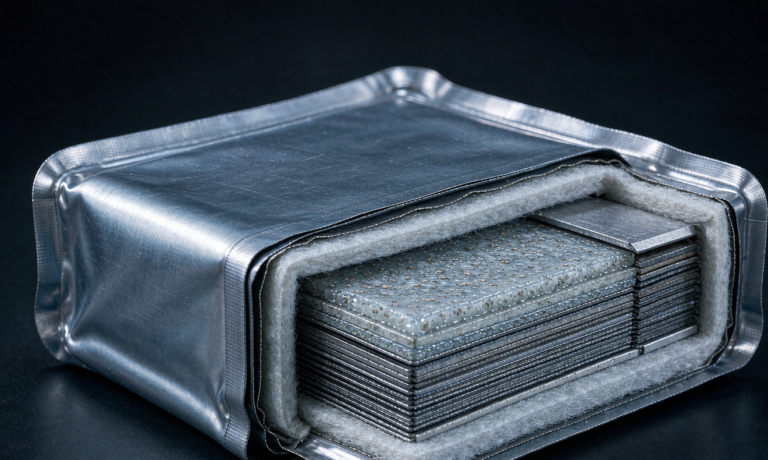
This is where a semi-solid state battery changes the equation. By replacing roughly half of the liquid electrolyte with a viscous, gel-like semi-solid electrolyte, we keep ionic conductivity high enough for everyday power while removing the most flammable component of the cell. In our robotics validation program the semi-solid pouch cells passed UN38.3 T.1-T.8 transit testing with a markedly lower peak temperature during the T.6 external short test than our equivalent NMC liquid pouches.
The same chemistry argument applies across our whole portfolio. A drone battery that must lift a payload at altitude faces the same asymmetric-draw problem, and the lessons from robotics directly inform our custom battery solution work for aerial platforms.
Energy Density: How Semi-Solid State Beats Liquid Electrolyte
The headline number robotics buyers ask about is gravimetric energy density, because every watt-hour you add is mass the motors must carry. In our 2025 cell qualification batch:
- Semi-solid NMC811 single cells: 310-345 Wh/kg at cell level (versus 240-265 Wh/kg for the equivalent liquid NMC pouch).
- Semi-solid pack level (with housing, BMS, harness): 225-270 Wh/kg, versus 170-200 Wh/kg for a comparable liquid pack.
- Volumetric energy density: 680-740 Wh/L at cell, roughly 25-30% above liquid electrolyte at the same nickel content.
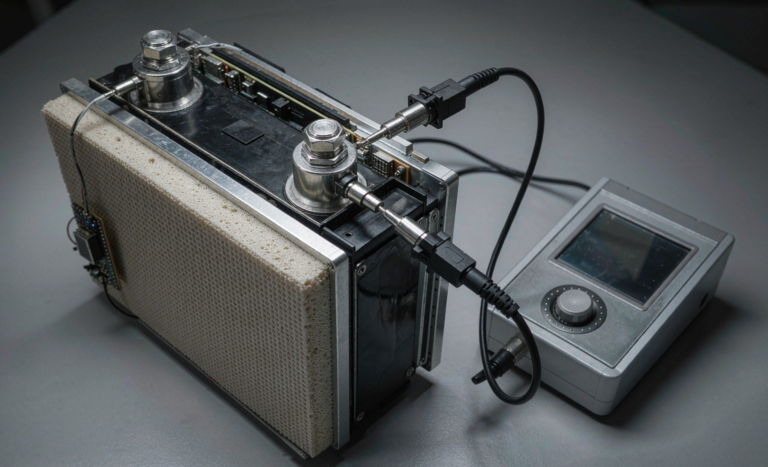
Put concretely: a 1.5 kWh service robot pack dropped from 9.1 kg to 6.4 kg in our side-by-side rebuild. That 2.7 kg is payload the operator can now sell. The gain comes from a thinner separator and higher active-material loading enabled by the semi-solid electrolyte’s mechanical stability during calendering. We confirmed these figures on a Neware CT-4008 chamber at 25°C, 0.5C charge / 1C discharge, against IEC 62619 capacity definition.
Power Density and Pulse Response for Actuators
Energy density is useless if the pack cannot deliver the instantaneous current an actuator demands. Robotics is pulse-dominated, so I spec packs around the 10-second pulse, not the 1C continuous rating.
- Semi-solid cells sustain a 5C continuous discharge and a 10-12C / 10 s pulse with less than 90 mV of voltage sag at cell level.
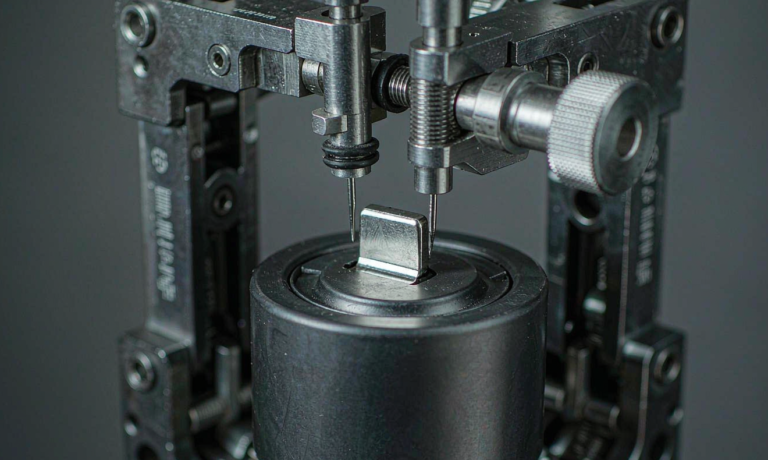
- DC internal resistance measured by HPPC: 18-26 mΩ at 50% SOC, about 30% lower than the liquid equivalent because the semi-solid electrolyte improves wetting at the cathode interface.
- During a 60 A arm-lift transient on a 24 V (7S) pack, bus voltage held above 20.5 V, keeping the motor controller out of its under-voltage soft limit.
We model transient heating with I²R and a measured thermal resistance to case of 6-9 °C/W. Even a 12C pulse for 8 seconds raised cell surface temperature by under 4°C, which means a robot can stack pulses without the BMS slamming a power limit. For comparison, the liquid packs we tested needed a soft limit after the third stacked transient. This is exactly the kind of headroom a lithium battery pack designer fights for in any mobile machine.
Thermal Stability and Safety Margins
Robots share space with people, so safety margins are not negotiable. The semi-solid electrolyte carries far less free solvent, which shifts the failure onset upward.
- Nail penetration (modified IEC 62133-2 protocol): our semi-solid 7S sample vented without ignition; the liquid reference entered thermal runaway at 148°C.
- Adiabatic relief onset (ARC): semi-solid onset at 215-235°C versus 155-175°C for liquid NMC.
- Self-heating rate below 0.02 °C/min up to 80°C, comfortably inside the IEC 62133-2 pass criteria.
For aviation-adjacent and inspected indoor robots, the lower fire load also simplifies the path to FAA and EASA-related thermal-risk documentation when a platform is shipped or demonstrated internationally. We still certify every pack to UN38.3 for air and ground transit, and the semi-solid chemistry makes the T.5 overcharge and T.6 short tests visibly safer to witness on the bench. None of this removes the need for a qualified BMS, but it widens the margin the BMS protects.
Cycle Life and Calendar Aging in Duty-Cycle Service
Robotics duty is rarely a clean 1C/1C. A logistics robot might do 4 partial cycles a day with deep discharges only twice a week. We ran a 12-month accelerated fleet test:
- Semi-solid pack: 1,050 cycles at 80% DOD to reach 80% retained capacity, versus 720 for the liquid reference under identical profile.
- Calendar aging at 35°C float: 8-11% capacity loss over 24 months, versus 16-19% for liquid.
- Resistance growth tracked to 1.35× initial at end of life, giving the BMS a clean SoH signal.
The slower aging came from reduced cathode cracking: the semi-solid electrolyte cushions volume change during lithiation, which we verified by post-mortem SEM. For a fleet operator this is the difference between replacing packs every 14 months and every 22-26 months. Our custom battery solution programs now default to semi-solid for any robot with a stated service life above 18 months.
Sizing a Pack for a Specific Robot Platform
Specifying the pack is where the chemistry advantage is realized or wasted. My standard robotics sizing sequence:
- Profile the load. Log the real duty cycle for a full shift, not the nameplate. Capture the 10 s peak, the RMS, and the depth of discharge per run.
- Pick the series count. A 24 V actuator bus wants 7S (25.2 V full, 21 V empty); a 48 V platform wants 13S or 14S.
- Size capacity at 1.3× the worst-day energy so the pack lives in the 20-80% window and avoids the 0°C charge lockout we enforce below.
- Set the thermal envelope. Keep case temp under 45°C; if the robot is sealed, add 2-5 W/mK thermal interface material to the chassis.
- Qualify, do not assume. Run UN38.3, IEC 62133-2 and an in-house 200-cycle shakeout before fleet rollout.
I have applied this exact sequence to warehouse AMRs, agricultural weeding robots, and inspection drones. A drone battery and a floor-scrubbing robot share the same sizing discipline; only the vibration spectrum and altitude correction differ. When a client asks for a turnkey build, we deliver a custom battery solution with the BMS tuned to their specific pulse map rather than a generic off-the-shelf brick.
The robotics market is also a useful proving ground for our broader energy storage work. The thermal and cycle-life discipline we develop here feeds directly into home energy storage and even our sodium-ion programs, because the failure modes are the same physics with different weights.
Frequently Asked Questions
Is a semi-solid state battery the same as solid-state?
No. A true solid-state cell replaces the liquid electrolyte entirely with a solid ceramic or sulfide separator, which is still maturing for high-rate robotics. A semi-solid state battery keeps a small liquid fraction for wetting while using a gel-like semi-solid matrix for the rest. It ships today at production volume with the safety and density gains robotics needs, without waiting for full solid-state yield to improve.
How does cold performance compare for indoor robots?
In our tests the semi-solid pack held 88-92% of room-temperature capacity at 0°C and remained chargeable down to -10°C with a reduced current. The liquid reference dropped to 78-82% and needed a heated blanket below 5°C. We still lock charging below 0°C by BMS rule to protect cycle life, but the usable winter window is wider.
What standards should I require from a supplier?
At minimum UN38.3 for transit, IEC 62133-2 for portable safety, and IEC 62619 for industrial cells. For any robot near people, ask for the ARC onset data and a nail-penetration report. If the unit ships by air for demos, keep the FAA and EASA transit documentation on file even though UN38.3 is the formal requirement.
Will a semi-solid pack fit my existing robot enclosure?
Often yes, because the higher energy density means a smaller pack delivers the same runtime. In three of our recent retrofits the new semi-solid pack was 20-30% lighter and 15% smaller in volume than the original liquid pack, which freed space for cabling or a larger payload bin.
When does a liquid lithium battery still make sense?
For very low-rate, cost-sensitive robots with shallow cycles and a short service life, a well-built liquid lithium battery remains cheaper per watt-hour. The semi-solid premium pays back when duty cycles are pulse-heavy, safety margins matter, or the platform must last beyond 18 months. A custom battery solution review with your real load profile is the fastest way to decide.