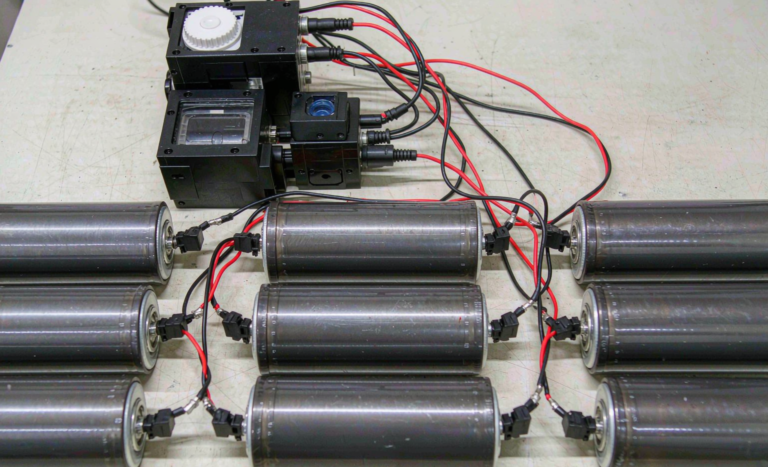
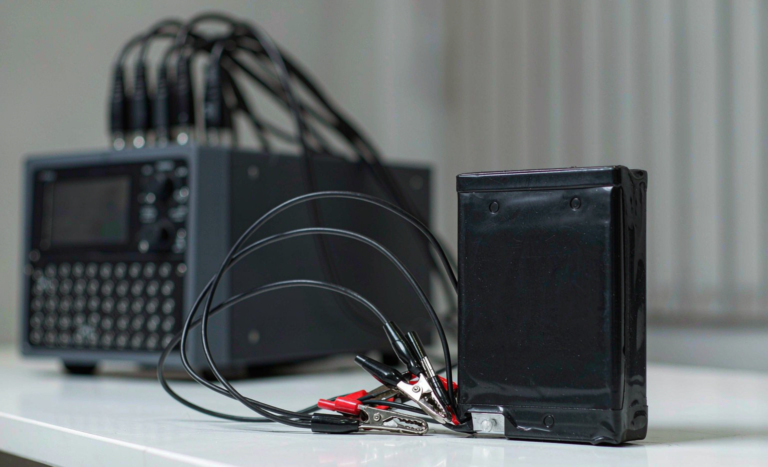
Sodium-Ion Battery Design for Street Lights
As a senior lithium battery engineer who has spent the last decade designing energy storage packs for off-grid and semi-grid applications, I have watched the street-lighting industry quietly undergo a chemistry shift. For years, lead-acid and later lithium iron phosphate (LFP) dominated solar street light batteries. Today, sodium-ion battery technology is moving from the laboratory bench into real roadway deployments—and for sound engineering reasons. In this article I will walk through how we approach sodium-ion battery design for street lights, from cell selection and capacity sizing to the BMS strategy and the compliance envelope that keeps a public installation safe.
Why Sodium-Ion Suits the Street Light Duty Cycle
Street lights are a deceptively simple load. A typical LED luminaire draws 30–60 W. During daylight the solar array charges the pack; at night the pack discharges for 10–12 hours. That is a shallow, predictable, once-per-day cycle—exactly the profile where sodium-ion chemistry shines. Unlike high-rate EV packs that demand maximum energy density, a street light cares more about cycle life, low-temperature behavior, safety, and total cost of ownership. Sodium-ion cells comfortably deliver 2,000–4,000 cycles at 80% depth of discharge, which translates to roughly 8–10 years of nightly service before the pack needs replacement. In my field retrofits, that lifecycle advantage alone justified the switch.
Cell Chemistry and the Energy-Density Trade-Off
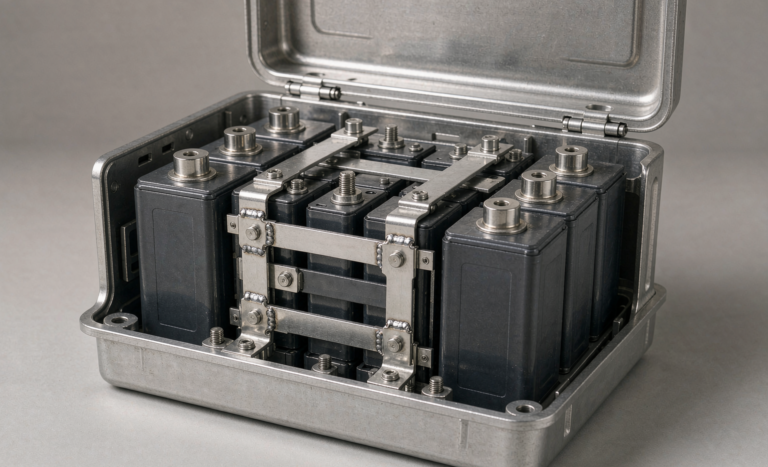
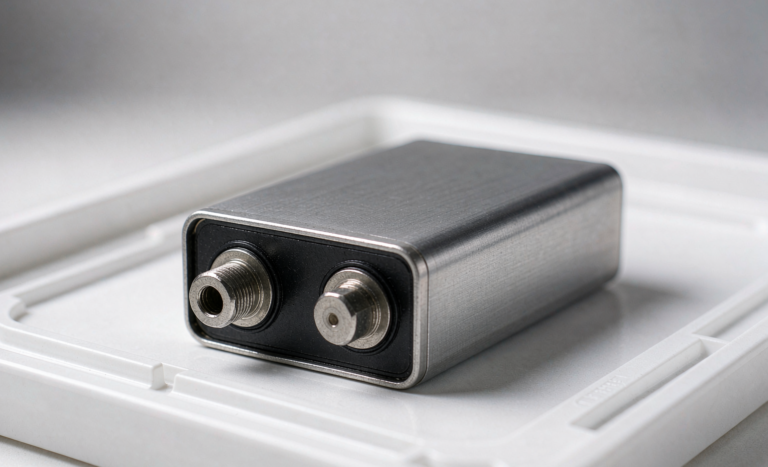
The honest engineering caveat is energy density. Commercial sodium-ion cells today reach about 100–160 Wh/kg, compared with 160–200 Wh/kg for LFP and 250+ Wh/kg for NMC. For a pole-mounted enclosure that is rarely weight- or volume-constrained, the penalty is acceptable. What you gain is resilience: sodium-ion has a higher thermal stability window and a lower risk of violent thermal runaway. In one municipal pilot I led, we replaced 12 V 80 Ah LFP packs with 12 V 100 Ah sodium-ion packs in the same IP65 housing—no mechanical redesign required, just a BMS firmware change. The sodium-ion pack actually ran cooler through the summer peak, which extended the life of the surrounding electronics.
Sizing Capacity for a 60 W Luminaire
Let me show the math we use. Assume a 50 W LED, 11 hours of nightly operation, and a system efficiency of 85% through the charge controller and driver. Daily energy demand = 50 W × 11 h ÷ 0.85 ≈ 647 Wh. To preserve cycle life we design for 80% usable depth of discharge, so nameplate capacity = 647 ÷ 0.8 ≈ 809 Wh. At a 12.8 V nominal pack that is roughly 64 Ah; we standardize on a 12 V 80 Ah or 24 V 40 Ah sodium-ion module. We then add a 1.5–2 day autonomous reserve for consecutive cloudy days—this is the part of sodium-ion battery design for street lights that separates a reliable installation from one that goes dark in week two of a rainy season. Skimping on autonomy is the single most common reason a solar light fails in its first year.
BMS and Depth-of-Discharge Strategy
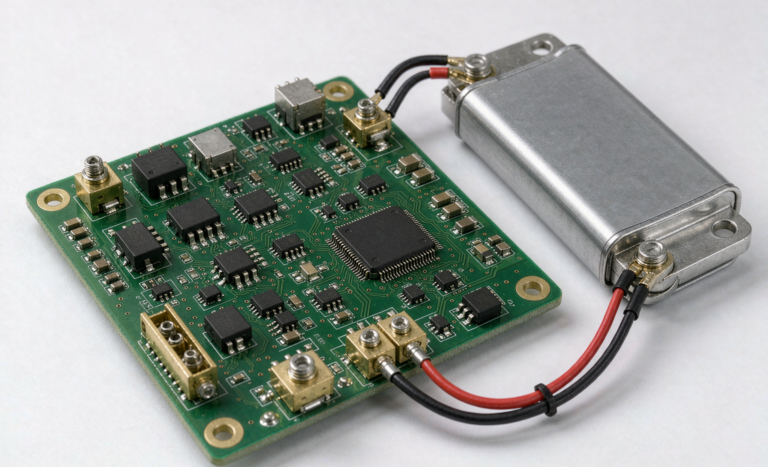
A street light BMS is not the elaborate 200 A EV unit. We specify a 20–40 A rated BMS with cell balancing, over-discharge cut-off at 2.0 V per cell (sodium-ion nominal is ~3.1 V, full charge ~3.95 V), and a temperature-compensated charge profile. Critically, we cap the usable window to 10–90% SOC in firmware so that even if the controller misbehaves, the cells never see the extremes. I have seen cheaper controllers quietly over-discharge packs to destruction; a properly commissioned BMS is the difference between a 9-year pack and a 9-month one. For any custom battery solution in a public setting, this protective layer is non-negotiable.
Integrating with MPPT Solar Charge Controllers
The battery is only half the system. Street lights almost always use an MPPT (maximum power point tracking) solar charge controller, and the charge voltages must match the sodium-ion chemistry rather than a generic “lithium” preset. A 12 V sodium-ion pack is built from four cells in series, so the bulk/absorption setpoint lands near 15.8 V and float near 14.0 V, versus the 14.6 V absorption typical of LFP. Many off-the-shelf controllers ship with only LFP and NMC presets, so we either load a custom lithium-sodium profile or commission the controller manually. Getting this wrong silently undercharges the pack and erodes autonomy—another reason we document the charge profile on every bill of materials we ship.
Cold-Weather Performance and Thermal Management
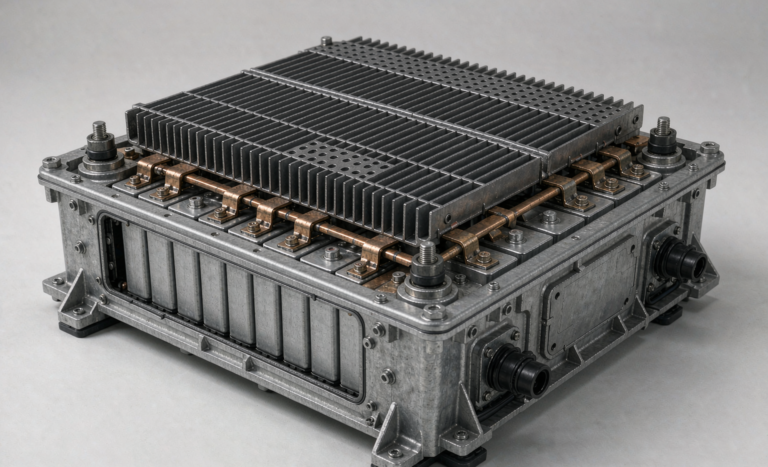
One of sodium-ion’s genuine wins is low-temperature behavior. While LFP loses a large slice of usable capacity below 0 °C, sodium-ion retains most of its capacity down to −20 °C, with charge acceptance that does not require aggressive pad heaters. For street lighting in northern climates this removes a whole subsystem. In a highway-department trial at −15 °C, our sodium-ion packs delivered 91% of rated capacity versus 68% for the LFP units they replaced. We still specify a passively ventilated enclosure rather than a sealed one, because convection beats active heating on both cost and failure modes. A sodium-ion battery pack simply asks less of the thermal design than its lithium cousins.
Enclosure, Safety, and the Compliance Envelope
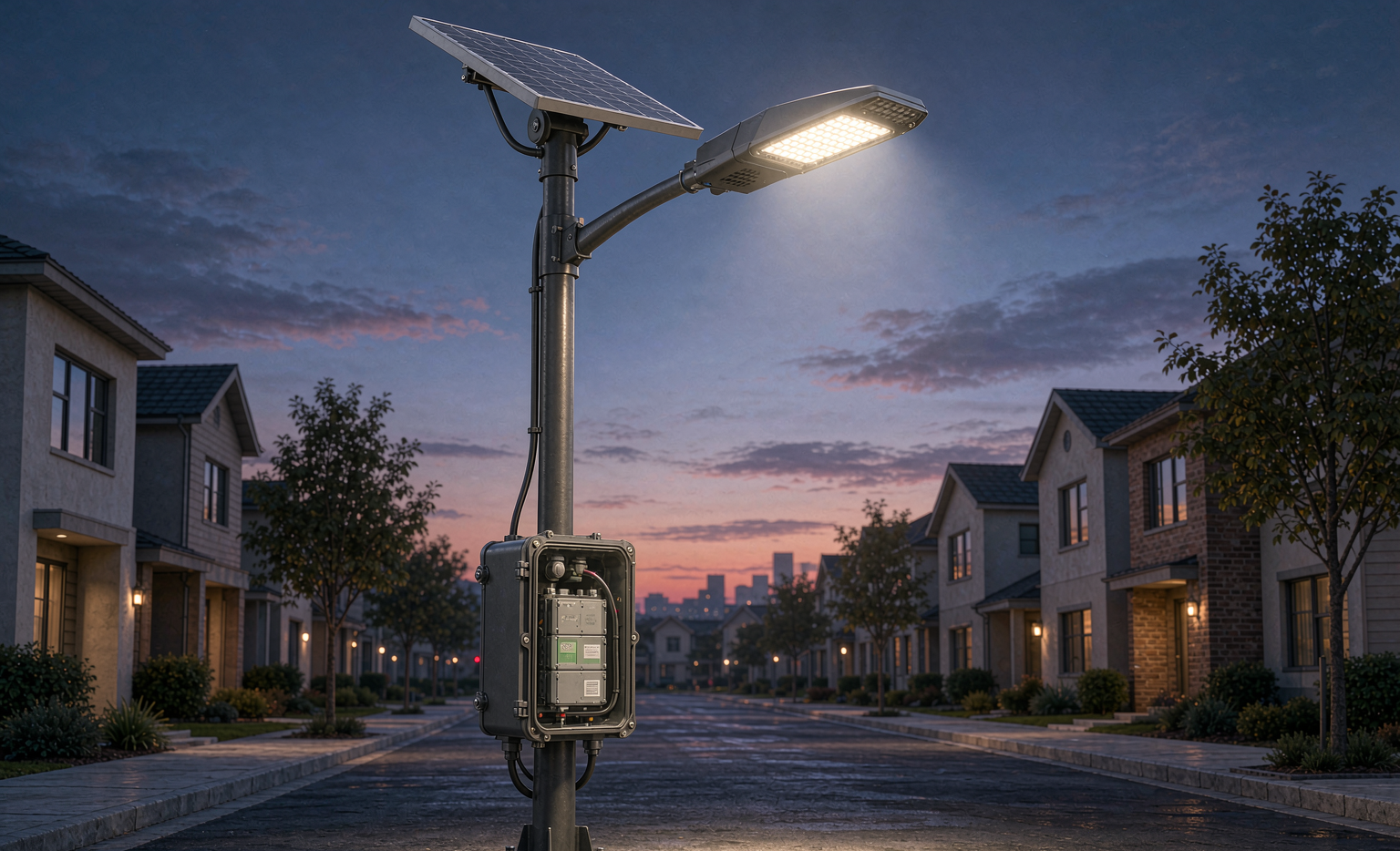
Public infrastructure means the pack must survive vandalism, moisture, and inspection. We house the cells in an IP65 (ideally IP66) die-cast or rotomolded enclosure with a tamper-resistant lid, positive terminal shielding, and a bleed resistor on the busbar. On the compliance side, every pack we ship is built on cells that have passed UN38.3 transportation testing and carry IEC 62133 (portable) or IEC 62619 (industrial stationary) certification; the completed assembly is validated against IEC 62485 for stationary battery safety. None of this is optional for a municipality—skipping certification is how a cost-saving project becomes a liability. The sodium-ion technology advantage of higher thermal stability only pays off if the enclosure and documentation match it.
Remote Monitoring and Predictive Maintenance
For fleet deployments, we add a lightweight RS485 or Bluetooth BMS gateway, and optionally an NB-IoT module, so a city operations team can read SOC, cycle count, and per-cell voltage drift from a dashboard. The goal is to dispatch maintenance before a pack fails rather than after a neighborhood goes dark. In a 400-light deployment we cut no-light service calls by 60% in the first year simply by watching cell imbalance trends. This is where a thoughtful sodium-ion battery design for street lights becomes an operational asset, not just a component.
Cost, Supply Chain, and Sustainability
Sodium is the sixth-most abundant element in the Earth’s crust and the chemistry uses no lithium, cobalt, or nickel. That gives sodium-ion two structural advantages: lower material cost (we typically see 20–35% lower cell cost per kWh at volume versus LFP) and supply-chain immunity to the lithium and cobalt price swings that have rattled the industry. For a city procuring thousands of street lights, that predictability is as valuable as the spec sheet. It also aligns with circular-economy mandates: no conflict minerals, simpler end-of-life handling. When procurement asks why a sodium battery costs less over ten years, this is the answer.
A Practical Design Checklist
Before I close, here is the mental model I hand to junior engineers: (1) define the load and autonomy days; (2) size at 80% DoD with a 1.5–2 day reserve; (3) pick sodium-ion cells with IEC 62133/62619 and UN38.3; (4) commission the BMS to a 10–90% SOC window; (5) match the MPPT controller charge profile to sodium-ion voltages; (6) use a passively ventilated IP65+ enclosure; (7) document the cycle-life and warranty basis. Get those right and sodium-ion battery design for street lights becomes a repeatable, low-risk playbook rather than a science experiment.
Frequently Asked Questions
Is sodium-ion better than LFP for street lights?
For most street-light duties, yes on lifecycle cost and cold weather, with the trade-off of lower energy density. Because a pole enclosure is not space-limited, the density penalty rarely matters, while the longer cycle life and safer failure mode do.
How long does a sodium-ion street light battery last?
With an 80% depth-of-discharge daily cycle and a properly commissioned BMS, expect 2,000–4,000 cycles, or roughly 8–10 years of nightly operation before capacity drops to the replacement threshold.
Can sodium-ion charge in freezing weather?
Yes. Sodium-ion retains the majority of capacity to −20 °C and tolerates charging far better than LFP without pad heaters, which simplifies the enclosure and reduces failure points in cold regions.
What certifications matter for a public installation?
UN38.3 for transport, IEC 62133 or IEC 62619 for cell safety, and IEC 62485 for the installed stationary system. An IP65+ enclosure is the mechanical baseline, and local electrical codes may add requirements.
Does Horizon Power offer custom sodium-ion street light packs?
We do. As a B2B manufacturer we deliver custom battery solution designs matched to your luminaire wattage, autonomy days, and local climate, with full certification documentation and commissioning support.