Semi-Solid State Battery Testing for Aerospace
When a battery leaves the lab and goes to altitude, the rules change. As Karl Huang, Senior lithium battery Engineer at Horizon Power, I have spent the last nine years qualifying energy storage for platforms where a single thermal event is not a warranty claim but a flight-safety incident. The short version of what I have learned: a semi-solid state battery testing aerospace program is not a longer version of a consumer test plan. It is a different discipline, governed by aviation authority expectations, harsher mechanical envelopes, and a zero-tolerance posture on propagation.
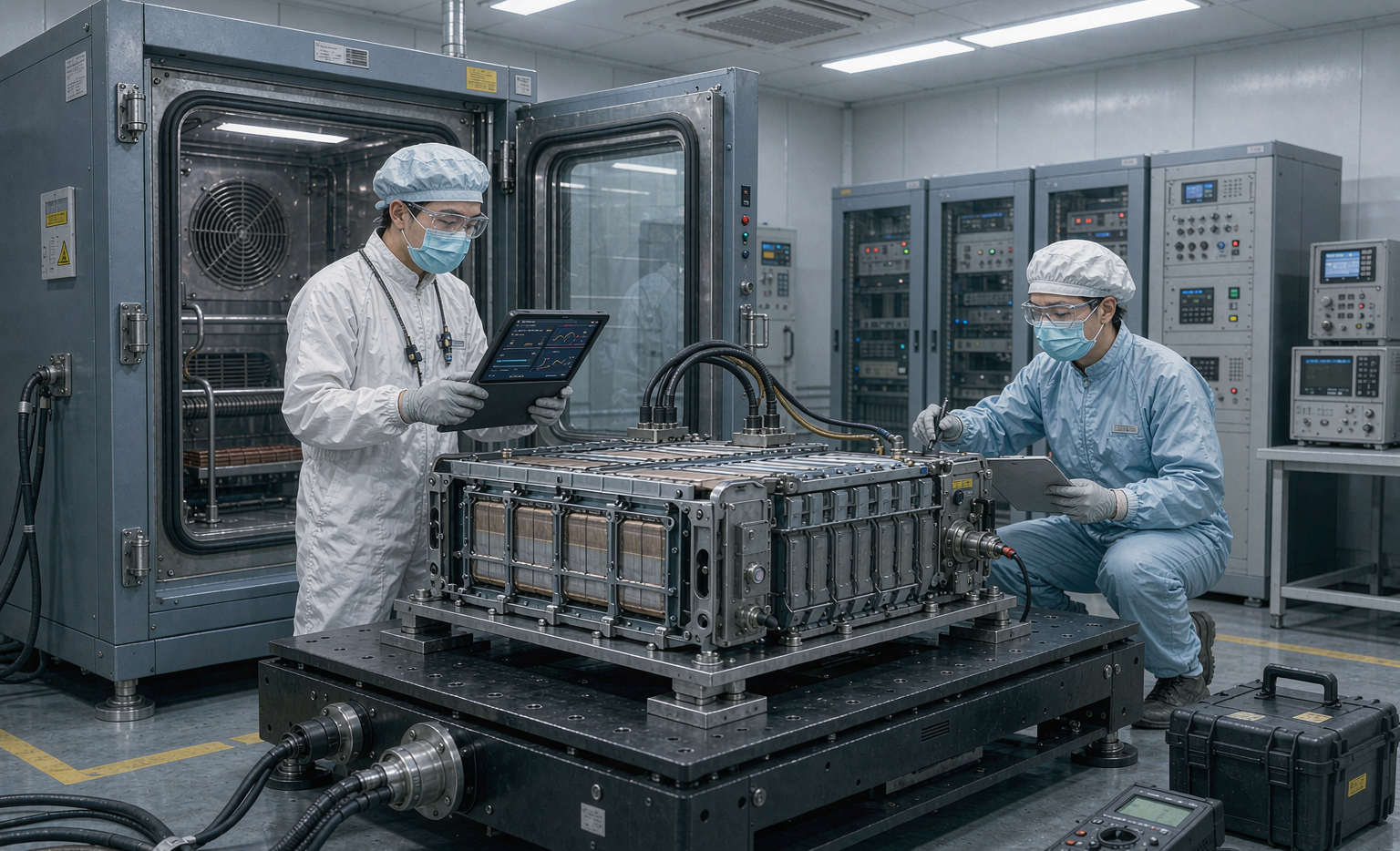
This guide walks through the way our team validates a semi-solid-state battery pack for airborne use, from the UN38.3 baseline every lithium cell must clear, through the RTCA DO-160 and DO-311A environmental envelope, and into the field data we collect once the pack is flying. If you are sourcing a custom battery solution for a UAV, an eVTOL subsystem, or a satellite bus, the checklist below is the one we hand to our customers before the first prototype is ever built.
Why Aerospace Pushes Battery Validation Further Than Consumer Specs
A drone battery for a consumer quadcopter is qualified to keep a phone-class risk profile: it sits near a person, it fails occasionally, and the worst realistic outcome is a burnt carpet. An aerospace pack is different in three ways. First, it may operate at 10,000 to 45,000 feet, where cabin-equivalent pressure drops to roughly 11–20 kPa and outgassing behavior shifts. Second, it lives through sustained broadband vibration from rotors or turbines that a handheld device never sees. Third, and most important, a cell-to-cell thermal runaway must not propagate to the rest of the pack mid-flight.
Because the energy density of a semi-solid state battery lets us shrink mass for the same watt-hours, aerospace programs are the single largest pull on our semi-solid roadmap. But higher energy density means tighter margins, so the test plan has to earn that mass saving back in validated safety.
The certification backdrop matters here. In the United States the FAA points battery designers to Advisory Circular AC 20-158 and the associated compliance criteria; in Europe, EASA issues its own acceptable means of compliance that map closely to the same RTCA and EUROCAE documents. A solid-state battery is not exempt from these frameworks. If anything, reviewers scrutinize the new chemistry harder because they have less flight history to lean on. That is precisely why our qualification reports lead with raw test data and only then with interpretation — an airworthiness reviewer trusts a thermocouple trace far more than a claim.
The Core Test Suite: UN38.3 and IEC 62133 as the Baseline
Every lithium battery we ship starts from the same floor. UN38.3 is the transport certification under the UN Model Regulations, and it is non-negotiable for moving cells and packs by air. The eight tests — T.1 altitude simulation, T.2 thermal test, T.3 vibration, T.4 shock, T.5 external short circuit, T.6 impact, T.7 overcharge, and T.8 forced discharge — are the minimum bar. For aerospace we treat UN38.3 as a starting point, not a finish line.
On top of that we apply IEC 62133-2, the international safety standard for portable sealed secondary lithium cells and batteries. IEC 62133 gives us a structured way to confirm that a single-cell failure stays a single-cell failure. In our internal reports I record the test temperature, the state of charge at test, and the peak case temperature, because those three numbers predict field behavior better than any marketing sheet.
Thermal Cycling and Altitude Simulation for Flight Profiles
For flight, we extend T.2 and T.1 well past the UN38.3 minimums. A typical aerospace profile ramps the pack from −40 °C to +71 °C in steps, holding each dwell for two to four hours, then repeating for a minimum of ten cycles. The goal is not to find the failure temperature — it is to measure capacity fade, internal resistance drift, and seal integrity after repeated thermal stress.
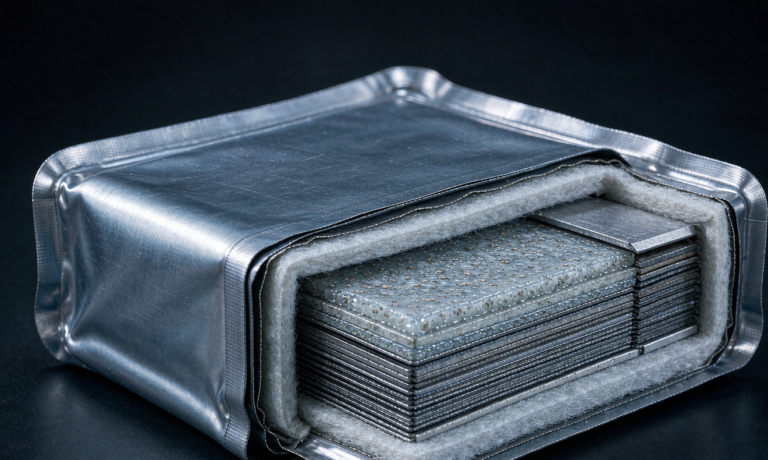
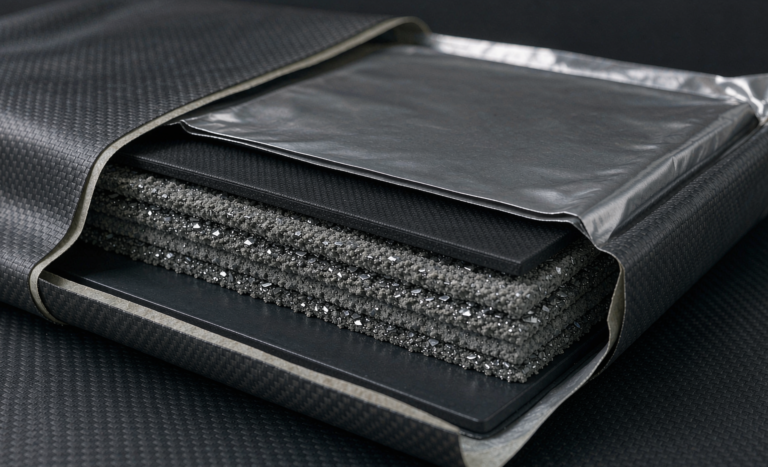
Altitude simulation is where the semi-solid electrolyte helps. Our cells use a quasi-solid separator that suppresses free liquid movement, so we see far less electrolyte creep at low pressure than a conventional lithium battery with a flooded pouch. In one survey-UAV program we held packs at 11.6 kPa for 96 hours and measured less than 1.2% capacity loss across the cycle, versus the 3–5% we typically see on equivalent liquid-electrolyte packs.
We do not stop at the single low-pressure hold. A realistic mission profile alternates climb, loiter, and descent, so we drive a pressure staircase — 101 kPa down to 20 kPa and back, repeated hourly — while the pack sits on a constant-current load that mimics the avionics bus. The alternating mechanical stress on seals and welds is what actually finds leaks, and we log mass change on a 0.01 g balance between cycles to catch slow electrolyte loss that a voltage check would miss.
Vibration, Shock, and the RTCA DO-160 / DO-311A Envelope
The real aerospace discriminator is mechanical. We qualify to RTCA DO-160 Section 8 (vibration) and the battery-specific guidance in RTCA DO-311A, which the FAA and EASA both reference for rechargeable battery systems on aircraft. DO-160 random vibration for a fuselage-mounted installation can exceed 0.3 g²/Hz in narrow bands, and we sweep from 10 Hz to 2,000 Hz in three orthogonal axes.
To that we add DO-160 Section 7 shock and a MIL-STD-810H-style crash-safety impulse. A custom battery solution for a rotorcraft gets a tougher random-vibration curve than one for a fixed-wing loitering munition, and we tune the fixture so the resonance of the pack housing, not the test shaker, dominates the measurement. Our rule is simple: if we cannot explain a resonance, we do not fly it.
How We Build the Semi-Solid Cell Sample and Instrument It
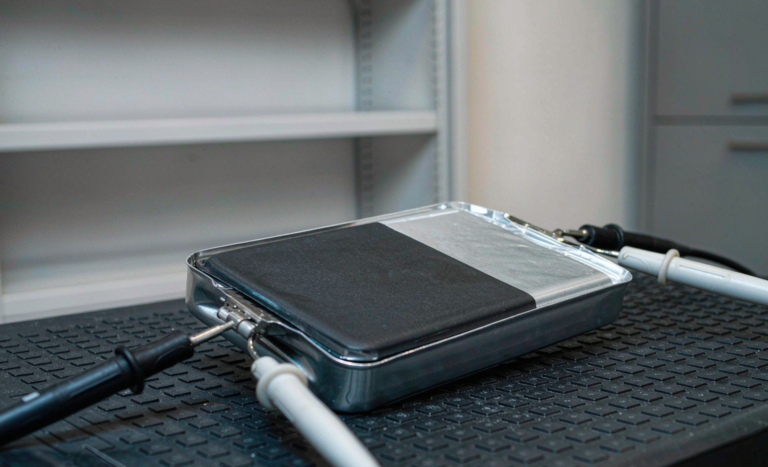
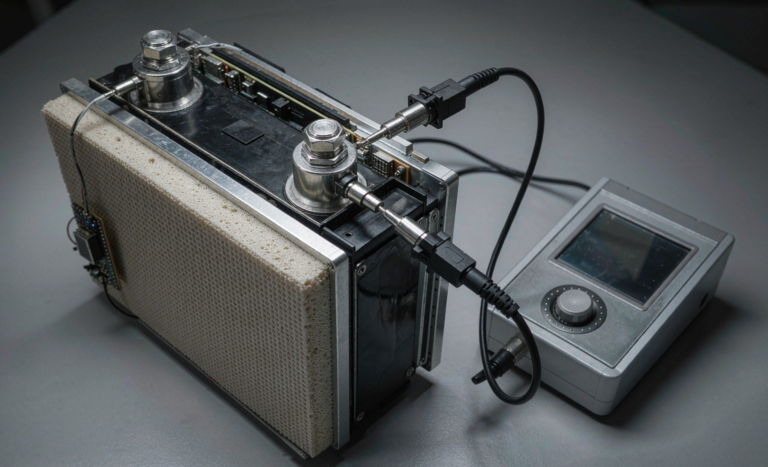
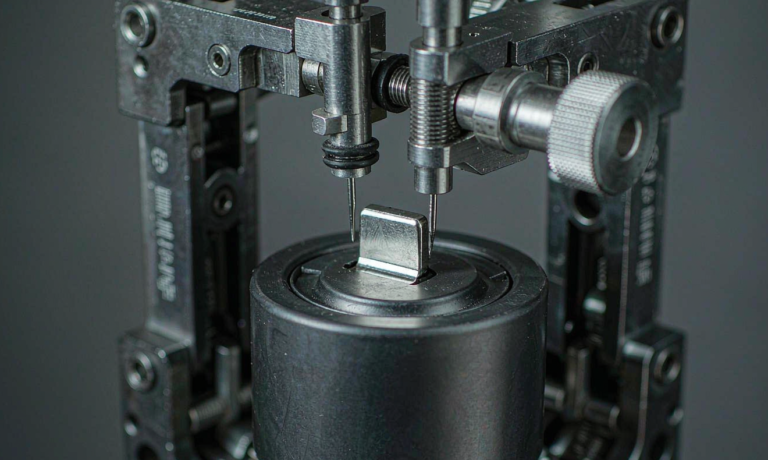
Validation is only as good as the instrumentation. For each semi-solid-state battery sample we bond type-K and type-T thermocouples to the anode tab, the cathode tab, and the cell pouch centerline, then add a fiber-Bragg strain sensor on larger formats. During forced-discharge and external-short tests we sample at 100 Hz so we capture the runaway front as it crosses the cell.
We also run the cells inside an instrumented pressure vessel so any venting is captured and analyzed for composition. This is how we confirmed that our semi-solid electrolyte vents at a lower peak pressure and a cooler flame front than the liquid cells it replaces — the single fact that lets our customers satisfy the “no propagation” clause in their own airworthiness submissions.
Cycle Life and Calendar Aging Under Real Flight Duty
A bench cycle life number is almost useless for aerospace unless it reflects the duty cycle. A surveillance drone may fly two hours a day and sit at 60% state of charge the other twenty-two. A high-altitude pseudo-satellite may hold 80% for weeks. Those are completely different aging paths, and a semi-solid-state battery ages differently in each because the quasi-solid electrolyte slows the parasitic side reactions that plague liquid cells at high states of charge.
For the loitering profile we run a calendar-aging matrix at 40 °C and 70% state of charge for twelve weeks, pulling impedance spectroscopy every 72 hours. What we report to the customer is not “80% after 500 cycles” but a capacity-retention curve tied to their actual mission, with a confidence band from three parallel samples. That curve is the input to their own reliability model, and it is the difference between a pack that is certified and a pack that is trusted for the full campaign.
The takeaway for anyone specifying a custom battery solution: ask for the aging data at your state of charge, not the vendor’s favorite number. The semi-solid chemistry gives us headroom, but headroom only becomes range when it is measured on your duty cycle.
Frequently Asked Questions
What standards does a semi-solid state battery need to fly on an aircraft?
At minimum, UN38.3 for transport and IEC 62133-2 for cell safety. For installed airborne systems, plan on RTCA DO-160 environmental sections and DO-311A battery guidance, with FAA or EASA airworthiness review layered on top. A solid-state battery does not get a waiver from these; it gets a tighter test plan.
How is semi-solid testing different from normal lithium battery testing?
The baseline is the same, but aerospace adds extended thermal cycling, low-pressure altitude holds, and broadband random vibration to DO-160 levels. The biggest difference is the propagation requirement: we must prove a single cell failure cannot cascade, which we verify with instrumented forced-discharge and crush tests.
How long does a full aerospace qualification program take?
For a new custom battery solution, budget 10 to 16 weeks. UN38.3 and IEC 62133 run in parallel in about three weeks; the DO-160 vibration and thermal profile add six to eight weeks; field telemetry review closes the loop. Rushing the mechanical phase is the most common cause of a failed first audit.
Can a semi-solid state battery be shipped by air before certification?
Only under the provisions that apply to prototype or exempted shipments, and only with the airline and authority approvals in place. We never air-freight an uncertified pack as if it were a commercial product. The transport classification is decided by the UN38.3 result, and we issue that before anything moves.
Why choose semi-solid over a conventional lithium battery for flight?
Two reasons: mass and safety margin. The semi-solid electrolyte removes most free liquid, which lowers vent pressure and slows any thermal front, and it lets us hit higher specific energy at the same form factor. For a long-endurance platform where every gram of battery is a gram less payload, that trade is decisive.
If you are scoping an aerospace energy program, start the semi-solid state battery testing aerospace conversation with us before the pack geometry is frozen. The changes that save the most qualification time — tab layout, vent paths, strain relief — are the ones designed in on day one, not retrofitted after a failed DO-160 sweep.