Home Energy Storage Design for New Homes
I have spent the last eleven years designing lithium battery packs — first for industrial drones, later for stationary systems — and the projects that keep me up at night are almost never the exotic ones. They are ordinary new-build houses where somebody bolted a battery to a garage wall six months after the electrician had already left. Good home energy storage design new homes work starts before the slab is poured, not after the drywall goes up. That is the single most valuable thing I can tell a builder, a developer, or a homeowner reading this: a new house is the cheapest moment in a building’s entire life to install a home energy storage system correctly, and the most expensive moment to get it wrong.
This guide is written from the engineering side of the table. It covers how I size a residential battery storage system for a new home, how I choose chemistry and voltage architecture, what the codes and standards actually require, and where I see the most costly mistakes. Where numbers appear, they are the numbers we design to in our own factory qualification programs, not marketing figures.
Why New Construction Changes the Whole Design Conversation
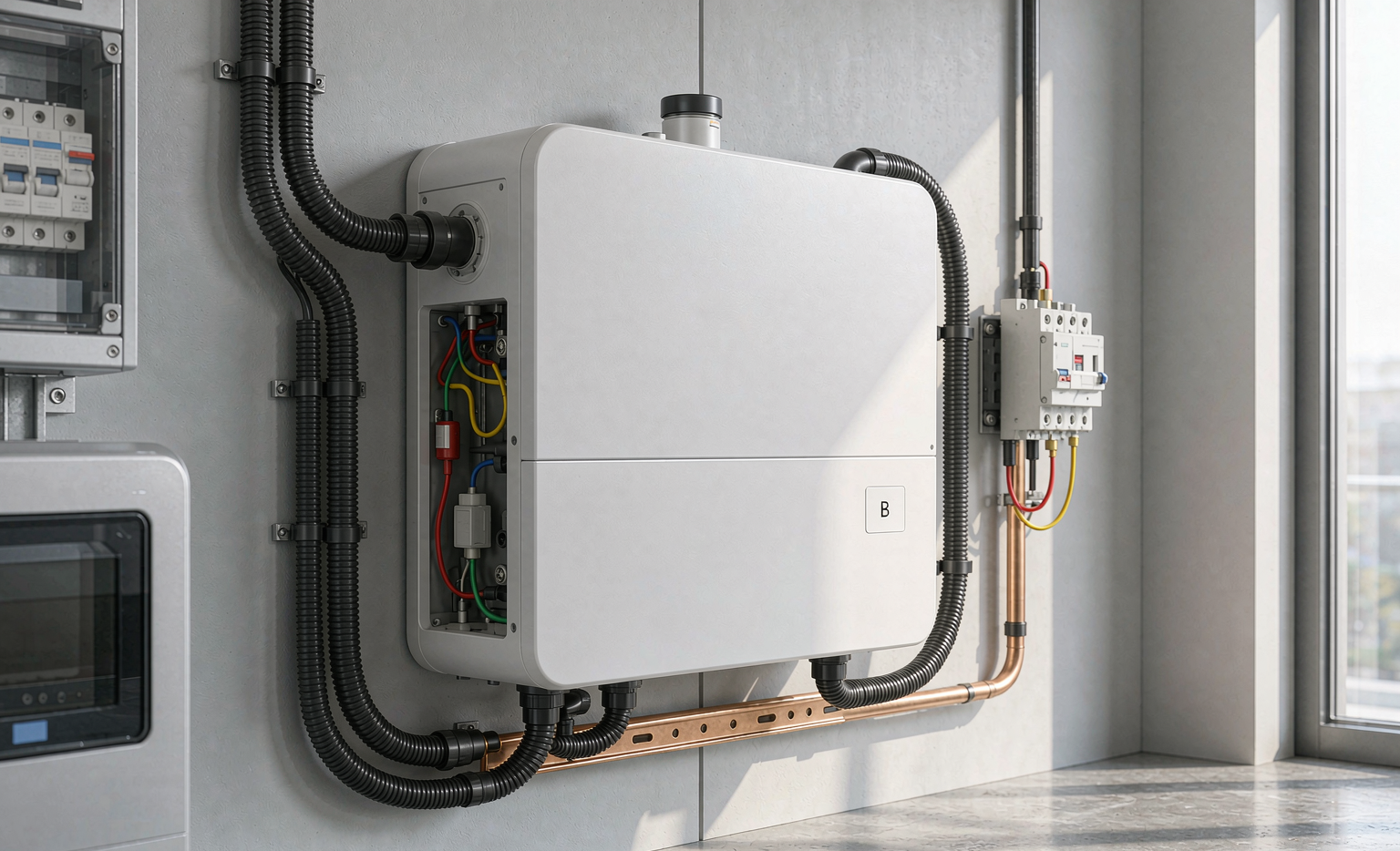
Retrofitting a home battery backup system into an existing house is an exercise in compromise. You inherit a service panel that is already full, a garage wall that shares a boundary with a bedroom, and a load centre located as far as physically possible from where the battery needs to live. In a new home, every one of those constraints is a design variable you still control.
The practical consequences are large. On new-build projects we routinely see:
- Conductor runs cut by 60–80%. Placing the storage enclosure within three metres of the main panel reduces DC and AC copper cost dramatically and keeps voltage drop under 1% instead of the 2–3% we fight on retrofits.
- Thermal environments that actually work. A dedicated, insulated, code-compliant utility space keeps cells in the 15–30 °C band where LiFePO4 calendar ageing is lowest. Uninsulated garages in continental climates swing from −10 °C to +45 °C, and cycling a lithium battery below 0 °C without preheat is the fastest route to permanent lithium plating.
- Pre-planned circuit segregation. Backup loads can be wired to their own subpanel from day one. Retrofits usually need a whole-panel replacement or a load-shedding controller to achieve the same result.
- Conduit for future capacity. We specify spare conduit and a second breaker position on nearly every new-home job. Households add EVs and heat pumps; storage capacity almost always grows.
The takeaway is simple. Treat the home energy storage battery as a permanent mechanical and electrical system on the same footing as the HVAC plant, and coordinate it during the electrical rough-in.
Sizing: Start From the Load Profile, Not the Brochure
Almost every oversized system I have audited was sized from a peak-power number on a datasheet. Correct sizing needs two independent quantities: energy (kWh, how long you run) and power (kW, what you can run at once). They are set by different physics and often by different components.
My working method for a new home:
- Build a 24-hour load table. For a typical 180 m² new build with a heat pump, induction cooking and no EV, we usually land between 18 and 30 kWh per day of total consumption, with an evening peak of 4–7 kW lasting one to two hours.
- Define the backup tier. Full-home backup is rarely the economic answer. A critical-load tier — refrigeration, networking, lighting, well pump, one HVAC zone, medical equipment — is typically 350–800 W continuous with 2–4 kW motor-start surges.
- Convert to usable energy. Divide the required backup energy by usable depth of discharge, and account for round-trip efficiency. A well-designed LiFePO4 residential battery storage system delivers 90–95% usable DoD and 92–96% DC round-trip efficiency; system round trip through a hybrid inverter is more realistically 86–90%.
- Check the surge case. The inverter, not the pack, is usually the constraint. A 5 kW hybrid inverter with 10 kW for 10 seconds handles most single-compressor starts; deep-well pumps and older air conditioners without soft-start need headroom or a soft-starter.
- Check the continuous C-rate. A 10 kWh, 51.2 V pack is roughly 200 Ah. Drawing 5 kW is about 100 A, or 0.5C — comfortable. Drawing 10 kW from the same pack is 1C, which is acceptable for short bursts on quality cells but pushes cell temperature rise and shortens life if sustained.
For self-consumption of rooftop solar rather than backup, sizing logic inverts: you size to absorb the daily solar surplus. In most temperate climates a 6–8 kW array pairs efficiently with 10–15 kWh of storage. Beyond that, marginal cycles per year fall and payback stretches badly.
Chemistry and Voltage Architecture
For stationary home use I specify lithium iron phosphate (LFP) in essentially every case. The reasoning is not fashion, it is failure behaviour. LFP cells have an olivine cathode with strong P–O bonding; thermal runaway onset sits around 200–270 °C versus roughly 150–200 °C for NMC, and the reaction releases less oxygen and less energy. In a house, that margin matters more than the 30–40% energy-density advantage NMC offers. Density is a drone problem, not a basement problem.
Typical LFP figures we design around: 3.2 V nominal per cell, 3.65 V charge cut-off, 2.5 V discharge floor, 6,000+ cycles to 80% capacity at 0.5C and 25 °C with a 90% DoD window. Real-world calendar life is 12–15 years when the pack is kept inside its thermal envelope and not held at 100% state of charge continuously.
On architecture, two options dominate:
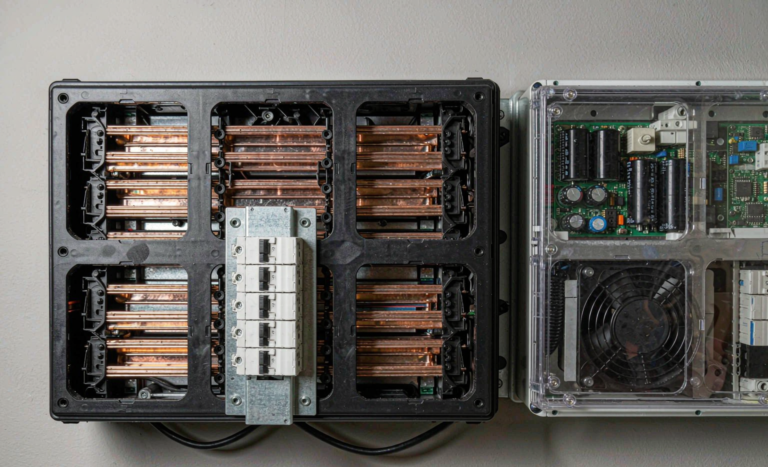
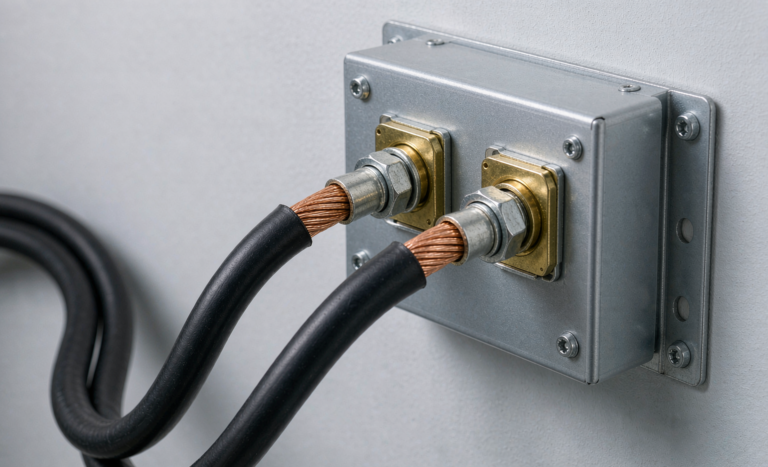
- Low-voltage 48 V class (16S, 51.2 V nominal). Mature, widely supported, easy to parallel in 5 kWh modules, safer for installers to work on. Current is higher, so busbars and interconnects need attention — this is where cheap systems fail.
- High-voltage stacks (150–500 V DC). Lower current, thinner conductors, better efficiency at high power, and generally required for 10 kW+ systems. Service requires more care and stack-level insulation monitoring.
For most new single-family homes under 10 kW, a 51.2 V modular design with 5 kWh building blocks gives the best balance of expandability and serviceability. When a builder needs something outside that envelope — an unusual enclosure depth, a specific communications protocol, marine or high-altitude conditions — that becomes a custom battery solution with its own qualification path rather than a catalogue pick.
The BMS Is the Product
Cells are commodities. The battery management system is where engineering value actually lives, and it is the part buyers inspect least. When I evaluate a home energy storage system, I look for:
- Per-cell voltage monitoring with ±10 mV accuracy or better, and balancing current adequate to correct real drift (passive 50–200 mA is usually enough for stationary duty).
- Multiple distributed temperature sensors — a minimum of one per four cells plus one on each main terminal. Single-sensor packs cannot see a developing hot spot.
- Low-temperature charge lockout below 0 °C with optional heater control. This one feature prevents more warranty failures than any other.
- Redundant protection layers: BMS firmware limits, independent hardware over-voltage and over-current cut-off, a correctly rated contactor or MOSFET bank, and a fuse sized to interrupt the pack’s prospective short-circuit current.
- Documented inverter compatibility over CAN or RS485. A mismatched communication profile turns a good pack into a dumb battery that never reaches full charge.
- State-of-charge accuracy within ±3% after a full calibration cycle, using coulomb counting corrected by OCV anchoring.
Much of this discipline came into our stationary line from aviation work. Certifying packs against UN 38.3 transport testing and FAA and EASA carriage rules for drone batteries forces a level of abuse-test rigour — altitude simulation, thermal cycling, vibration, shock, external short, forced discharge — that translates directly into more conservative and better-instrumented stationary designs.
Codes, Standards and What Inspectors Actually Check
The regulatory picture for residential storage has tightened considerably, and new construction is where compliance is easiest to achieve. The framework I design to:
- UL 9540 — safety standard for the complete energy storage system. In most North American jurisdictions, an unlisted system will not pass inspection.
- UL 9540A — the thermal-runaway fire propagation test method. Its results drive installation spacing and location rules.
- IEC 62619 and IEC 62133-2 — safety requirements for secondary lithium cells and batteries in industrial and portable applications; IEC 62133 remains the baseline cell-level safety reference in most export markets.
- NFPA 855 — installation standard. Practical constraints include a 20 kWh limit per group in utility-adjacent spaces, 1 m separation between units unless large-scale fire testing proves otherwise, and restrictions on habitable-space installation.
- NEC Article 706 (plus 705 for interconnection) — disconnecting means, working clearances, marking and rapid shutdown provisions.
- UN 38.3 — transport testing. Relevant to shipping, but its eight test sequences are also the best available screen for cell-level abuse tolerance.
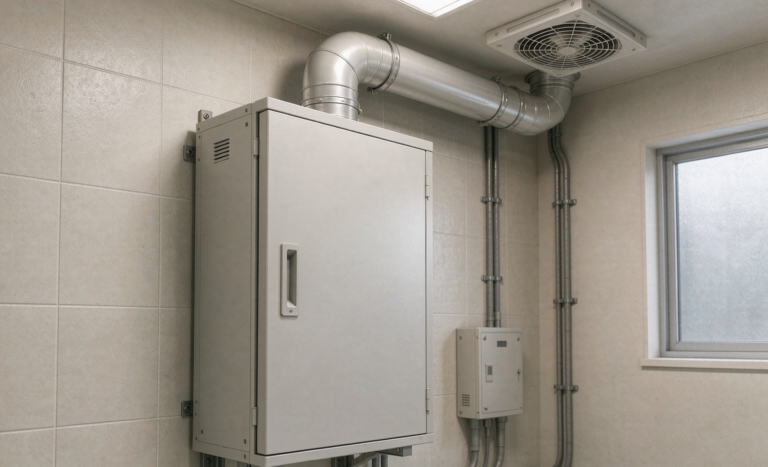
In practice, inspectors focus on four things: is the system listed, is it installed where the listing allows, are the disconnects and labels correct and accessible, and is there an approved means of ventilation or fire detection in the room. Sort those out at design stage and inspection is uneventful.
Thermal, Enclosure and Installation Detail
A new home lets you design the battery’s environment instead of apologising for it. What I specify:
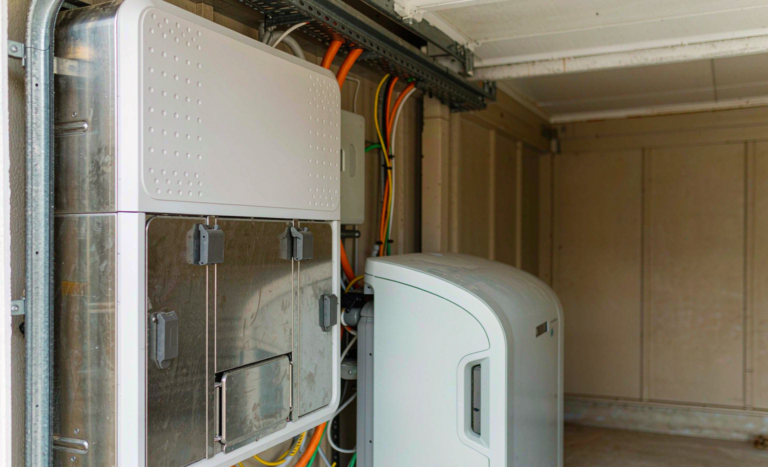
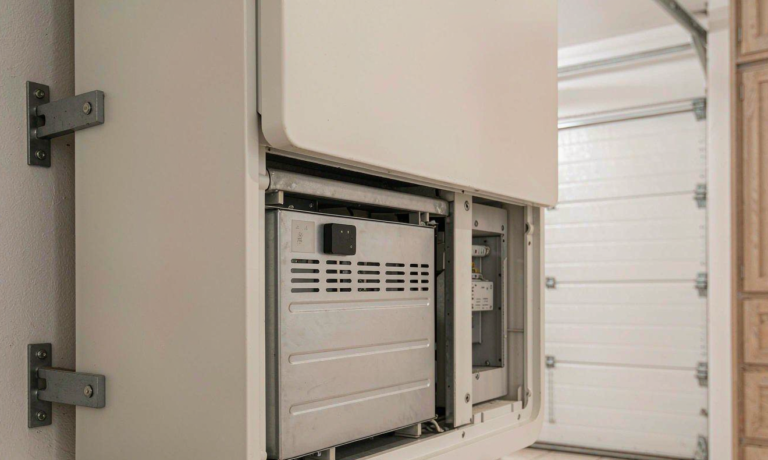
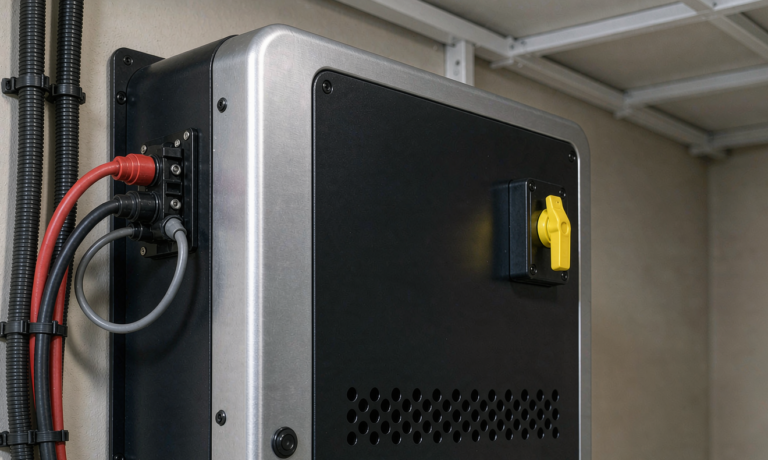
- Location: attached garage, dedicated plant room or exterior wall of a non-habitable space. Never a bedroom wall, never a stairwell, never under the only egress path.
- Temperature: a design envelope of 10–35 °C. Insulate the wall cavity behind the pack and avoid west-facing exterior walls in hot climates.
- Clearances: 900 mm working space in front, 150 mm above and to the sides for convection, per listing instructions.
- Mounting: lag-bolted into structural blocking, not drywall anchors. A 10 kWh LFP wall unit weighs 90–120 kg. In seismic zones, follow the certified seismic bracing detail.
- Wiring: DC conductors sized for 125% of continuous current with derating for ambient and conduit fill; torque every lug to specification and mark it. Loose terminals are the leading cause of thermal events in field-failed systems I have inspected.
- Detection: a heat or smoke detector in the room, interconnected with the house alarm. Cheap, and the single best early-warning measure available.
Commissioning and the First Year
Commissioning is not “turn it on and check the app”. Our handover procedure includes a full charge to 100% to balance the pack, a controlled discharge to verify usable capacity within 3% of rating, a simulated grid outage with backup loads live to confirm transfer time and surge behaviour, verification of BMS-to-inverter communication under fault conditions, an infrared scan of all terminations at full load, and a documented record of firmware versions.
Then set the operating strategy conservatively. Charging to 90–95% rather than 100% for daily cycling, and holding 20–30% as a reserve floor, costs a little usable energy and buys years of calendar life. Review the data after twelve months: capacity fade above 3% in year one indicates a thermal or balancing problem worth investigating while the warranty is fresh.
Frequently Asked Questions
How much home energy storage capacity does a new home actually need?
For critical-load backup only, 5–10 kWh is usually sufficient — that covers refrigeration, lighting, networking and a well pump through an overnight outage. For solar self-consumption in a typical 180 m² new build, 10–15 kWh matched to a 6–8 kW array is the efficient range. Whole-home backup including heat pump and EV charging pushes you to 20–30 kWh and a high-voltage architecture. Size from a measured or modelled load table, never from a headline kW figure.
Should the battery be installed inside or outside the house?
Inside a non-habitable, temperature-controlled space is technically better because thermal stability drives cell life. An attached garage or dedicated plant room is ideal. Outdoor installation is acceptable with an IP55 or better enclosure, but expect faster ageing in climates with wide temperature swings unless the unit has active thermal management. Local code and the product listing have the final say.
Can I add more storage capacity later?
Yes, if it is planned. Modular 51.2 V systems generally allow parallel expansion, but new modules should match the existing chemistry, capacity and firmware generation, and mixing packs of significantly different age causes current-sharing imbalance. In new construction we specify spare conduit, an oversized enclosure footprint and a free breaker position specifically to make later expansion straightforward.
How long will a residential LFP battery last?
Expect 6,000+ cycles to 80% of rated capacity at 0.5C and 25 °C with a 90% depth of discharge, which translates to 12–15 years of daily cycling in a well-designed installation. The dominant life factors are temperature and time held at high state of charge, not cycle count alone. Warranties of 10 years or 6,000 cycles with a 70% end-of-life threshold are the current market baseline.
Is a home battery worth it without solar?
It depends entirely on tariff structure. Under time-of-use rates with a spread above roughly 0.15 USD per kWh, arbitrage plus backup value can justify the investment. On a flat tariff, the economics rest almost entirely on backup resilience — which is a legitimate reason, but should be priced as insurance rather than as a return-generating asset.
What certifications should I insist on?
UL 9540 for the system with UL 9540A test data available, IEC 62619 or IEC 62133-2 at cell and battery level, and UN 38.3 documentation for transport. Ask for the actual test reports, not a compliance claim on a brochure — and confirm the certified model number matches exactly what is being delivered.
Closing Notes From the Bench
The best residential storage installations I have worked on were unremarkable to look at: correct enclosure, short cable runs, sensible temperature, honest sizing, listed hardware, torque marks on every lug. None of that requires exotic technology. It requires deciding early, while the walls are still open, that the storage system is part of the building rather than an accessory bolted on afterwards. If you are designing a new home now, put the battery on the electrical plan at rough-in stage, size it from real loads, specify LFP with a well-instrumented BMS, and document the commissioning. That approach has never let a client down, and it is the difference between a system that quietly works for fifteen years and one that becomes somebody’s warranty claim.