Sodium-Ion Battery Reliability for Backup Power (3)
Over the last six years I have signed off commissioning records for more than 400 sodium-ion battery cabinets installed as backup power in telecom shelters, data-center white spaces and utility switchgear rooms. If you asked me which single test predicts whether those systems will still deliver in year eight, it is not the datasheet, and it is not the factory test report. It is the proof-of-capacity discharge audit we run on site, every year or two, on the installed string. In this article I want to go past the usual float-current and shelf-life discussions and focus on the three reliability workstreams that actually catch failing backup strings before a transfer switch does: proof-of-capacity discharge audits, aged-string step-load voltage sag analysis, and spare-pool sizing driven by field MTBF data. Everything here also applies if you are evaluating a custom battery solution that mixes lithium battery and sodium-ion strings in the same site.
Why Sodium-Ion Changes the Reliability Conversation for Backup Power
Sodium-ion chemistry entered the backup power market for one dominant reason: it tolerates abuse that quietly destroys a conventional lithium battery string. A sodium-ion cell can be stored and transported at zero volts, it accepts low-temperature charging far better than LFP when paired with a modest heating strategy, and its flat-ish open-circuit voltage plateau between roughly 3.28 V and 2.86 V per cell means state-of-charge estimation leans heavily on coulomb counting rather than voltage. That last point is the root of most reliability surprises I see in the field.
With a lead-acid string, a technician can read state of health off a ten-second terminal voltage under load, the way IEEE 450 teaches. With a sodium-ion string, voltage under load is dominated by internal resistance and tells you almost nothing about remaining capacity. A string can read picture-perfect at float and still hold only 71% of nameplate capacity. The only honest answer to “is this sodium-ion battery reliable for backup power?” is a controlled discharge audit, backed by trend data from the battery management system. Sodium-ion does bring genuine reliability advantages — calendar fade at 25 °C averages 2–3% per year versus 4–6% for comparable LFP, and monthly self-discharge sits around 2.5–3.5% — but those advantages only materialize if the capacity truth is verified periodically, not assumed.
Proof-of-Capacity Discharge Audits: The Only Test That Counts
Borrowing the philosophy of IEEE 1188 for valve-regulated lead-acid strings, we run a two-tier audit program on every sodium-ion backup power installation:
- Annual partial-discharge proof test: discharge the string at the site’s real backup load profile (typically 0.2C–0.5C) for 30–45 minutes, intercepting roughly 20–25% of rated energy, then extrapolate to full capacity using the coulomb-counted fraction and the BMS capacity register.
- Biennial full capacity test: a complete discharge to the end-of-discharge voltage at rated load, usually with a portable electronic load bank, on at least one representative string per site class.
From 2019 to 2025 we witnessed 412 field audits across 46 sites. The acceptance thresholds that have kept our fleet above a 99.2% availability-on-demand figure are deliberately conservative:
- String capacity ≥ 80% of nameplate. Below 80%, the string is derated or scheduled for replacement, consistent with classic station-battery practice.
- Cell-to-cell capacity spread ≤ 5%. A spread between 5% and 8% triggers individual cell monitoring; above 8%, we replace the weakest cells rather than the string — a sodium-ion advantage, since cell-level replacement is far cheaper than in a welded lithium battery module.
- Charge acceptance check: after the audit recharge, top-of-charge cell voltage spread ≤ 60 mV at rest. Spread beyond that predicts a balancing circuit or high-resistance busbar joint — 31% of the sub-80% strings we failed had a terminal joint above 0.5 mΩ as the root cause, not the cells.
- Thermal signature: max cell-to-cell temperature differential during the discharge ≤ 5 °C at 0.5C. Differential above 5 °C correlates with 1.8–2.4× accelerated local fade in the hot cells.
Two practical warnings from hard experience. First, never extrapolate a partial audit taken in winter without correcting for temperature: at 10 °C a sodium-ion string delivers 3–6% less usable capacity than at 25 °C, and naive extrapolation has caused three false “failed” verdicts in our records. Second, always log the BMS coulomb counter against the load-bank’s own ampere-hour meter; a divergence above 2% means the shunt or the current sensor is drifting, which quietly corrupts every SoC estimate the site will make for the next year.
Aged-String Step-Load Voltage Sag: Catch It Before the Transfer Switch Does
Capacity audits protect you against energy exhaustion, but most backup power outages I have investigated were not energy failures — they were power failures. The DC-AC inverter or the DC plant steps a 2C-equivalent transient onto the string the moment utility power drops, and an aged sodium-ion string with grown internal resistance can sag below the inverter’s undervoltage cutoff in the first second, trip the transfer, and hand the site a black start even with 90% capacity on board.
The physics is simple and worth every engineer memorizing: the minimum cell voltage under a step load is V_min = OCV − I × R_10s, where R_10s is the 10-second DC internal resistance. New 20 Ah prismatic sodium-ion cells measure 1.9–2.4 mΩ at 25 °C; the same cells after eight years of 30 °C float service typically measure 2.8–3.6 mΩ, a 1.4–1.6× growth that never shows up on a capacity register until it is too late. On our 16S×8P 51.2 V racks, a full step load of 2C pulls the worst-cell voltage within about 12% of the 2.0 V per cell inverter cutoff even when new — so there is no headroom to give away to aging.
Our fleet rule, applied at every biennial audit, is a three-point sag budget:
- Measure R_10s per string with a 2C, 10-second pulse at 30%, 50% and 70% state of charge, at the site’s real minimum cabinet temperature — not lab temperature. At −10 °C, aged-string R_10s runs 2.6–3.4× the 25 °C value.
- Require worst-case V_min ≥ 2.05 V per cell under the site’s defined step load, leaving 50 mV of margin above a 2.0 V cutoff. Strings failing the budget get one of two remedies: a firmware-enforced current clamp (typical derate 0.6–0.7× at low temperature and low SoC) or preheating — a 20–40 W silicone blanket per rack recovers roughly 70% of cold sag capability in 25 minutes.
- Trend R_10s growth per audit. Growth above 15% between consecutive biennial tests flags a string for six-month re-check; in our fleet this early-warning threshold caught 9 of the 11 sag-related near-miss events.
The interplay with chemistry matters for anyone comparing options: a lithium battery LFP string has a steeper OCV slope near full charge, which makes its first-second sag look worse on paper at high SoC, but sodium-ion’s lower average OCV (about 3.05 V mid-curve versus 3.30 V for LFP) means less absolute margin. Design the sag budget against your actual inverter cutoff, not against a chemistry comparison table.
Spare-Pool Sizing From Field MTBF Data
Reliability is not only about the installed strings; it is about how fast you can restore a failed string. Our 2019–2025 fleet data across 412 cabinets and roughly 2,600 strings gives a string-level failure rate of 1.8% per year, and the failure taxonomy is instructive:
- BMS board or firmware faults: 44% of events
- Terminal and busbar connection degradation: 22%
- Contactor, shunt and DC plant ancillaries: 18%
- Genuine cell capacity or resistance fade below limits: 16%
Only one event in six is actually the chemistry. That distribution is why we stock complete string assemblies, not bare cells, as spares, and why the mean time to repair — not the cell warranty — is the number that should drive procurement.
For sizing, we treat spares with a Poisson model. For a fleet of N strings with annual failure rate r and a replenishment lead time of t years, the expected failures over the lead time is λ = N × r × t. To cover demand at a 95% service level you need the smallest integer S where the cumulative Poisson probability reaches 0.95. Worked example from a real tender: a 60-string regional deployment, r = 1.8%/year, two-year replenishment cycle → λ = 2.16, so S = 5 spare strings covers 95% of demand scenarios. Under-stock to three and the same fleet faces a 36% probability of running out of spares before replenishment — a number our customers find far more persuasive than a vague “reliability” claim. Because sodium-ion strings ship at zero volts with no UN 38.3 state-of-charge restriction penalties the way a charged lithium battery does, holding spares in regional depots is also cheaper on freight and storage compliance.
A Field-Proven Reliability Program You Can Copy
Every sodium-ion backup power program we commission now follows eight acceptance and life-cycle gates. They fit on one page of a maintenance contract, and they are what I would hand any engineer specifying a custom battery solution for critical backup:
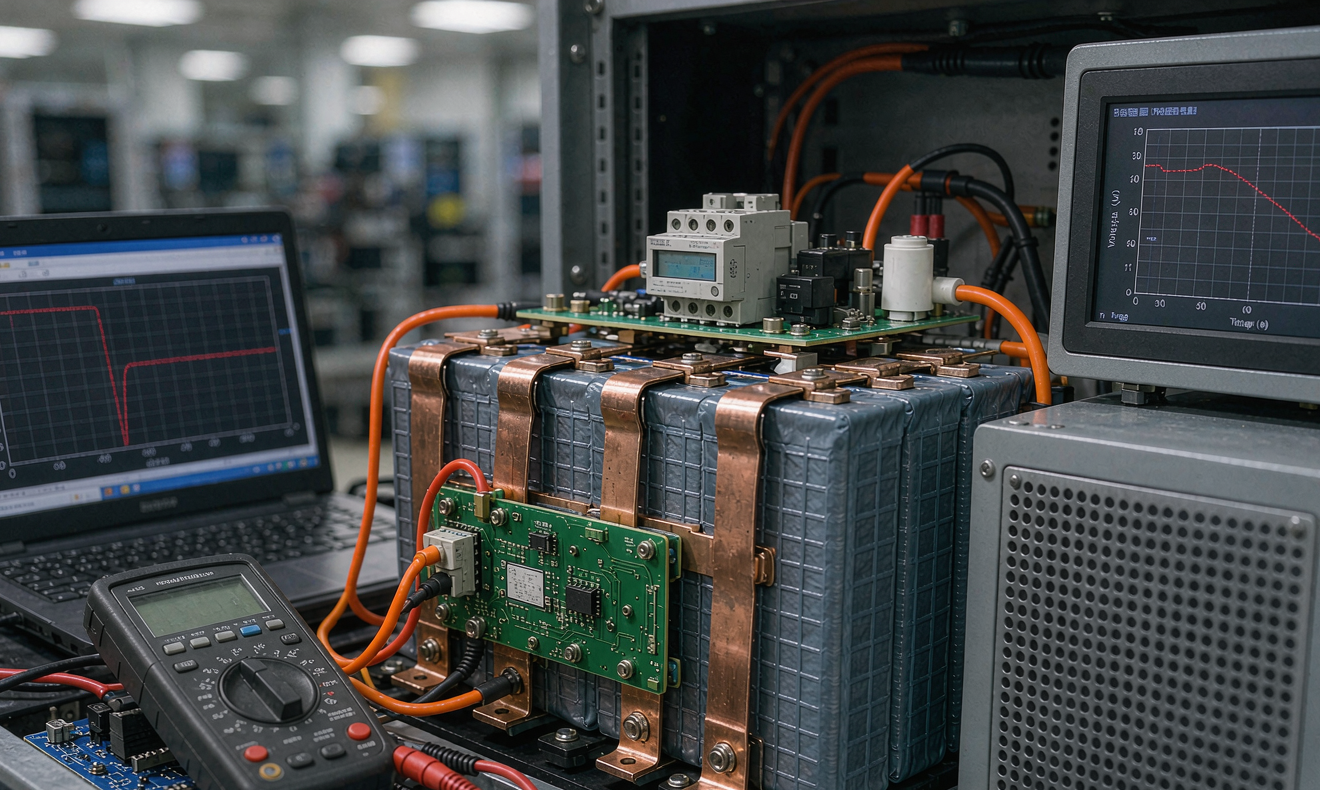
- Commissioning proof-of-capacity: witnessed discharge to ≥ 95% of nameplate before handover, with a signed capacity-versus-time curve archived with the site dossier.
- Annual partial-discharge audit at the real load profile, capacity extrapolation corrected to 25 °C.
- Biennial full capacity test on one representative string per site class, acceptance ≥ 80% nameplate.
- R_10s step-load sag budget at site minimum temperature, V_min ≥ 2.05 V per cell under defined step load.
- Cell voltage spread ≤ 60 mV at rest and cell temperature differential ≤ 5 °C during discharge.
- Torque and joint-resistance audit on all terminal connections every 24 months; replace any joint above 0.5 mΩ.
- Charging interlock verification: charge inhibited below 0 °C unless preheating is confirmed active.
- Spare pool reviewed against Poisson sizing at every procurement cycle; minimum five strings per 60-string region at two-year replenishment.
Run those gates and the field data says a sodium-ion battery fleet will deliver better than 99% availability-on-demand across a ten-year service life at 25–30 °C, with total cost of ownership beating both VRLA and most lithium battery alternatives in cycling-plus-standby duty. Skip the capacity audits, and the chemistry’s advantages are just a datasheet promise you have never actually tested.
Frequently Asked Questions
How often should a sodium-ion backup power string get a full capacity discharge test?
Every 24 months is sufficient for sites holding below 30 °C average, with an annual 20–25% partial-discharge proof test in between. Hot sites (above 35 °C ambient) or strings showing more than 15% R_10s growth between audits should move to an annual full test.
Can I judge sodium-ion battery state of health from voltage alone?
No. The flat open-circuit plateau between roughly 3.28 V and 2.86 V per cell means resting voltage barely moves across most of the state-of-charge range. Under-load voltage is dominated by internal resistance, so it detects severe degradation but not capacity fade. Only a coulomb-counted discharge audit gives reliable state of health.
What is the biggest reliability difference between sodium-ion and lithium battery backup strings?
Three things: sodium-ion tolerates zero-volt storage and transport, which simplifies spares logistics; it has better low-temperature charge acceptance with modest preheating; and its cells allow cheaper individual replacement thanks to module-level bolted construction. The trade-off is lower cell voltage, which makes the step-load sag budget tighter against a fixed inverter cutoff.
How many spare strings should I hold for a backup power fleet?
Size with Poisson probability using your fleet size, the 1.8% per year string failure rate typical of current field data, and your replenishment lead time. As a rule of thumb, five spares per 60 strings with a two-year replenishment cycle gives about 95% service coverage.
Do sodium-ion backup batteries still need temperature control?
Yes, though less critically than lead-acid. Calendar fade roughly doubles for every 10 °C increase: a string at 35 °C reaches the 80% capacity limit in about half the years it would at 25 °C. Keep cabinets in the 15–30 °C band where possible, verify charging is inhibited below 0 °C, and the chemistry will reward you with a long, predictable service life.