Sodium-Ion Battery Charger Compatibility and Protocols
Why Charger Compatibility Is the First Sodium-Ion Deployment Gap
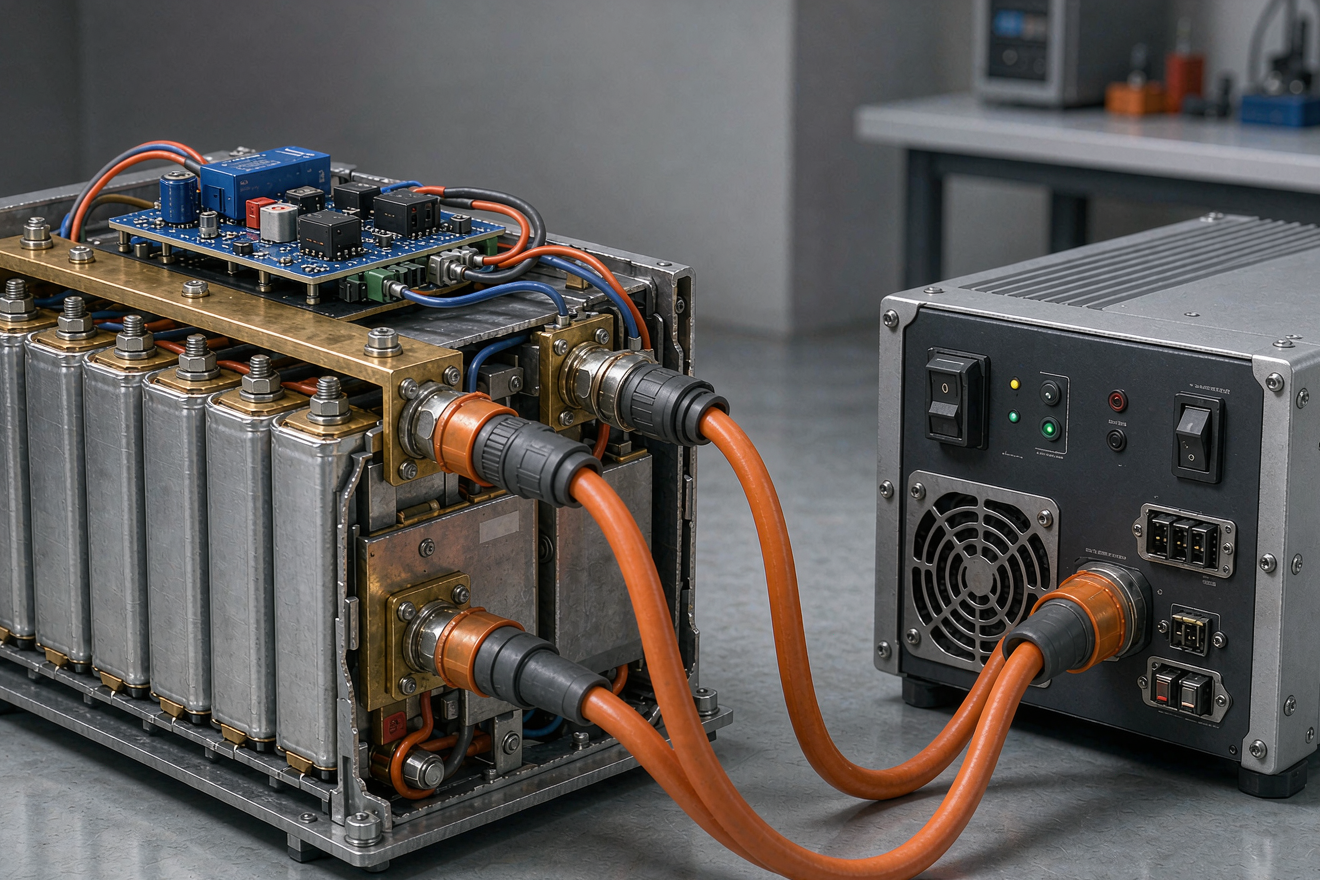
I have spent the last decade spec’ing lithium battery packs for drones, robots, and stationary storage, and the single biggest integration mistake I see when teams move to sodium-ion is treating the charger as a commodity. A 48 V bus is not a 48 V bus. The moment a fleet mixes sodium-ion battery packs with existing lithium infrastructure, the charger becomes the component that decides whether the pack lives ten years or fails in a season. In this guide I will walk through the voltage, protocol, and compliance details I check before I ever connect a sodium-ion pack to a charger.
Why Voltage Windows Decide Charger Compatibility
The root cause of most charger failures is a mismatch between the charger’s termination voltage and the cell’s actual window. A typical sodium-ion full cell built on a hard-carbon anode with a layered-oxide or polyanionic cathode operates from roughly 1.5 V to 4.0 V, with a nominal around 3.1 V. Some cathode choices push the upper limit to 4.2 V, but the lower cutoff and the shape of the curve are different from anything a lithium battery uses.
For comparison, an LFP lithium battery runs about 2.5 V to 3.65 V with a 3.2 V nominal, while an NMC cell spans 3.0 V to 4.2 V. If you connect a 4.0 V sodium-ion battery to a charger hardcoded to an LFP ceiling of 3.65 V, the pack will never reach full state of charge and you quietly lose 15 to 25 percent of usable capacity. Connect that same pack to a charger assuming NMC and pushing to 4.2 V, and you overcharge the cathode, accelerate electrolyte oxidation, and raise the risk of venting. The CV setpoint must come from the cell datasheet, never from the charger’s default profile.
CC/CV Profile and Termination Current
Sodium-ion cells follow the same constant-current, constant-voltage shape I use for lithium, but the acceptable termination rules are looser in a useful way. I charge at a fixed current up to the CV setpoint, then let voltage hold while current tapers. Most sodium-ion cells tolerate a higher termination current, often C/20 to C/10, without a meaningful capacity penalty, which means the top-off phase can finish faster than it would on an equivalent lithium battery.
Temperature compensation still matters. Below 0 C I reduce current and hold a lower CV to protect the anode, and above roughly 45 C I trim the setpoint to limit side reactions. Sodium-ion keeps better low-temperature kinetics than LFP, so a pack that would refuse to charge on a cold morning as lithium may still accept current as sodium-ion, but that is not a license to skip the thermal limits in the battery management system.
Communication Protocols Between Pack and Charger
A modern pack is not a dumb brick of cells. The battery management system and the charger must agree on a language, and that handshake is where mixed fleets break. I design around four tiers of communication.
- SMBus and PMBus (Smart Battery Data SBS 1.1) for smart portable packs, where the BMS reports voltage, current, temperature, and state of charge over a two-wire bus.
- CAN bus (CAN 2.0B) with a vendor profile, CANopen, or J1939 for industrial and energy-storage chargers, which is what I use for larger sodium-ion battery cabinets.
- Modbus RTU over RS485 for grid-tied and stationary applications where the charger sits on the same control network as the inverter.
- Analog signaling (an NTC thermistor line, an enable pin, and a 0 to 5 V limit) for basic chargers that simply need a go or no-go and a temperature cutoff.
The critical behavior is that the BMS broadcasts its maximum voltage, maximum current, and temperature limits, and the charger clamps to them. When the protocol does not match, the charger ignores the BMS and falls back to its own fixed profile, which is exactly how a healthy pack gets overcharged. I always validate the handshake on the bench before a pack ships.
Running Mixed-Chemistry Fleets on One Charger
In real depots the question is not theoretical. A drone battery fleet might run on high-energy lithium while the ground-support sodium-ion battery packs share the same charging room. The safe pattern is chemistry auto-detection or an explicit selector on the charger, plus physical labeling so nobody grabs the wrong connector.
The failure mode I warn clients about is plugging a 4.0 V sodium-ion pack into a charger still set to an NMC profile at 4.2 V. The pack looks like it charges fine for a few cycles, then the cathode degrades. The opposite mistake, an LFP-only 3.65 V charger on a sodium-ion pack, just leaves the operator confused about why range dropped. A smart charger that reads the BMS and self-configures removes both risks, and for a custom battery solution I specify that behavior in the contract.
Standards and Compliance You Should Quote
When I write a spec sheet I cite the references a procurement reviewer will look for. Cells should meet UN38.3 for transport, IEC 62133 for portable applications, IEC 62619 for industrial cells, and IEC 63056 or IEC 62620 for large stationary systems. Chargers fall under IEC 62368-1 and UL 1310 or UL 60335 depending on the class. Communication references include the SMBus specification, CAN profiles described in IEC 62933 for energy storage, and J1939 for mobile equipment. For aviation use, FAA and EASA rules on battery transport and operation still apply to sodium-ion the same way they apply to a lithium battery, so do not assume the newer chemistry gets a free pass.
A Practical Integration Checklist
Before I sign off on any sodium-ion battery deployment, I run this short list with the client.
- Pull the termination voltage and CV setpoint directly from the cell datasheet, not from the charger menu.
- Configure the BMS communication profile to match the charger, whether that is SMBus, CAN, or Modbus.
- Bench-validate the handshake by sending a max-voltage command and confirming the charger clamps.
- Set temperature limits in both the BMS and the charger, with a hard cutoff below 0 C and above 45 C.
- Label ports and document the chemistry so future operators cannot mix connectors.
- For a custom battery solution, request the charger compatibility matrix from the manufacturer in writing.
Get those six items right and sodium-ion stops being a charger compatibility problem and becomes the cost-stable, cold-tolerant chemistry it was meant to be.
Frequently Asked Questions
Can a sodium-ion battery use an existing lithium charger?
Only if the charger’s termination voltage and communication profile match the sodium-ion cell datasheet. A charger set to an LFP ceiling of 3.65 V will undercharge a 4.0 V sodium-ion battery, while an NMC-profile charger at 4.2 V will overcharge it. Use a smart charger that reads the battery management system, or reconfigure the profile explicitly.
What communication protocol does a sodium-ion BMS usually speak?
It depends on the application. Portable smart packs typically use SMBus or PMBus, industrial and energy-storage systems use CAN bus or Modbus RTU over RS485, and basic chargers rely on analog signals such as an NTC thermistor and an enable line. The protocol must let the BMS tell the charger its voltage and current limits.
What happens if the charger voltage exceeds the cell limit?
Overvoltage drives cathode oxidation and electrolyte breakdown, accelerates capacity fade, and in the worst case causes venting or thermal runaway. The battery management system should broadcast a hard limit that the charger clamps to, and a mismatched protocol that ignores that limit is the dangerous case to avoid.
Can sodium-ion batteries be fast charged in cold weather?
Sodium-ion keeps better low-temperature kinetics than LFP, so it can often accept charge at temperatures where a lithium battery would refuse. Even so, I reduce current and hold a lower constant voltage below 0 C, because the anode still has a safe operating boundary that the charger must respect.
How do I set the CV termination voltage for a sodium-ion pack?
Read the constant-voltage setpoint from the cell manufacturer’s datasheet rather than from the charger default. Confirm the full-cell window, set the CV to the specified upper limit, choose a termination current around C/20 to C/10, and verify on the bench that the charger actually clamps at that voltage under load.
Are sodium-ion chargers covered by the same safety standards as lithium?
Generally yes. Cells are evaluated under UN38.3, IEC 62133, IEC 62619, and related stationary standards, while chargers follow IEC 62368-1 and UL 1310 or UL 60335. Aviation and transport rules from FAA and EASA apply to sodium-ion the same way they apply to a lithium battery, so compliance paperwork should not be assumed lighter.
Further Reading
References