Battery Solution for Continuous Miners and Roadheaders
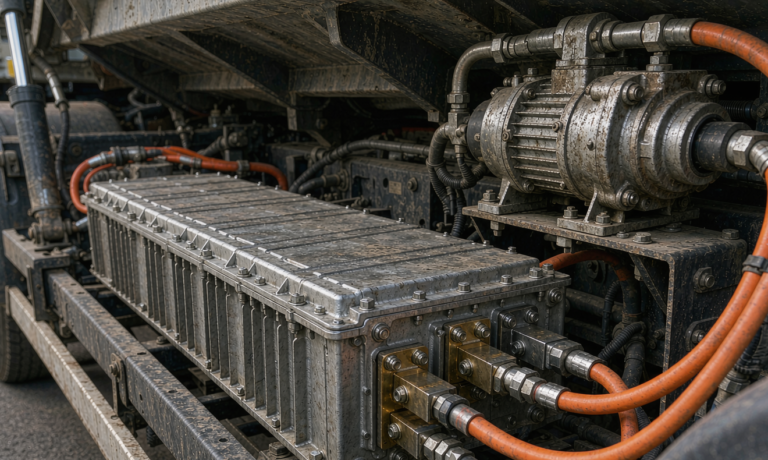
A boom-type mining machine is the hardest place I have ever put a battery pack. A continuous miner bites into a coal seam with one or two 150 kW to 250 kW motor loads while it rides on rubber tracks a few metres from a face at 40 degrees Celsius, in damp air, with methane around it. The duty is short, brutal power bursts rather than steady discharge. Getting a battery solution for continuous miners and roadheaders right means designing for peak power, for an enclosure that will not ignite the seam, and for a change-out that fits inside a shift.
Why the diesel engine is leaving the face
For decades the answer to “how do you move a machine that needs 400 kW” underground was a diesel engine with a particulate trap, a catalyst and a scrubber. That works, but the aftertreatment is a maintenance item and the exhaust is a hazard. In a gassy seam, the exhaust becomes another ignition source competing with the flameproof electrical equipment, and the ventilation needed to dilute it is never free.
Battery-electric boom miners remove the exhaust at the source. There is no diesel particulate filter to regenerate, no catalyst to bake out at 600 degrees Celsius, no oil to sample every 250 hours, and no exhaust plume that heats the operator cabin. The result is a cleaner machine with fewer moving parts in the power path, and a face that needs no extra auxiliary ventilation.
What replaces the engine is a traction pack, a high-voltage bus, a machine controller and a set of standards most consumer battery engineers never touch. Two matter more than anything else: IEEE 1122, which covers safety and health requirements for electric battery-powered mobile mining equipment in underground mines, and IEEE 1302, which guides mine power system design.
Power budget of a continuous miner or roadheader
Every sizing conversation starts with the load list, because a boom machine spikes harder than it averages. A mid-size continuous miner installs 300 kW to 520 kW of motors: the cutter head alone takes 150 kW to 250 kW, the hydraulic pump that swings the boom takes 45 kW to 75 kW, the two traction drives take 30 kW to 55 kW each, and dust-suppression pumps, fans and roof drills add 25 kW to 45 kW more.
- Cutting into hard rock or icy limestone is the load that decides the design: 400 kW to 900 kW for 10 s to 20 s while the bits engage
- Tramming is sustained but modest: two drives at roughly 30 kW to 55 kW each over 8 min to 15 min
- Hydraulics run continuously, because the boom must be repositioned constantly even when the cutter is idle
- Auxiliaries, water spray and cabin filtration draw 10 kW to 20 kW in total and never stop
Look at the cycle. Between cuts the operator trams, sets the boom, sprays water and clears spoil for 8 min to 15 min, then cuts for 20 min to 45 min. Three to eight cuts per shift puts the average draw at 35% to 55% of peak, and the pack must survive peaks five to ten times its average current.
Pack is sized on energy for the shift and pulse current for the cut. A 320 kWh pack drawing an average of 240 kW gives about 1.3 h of continuous mining, which sounds short until you remember a shift is only a few hours of cutting in total. Operators specify 250 kWh to 400 kWh for a heavy continuous miner and 150 kWh to 280 kWh for a roadheader, then keep two spare packs per section.
Pack architecture for 40 degree Celsius rock
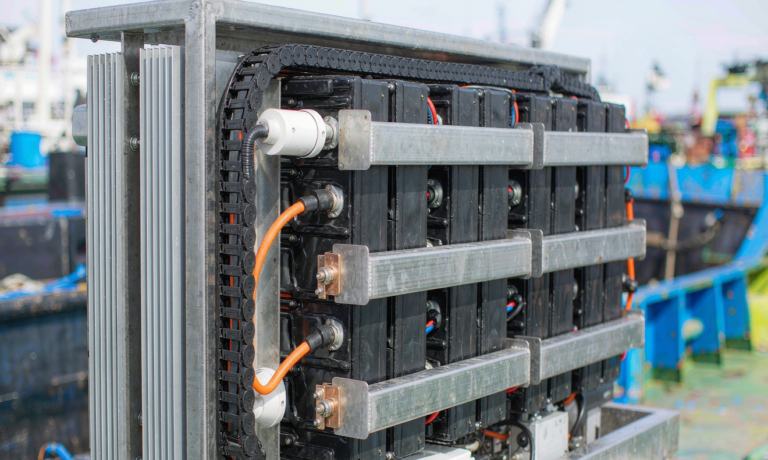
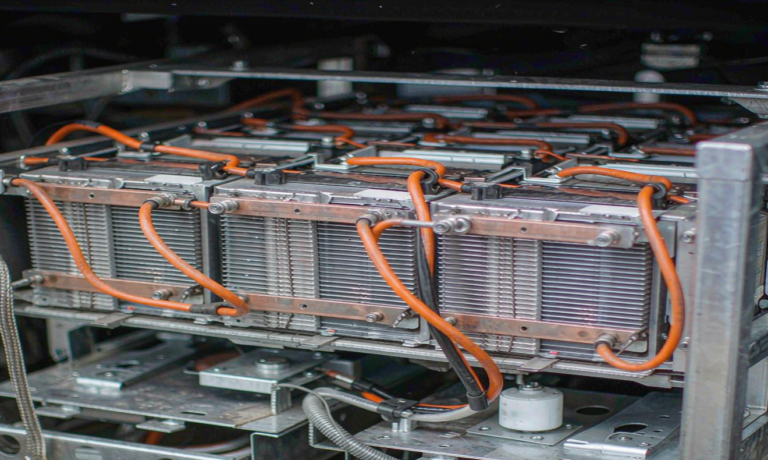
We build these packs around LFP prismatic cells in the 100 Ah to 280 Ah range. LFP is not a compromise here; it is a match. The face is hot, the cycle life target is 8 to 10 years of daily swaps, and the flat discharge curve keeps state-of-charge bookkeeping predictable under bursty loads.
Voltage architecture follows the same logic as any high-power traction pack. A 160S string gives 512 V nominal, common on smaller roadheaders. A 256S string gives roughly 819 V nominal, close to 925 V when fully charged, and is better once peak power climbs past 400 kW. The reason is copper: at 400 kW an 819 V pack pulls roughly half the current of a 512 V pack, which quarters resistive heating in the busbars and lets you run smaller cable on the trailing side of the machine.
What the pack has to survive
- Peak discharge of 2C to 3C for 10 s to 20 s, sustained at 0.5C for the tram legs
- An internal DC resistance budget where 160 cells at 1.0 mohm plus 300 busbar nodes at 0.15 mohm already reach 0.2 ohm, so cell selection dominates the thermal design
- Cell surfaces held between 15 degrees Celsius and 45 degrees Celsius under load, with a 5 degrees Celsius maximum spread across a module
- 8 thermistors to 12 thermistors per pack, tapped at the cell lugs rather than the module surface, because surface sensors lag the hot cell by 10 K to 30 K
- Charge derate to 0.05C once the pack exceeds 40 degrees Celsius, which is routine in summer faces
Cooling is usually borrowed from the machine. A mining machine already carries a water loop for dust suppression, so we route it through cold plates under the module tray. In a face at 40 degrees Celsius with rock at 45 degrees Celsius, pack ambient is what it is; the goal is keeping cells below the point where a thermal runaway chain can start, and keeping equalization honest as cells age.
Flameproof enclosures, methane and IEEE 1122
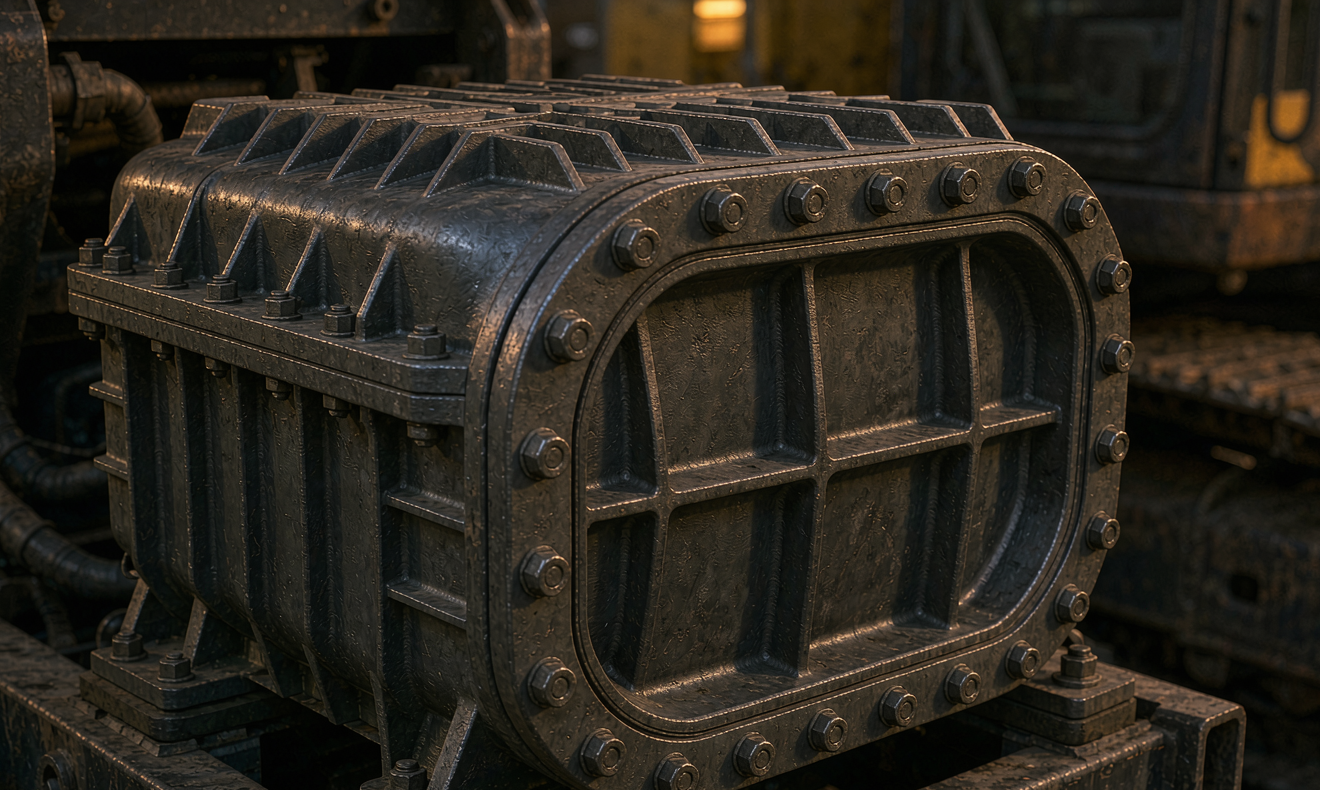
This is the section that separates a mining battery from an industrial one. Underground machinery in a gaseous mine carries a Group I hazardous-area classification, which means the enclosure has to contain an internal explosion rather than merely stop sparks from entering. The flameproof envelope, a bolted flange with a defined joint gap, has to hold against a methane-air ignition while its outside surface stays below the certified temperature class.
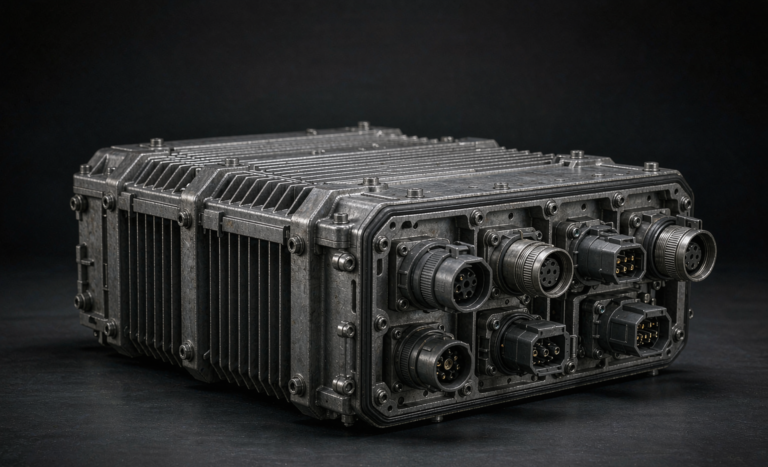
The practical consequences are easy to underestimate. The enclosure face is heavy plate with a machined joint, sealed with an O-ring and capped by 10 mm to 14 mm bolts on a tight pitch. Cable entries are flameproof glands, not ordinary glands. Every conductor inside is shrouded and insulated for working voltage plus margin, every terminal is a sealed block, and the assembly is laid out so an internal thermal event cannot vent a flame front into the seam. Vent paths, where they exist, run up and to the rear, away from the operator.
On monitoring, methane detection is tied to the pack contactor. A reading at 1.0% to 1.25% above background triggers an alarm and, on most modern machines, a cached disconnect before anyone has to decide. Carbon monoxide sensors in the pack bay warn early of an internal fault, and the thermistor ladder can open the main contactor in under 100 ms.
For a Horizon Power mining pack the compliance list is not paperwork: cells to IEC 62133-2, complete packs to UL 2271, transport to UN38.3 with the applicable dangerous goods instructions, machinery safety to ISO 20428, mine power guidance to IEEE 1302, and the hazardous-area certificate the seam requires. Design also follows IEEE 1122 for the battery housing, the disconnect and the insulated shrouding.
Change-out, charging and the battery bay
Operations live or die on swap time. A spare pack is hoisted on a section gantry or a purpose-built change frame, the isolating switch is locked out, the main contactor opens, the heavy connector backs out and the pack rolls out. Twenty minutes is a good swap with a trained crew; 35 minutes is realistic for the first pack in a new section. Three swaps per shift is the planning number most operators use.
Charging happens where the mains connection is clean. A 320 kWh pack at 0.2C charges at about 64 A, which is roughly 6 h to 7 h to 90% and fits a shift change. Heavy sections run two charging bays on the surface plus a fire-rated bay near the shaft bottom, with fixed gas detection, rock-dust mixing and a deluge line. Connectors carry 400 A to 630 A with interlocks and key exchange, so the pair cannot be separated under load.
The operating rule is depth of stay: work inside a 20% to 90% SOC window, about 70% depth of discharge, and pull the pack for a rest rather than running it flat into a tram. Under those conditions an LFP mining pack gives 3,000 to 5,000 cycles and 8 to 10 years of section duty before capacity reaches the 70% retirement line. Retired packs go to surface equipment, where the same cells are worth more than as scrap.
Total cost: fuel, ventilation and the change crew
The diesel comparison is not just fuel. A continuous miner burns 80 L to 130 L per hour under load, 600 L to 900 L over a shift, and it needs oil analysis, filter changes, spark arrestor servicing, catalyst replacement and particulate-trap regeneration. All of that disappears when the power path is electric.
Ventilation is the quiet saving. A diesel section carries extra auxiliary fan load, booster fans and the cooling duty that exhaust heat adds to the return air; a battery-electric section drops part of that and can often run a smaller main fan at lower hours. In our models, converting a high-utilization continuous miner from diesel typically pays back in 3 to 5 years, shortening as ventilation energy and maintenance hours rise.
The battery side of the ledger is capex, a change crew, a charging bay and fire infrastructure. It is a real cost and it is front-loaded, which is why the conversation usually starts with a pilot: one machine, one section, one measured shift, then the fleet decision.
FAQ
How long will a battery power a continuous miner?
It depends on cut time, not shift length. A 250 kWh to 400 kWh pack covers roughly 4 h to 6 h of cutting and tramming per charge, and more if the section has a charging bay at the face.
Can a battery-powered continuous miner work in a gassy seam?
Yes, provided the machine carries the hazardous-area certification the seam requires, including a flameproof enclosure, methane and carbon monoxide detection, and an automatic disconnect tied to gas readings.
Which chemistry is used in mining machine packs?
LFP prismatic cells dominate. Long cycle life, stable chemistry and a flat voltage curve suit daily swap duty better than high-energy nickel-based chemistry, which buys energy density the machine cannot use.
How long does an underground battery change take?
A trained crew changes a 300 kWh pack in about 20 min to 35 min. The critical path is the lockout, roll-out and connector torque check, not the lift itself.
Do mining battery packs need explosion-proof enclosures?
In gaseous underground mines they need the equivalent: a certified flameproof envelope, shrouded conductors, flameproof cable glands and a vent path directed away from the operator.
What certifications should I ask a mining battery supplier for?
Ask for UN38.3 test reports and dangerous goods shipping papers, cells to IEC 62133-2, packs to UL 2271, the mine hazardous-area certificate, and the machine-level documentation IEEE 1122 and ISO 20428 require.
Further Reading
References