Lithium Battery Performance for Backup Cabinets
Backup cabinets sit at the edge of networks, inside telecom huts, along railway signaling routes, and in small commercial buildings where a short power gap means lost data or a stalled process. I have spent the last decade specifying lithium battery packs for exactly these enclosures, and the performance envelope is different from what most buyers expect. A cabinet battery is not a mobility battery. It sits at rest most of its life, then must deliver full rated power the instant the grid drops. In this article I walk through the cell choices, thermal limits, cycle behavior, and the battery management details that decide whether a lithium battery pack in a backup cabinet performs for seven years or fails in eighteen months.
What a Backup Cabinet Demands From a Lithium Cell
When I audit a failed cabinet pack, the root cause is almost never the cells. It is the mismatch between the duty cycle and the specification. A backup cabinet asks for three things at once: long standby with minimal self-discharge, instant high-current delivery during an outage, and survival through wide temperature swings because many cabinets are unconditioned. A lithium battery designed for an e-bike or a power tool is tuned for deep daily cycling at moderate temperature. Drop that same cell into a roadside cabinet that sees minus 20 degrees Celsius in winter and plus 45 degrees Celsius in summer, and the performance curve shifts hard. The first rule of backup cabinet design is to size the pack for the worst-case temperature, not the laboratory temperature. I also budget for a depth of discharge that never exceeds 80 percent, because a cabinet that fully flattens its pack on every outage loses calendar life faster than one that reserves headroom. The recharge window matters too: a pack that can only trickle-charge from a weak solar or generator feed needs a larger capacity than the nameplate load suggests, since the battery must both serve the load and refill itself before the next event.
LiFePO4 Versus NMC for Cabinet Duty
For stationary backup, I default to LiFePO4, or lithium iron phosphate, in almost every cabinet project. The nominal voltage of 3.2 volts per cell, a flat discharge curve, and a thermal runaway threshold near 270 degrees Celsius give it a safety margin that nickel manganese cobalt does not. NMC packs can be smaller and lighter, which matters for drones and power tools, but a cabinet does not move. What it needs is tolerance to calendar aging and a low risk profile when sealed in a metal enclosure with no one watching. In my field data, LiFePO4 cabinet packs retain above 80 percent capacity after 2000 cycles at room temperature, while the same duty on NMC shows faster capacity fade past 1500 cycles. When a customer asks for maximum energy density in a tight cabinet, I still warn them about the thermal management cost before recommending NMC. At Horizon Power we have shipped both chemistries, and the return rate on LiFePO4 cabinet packs stays an order of magnitude below NMC in the same environment.
Thermal Behavior Inside a Sealed Cabinet
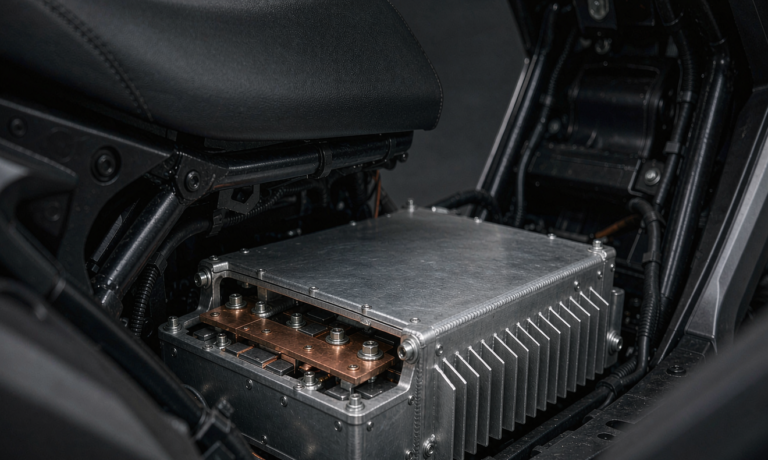
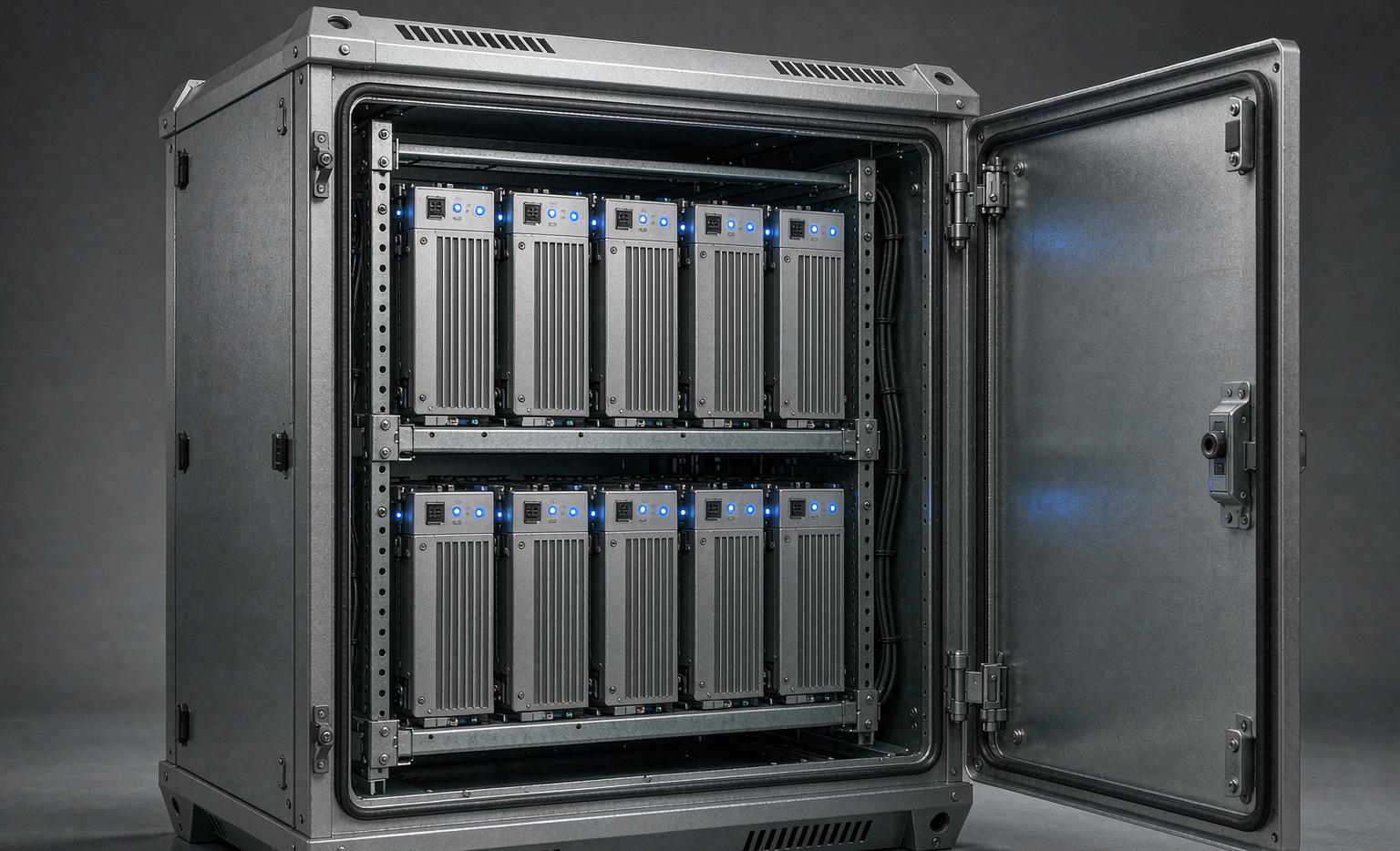
The hidden enemy in a backup cabinet is heat accumulation during a discharge event. A lithium battery pack rated for 5 kilowatts continuous can push the internal temperature up by 10 to 15 degrees Celsius during a sustained outage if the cabinet is poorly vented. I specify cell spacing and aluminum heat sinks even when the average load looks modest, because the peak load during a compressor startup or a radio burst is what drives the temperature, not the average. At the low end, cold is equally punishing. Below 0 degrees Celsius, LiFePO4 charge acceptance collapses, so any cabinet with a charging source must include low-temperature cut-off or a self-heating film. I have measured cabin internal temperatures of minus 18 degrees Celsius in northern installations, and a pack without cold protection simply will not recharge after a deep discharge. Humidity is the second silent killer. In coastal or tropical sites, dew forms on cold cells during a nighttime discharge, and that moisture accelerates terminal corrosion long before any cell fails. I specify conformal-coated PCBs and a dessicant pack in the cabinet base for any site where the daily temperature swing crosses the dew point.
Cycle Life and Calendar Life Under Standby
Buyers often fixate on cycle count, but a backup cabinet spends 99 percent of its life in standby. Calendar aging, not cycling, dominates the real lifespan. A lithium battery pack held at 3.40 volts per cell, about 50 percent state of charge, at 25 degrees Celsius ages roughly twice as slowly as one held at full charge. My standard recommendation for backup cabinets is to float the pack at 50 to 60 percent state of charge and top up only after a discharge event. This single decision extends service life from perhaps four years to seven or more. I also track capacity with a quarterly impedance check rather than waiting for a visible failure, because the first symptom of a weak cabinet battery is usually a silent outage that no one noticed coming. As a rule I set an end-of-life threshold at 80 percent state of health and schedule replacement when the quarterly check crosses it, rather than waiting for the pack to drop a load. This turns an unpredictable failure into a planned maintenance event, which is what every network operator actually wants from a backup cabinet.
BMS Functions That Matter for Cabinets
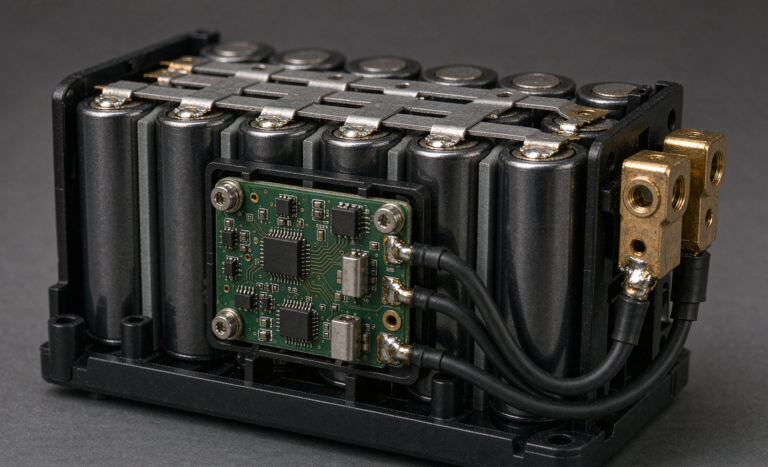
A generic battery management system is not enough for a cabinet. The functions I require are cell voltage balancing to within 10 millivolts, overcurrent protection rated for the cabinet breaker, and a communication port so the network operations center can see state of charge remotely. Most of my backup cabinet projects use RS485 with the Modbus protocol or CAN bus, because the field router already speaks those languages. The BMS must also log the last ten fault events, because when a cabinet fails at 3 a.m. the technician needs the history, not a blinking light. I have replaced too many packs that died from a single unbalanced cell that the original BMS ignored. A proper custom battery solution for a cabinet always treats the BMS as a safety device, not an afterthought.
Compliance and Handling for Field Service
Backup cabinets get shipped, lifted, and serviced, so the battery inside must clear the same compliance gates as any portable pack. Every lithium battery pack I ship for cabinet duty is built to UN38.3 for transport and IEC 62133 for cell and pack safety. When a cabinet is installed at an airport or on an aircraft-support site, the EASA and FAA rules on lithium battery handling apply to the service crew, not just the product. I keep the transport documentation in the cabinet door pocket and train the field team on the thermal runaway signs, because a battery emergency in a sealed metal box is not the place to learn on the job. A lithium battery that passes the lab test but fails the field handbook is not a finished product.
What size lithium battery do I need for a backup cabinet?
The size depends on the load and the required backup time, not on the cabinet volume. I calculate watt-hours as load in watts multiplied by backup minutes divided by 60, then add 30 percent for temperature derating and aging. A typical telecom cabinet at 300 watts for four hours needs roughly 1.5 kilowatt-hours of usable lithium capacity.
How long do lithium backup cabinet batteries last?
With LiFePO4 held at partial state of charge, expect seven to ten years of calendar life in temperature-controlled sites, and four to six years in harsh outdoor cabinets. Cycle life is rarely the limiting factor because outages are infrequent. The packs that outlive their warranty are the ones sized for temperature, not for the brochure number.
Can I mix old and new lithium modules in one cabinet?
No. Mixing modules with different internal resistance causes the weaker one to overheat and the stronger one to overcharge. I always replace a cabinet pack as a complete set and recycle the old modules through a certified channel. Partial swaps create imbalance that a standard BMS cannot correct.
Do backup cabinet batteries need ventilation?
A LiFePO4 pack does not vent under normal operation, but the cabinet still needs airflow to carry away discharge heat. I specify at least natural convection slots and, for high-power cabinets, a temperature-controlled fan triggered by the BMS. Sealing a pack inside an airtight box with no thermal path is the fastest way to shorten its life.
Is LiFePO4 safe for indoor cabinets?
Yes. LiFePO4 has the highest thermal stability of common lithium chemistries and meets IEC 62133 for indoor stationary use. The main indoor risk is not the cells but poor balancing and blocked cooling, both of which a proper BMS prevents. Treat the enclosure airflow and the balancing strategy as part of the safety case, not as optional extras.
Further Reading
References