Battery Fire Truck Pack Sizing and Duty Cycle Guide
When a fire department asks me why their rig needs a purpose-built battery fire truck pack instead of a generic industrial unit, I usually answer with one number: 200 amps. That is what an aerial truck draws while extending its boom with the pump running and scene lights on. A generic deep-cycle bank sags and shuts down within minutes under that load; an engineered pack holds voltage flat through a full incident. Over the past decade I have specified, built, and qualified these packs for pumper, aerial, and rescue fleets. This guide walks through that work: chemistry choice, a worked sizing example, enclosure design, the certification stack, and the field failures I see most often.
Why Fire Apparatus Duty Cycles Break Ordinary Batteries
Emergency vehicles sit idle 95 percent of their life, then demand enormous current in short bursts, at ambient temperatures from minus 30 degrees Celsius at a winter fire to 55 degrees Celsius in a summer apparatus bay. I have watched lead-acid banks lose half their capacity in two seasons, not from cycling but from sulfation during idle stretches and plate shedding during surges.
The electrical profile is unforgiving. A fire truck battery must deliver a starter burst of 800 to 1,200 amps for seconds, then sustain a hydraulic pump at 150 to 300 amps for twenty minutes, while a low-current rail feeds radios, scene lighting, and the vehicle data bus. LFP handles this because its flat curve holds above 3.2 volts per cell until state of charge falls below roughly 20 percent, so accessories do not brown out when the pump engages. That is the biggest reliability gain I see when departments migrate to a custom lithium battery solution.
Choosing the Right Chemistry for a Fire Truck Battery
For the pack I almost always specify lithium iron phosphate. Its olivine chemistry stays stable to roughly 270 degrees Celsius before oxygen release becomes a concern, versus about 180 degrees Celsius for cobalt-based NMC. In a fire service application the pack may sit near a hot engine compartment or inside a sealed compartment at a structure fire, so that margin matters. LFP also delivers 3,000 to 6,000 cycles at 80 percent depth of discharge, which is fifteen years of daily readiness with modest fade.
The trade-off is energy density. LFP cells provide 150 to 180 watt-hours per kilogram versus 220 to 250 for NMC. On a truck already carrying thousands of kilograms of water and equipment, a 40 kilogram pack difference is rounding error, so energy density rarely decides the choice. I pivot to NMC or a semi-solid-state cell only on weight-critical rescue platforms such as an aerial device where every kilogram at the boom tip reduces reach, and I document that trade-off with the buyer so the decision reflects their real duty cycle, not a spec sheet.
How I Size a Fire Truck Battery Pack: A Worked Example
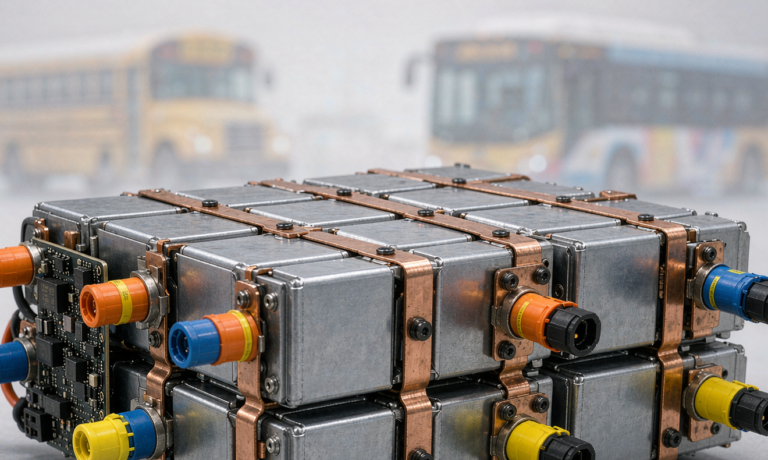
Let me make sizing concrete. Suppose a pumper must support a 24-volt hydraulic pump drawing 200 amps for 30 minutes per incident, plus lighting and radios at 30 amps continuous, with four incidents a week and a requirement to run three calls without recharge. Usable energy is (200 + 30) amps x 24 volts x 0.5 hours x 3 calls = 8,280 watt-hours. At 80 percent depth of discharge and 10 percent conversion losses, nominal capacity must be at least 8,280 divided by 0.72, or about 11,500 watt-hours. I specify a 48-volt 240-amp-hour LFP pack, which gives 11,520 watt-hours nominal with a comfortable reserve.
Then I check current. That pack must deliver the 200-amp pump load plus transients inside cell limits. At 240 amp-hours the 200-amp draw is under 1C, well inside the 2C continuous rating of a quality prismatic LFP cell. I route the 800-amp cranking burst to a separate high-rate starter module instead of the house bank; separating cranking from house loads has eliminated a surprising share of the field failures I have investigated.
Charging is the other half. A station has hours of dwell time, so I specify an onboard charger at 0.2C to 0.3C, or 48 to 72 amps at 48 volts for a 240-amp-hour pack, which tops the pack off overnight without stress. For fast turnaround I add a high-current alternator or shore-power rectifier that can deliver 150 amps, but only after confirming the cell maker permits that rate in the operating window. Charging LFP below 0 degrees Celsius without a heating circuit plates lithium and permanently damages cells, so a low-temperature cutoff and heating pad are standard in every cold-climate build.
Enclosure, Cooling, and Ingress Protection
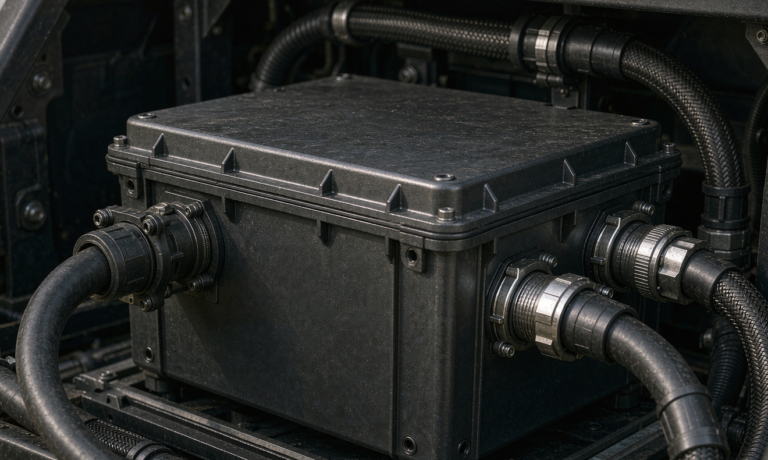
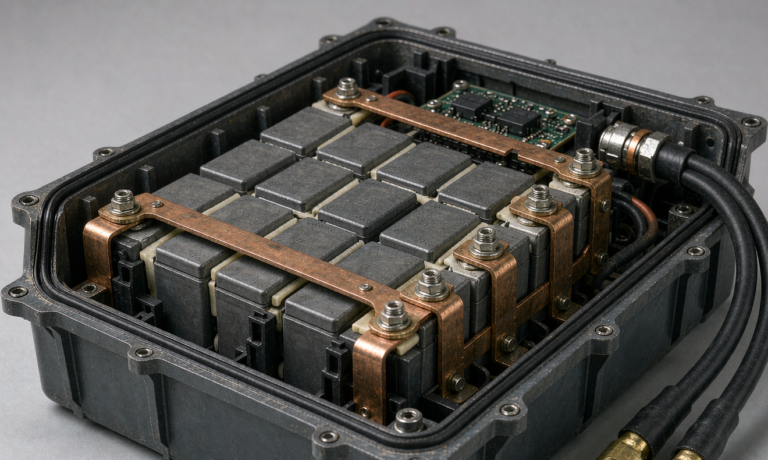
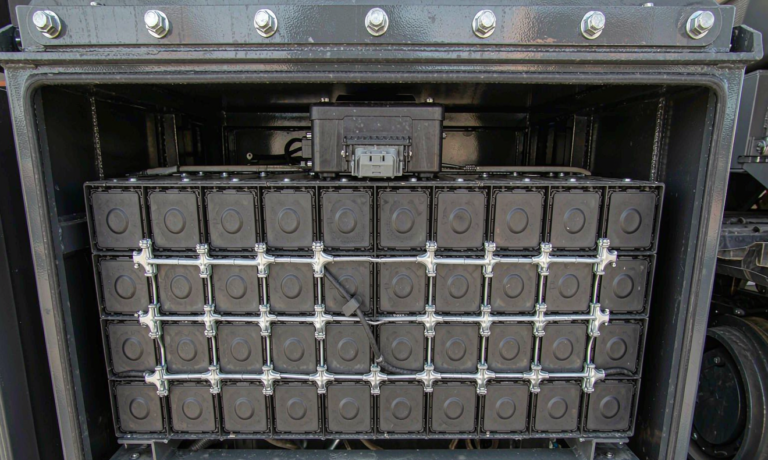
The enclosure is not a plastic box. I specify welded 5052 aluminum or powder-coated steel with an IP67 rating and internal gaskets rated across the full temperature range. Apparatus get high-pressure washdown after a call, so every cable penetration uses a sealed bulkhead and every seam is pressure-tested. I have seen water enter through one poorly sealed gland and destroy a pack in a single season, a completely preventable failure.
Thermal management is modest but essential. LFP makes little heat at 1C, yet a sealed enclosure in a summer sun reaches 65 degrees Celsius and accelerates calendar aging. I use aluminum heat spreaders and, on larger packs, a filtered ventilation fan that engages above 45 degrees Celsius; the BMS watches four temperature points and derates current above 60 degrees Celsius, protecting the pack without interrupting an incident. Mounting gets equal care: the enclosure bolts to a subframe through vibration isolators, center of gravity stays below the axle where possible, and every high-current cable carries a fuse within 150 millimeters of the terminal, since an un-fused short is the most common cause of retrofitted-apparatus electrical fires.
Safety Standards, Certification, and Field Failures
No single standard certifies a complete pack, so I build to a stack. Cells must pass UN 38.3 transport testing: altitude simulation, thermal cycling, vibration, shock, external short, impact, overcharge, and forced discharge. The pack and charger should be assessed to IEC 62619, the correct standard for industrial and traction packs; IEC 62133 covers portable consumer cells and is not sufficient for a vehicle system. For vehicle integration I reference SAE J1455; I have measured packs surviving 3 to 5 g RMS vibration and 20 g shocks to that profile.
For a high-energy source I also ask for UL 2580 certification and a documented thermal runaway propagation test showing a single-cell event cannot cascade to neighbors, the scenario that most endangers firefighters. Documentation is part of the product: every pack ships with cell lot traceability, a factory report of measured capacity and internal resistance, a wiring diagram, and a maintenance schedule. Departments with NFPA 1901 requirements should keep these with vehicle records for annual inspections and after any electrical incident.
The same field problems recur. First is capacity loss from chronic undercharging, where a pack sits partially charged for months and drifts out of balance. The symptom is a sudden runtime drop under load even though the state-of-charge display reads full. The fix is a controlled balancing charge; if imbalance exceeds 50 millivolts, a module-level service is needed.
Second is connector corrosion. Foam and water are conductive and find their way into connector cavities. I check every high-current connector with a milliohm meter during annual service; anything above 2 milliohm at a terminal means clean or replace. Third is a failed temperature sensor, which the BMS reports as a fault code. Never bypass a temperature interlock to return a truck to service; it is the last defense against a thermal event.
Fourth is subtler: a pack that passes a bench capacity test but fails in the apparatus because the DC-DC converter is undersized. I measure voltage at the pack terminals and at the load simultaneously under full current. A drop above 0.5 volts between the two points indicates cabling resistance needing correction. These checks take under an hour and have returned more trucks to service than any component upgrade.
Total Cost, Lead Time, and What Drives a Quote
A purpose-built fire truck battery pack runs 8,000 to 25,000 US dollars by capacity, enclosure, and certification scope, with a 48-volt 240-amp-hour LFP system with full documentation landing near the middle. Cost drivers are cell grade, ingress-protected enclosure work, BMS sophistication, and certification testing. Departments requesting UL 2580 and thermal propagation testing should budget the upper range and a 10 to 14 week lead time.
A prototype pack takes 4 to 6 weeks including design review and bench testing, and I recommend a field trial on one apparatus before a fleet order. Minimum order quantity for a custom configuration is one unit, since these are engineered to order; a catalog configuration ships in 2 to 3 weeks. Budget for training on charging and storage, because the costliest failures I have seen came from unfamiliarity with lithium chemistry rather than from hardware.
Selecting a fire truck battery means matching chemistry, capacity, enclosure, and certification to a duty cycle far tougher than it first appears. Start with an honest load audit and a real operating temperature range; get those two inputs right and the design follows cleanly. Horizon Power builds custom battery solutions for emergency vehicles and can work from your load profile to a documented, testable specification.
Frequently Asked Questions
How long does a lithium fire truck battery last in service?
A quality LFP pack delivers 3,000 to 6,000 cycles at 80 percent depth of discharge, which in fire service translates to roughly 12 to 15 years of daily readiness. Calendar aging is usually the limiting factor rather than cycle count, so keeping the pack between 30 and 80 percent state of charge when idle will extend life meaningfully. Most manufacturers offer a 5 to 8 year warranty.
Can a fire truck battery replace the engine alternator entirely?
In a fully electric apparatus, yes, but on a conventional rig I recommend a hybrid approach where the battery supports high transient loads and the alternator handles baseline charging. This reduces the required pack size and provides redundancy, which is essential when a vehicle must respond reliably after sitting idle for days.
Is LFP safe enough for use inside a crew compartment?
LFP is the safest mainstream lithium chemistry because of its high thermal runaway onset temperature and lack of cobalt, but I still recommend a sealed, ventilated external compartment rather than the crew area. The enclosure should meet IP67 and include pressure relief venting directed away from occupants.
What charging standard should a fire station install?
Use a charger matched to the pack voltage and approved by the battery manufacturer, with a 0.2C to 0.3C rate and temperature-based charge inhibition below 0 degrees Celsius. The charging area should be ventilated and protected by a class D or lithium-specific extinguishing system, and station personnel should be trained on the shutdown procedure.
How do I verify a supplier’s fire truck battery claims?
Request the UN 38.3 test summary, the IEC 62619 or UL 2580 certificate, a sample factory test report with measured capacity and internal resistance, and a thermal propagation test result. Cross-check the cell model number against the manufacturer datasheet and ask for two references from departments with similar apparatus. Claims without traceable documentation should be treated as marketing.
Further Reading
References