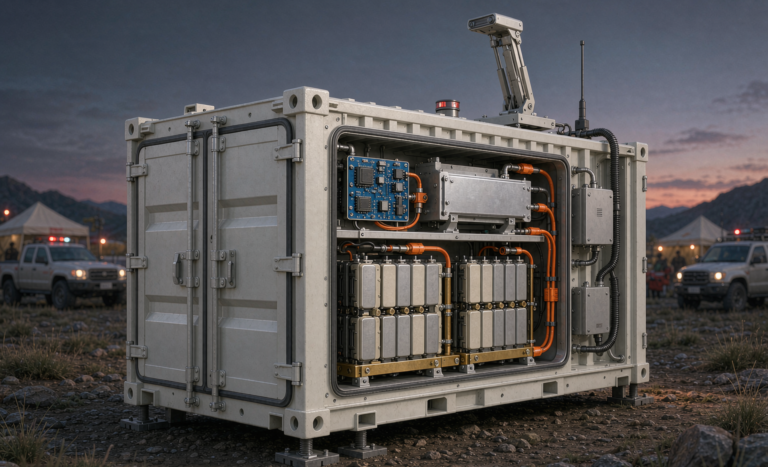
Battery Solution Performance for Towers
Tower sites have a habit of punishing battery systems. Whether it is a telecom tower on a ridge line, a mobile light tower on a highway project, or a communications node above the treeline, the load is rarely steady and the environment is rarely kind. I have spent the better part of a decade sizing and auditing packs for exactly these deployments, and the gap between a battery solution that looks good on a datasheet and one that survives five winters outdoors comes down to a few performance parameters: usable capacity, discharge rate, cycle life, and thermal behaviour. This article walks through how I evaluate battery solution performance for towers, using field measurements rather than brochure claims.

What Makes Tower Loads Different from Typical Off-Grid Sites
A tower is not a house with a bigger battery. The load profile is fundamentally different, and that difference drives every downstream decision. On a telecom tower, the radio units pull a large, short surge when a call or data session starts, then drop back to a low idle draw. A mobile light tower does the opposite: a modest but continuous dusk-to-dawn draw from an LED array, sometimes paired with a small camera or sensor load. A microwave or communications relay may sit almost silent for hours, then transmit a burst that briefly triples the site load.
I log every site for at least seven days before I size anything. That log reveals what a datasheet cannot: the true peak demand, the shape of the daily energy curve, and how often the site runs on battery alone. Tower sites also concentrate environmental stress. They sit on ridges, rooftops, and highway shoulders where wind, salt, dust, and wide temperature swings are the norm. The battery cabinet may see 50 degrees Celsius in summer and minus 20 in winter, without any climate control. Designing for the average case here is how you end up with a two-year battery instead of a ten-year one.
Usable Capacity and Autonomy Sizing for Tower Battery Solutions
The single most common mistake I see is sizing on nameplate kilowatt-hours instead of usable energy. A 48 V, 200 Ah pack is 9.6 kWh of nameplate storage, but you will never access all of it. Usable energy is nameplate energy multiplied by the depth of discharge you will run, then again by temperature and conversion derates.
I use this working sequence for tower sites:
- Step 1: daily energy equals average load in kW times 24 hours.
- Step 2: required deliverable energy equals daily energy times days of autonomy.
- Step 3: nameplate energy equals deliverable energy divided by (depth of discharge times temperature derate times converter efficiency).
For a 2 kW average telecom load with three days of autonomy, the deliverable energy is 144 kWh. Divide that by 0.8 depth of discharge, 0.9 temperature derate, and 0.95 converter efficiency, and you land near 210 kWh of nameplate capacity. If someone quotes you 150 kWh for the same site, they are either assuming grid backup that is not there or ignoring temperature. I always build the derates in explicitly and show the client the arithmetic.
C-Rate and Surge Performance Under Tower Duty Cycles
Capacity gets you through the night; discharge rate gets you through the surge. A tower load can jump from idle to peak in milliseconds, and the battery has to hold voltage while it does. This is where the C-rate, the current a pack can deliver relative to its capacity, becomes the binding constraint. A 100 Ah pack rated at 1C can deliver 100 A continuously, but the same pack at 0.2C is far happier and lasts longer.
When I specify a battery solution for towers, I separate the continuous rating from the peak rating. A typical radio site might draw 0.2C continuously but spike to 0.8C for a few seconds per transmission cycle. I want a pack whose continuous rating sits well above the steady load, with headroom for the spike, so the BMS current limit never becomes the bottleneck. Internal resistance matters here: a pack built from low-resistance cells sags far less under surge, and that voltage stability keeps the radio units online. On lighting towers, the inrush current of the driver can briefly exceed the running current several times over, so the same logic applies. Undersize the discharge path and you get nuisance shutdowns that look like control faults but are really a power problem.
Cycle Life, Float Duty and Depth of Discharge at Tower Sites
Tower batteries rarely live the clean cycle life a laboratory test describes. Many sites have a grid connection or solar array that keeps the pack on float most of the time, with only shallow discharges when the grid drops or the sun disappears for a few days. That duty is gentler than deep daily cycling, but it introduces a different failure mode: calendar ageing, which advances whether you cycle the pack or not.
I treat cycle life and calendar life as two separate budgets. Lithium iron phosphate cells in a well-designed tower pack will typically deliver 3,500 to 6,000 full cycles at 80 percent depth of discharge, and that number improves sharply if you limit routine cycling to 50 or 60 percent. But even an idle pack loses capacity over time, and the loss accelerates with temperature; every 10 degrees Celsius of sustained rise roughly doubles the ageing rate. That is why I keep an eye on both the cycle counter and the state of health trend, not just the state of charge. A pack that has done 500 cycles but spent three summers at 45 degrees Celsius may be closer to retirement than its cycle count suggests.
Thermal Management and Enclosure Ratings for Outdoor Towers
Thermal design is where outdoor tower projects are won or lost. I start by mapping the real ambient envelope, then decide whether the pack needs passive cooling, forced air, or a small thermoelectric or compressor-based unit. Passive cooling is the most reliable option when it works, because it has no moving parts to fail, but it only works if the cabinet has been sized for airflow from the start.
Charging is the harder problem at the cold end. Most lithium chemistries cannot be charged safely below 0 degrees Celsius, so a tower pack in a cold climate needs either internal heating pads or a BMS that blocks charge current until the cells warm up. I have seen sites lose weeks of autonomy because a charge block was never configured and the pack simply stopped accepting energy in a cold snap. On the enclosure side, I look for at least IP66 and NEMA 4X for exposed cabinets, with the assembly built to IEC 61439. Humidity matters too: a sealed cabinet that breathes through a filter collects condensation, so I prefer a gasketed enclosure with a desiccant or a small controlled vent.
Certification, Safety and Qualifying a Custom Battery Solution
When you buy a tower battery, you are buying a safety case as much as a power source. I ask for the test reports, not the marketing claims. Transport is covered by UN38.3, which any shipped lithium pack must pass. Industrial and stationary applications are covered by IEC 62619 and UL 1973; portable-style packs fall under IEC 62133-2. For larger cabinets and containerized sites, UL 9540A is the reference for thermal runaway propagation behaviour. A vendor who cannot produce these documents is a risk you cannot underwrite.
A custom battery solution for towers should also be qualified against your actual duty cycle rather than a generic one. My qualification process runs from load logging through electrochemical modelling, prototype build, accelerated ageing, and a field pilot at one or two representative sites. During the pilot I watch state of health drift, cell balance spread, and BMS logging accuracy over a full seasonal swing. At Horizon Power, this is the sequence we follow before a tower pack goes into volume production, because a design that survives the pilot almost always survives its warranty. The point is not to slow the project down; it is to move the surprises to the bench instead of the tower.
Frequently Asked Questions
What battery solution works best for off-grid telecom towers?
For most off-grid telecom towers I recommend lithium iron phosphate (LFP) packs at 48 V, because they offer a good balance of cycle life, thermal stability, and cost per usable kilowatt-hour. LFP tolerates partial state of charge well, which suits solar-backed sites that rarely reach full charge. Where energy density is critical, a higher-nickel chemistry can help, but it demands tighter thermal management. The right choice follows the load log and the site climate, not a blanket preference.
How many days of autonomy should a tower battery provide?
I size for three to five days of autonomy on grid-connected sites and five to seven days on fully off-grid sites, depending on how reliable the grid or solar resource is. Three days covers most short outages without overbuilding. With a backup generator, you can cut autonomy to one or two days and let it carry long events. Longer autonomy always raises cost, so I make the trade-off explicit with the client rather than guessing.
Can a lithium battery solution replace lead-acid at tower sites?
Yes, and it usually should. A lithium battery solution gives you roughly double the usable depth of discharge, so a smaller and lighter pack can replace a much larger lead-acid bank. It also tolerates higher discharge rates without severe voltage sag. The caveats are temperature and charge control. Lithium packs need a BMS that blocks charging below freezing and manages cell balance, which lead-acid did not require.
What certifications does a tower battery solution need?
At a minimum, UN38.3 for transport, IEC 62619 for industrial battery safety, and UL 1973 for stationary applications. Portable-format packs should carry IEC 62133-2. If the installation uses a cabinet or container, ask for UL 9540A thermal runaway data and confirm the enclosure rating, typically IP66 and NEMA 4X for exposed sites. Your project spec may add local grid codes, so check those early in procurement.
How do you size a battery solution for a mobile light tower?
Start with the LED array wattage and the number of dusk-to-dawn hours you need, then add a margin for the driver inrush current. A 300 W array running 12 hours draws 3.6 kWh per night. For two nights of autonomy, that is 7.2 kWh deliverable, which becomes about 10 kWh of nameplate capacity once you apply depth of discharge and temperature derates. I also oversize the discharge path to handle the inrush so the luminaire never flickers or shuts down at start-up.
How long does a tower battery solution last before replacement?
With a well-designed pack, expect eight to twelve years in a temperate climate and six to nine in a hot one, assuming moderate cycling and good thermal control. The failure driver is usually calendar ageing plus heat, not cycle count. I track state of health quarterly and plan replacement when the pack falls below 80 percent of its original usable capacity, because below that point runtime margins shrink quickly and surprise outages become common.
Further Reading
References