Drone Battery Performance for Racing Drones: An Engineer (2)
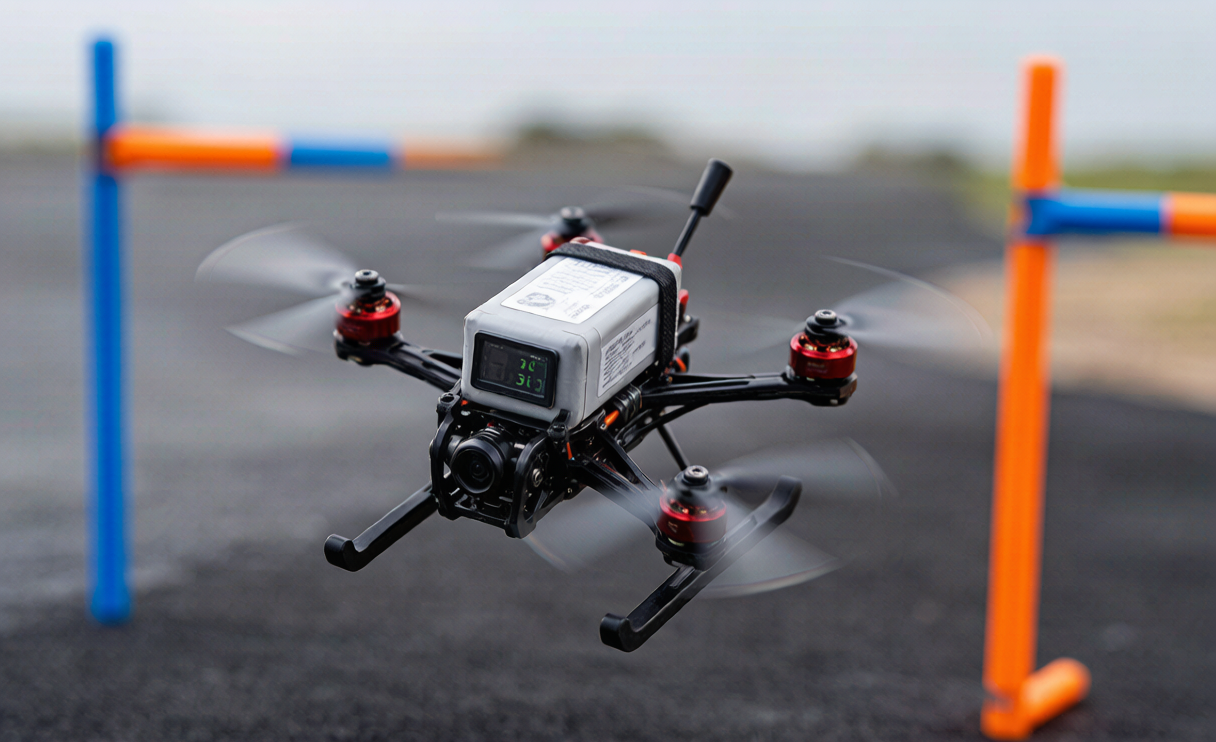
When pilots ask me what separates a podium FPV run from a mid-pack finish, they expect me to talk about the frame, the motors, or the PID tune. As a senior lithium battery engineer who has built packs for agricultural UAVs, cinema drones, and more than a few racing quads, my answer is almost always the same: it is the drone battery performance. Racing drones are the single most abusive application we put lithium cells through. A 5-inch class racer can pull a 150-ampere burst from a pack that weighs less than 150 grams, hold full throttle for the entire 60-second heat, and walk away with cells glowing past 55°C. If you want faster lap times, you start with the cell, not the prop — and you measure progress in milliohms, not marketing watts.
Why Racing Drone Performance Lives and Dies by the Battery
The motors, ESCs, and props only do what the pack allows them to do. Every gram of thrust at the propeller starts as a volt and an amp leaving the cells. The moment a pack cannot deliver current without its voltage collapsing, the motors lose RPM, the craft loses punch, and the pilot loses the race. I have watched two otherwise identical quads — same frame, same motors, same pilot — turn in lap times more than a second apart purely because one was flying a fresh low-resistance drone lithium battery and the other was flying a pack that had been through ninety hard cycles. Battery performance is not a detail; on a racetrack it is the whole game.
The Core Electrical Specs That Define Drone Battery Performance
When we qualify a racing pack on the bench, four numbers decide whether it earns a place in a race-day bag. I tell new builders to stop reading the cartoon “C-rating” on the label and start reading these:
- Specific energy (Wh/kg). Racing packs deliberately trade energy density for power. A typical 4S 1500 mAh racing pack lands around 160–190 Wh/kg — lower than a cinema-drone pack because the cells are built for low internal resistance, not range. You are buying responsiveness, not flight time.
- Continuous and burst C-rate. Continuous ratings of 50–75C and burst ratings of 100–150C are common. Remember that C-rate is just a multiple of capacity: a 1.5 Ah pack at 100C must deliver 150 A. The number only means something when paired with the pack’s actual internal resistance.
- DC internal resistance (DCIR). This is the number that quietly wins races. A good racing cell sits around 3–6 mΩ per cell. Everything below — voltage sag, heat, throttle feel — follows from it.
- Voltage window. Cells rest at 4.20 V fully charged and we cut throttle near 3.3 V under load. A 4S pack is 16.8 V full; a 6S pack is 25.2 V full. The higher the series count, the more voltage headroom you keep at the motor.
Burst Discharge Current and the Physics of Punch-Out
The “punch-out” — that instant vertical yank that launches a quad off the start gate — is pure burst-current physics. Motor current is roughly I = (V − back-EMF) / (Rwinding + Rpack). The pack’s internal resistance sits right there in the denominator with the motor winding. Drop the pack resistance and far more current reaches the motor in the first 200 milliseconds, which means more torque, more thrust, and a cleaner launch.
Here is the scale we actually see on the lab load bank. A 6S pack at 25.2 V delivering a 120 A burst is pushing about 3 kW of instantaneous power. From a 150-gram pack that is roughly 20,000 W/kg of power density for the brief moment the throttle is slammed. A custom battery solution with laser-welded nickel strips and 12 AWG silicone leads keeps that path resistance low enough to actually realize the cell’s rated burst, whereas a poorly welded off-the-shelf pack wastes a chunk of it as heat at the tabs.
Voltage Sag, Internal Resistance, and Why Lap Times Collapse in the Final 30 Seconds
Voltage sag under load is simply Vsag = I × R. At 120 A through a healthy 5 mΩ cell, that is a 0.6 V drop per cell — annoying but manageable. Through a hot, aged cell at 10 mΩ, it is 1.2 V per cell, and across a 6S pack that is over 7 V of lost headroom. The motor sees a softer bus, spins slower, and the pilot feels “mushy” throttle exactly when they need authority most: the final split before the finish gate.
We log pack DCIR before and after every race weekend. A pack that gains 40% internal resistance after roughly fifty hard cycles typically loses 0.3–0.5 seconds per lap on a 25-second track — enough to fall from first to fifth. My field rule is simple: keep the pack surface below 50°C, store at 3.8 V, and retire any cell that climbs above 8 mΩ. A tired lithium battery does not fail dramatically; it just quietly bleeds your lap times.
Pack Architecture: 4S, 6S, and What We Learned Building Custom Battery Solutions
The 4S-versus-6S debate is really a debate about current. For the same motor power, a higher pack voltage means lower current, which means less I²R heating and less sag. That is why modern racing has migrated toward 6S: cooler packs, more consistent voltage, and better throttle feel deep into a heat. The trade-off is that 6S demands motors and ESCs rated for the higher bus, and it punishes a weak battery pack design even harder if the cells are mismatched.
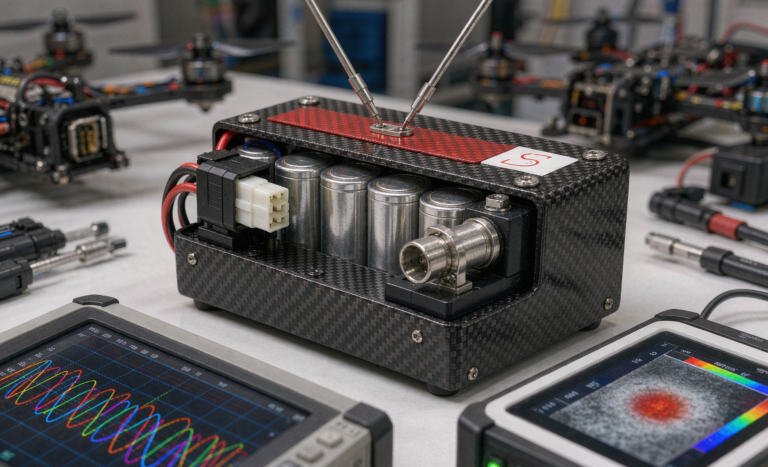
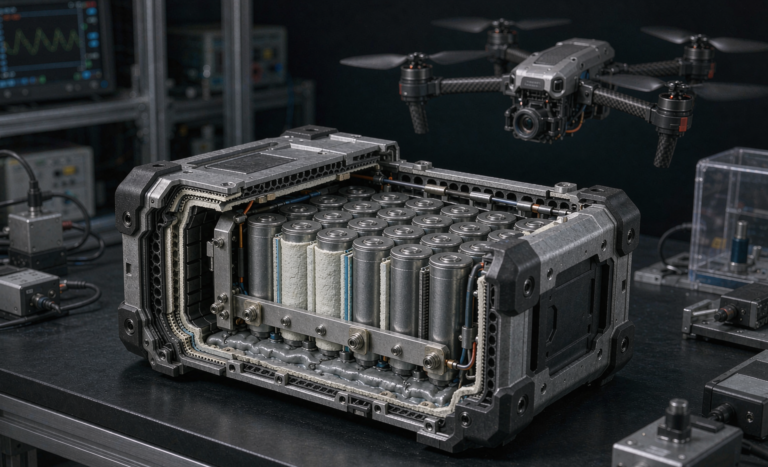
This is where a custom battery solution earns its keep. When we build a pack to a specific airframe, we match cells within 2 mV, laser-weld the series tabs instead of relying on pressure contacts, and route a short, fat balance lead so the charger can actually equalize the cells. A bespoke pack is typically several grams lighter and a milliohm or two lower in resistance than a generic equivalent — and on a racetrack, those milliohms are lap time. We have also learned the hard way that a cold weld is a hotspot: every joint gets a four-point resistance check before it leaves the bench.
Thermal Reality: Running Cells Past 60°C and Staying Inside the Safety Envelope
Lithium-polymer cells do not like heat, and racing pushes them right up to the line. Above about 60°C, cycle life craters and the risk of a thermal event climbs fast. Our field cap is 50°C surface temperature, measured with an IR gun between heats. We do not use active cooling — there is no weight budget for it — so the entire thermal strategy is airflow and discipline: short heats, shaded rest, and never launching a pack that has not cooled to ambient.
Every cell chemistry we ship is qualified to IEC 62133-2:2017 for portable secondary-cell safety, and transport batches clear UN 38.3 T.1 through T.8 (altitude, thermal, vibration, shock, external short-circuit, impact, overcharge, and forced discharge). Those standards are not paperwork; they are the reason a pack that takes a hard crash landing does not become a fire on the way home.
Our Qualification Playbook: UN 38.3, IEC 62133, and Air-Transport Rules
Before any racing pack carries the Horizon Power name, it goes through a fixed set of gates. First, cell-level abuse testing under UN 38.3 T.1–T.8 confirms it survives the shocks and shorts of real-world handling. Second, IEC 62133-2:2017 validation confirms the cell and pack meet portable-battery safety limits for normal and foreseeable abuse. Third, we bench-log DCIR and burst capability at 25°C and at 50°C to confirm the numbers hold when the pack is hot, not just when it is fresh.
For pilots who travel to events, the air-transport rules matter. Under FAA and EASA guidance, spare lithium batteries must be carried in cabin baggage, and individual cells must stay under 100 Wh with a 160 Wh aggregate passenger limit for the larger commercial packs. A typical racing pack is 22–45 Wh, so it clears easily — but we still label and terminal-cover every pack per IATA so there is never a question at the gate. A drone battery performance racing drones program is only useful if the packs can legally ride in the same plane as the pilot.
Frequently Asked Questions
What C-rating do I actually need for a racing drone battery?
For competitive 5-inch racing, look for a continuous rating of at least 75C and a burst rating of 120–150C on a pack whose measured DCIR is under 6 mΩ per cell. Do not trust the label alone — measure internal resistance on a fresh pack and again after twenty cycles to see how fast it drifts.
How does internal resistance affect drone battery performance?
Internal resistance sets how much voltage the pack keeps under load. Lower resistance means less sag, more current at the motor, cooler operation, and a pack that holds its lap times deep into a heat. It is the single most predictive number for real-world performance.
Is a 6S pack always faster than a 4S pack?
Usually, because the higher voltage reduces current for the same power, cutting I²R losses and voltage sag. But 6S only helps if your motors, ESC, and props are tuned for the higher bus. On mismatched hardware, 6S can simply run hotter without going faster.
How many flight cycles can a racing drone battery deliver?
Aggressively flown racing packs typically stay competitive for 50–80 hard cycles before DCIR climbs enough to cost measurable lap time. Retail “300 cycles” claims assume gentle discharge; full-throttle racing is a different sport entirely.
Can I fly a high-C drone lithium battery on commercial airlines?
Yes, if each pack is under 100 Wh and carried in cabin baggage with terminals protected. Racing packs at 22–45 Wh qualify comfortably, but always tape or cap the connectors and follow the airline’s lithium-battery rules.
Conclusion
At the end of the day, drone battery performance for racing drones is an engineering problem solved in milliohms and degrees, not in marketing watts. Pick cells with low, stable internal resistance, build the pack so nothing wastes that resistance as heat, keep it cool, and qualify it against UN 38.3 and IEC 62133-2:2017 so it is safe as well as fast. Do that consistently, and the lap times take care of themselves.