Semi-Solid State Battery Patents and IP Landscape
I am Karl Huang, Senior lithium battery Engineer at Horizon Power, and I spend a surprising share of my week not in the lab but reading patents. That was not the plan when I started building cells. But once you move a semi-solid state battery from a 2 Ah lab pouch into a product that ships to Germany, California and Japan, the question stops being “does it work” and becomes “are we allowed to sell it.” I have watched two otherwise excellent projects stall — one at the tooling-order stage, one three weeks before a customer audit — because nobody had mapped the intellectual property around the electrode process.
This article is the briefing I give our own engineering managers and our OEM customers on the semi-solid state battery patents IP landscape: where the art actually sits, which claim families create real exposure, how I run a freedom-to-operate check before a cell enters a pack design, and which engineering levers let you design around a blocking claim without wrecking your energy density. I am an engineer, not a patent attorney, and nothing here is legal advice. But the technical half of an IP analysis is engineering work, and that half is where most teams get it wrong.
Why the Patent Landscape Matters Before You Order Tooling
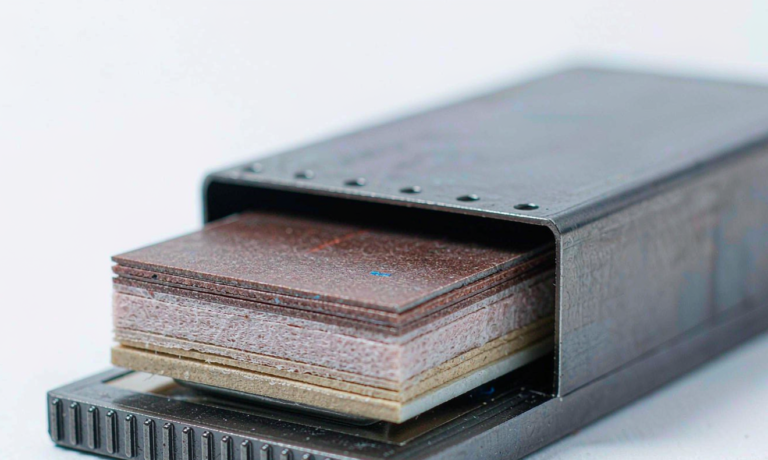
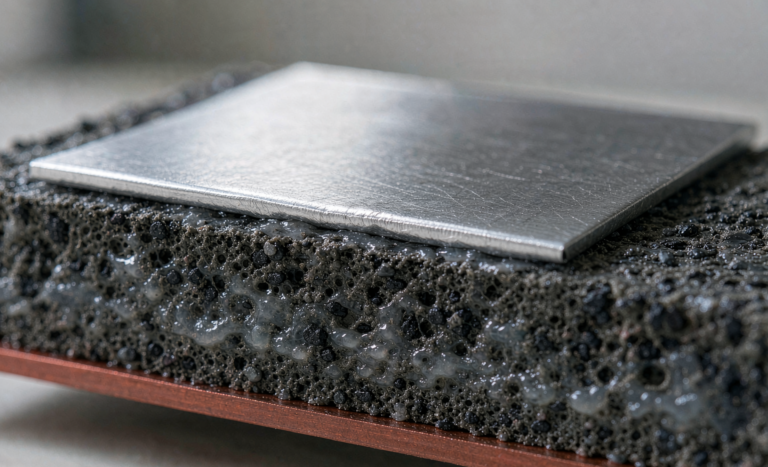
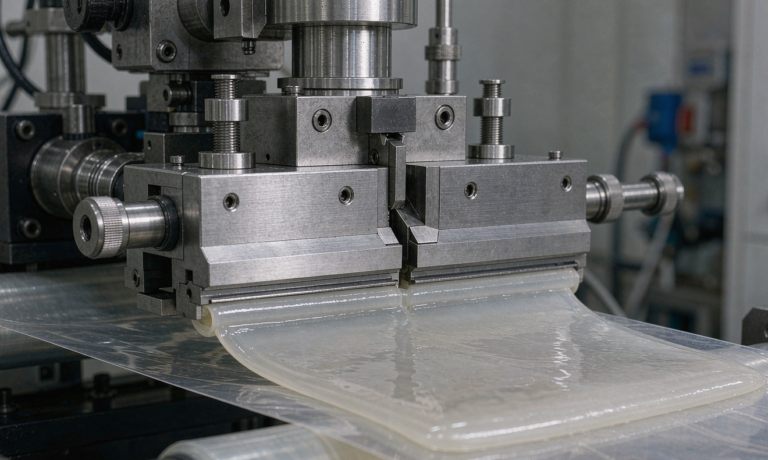
A conventional lithium battery electrode is a thin coating, roughly 60–100 µm per side, dried hard and calendered. A semi-solid electrode is different in kind: it is a thick, cohesive slurry — commonly 200–400 µm — that retains something like 5–15 wt% mobile liquid inside a gel or quasi-solid matrix. That single change is why the format is attractive. Fewer inactive layers per unit of active material pushes cell-level energy density from the 250–280 Wh/kg typical of a good NMC pouch toward the 300–360 Wh/kg range that suppliers now claim for semi-solid designs.
Here is the commercial problem. That same change is also a dense thicket of filings. Because the innovation lives in the slurry formulation and the coating process, not in some exotic new element, the claims read on manufacturing steps that any competent plant would arrive at independently. Viscosity windows. Binder-to-solvent ratios. In-situ curing after stack assembly. Two teams can invent the same route in good faith, and only one of them filed in 2019.
The cost asymmetry is brutal. Redesigning a formulation at the sample stage costs a few engineer-weeks. Discovering the problem after you have bought coating and calendering tooling, qualified a supply chain and passed UN 38.3 means re-running the entire validation program. I have quoted that rework: it is rarely under six figures in USD and it always costs a product launch window.
The Four Claim Clusters I Chart Every Time
When I map this space, I do not read patents one by one. I sort the art into four buckets, because each bucket carries a different kind of risk and a different design-around strategy.
- Composition claims — the electrolyte and gel matrix. Polymer host, lithium salt, plasticiser, ceramic filler, and the ratios between them. These are the broadest and oldest filings. Design-around means genuinely changing chemistry.
- Electrode architecture claims. Thickness ranges, porosity gradients, conductive network topology, current-collector treatment, and the boundary between electrode and separator. Often written with numeric ranges, which is good news: ranges have edges.
- Process claims. Mixing sequence and shear history, coating rheology, solvent removal profile, calendering pressure, and in-situ curing (thermal versus UV) after the stack is assembled. This is the cluster that surprises people, because a process claim can capture a cell whose bill of materials looks nothing like the patent.
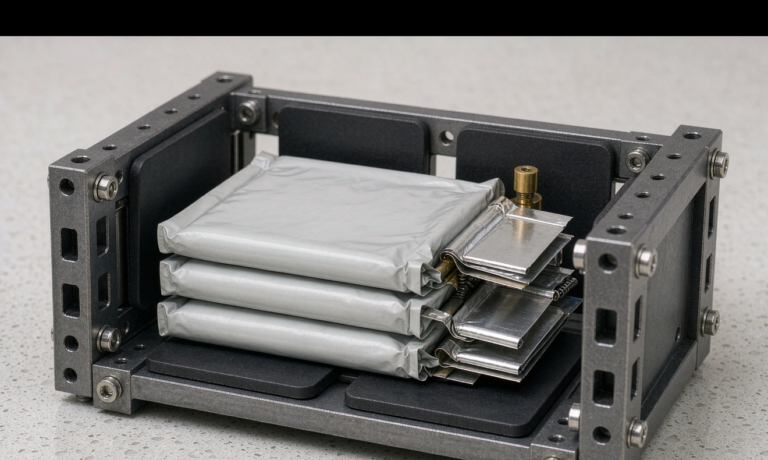
- Pack and system claims. Compression fixturing, stack pre-load, thermal management adapted to a low-liquid cell, and the BMS logic that handles the different impedance signature of a semi-solid cell. As a pack house, this is the cluster we are most likely to infringe by accident, and also the one where our own filings live.
In my experience the composition cluster gets all the attention in press coverage while the process cluster does the actual blocking. If you take one thing from this article: chart the process claims first.
Where the Art Actually Lives: Reading Classification Codes
You cannot find this art with keyword search alone, because there is no settled vocabulary. The same cell is called semi-solid, quasi-solid, gel-polymer, hybrid electrolyte, or simply a solid-state battery in marketing copy while retaining meaningful liquid content. Keyword-only searching will miss whole families. Classification codes are the reliable entry point.
These are the CPC/IPC subclasses I search first:
- H01M 10/0565 — polymer/gel electrolytes with organic plasticiser. The core of most semi-solid electrolyte filings.
- H01M 10/0562 — solid inorganic electrolytes, for the ceramic-filler hybrids that straddle the semi-solid and full solid-state boundary.
- H01M 10/052 — lithium-ion secondary cells generally, as the parent context.
- H01M 4/62 — non-active electrode ingredients: binders, thickeners, conductive additives. Underrated and full of teeth.
- H01M 4/139 and H01M 4/1391 — electrode manufacturing processes, where the coating and curing claims sit.
- H01M 50/40x — separators and their coatings, which matter because a semi-solid design often blurs the separator function into the electrode.
Two practical notes. First, cross-search in both the applicant’s home language and English; a large share of filings in this field originate from Chinese, Japanese and Korean applicants, and machine-translated abstracts routinely mangle the distinction between “gel” and “solid.” Second, respect the 18-month publication blind spot. An application filed 14 months ago is invisible today. When we commit tooling, I assume there is unpublished art and I write that assumption into the risk register rather than pretending the search was complete.
My Freedom-to-Operate Workflow Before a Cell Enters a Pack
This is the sequence we actually run, and it is deliberately staged so that cheap filtering happens before expensive analysis.
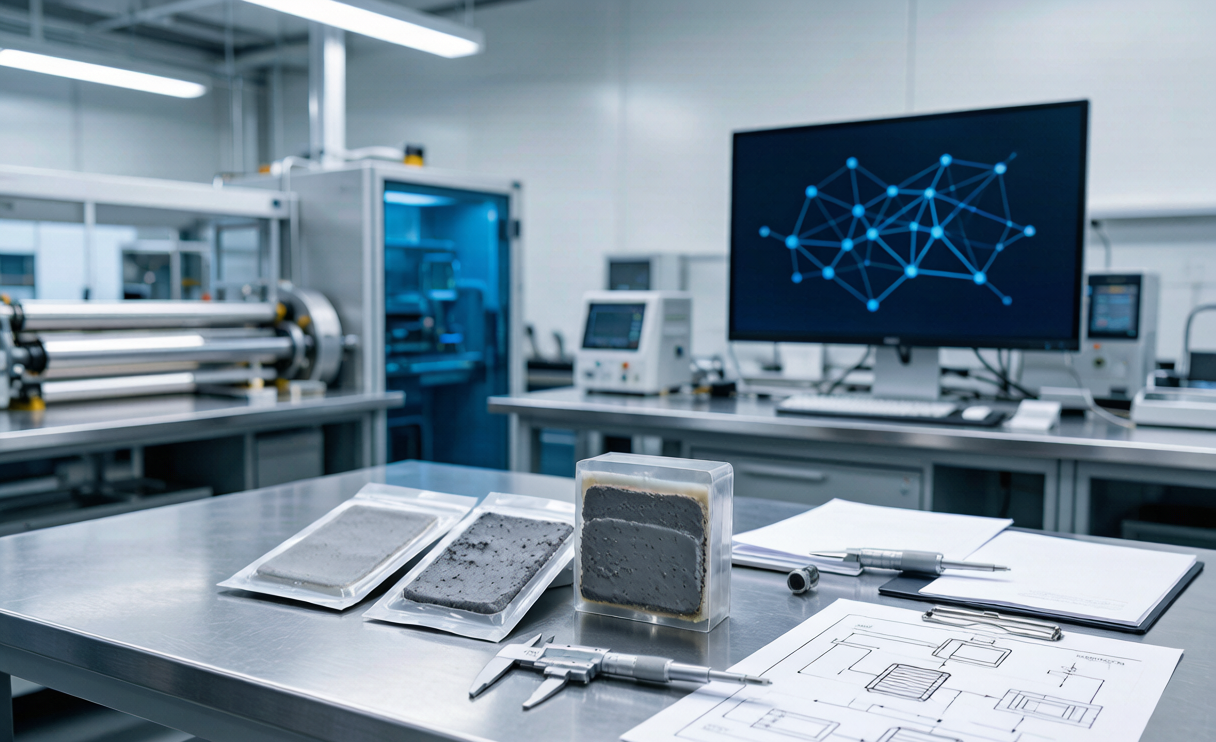
- Define the product, not the technology. I write a one-page technical description of the specific cell and pack: chemistry, electrode thickness, electrolyte class, curing method, format, target markets. FTO is jurisdictional and product-specific. “Semi-solid cells in general” is not a searchable question.
- Classification sweep. Pull the subclasses above, filtered to the jurisdictions we actually sell into — typically CN, US, EP, JP, KR. A patent granted in a country where we neither make nor sell is not our problem.
- Independent claims only, first pass. I read only claim 1 of each hit. If claim 1 does not read on our product, the dependents cannot. This cuts a 400-document set to perhaps 30 in a couple of days.
- Claim charting. For survivors, build a literal element-by-element table: claim element in the left column, our corresponding feature in the right. Every element must be present for literal infringement. One missing element and we are outside the literal scope.
- Legal status check. Verify the family via INPADOC: is it granted or still pending, are maintenance fees paid, has it lapsed, was it narrowed during prosecution? A meaningful fraction of scary-looking documents are abandoned or were cut back so far in examination that they no longer bite. Also check the 20-year term from earliest filing — art from 2005 era gel-polymer work is now expired and is free prior art you can use.
- Escalate the survivors to counsel. Typically three to eight documents. That is an affordable opinion. Sending 400 documents to a law firm is how teams end up skipping FTO entirely.
Design-Around Levers That Do Not Destroy Your Cell
When a claim chart comes back with a literal hit, the engineering question is which element to break with the least performance penalty. Four levers, roughly in order of how often they work for us:
Binder and dispersant system. Many composition claims recite a specific binder family with a weight-percent range. Moving to a different binder chemistry, or outside the recited range, is often the cheapest exit — but it changes adhesion and slurry rheology, so budget peel-strength and coating-uniformity retesting.
Curing route. If a process claim recites thermal in-situ curing at a stated temperature window, UV or e-beam initiation may sit outside it entirely. This changes your line layout, so evaluate it before capex, not after.
Electrode thickness and porosity profile. Numeric ranges are the most tractable claim elements. If a claim recites 250–400 µm, a 220 µm electrode with a compensating porosity gradient may deliver comparable areal capacity outside the range. Verify with DCIR and rate testing, because thick-electrode ion transport is where semi-solid designs live or die.
Filler and salt selection. Swapping the ceramic filler class or the lithium salt package can exit a composition claim, but this is the highest-risk lever: it moves ionic conductivity, the SEI, and gas generation, which means you re-open safety qualification.
Whatever lever you pull, document the engineering rationale contemporaneously. A dated design record showing you chose a parameter for a technical reason is far more defensible than reconstructing intent later.
Certification and Contracts: Where IP Meets Compliance
IP and compliance are separate gates, and I have watched buyers conflate them. A cell that passes every test can still be unsellable, and a cell with clean IP can still fail certification. You need both.
On the compliance side, nothing about semi-solid construction exempts you from the standard battery of tests. UN 38.3 still applies for transport, all eight parts: T.1 altitude simulation, T.2 thermal cycling, T.3 vibration, T.4 shock, T.5 external short circuit, T.6 impact/crush, T.7 overcharge, T.8 forced discharge. Consumer and portable applications still route through IEC 62133-2, industrial and stationary systems through IEC 62619. For anything flying, FAA and EASA rules follow the IATA framework — the 100 Wh and 160 Wh thresholds for passenger-carried packs, and the state-of-charge restriction near 30% for cells shipped as air cargo. Retained liquid content matters here: I always confirm with the test house how they will treat a semi-solid cell in T.1 and T.6, because assumptions about leakage and venting differ between labs.
On the contract side, this is what I insist on in any supply agreement for cells we integrate:
- An IP warranty and indemnity from the cell supplier, with a stated cap, covering the jurisdictions we ship to — not just the country of manufacture.
- Written confirmation of which party owns improvements developed jointly during a custom battery solution program. Ambiguity here poisons the relationship exactly when the product succeeds.
- Disclosure of any licences the supplier relies on, and whether those licences survive a change of control.
- A change-notification clause. If the supplier alters binder, electrolyte or curing process, that is both a requalification trigger and a fresh IP question.
What I Tell Buyers Evaluating Semi-Solid Cells Today
Buyers ask me whether the IP situation means they should wait. My answer is no, but be specific about what you are buying. Ask the supplier which claim families they own versus licence. Ask whether their process is their own or a licensed route. If a quote for a semi-solid state battery is dramatically below the market, ask what is being cross-subsidised — sometimes it is scale, and sometimes it is an IP position nobody has tested.
For our own work, the discipline is straightforward. We chart claims before tooling. We keep dated design records. We prefer design-arounds we can validate over licences we cannot afford. And we tell customers plainly which parts of a design are ours, which are licensed, and which are open art. For a drone battery programme where a semi-solid cell buys 15–20% more flight time, that clarity is worth as much as the energy density, because it is what lets the customer build a product line on top of it rather than a single shipment.
Frequently Asked Questions
Is a semi-solid state battery legally the same as a solid state battery for patent purposes?
No, and the distinction matters. Claim scope turns on what the claim recites, not on marketing labels. A claim to a “solid electrolyte” may or may not read on a gel containing 10 wt% mobile liquid, depending on how the specification defines the term and how it was construed in prosecution. This is precisely why I chart claims literally rather than reasoning by category, and why I search both the polymer-gel and inorganic-solid classification codes even for a design I would describe as semi-solid.
How long does a proper freedom-to-operate analysis take?
For a defined product in five jurisdictions, budget four to eight weeks end to end: about two weeks for the classification sweep and independent-claim screen on our side, then counsel’s opinion on the survivors. Rushing it to a week only works if you are willing to narrow the jurisdiction list. The staged workflow above exists to keep that timeline affordable — the expensive legal hours only ever touch a handful of documents.
Can I rely on my cell supplier’s assurance that there is no infringement?
Partially. A written IP warranty with indemnity is genuinely valuable and you should insist on it. But it typically covers the cell, not your pack. Compression fixturing, thermal design and BMS logic are your contribution, and pack-level claims exist. We run our own FTO on the pack layer even when the cell is fully warranted, and for any lithium battery programme going into a regulated end market I treat that as non-negotiable.
Does a lapsed or expired patent still affect my design?
It cannot be infringed, but it is not irrelevant — it becomes prior art you can use, both as a free technical route and as ammunition if someone asserts a later, broader claim against you. Some of the mid-2000s gel-polymer electrolyte work has now passed its 20-year term from earliest filing. I keep a small library of expired art precisely because it is the cheapest source of legitimate design freedom available.
What is the single most common IP mistake you see in battery programmes?
Running the analysis too late, and running it on the technology instead of the product. Teams ask “is semi-solid patented” — an unanswerable question — when they should ask “does claim 1 of this specific granted patent, in this specific country, read on the cell and pack we are about to tool.” The second question has an answer, and answering it at sample stage costs a fraction of answering it after capex. Whether you are sourcing a standard cell or commissioning a custom battery solution, do the charting before the purchase order, not after.