Home Energy Storage EV Owner Capacity Planning
As a lithium battery engineer who has spec’d home energy storage systems for clients with an EV parked in the driveway, I can tell you the design math changes the moment a charger appears. A typical home draws 1–2 kW on average, but a single Level 2 EV charger can pull 7.2 kW to 11.2 kW the instant you plug in. Home energy storage EV owner capacity planning is therefore a different exercise from sizing a battery for a house with no EV. You are no longer just backing up a fridge and a few lights—you are deciding whether the battery should also feed the car, ride through a peak tariff while the vehicle charges, or simply stay clear and protect the home loads.
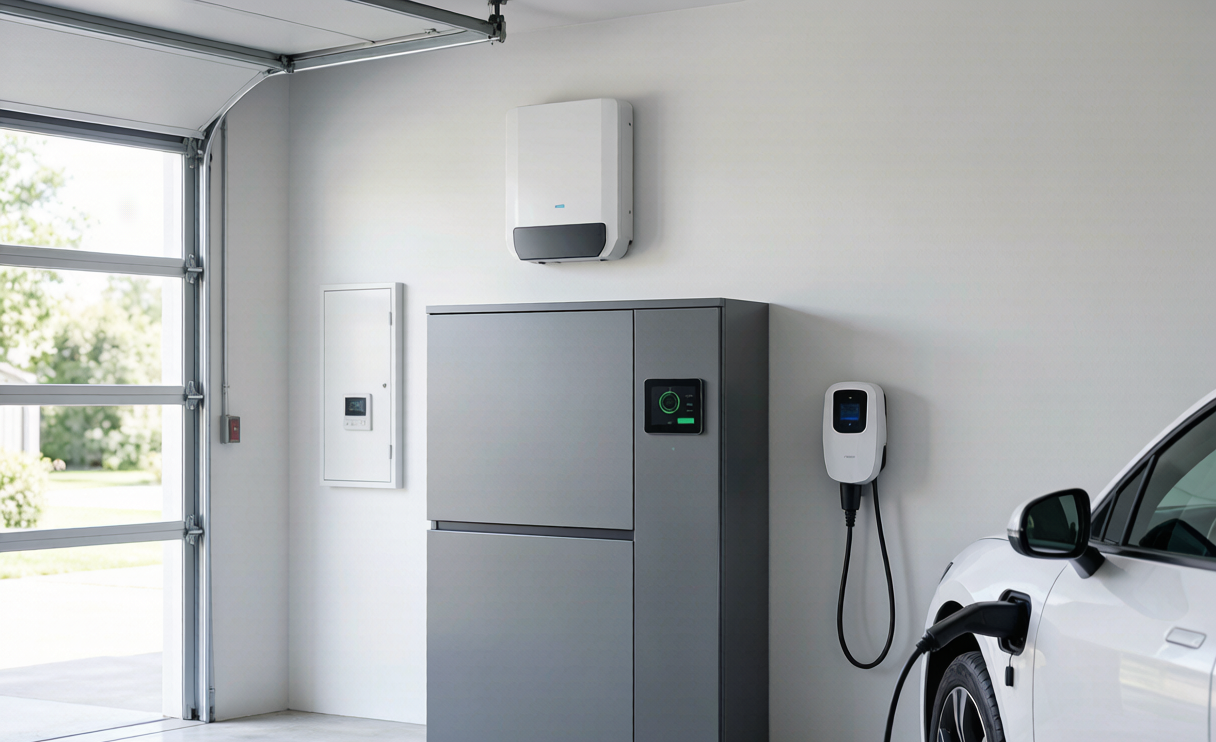
I have watched too many buyers size a home battery backup using only their “critical loads” list, then get blindsided when their EV charger trips the main breaker the first winter they try to pre-heat the cabin on stored energy. This guide walks through the engineering I actually use to size storage for EV-owning households, with real numbers and the standards a procurement or installer team should verify before sign-off.
Why an EV Changes the Home Battery Sizing Equation
An EV is not just another appliance. It is the single largest controllable load most homes will ever add. Two factors matter for capacity planning:
- Power, not just energy. A 11.2 kW charger draws more instantaneous power than the rest of a modest home combined. If your home energy storage system is meant to run during an outage, the inverter’s continuous rating must clear the charger plus the essentials—or you must segment the EV onto a controlled circuit.
- Time-shifted energy. Most EV owners charge overnight. That is also when grid tariffs are often lowest, which removes one of the main reasons to discharge a battery. So the battery’s value shifts toward backup resilience and demand-charge shaving rather than simple arbitrage.
In my field notes, an EV-owning household that previously needed a 10 kWh residential battery storage pack for backup alone often ends up specifying 18–25 kWh once they decide the battery should also cover EV charging during outages or shoulder-period peak rates.
Step 1 — Quantify Your Real EV Charging Load
Before touching any battery spec, measure the load. Pull your EV’s usable battery size and your charging rate:
- A compact EV with a 54 kWh pack charged at 7.2 kW adds roughly 7.5 kWh per hour of charging.
- A long-range SUV with a 90 kWh pack on an 11.2 kW charger adds about 11 kWh per hour.
- Most commuters replace 20–40 km of driving per day, which is only 4–8 kWh—but a “fill-up” session before a road trip can be 40–70 kWh in a single night.
The planning trap is sizing for the average and getting caught by the peak. I always model the worst realistic week: two full charges plus a winter heating spike. That scenario, not the daily average, sets the floor for your home energy storage EV owner capacity.
Step 2 — Decide the Battery’s Job (Three Operating Modes)
Capacity depends entirely on what you ask the battery to do. I frame this for clients as three modes:
- Mode A — Backup only. The battery covers lights, fridge, internet, and heat circulation during an outage. The EV is excluded. This is the cheapest path and needs only 10–13.5 kWh.
- Mode B — Tariff + partial EV. The battery runs daily arbitrage and can trickle-charge the EV during overnight off-peak, but won’t cover a full charge in an outage. Typically 15–20 kWh.
- Mode C — Whole-house including EV. The battery must keep the home and the EV charger alive through a multi-hour or overnight outage. This usually means 25–40 kWh of usable residential battery storage, often as a stackable system.
There is no “correct” mode—only the one that matches your outage tolerance and budget. I steer most first-time EV owners to Mode A or B and leave headroom in the inverter busbar for a later expansion.
Step 3 — Sizing the Home Energy Storage System Capacity
Here is the simple model I hand to installers. Compute usable capacity as:
Usable kWh = (daily protected load kWh × autonomy days) + (EV contribution if in scope)
Apply a depth-of-discharge (DoD) factor. LFP cells in a well-designed home energy storage system are safely cycled to 90–95% DoD, but I recommend specifying nameplate capacity at 90% DoD so the pack degrades gracefully. Worked example for a two-EV household on Mode B:
- Protected home loads: 12 kWh/day × 1.5 days autonomy = 18 kWh
- EV overnight contribution (one partial charge): 8 kWh
- Subtotal = 26 kWh; divide by 0.90 DoD = ~29 kWh nameplate, rounded to a 30 kWh stackable unit.
For Mode C with both cars needing a full overnight charge, I have spec’d systems up to 40 kWh nameplate. The key is that the battery chemistry—almost always LFP for stationary home battery backup—supports that daily cycling without the calendar-life penalty you’d see with NMC.
Step 4 — Don’t Forget the Inverter and the Panel
Capacity in kWh is only half the story. The inverter’s continuous and surge ratings decide whether the EV charger will even start. A 7.2 kW charger needs an inverter rated for at least 8 kW continuous, and an 11.2 kW unit needs 12 kW or more. In the U.S., grid-tied storage must comply with UL 1741 and IEEE 1547-2018 for interconnection, and the wiring falls under NEC Articles 706 and 710. The existing service panel busbar rating also limits how much you can backfeed—many 100 A panels need a sub-panel or a partial retrofit before a high-power EV charger and storage can coexist.
I have lost count of the sites where the battery was perfectly sized but the 60 A panel simply could not host both a 48 A charger and a 12 kW inverter. Check the busbar first; it is cheaper to discover on paper than during commissioning.
Step 5 — Safety, Standards and Certifications
For any home energy storage deployment with an EV load, I verify the same certifications I would for a commercial install:
- UN38.3 — transport safety of the lithium cells (T.1–T.8 tests) before they ever reach the site.
- IEC 62133-2 — secondary cell safety for the lithium systems.
- IEC 62619 — industrial/commercial stationary battery safety, the baseline for stationary packs.
- UL 9540 and UL 9540A — energy storage system and thermal runaway fire propagation standards.
- NFPA 855 — installation fire code for stationary storage, increasingly required by local authorities having jurisdiction.
An EV adds heat and duty-cycle stress, so I also confirm the battery’s thermal management margins and that the BMS can shed the EV circuit before cell temperature or voltage limits are approached. A custom battery solution provider should document this load-shed logic explicitly; if they cannot, that is a red flag.
Common Mistakes EV Owners Make When Sizing Storage
- Sizing to the daily average. The outage you actually care about is the peak week, not the calm Tuesday.
- Ignoring inverter power rating. A 13.5 kWh battery with a 5 kW inverter cannot start an 11.2 kW charger, full stop.
- Forgetting the panel. Busbar and feeder limits kill more projects than battery cost.
- Buying non-stackable. EV charging needs grow; a sealed 10 kWh box leaves no path to Mode C without replacement.
- Skipping certifications. Cheap packs without UL 9540 / IEC 62619 create insurance and permitting problems later.
Conclusion
Home energy storage EV owner capacity planning comes down to one question: what should the battery do when the grid is down or the rate is high and the car needs power? Answer that, model the peak week, size the inverter to start the charger, and verify the certifications. Do that and your home battery backup will serve the EV instead of fighting it. If your load profile is unusual—two EVs, a heat pump, and a workshop on one panel—talk to a custom battery solution engineer who can model the duty cycle before you buy.
Frequently Asked Questions
How many kWh of home battery do I need for one EV?
For backup-only (Mode A), 10–13.5 kWh covers essential home loads and a short EV top-up. If you want the battery to also cover a partial overnight EV charge during peaks, plan 18–25 kWh usable. A full overnight charge for both cars in an outage pushes you to 30–40 kWh nameplate.
Can my home energy storage system charge my EV directly?
Yes, but only if the inverter’s continuous rating exceeds the charger’s draw and the EV sits on a managed circuit. Many owners instead let the battery power the home during the cheap overnight window while the car charges from the grid, which avoids sizing the inverter for the full charger load.
Will adding an EV require a service panel upgrade?
Often, yes. A 7.2–11.2 kW charger plus a 12 kW storage inverter can exceed a 100 A panel’s busbar rating. A load calculation per NEC Article 220 usually resolves whether you need a sub-panel, a panel upgrade, or a partial-load setup.
Is it worth sizing storage to cover EV charging during outages?
Only if you reliably need the car during multi-hour outages—for example, for medical transport or a long commute with no public charging. For most households, Mode B (battery covers home, grid or limited trickle covers the car) delivers 80% of the value at a much lower cost.