Home Energy Storage Testing for Apartments
Why Apartment ESS Testing Differs From Single-Family Setups
When I commission a home energy storage system in a multistory apartment building, the margin for error is far thinner than in a detached house. In a single-family home the battery sits in a garage or basement with one owner and one set of incentives. In an apartment block the enclosure shares walls, floors, and evacuation paths with dozens of unrelated tenants. A fault does not stay local. That is why my field validation playbook for apartments starts from the building code, not from the product datasheet.
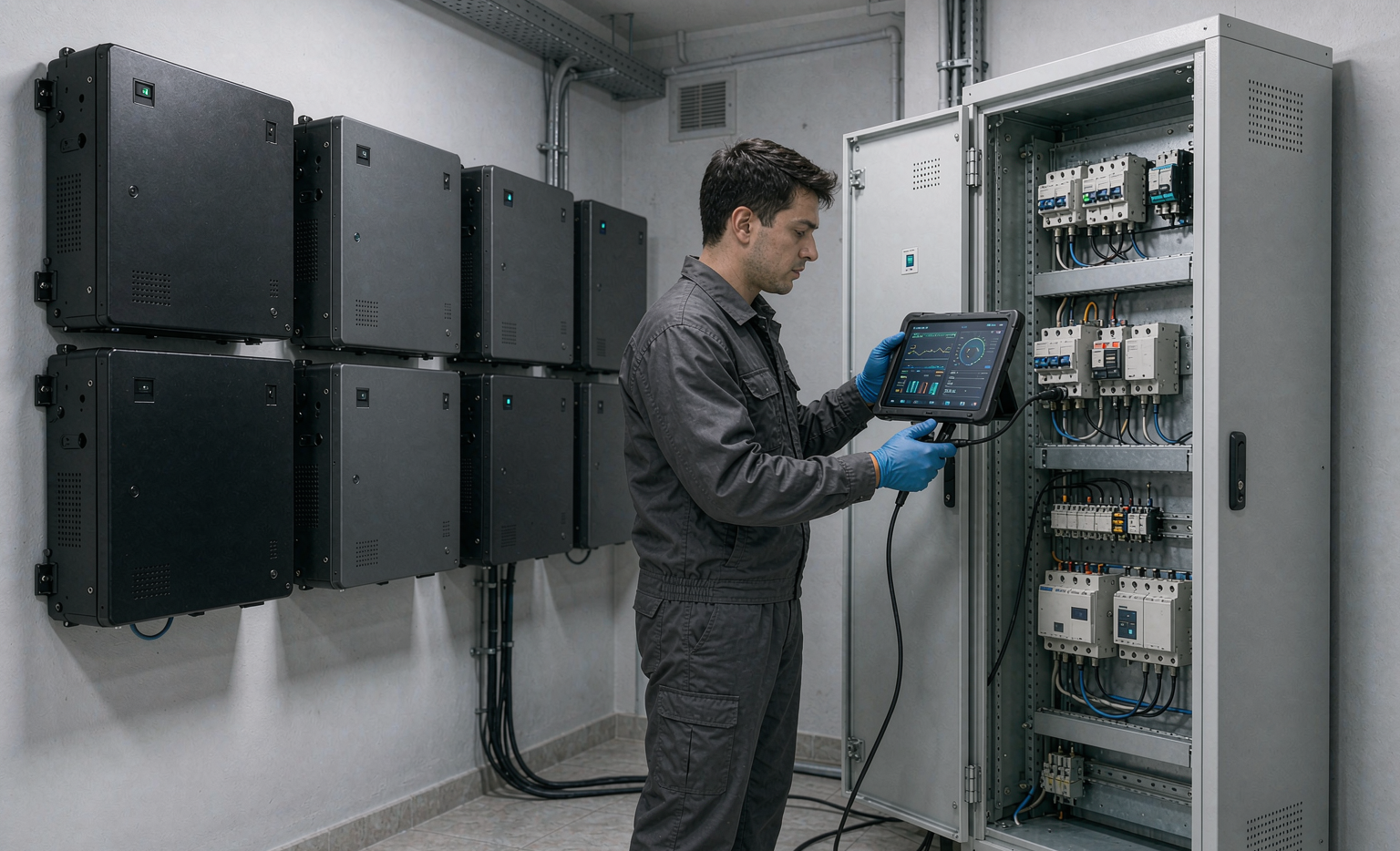
The first question I ask the housing manager is who owns the energy. In many retrofit projects the landlord owns the lithium battery bank and sells stored solar to tenants; in others each unit has its own metered cabinet. The answer changes the test scope. Shared-asset systems must pass stricter tenant-transparency checks: a readable state-of-charge, a visible disconnect, and an audible fault alarm that anyone on the landing can hear. I treat these as commissioning requirements, not nice-to-haves.
Multifamily fire codes also force spacing and ventilation rules that a warehouse pack never sees. NFPA 855 limits the allowable lithium capacity per compartment, and most European apartment basements reference IEC 62933 or local equivalents. My acceptance test is not complete until the as-built spacing matches the calculation I submitted for permitting. A custom battery solution that passes the lab but fails the landing is not a pass.
Pre-Commissioning Checks Before First Energization
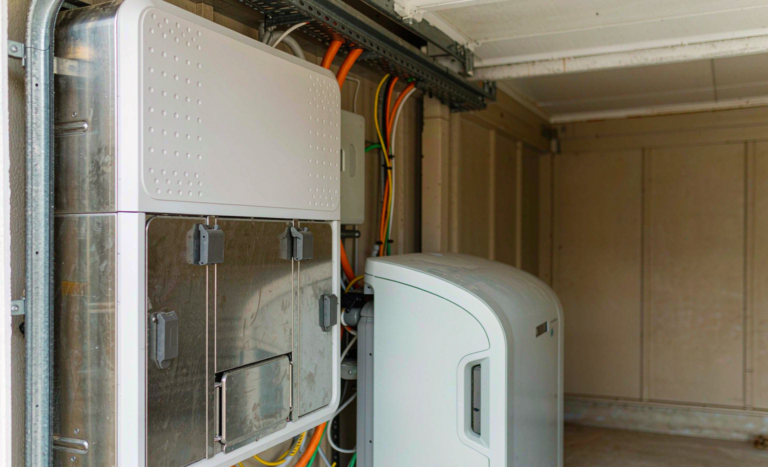
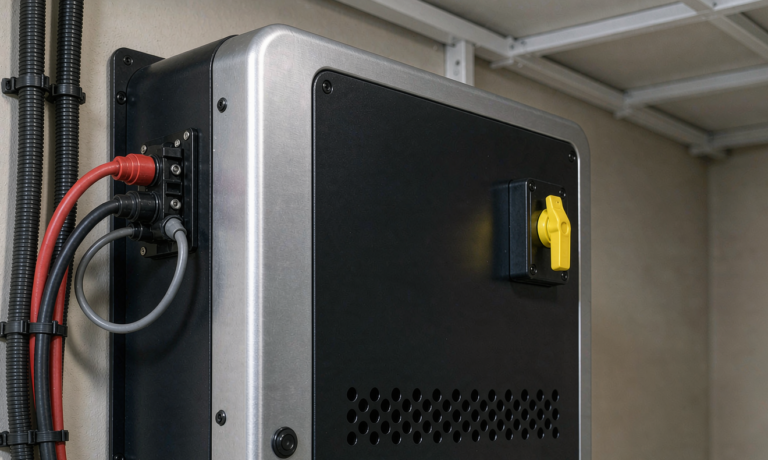
Before I connect a single cable, I walk the physical install with a torque wrench and a checklist. I verify the wall bracket rating against the enclosure mass — a 90 kg cabinet on a 60 kg-rated rail is a recall waiting to happen. I confirm the dedicated disconnect is within 1 m of the unit and that a non-resident can operate it without tools. For apartments, I also photograph the clearance to the nearest tenant door and combustible surface; NFPA 855 spacing is not negotiable.
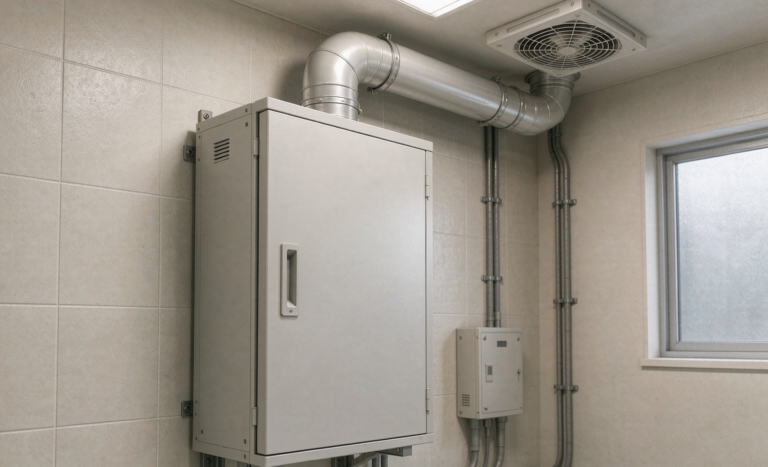
Ventilation is the next gate. A sealed utility room with a 5 kWh home energy storage module still needs passive or forced airflow sized to the worst-case heat rejection, roughly 15–25 W per kWh at 0.2C. I measure the free intake and exhaust area and refuse to energize if the calculated air changes per hour fall below the design value. Moisture matters too: I log the room’s relative humidity over 24 h, because condensation on busbars is a silent killer that no factory test catches.
Finally I confirm labeling. Every disconnect, every lithium battery module, and every breaker gets a permanent tag with the asset ID. Tenants and first responders need to identify the system in seconds. I have rejected otherwise-perfect installs purely on missing labels — the test report is only as good as the field it describes.
Electrical Safety Tests: Insulation, Hipot, and Ground Fault
The first live test is the one that protects life. I measure insulation resistance between every DC conductor and the grounded enclosure at 500 VDC, and I will not proceed unless the reading exceeds 1 MΩ. In practice a healthy 48 V or 100 V apartment pack reads 5–50 MΩ; anything below 1 MΩ means a trapped harness or a cracked module case. I repeat the test after the enclosure is closed and bolted, because a cable that clears when loose can pinch when seated.
Next is the dielectric withstand, or hipot, at 2× the system voltage plus 1000 V for one minute with a 10 mA trip. I keep the current-limited supply on a timer and watch for the characteristic slow creep that signals moisture ingress rather than a hard short. Then I validate ground-fault detection: I inject a 30 mA imbalance and confirm the contactor opens within 300 ms. Apartment systems sit on shared grounding, so a missed fault can energize a neighbor’s conduit.
I also verify polarity and that the BMS reports the same bus voltage I measure at the terminals to within ±0.5%. A custom battery solution whose firmware lies about its own voltage is a liability I will not sign off.
Functional and Communication Validation
A modern home energy storage unit is a network node, not a dumb battery. I bring up the communication bus — usually CAN or Modbus/RS485 — and confirm the inverter, BMS, and meter all agree on state-of-charge. My acceptance band is ±2–3% SoC across nodes after a controlled 5% partial cycle. Disagreements larger than that mean a mismatched coulomb-counting constant, and they wreck peak-shaving logic.
I then exercise the self-test and firmware-integrity routines. The BMS should report a hash of its firmware image so I can confirm the field unit matches the version I qualified. For apartments with remote monitoring, I push a simulated grid-event message and confirm the system responds — curtailing charge on a price signal, or islanding cleanly on a simulated outage. A unit that only works with a laptop on site is not fit for a building manager who is never there.
I close this stage by forcing a controlled fault: I pull the communication heartbeat and confirm the inverter drops to a safe state rather than freezing. In a lithium battery fleet, a silent BMS is more dangerous than a loud one.
Thermal and Fire-Propagation Screening
This is the test that matters most in apartments. I screen every pack against UL 9540A propagation methodology and IEC 62619 thermal-runaway requirements, treating EUCAR hazard level 4 as my ceiling. During a single-cell trigger test I monitor adjacent cells; if a second cell goes into runaway within the observation window, the module fails regardless of how good its datasheet looks. I have watched a competitor’s pack pass certification on a 1 kWh sample and fail badly at the 10 kWh apartment size, because scaling changes the heat sink.
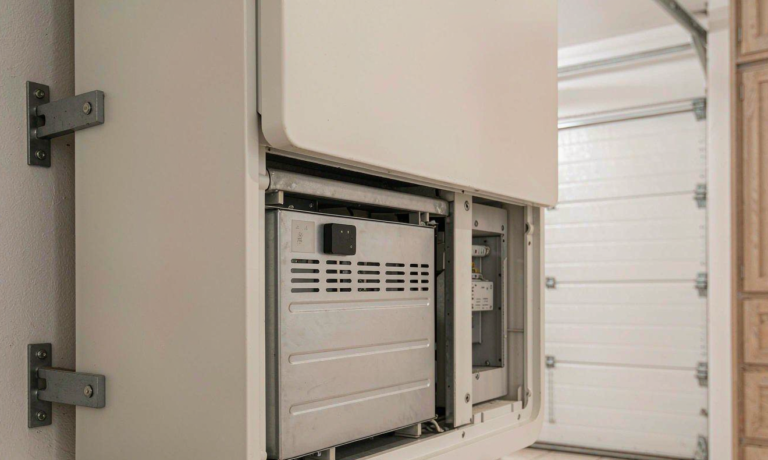
Mitigation is where the engineering lives. I verify the barrier stack — typically 0.3–0.5 mm mica plus 1–2 mm aerogel with 2–3 mm air gaps — is actually present between modules and not just on the drawing. I measure the vent path: a single 100 Ah cell can release 30–50 L of gas, so the enclosure must route it away from the tenant side and from the BMS bay, or the diagnostics get destroyed by its own event.
I also note where a sodium-ion chemistry would change the math: sodium’s wider thermal margin lets me sometimes thin the barrier, but only after its own propagation test. A semi-solid state cell shifts the failure mode toward pressure rather than heat, which I screen separately with a compression fixture. The same containment reasoning scales down to a high-discharge drone battery pack, where the envelope is tighter but the runaway energy per litre is higher, so the barrier math only gets stricter.
Performance Acceptance: Capacity, Round-Trip, and Peak Shaving
Capacity is the test tenants actually feel. I discharge the home energy storage bank at the real apartment duty cycle — usually 0.2–0.5C — and confirm it delivers at least 95% of the nameplate usable energy between the qualified voltage window. Factory numbers at 0.05C are irrelevant to a building that cycles twice a day. I log round-trip efficiency too; a well-built lithium battery system lands at 88–92% AC-to-AC, and anything under 85% signals a resistive connection I need to find.
Peak shaving is the economic reason the landlord bought the unit, so I validate it directly. I program the agreed target and replay a representative day’s load profile, then confirm the system trims the building’s peak demand by the contracted margin — typically 20–40% — without dipping the common-area voltage below code. A custom battery solution that shaves the bill on paper but sags the elevator is a failure.
I finish with a cold-capacity check if the basement drops below 10 °C, because lithium derates and a pack that promises 10 kWh at 25 °C may deliver 7 kWh at 5 °C. Tenants pay for the nameplate, so I report the real number.
Acoustic, Vibration, and EMC
Apartments are sound-sensitive in a way a cabin in a field is not. I measure enclosure noise at 1 m with the cooling fan at full speed; my limit is 35–45 dB(A) in a sleeping-area-adjacent room, and I have swapped fans on site to meet it. Vibration is lighter than in vehicular use, but I still run a short IEC 60068-2 sweep to catch a loose busbar that will rattle into a fault over a year of compressor pulses next door.
Electromagnetic compatibility closes the stage. I screen against IEC 61000-6 family limits for both emission and immunity, because the enclosure shares a riser with the building’s fire alarm and lift controls. A home energy storage inverter that chatters the smoke detector is an instant fail. I inject a burst and a surge on the AC port and confirm the BMS keeps logging through the event rather than rebooting and losing SoC.
Documentation and Handover Package
The test is not done until the paper is done. My handover package for an apartment lithium battery install includes the signed commissioning report, the UN38.3 test summary mapped to the exact BOM version shipped, the IEC 62619 and UL 9540A reports, the as-built spacing drawing, and a one-page tenant-facing guide. I also leave the firmware hash and the torque record for every critical joint, because the next engineer who opens the cabinet will need them.
I hand the building manager a simple rule: if the unit ever shows a thermal, insulation, or communication fault, isolate it at the disconnect and call before resetting. Most apartment incidents I investigate trace back to someone clearing an alarm without reading it. A custom battery solution earns its keep not when it never faults, but when its faults are legible and containable.
FAQ
How long does apartment ESS commissioning take?
For a typical 5–20 kWh shared system I budget one to two full days on site plus a week of report compilation, with the electrical safety and fire-propagation screens consuming most of the time.
Do I really need UL 9540A propagation testing for a small pack?
Yes, for any apartment install. Even a 5 kWh home energy storage unit shares a wall with sleeping tenants, and the code treats propagation containment as non-negotiable regardless of size.
What insulation resistance is acceptable?
I require above 1 MΩ at 500 VDC between every DC conductor and ground, with a healthy field reading usually 5–50 MΩ. Below 1 MΩ means a trapped harness or moisture and the unit is not energized.
Can sodium-ion or semi-solid cells change the test plan?
They shift emphasis, not the structure. Sodium-ion widens the thermal margin; semi-solid state adds a pressure-screening step. Both still pass the same insulation, communication, and propagation gates.
Why does my SoC read differently on the app than at the terminals?
A mismatch over ±3% means a coulomb-counting constant error in the BMS. I calibrate it during commissioning, because wrong SoC destroys peak-shaving economics and can over-discharge the lithium battery bank.