Sodium-Ion Battery Manufacturing for Microgrids
As a senior lithium battery engineer at Horizon Power, I have spent the last decade moving battery manufacturing from a laboratory curiosity into line-proven product. Over the past three years, sodium-ion battery manufacturing has shifted from a research sidebar into a credible, deployable option for microgrid energy storage. The appeal is not raw energy density – sodium-ion trails a lithium battery on that axis – but supply resilience, cold-weather behavior, and a manufacturing process that reuses much of the lithium-ion line you already know. In this article I walk through how we actually build sodium-ion cells and packs for microgrid duty, the deviations from lithium-ion practice that matter, and the acceptance tests that decide whether a factory’s product is fit for a 20-year grid asset.

1. Start With the Right Sodium-Ion Chemistry for Microgrid Duty
Microgrid cells live at 0.2-0.5C for most of their life, so the design priority is cycle life, safety margin, and low-temperature tolerance rather than gravimetric energy. The two chemistry families that have reached line production are layered oxide cathodes (NaxMO2, where M is Ni/Mn/Fe/Cu) and Prussian-blue-analogue cathodes, paired almost universally with a hard-carbon anode. Hard carbon is the real differentiator: it is made from biomass or petroleum-coke precursors and absorbs sodium in nanopores at a higher potential than graphite absorbs lithium, which avoids plating risk at low state of charge. For a microgrid in a cold-climate clinic or a mountain village, sodium-ion holds 80-88% of room-temperature capacity at -20°C, versus 55-70% for LFP. That single property can remove an entire cabinet of heaters from a lithium battery home energy storage system or a remote microgrid. We qualify the cathode on transition-metal content, because as soon as a supplier adds nickel or cobalt for energy, you lose the supply-cost argument that made sodium attractive in the first place.
2. Electrode Manufacturing: Where Sodium-Ion Diverges From Lithium
The slurry, coating, and calendering sequence is familiar, but three deviations decide yield. First, sodium salts (NaPF6) are moisture-sensitive, yet the cell chemistry tolerates a higher residual-moisture ceiling, so several lines run at -20°C dewpoint instead of the -45°C typical for NMC – a large capital and energy saving on the dry room. Second, hard carbon has lower tap density than graphite, so areal loading targets sit around 180-220 g/m² for the anode and 280-340 g/m² for the cathode to keep coat weight realistic; pushing higher simply cracks the coating. Third, calendering pressure is tuned to a final electrode density of about 1.6-1.9 g/cm³ for hard carbon rather than graphite’s 1.5-1.7, because hard carbon tolerates less compression before losing the porosity needed for sodiation. We measure coating uniformity with a beta-ray or laser gauge every 30 minutes and reject lots with more than ±3% gram-weight deviation, because in a microgrid pack a single weak cell becomes the current bottleneck for the whole string.
3. Cell Assembly: Prismatic Hard-Case Over Cylindrical for Stationary Packs
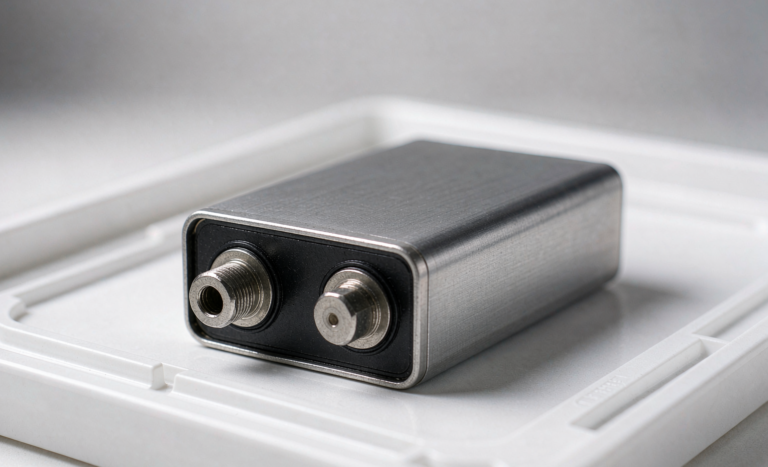
For microgrid deployment we standardize on prismatic hard-case cells, typically 50-100 Ah, rather than cylindrical 21700-format. At 0.5C the prismatic cell shows a 4-6 K internal temperature spread versus 8-12 K for a wound cylindrical cell of equal capacity, which simplifies the thermal design of the cabinet. Assembly uses laser welding for the terminal and ultrasonic welding for the tab-to-collector joint; we audit weld peel strength on a per-lot basis and require at least 25 N/mm for the tab joint. Unlike a custom battery solution built for a drone battery, where every gram is fought over, a microgrid cell can afford a steel or aluminum case that also serves as the structural and thermal spreader. We avoid pouch format for grid duty: pouch swell after 1,000 cycles can exceed 8% and break the mechanical stack, and a microgrid cabinet has no technician visiting weekly to re-torque the assembly.
4. Formation, Aging, and Grading
Formation is where sodium-ion surprises newcomers. The first charge consumes more energy than lithium because the hard-carbon SEI stabilizes over a wider potential window, and gas evolution is higher on the first cycle, so we vent and reseal before final sealing. We run formation at 0.05-0.1C for the first two cycles, then grade cells by capacity, internal resistance (DCIR at 50% SoC, typically 0.4-0.8 mΩ for a 100 Ah prismatic), and self-discharge. For a microgrid, the grading window is tighter than for consumer cells: we bin to ±2% capacity and ±0.5 mΩ ACIR within a pack so that string-balancing current stays under 5 A. A cell that passes consumer grading but drifts 30 mΩ from its neighbors will, over a decade, force the battery management system to bleed energy continuously – invisible in year one, expensive in year eight. This is the same discipline our semi-solid state programs apply, and it is non-negotiable for a 20-year asset.
5. Module and Pack Assembly for Microgrid Cabinets
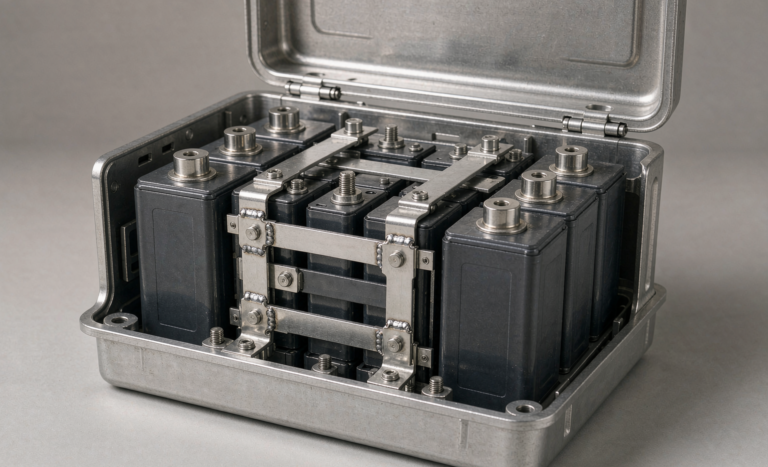
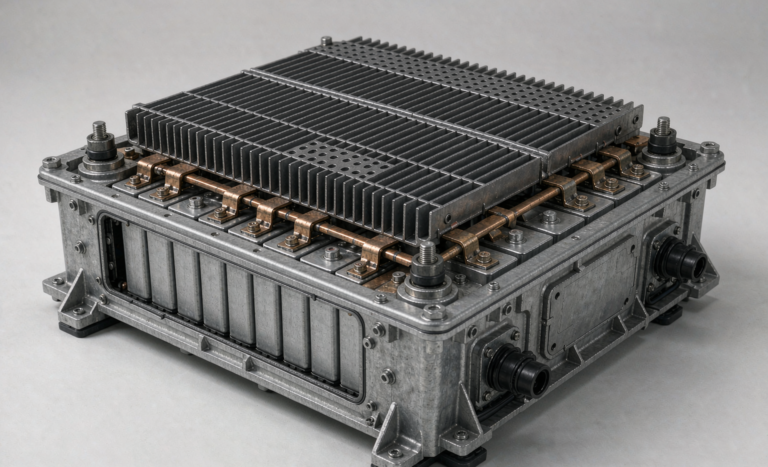
A microgrid battery is really a power-electronics-filled cabinet, not a cell problem. We build modules from 12-24 cells in series with laser-welded copper busbars rated at 3-4 A/mm² (not the 6-8 A/mm² you use in free air), because the enclosed cabinet traps heat. Every busbar joint is torqued to a recorded value (M8 at 8-12 N·m) and re-torqued after one thermal cycle to catch relaxation. Protection uses aR or gPV fuses sized to the prospective short-circuit current – a 90 kWh block at 12 mΩ internal can exceed 20 kA, so we validate the fuse let-through with the exact busbar layout, not a catalog number. Insulation resistance must exceed 1 MΩ at 500 VDC after assembly, and the enclosure is rated IP54 (filtered forced cooling) for temperate sites or IP55 (sealed with an air-to-air heat exchanger) for dusty, saline, or livestock environments. As with all our stationary pack programs, we test IP only after the vibration and shock profile, never before, because vibration opens gaps that a pristine sample would hide.
6. Standards and Traceability for Grid Deployment
A microgrid cell that cannot show its paperwork will not be commissioned. We build every lot to UN38.3 (T.1-T.8: altitude simulation at 11.6 kPa, thermal shock -40 to 75°C, vibration 7-200 Hz at 8 g, shock 50 g/11 ms, external short, crush, overcharge, forced discharge), IEC 62619 for industrial cells, IEC 62133-2 as the secondary-cell safety baseline, and UL 9540A for propagation control. The grid interface imposes IEEE 1547 on the inverter, but the battery must still supply the ride-through current the inverter promises, so we test the pack at the inverter’s fault profile, not just at steady load. Critically, certification is bound to configuration: change the cell supplier, the separator, the BMS protection logic, or the barrier material and you reopen the test file. We keep a change-control register and a per-lot bill of materials version, because a microgrid operator’s insurance and NFPA 855 spacing both depend on the exact construction that was certified. When we scope a battery solution for a new site, this documentation package is the first deliverable we hand over.
7. How to Audit a Sodium-Ion Factory Before You Buy
If you are specifying a battery solution for a microgrid, the factory audit decides more than the datasheet. Ask for the formation yield over the last six months (we target at least 92%), the weld peel-strength log, the grading tolerance actually shipped, and the UN38.3 test summary that corresponds to your exact configuration – available on request since 2020, not a generic document. Watch for a supplier who ships cells graded to ±5% capacity; in a microgrid string that imbalance becomes the BMS’s permanent tax. Require a documented first-cycle gas-vent and reseal step, because skipping it hides swelling that reappears in year two. And confirm the hard-carbon source: a stable biomass or coke precursor supply is what keeps sodium-ion’s cost story true when lithium prices spike. A supplier who cannot show the independence of their protection layers, the grading records, and the configuration-locked certification is selling a box of cells, not a microgrid-grade battery.
What makes sodium-ion battery manufacturing different from lithium-ion?
The cell assembly and formation steps reuse lithium-ion equipment, but sodium-ion tolerates a warmer dry room (-20°C versus -45°C dewpoint), uses hard-carbon anodes with different calendering density, and needs a first-cycle gas vent and reseal because of higher initial gas evolution. The grading tolerance for grid use is also tighter, typically ±2% capacity, to keep string-balancing current low over a 20-year life.
Can existing lithium-ion factories make sodium-ion cells?
Yes, for the most part. Slurry mixing, coating, calendering, and laser welding lines transfer directly. The changes are in chemistry handling (NaPF6 salt, hard-carbon electrodes), the formation protocol (lower rate, vent-and-reseal), and the tighter grading window. A plant that already builds LFP or NMC cells can usually convert a line to sodium-ion with modest capital, which is why sodium-ion battery manufacturing is scaling faster than a wholly new chemistry would.
How long do sodium-ion microgrid batteries last?
For microgrid duty at 0.2-0.5C with rated depth-of-discharge, well-graded prismatic cells typically reach 3,000-6,000 cycles to 80% capacity, translating to 10-15 years of daily operation. The limiting factor is usually capacity fade from imbalanced strings rather than intrinsic chemistry wear, which is why the ±2% grading and recorded busbar torque matter more than the headline cycle number.
Is sodium-ion safer than lithium-ion for stationary storage?
Sodium-ion cathodes are more thermally stable than nickel-rich lithium chemistries and avoid the cobalt that drives much lithium-ion supply risk, which helps in stationary, unattended microgrid cabinets. Safety still depends on the full stack: IEC 62619 construction, UL 9540A propagation control, independent protection layers, and proper NFPA 855 spacing. Sodium-ion is not inherently safe by chemistry alone; it is safe by disciplined manufacturing and system design.
Does sodium-ion work in cold climates for microgrids?
This is sodium-ion’s strongest case. It retains 80-88% of room-temperature capacity at -20°C and accepts charge far better than LFP, which often needs heater gates below 0°C. For a remote microgrid or a lithium battery home energy storage unit in a cold region, that cold tolerance can eliminate a heater cabinet, saving both energy and capital. We still specify a 0-45°C charge window and a low-temperature charge gate, but the margin is much wider than with lithium-ion.