Lithium Battery Performance for Marine Craft
Why Marine Duty Cycles Are a Different Test
When boat builders ask me to specify a lithium battery for a vessel, the first thing I tell them is that a marine craft is not a car and not a backyard solar shed. The combination of constant vibration, high humidity, wide temperature swings and irregular discharge patterns creates one of the harshest duty cycles a cell will ever see. Over my years designing packs at Horizon Power, I have learned that the numbers printed on a spec sheet mean little until you map them to the actual load profile of the craft. This article walks through how lithium battery performance behaves on marine craft, and which numbers actually matter when you size, select and commission a pack.
Energy Density and What It Buys a Vessel
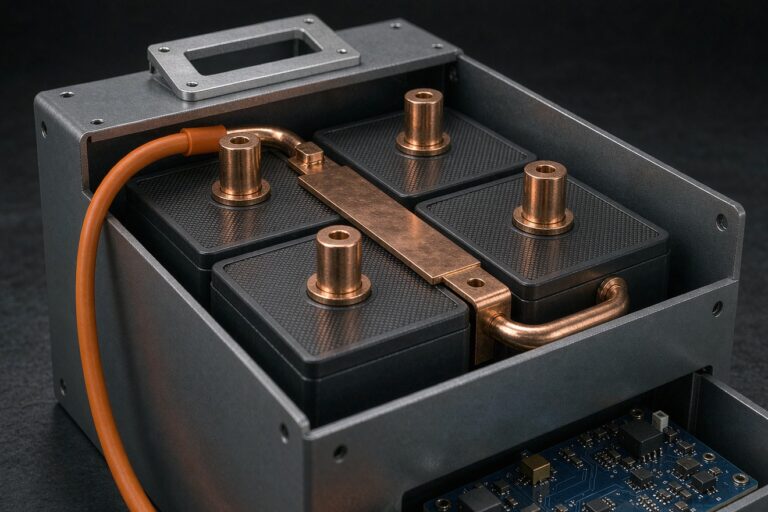
The headline benefit of a lithium battery is energy density, but the real saving is usable energy. Typical marine-grade lithium-ion cells deliver 160 to 220 Wh per kilogram at the cell level. A 100 Ah 12 V lead-acid bank weighs roughly 30 kg, while an equivalent lithium pack weighs only 12 to 14 kg. That weight reduction lowers the vessel’s draft, improves fuel economy on hybrid drives and frees up payload space.
More important than raw density is depth of discharge. Lead-acid is safely discharged to about 50 percent, whereas lithium can deliver 80 to 90 percent of its nameplate capacity without damage. In practice a lithium battery gives roughly twice the usable energy in the same physical footprint. When I run a range model for an electric tender, that two-times factor usually decides whether the craft meets its mission or falls short by a mile.
Cycle Life Under Partial-State-of-Charge Cycling
Marine craft rarely discharge fully and recharge in a clean linear curve. Trolling, hotel loads and anchor lighting create shallow, frequently interrupted cycles. A chemist who quotes “2000 cycles” at 100 percent depth of discharge is misleading the buyer. In real marine service at 80 percent depth of discharge and 25 degrees Celsius, quality LiFePO4 cells hold 80 percent of original capacity after 2000 to 3500 cycles.
The classic killer is partial-state-of-charge corrosion in lead-acid; lithium chemistry avoids that failure mode entirely. The new risk is storage at very high state of charge inside a hot bilge. I advise owners to store packs at 40 to 60 percent state of charge during layup, and to keep the battery compartment vented. A well-managed lithium battery on a recreational craft routinely delivers 8 to 12 years of service.
Discharge Rates and Peak Power for Thrusters and Winches
Electric thrusters and anchor winches draw enormous instantaneous current. A tunnel thruster can pull 3C to 5C for 30 seconds; a windlass surge can exceed that. A lithium battery handles this far better than lead-acid, whose voltage sags badly under high C-rate loads. I design marine packs with a continuous rating of 1C to 3C and pulse ratings of 5C to 10C for 10 to 30 seconds.
The engineering number that matters is the cutoff voltage under load. If pack voltage drops below the inverter or thruster trip point during a maneuver, the operation fails at the worst possible moment. We model peak C-rate against pack internal resistance to keep voltage sag inside 8 percent at the terminal, and we verify it with a real thruster load test before sign-off.
Temperature, Humidity and Thermal Management Below Deck
Bilge temperatures swing from near freezing on a night crossing to 45 degrees Celsius in tropical sun on the hard. Lithium-ion capacity fades above 45 degrees Celsius, and LiFePO4, while more tolerant, still loses cycle life in sustained heat. Below 0 degrees Celsius, charging must be blocked or current-limited to avoid lithium plating on the anode, which permanently damages the cell.
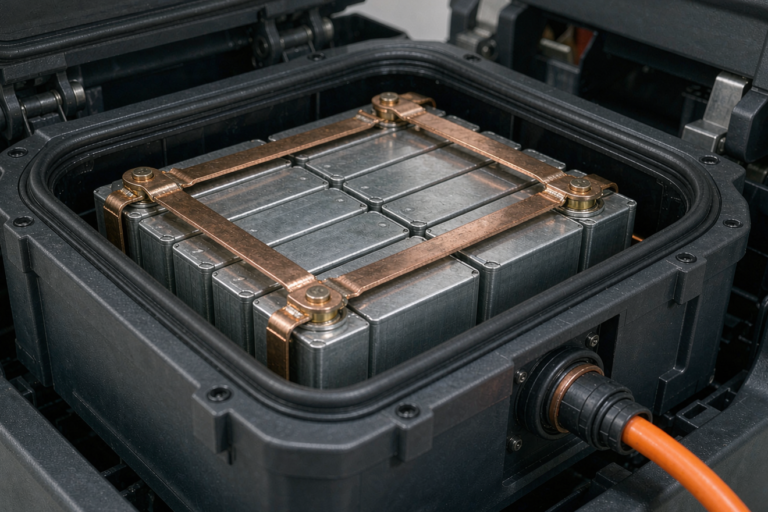
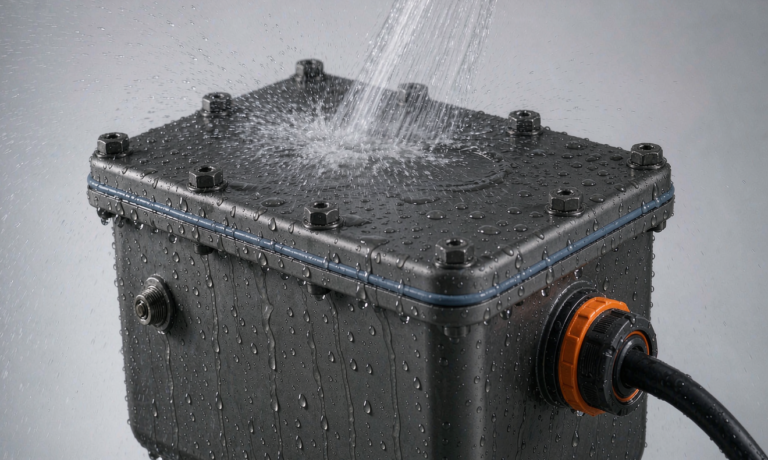
A marine battery management system must carry temperature sensing on at least two cells and offer a heating element option for cold-climate vessels. Humidity is the silent enemy. We seal packs to IP65 and apply conformal coating to the BMS board so it survives salt fog per ISO 9227. I have seen untreated control boards fail within a single season on a saltwater tender; the coating step is not optional.
BMS, Balancing and Fleet Monitoring
The battery management system is where marine performance is won or lost. I specify a BMS with cell-level voltage and temperature monitoring, balancing within 20 mV, and CAN or RS485 telemetry so the helm display shows state of charge, state of health and fault codes. For fleet operators we push that telemetry to a cloud dashboard, so a skipped balancing event on one vessel is caught before it cascades into a stranded boat.
A good marine BMS also enforces the certification envelope. It will disconnect the contactor before any cell leaves its safe operating area, logging the event for the owner. This is the layer that lets a custom battery solution behave predictably across a mixed fleet of workboats and pleasure craft.
Certifications and Compliance You Cannot Skip
Marine lithium batteries must satisfy more than consumer standards. At minimum I require UN38.3 transit safety, IEC 62133 for portable cells and IEC 62619 for industrial stationary packs. For the vessel itself, ABYC requirements and ISO 8846 ignition-protection rules apply in enclosed engine compartments, and an IP rating of IP65 or better is expected in splash zones.
If a pack ever travels as air cargo, FAA and EASA dangerous-goods rules govern labeling and state-of-charge limits at transport. Horizon Power documents every pack to these standards so the boat builder passes survey without rework. Skipping this paperwork is the fastest way to lose a season at the customs dock.
Putting the Numbers to Work
The practical path is simple. Sum your daily ampere-hour loads, divide by usable depth of discharge, add a margin for peak thruster current, and then confirm the BMS can enforce the thermal and certification envelope. A lithium battery that is correctly sized and protected will outlast the vessel’s first owner. If your duty cycle is unusual, a custom battery solution tuned to your load profile will beat any off-the-shelf bank on weight, life and reliability.
Volumetric Density and Where the Bank Sits
Volumetric density matters as much as weight on a small craft. A lithium battery packs more watt-hours into the same locker volume, which lets you place the bank low and central for better stability and a lower center of gravity. I often trade a little cell-level energy density for a wider temperature tolerance, because a pack that fails in August heat is worse than a slightly heavier one that survives the season. The placement decision is part of the performance equation, not an afterthought.
Calendar Aging and Winter Layup
Beyond cycle aging there is calendar aging. Even when unused, a lithium cell slowly loses capacity, and it does so faster at high temperature and high state of charge. Storing the bank at 40 to 60 percent state of charge in a cool, vented compartment is the single best thing an owner can do during winter layup. I have pulled packs from two-year-stored boats that still showed 98 percent capacity simply because the owner followed this rule, while a neighbor’s always-full bank had aged ten times faster.
Parallel Strings and Current Sharing
When a vessel needs more capacity than one string provides, we parallel multiple strings. The BMS must then manage inter-string current sharing. I specify a contactor and a current sensor per string so a weak module is isolated instead of dragging the whole bank down. This is where a custom battery solution earns its keep: a generic bank with a single BMS across parallel strings hides imbalance until it becomes a fire risk.
Condensation Below Deck
Condensation is another below-deck hazard. Moving from a cold night crossing into a warm humid cabin causes water to form on metal surfaces. We specify desiccant breathers on vented compartments and keep terminals coated, because a conductive film across a high-voltage terminal is a short waiting to happen. Pair that with the IP65 seal and the pack survives the damp reality of life on the water.
How long does a lithium battery last in a marine craft?
In typical recreational service at 80 percent depth of discharge, a quality LiFePO4 lithium battery lasts 8 to 12 years or 2000 to 3500 cycles while still holding 80 percent of original capacity. Heat and chronic over-charge are the two habits that shorten that lifespan.
Can I replace my lead-acid marine battery with lithium directly?
Often, but not always. The charger profile, alternator regulation and bank voltage set points differ between chemistries. Use a drop-in pack with a compatible BMS, or reconfigure the charging source so it does not over-voltage the lithium cells. A straight swap without checking the charger is a common and costly mistake.
What certifications does a marine lithium battery need?
At minimum plan for UN38.3 transit safety, IEC 62133 for the cells and IEC 62619 for stationary industrial packs. On the vessel, ABYC and ISO 8846 ignition-protection rules apply in enclosed spaces, and IP65 sealing is expected in splash zones.
Does cold water reduce lithium battery performance?
Cold temporarily reduces available capacity and slows discharge, and it blocks charging below 0 degrees Celsius unless the pack has a heater. The effect is reversible once the cells warm up. I size cold-climate vessels with a heating option so morning starts are never a gamble.
How do I size a lithium battery for my boat?
Add up your daily ampere-hour loads, divide by usable depth of discharge, add headroom for peak thruster or winch current, and confirm the BMS can hold voltage under that load. If your profile is unusual, ask the pack builder for a load-based model rather than trusting a generic amp-hour number.
Further Reading
References