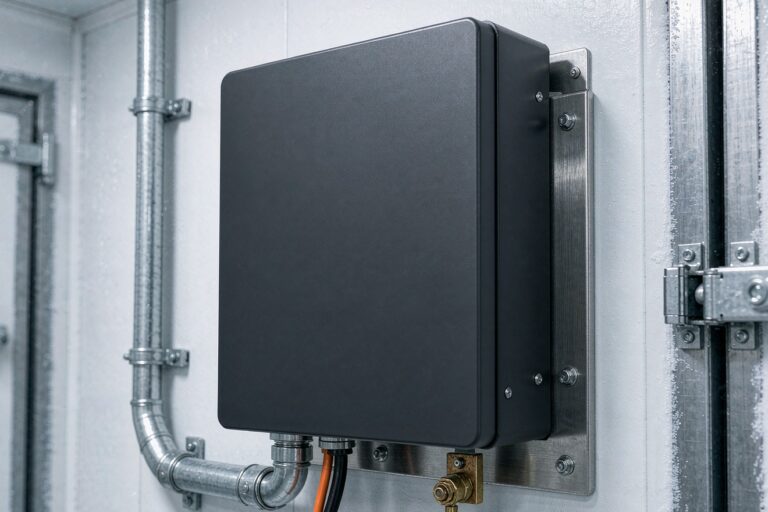
Battery Solution for Edge Data Cabinets
Edge data cabinets are showing up everywhere: a cell-site hut, a retail back room, a factory floor corner, a remote substation. Each one packs a small server, a switch, and sometimes a GPU inference box into a sealed enclosure that nobody visits unless something breaks. When the grid drops, that cabinet still has to keep serving traffic, transactions, or safety logic for minutes or hours. After deploying dozens of these packs in the field, I have learned that a generic UPS battery is the wrong answer. You need a purpose-built battery solution that survives the enclosure, not just the spec sheet.
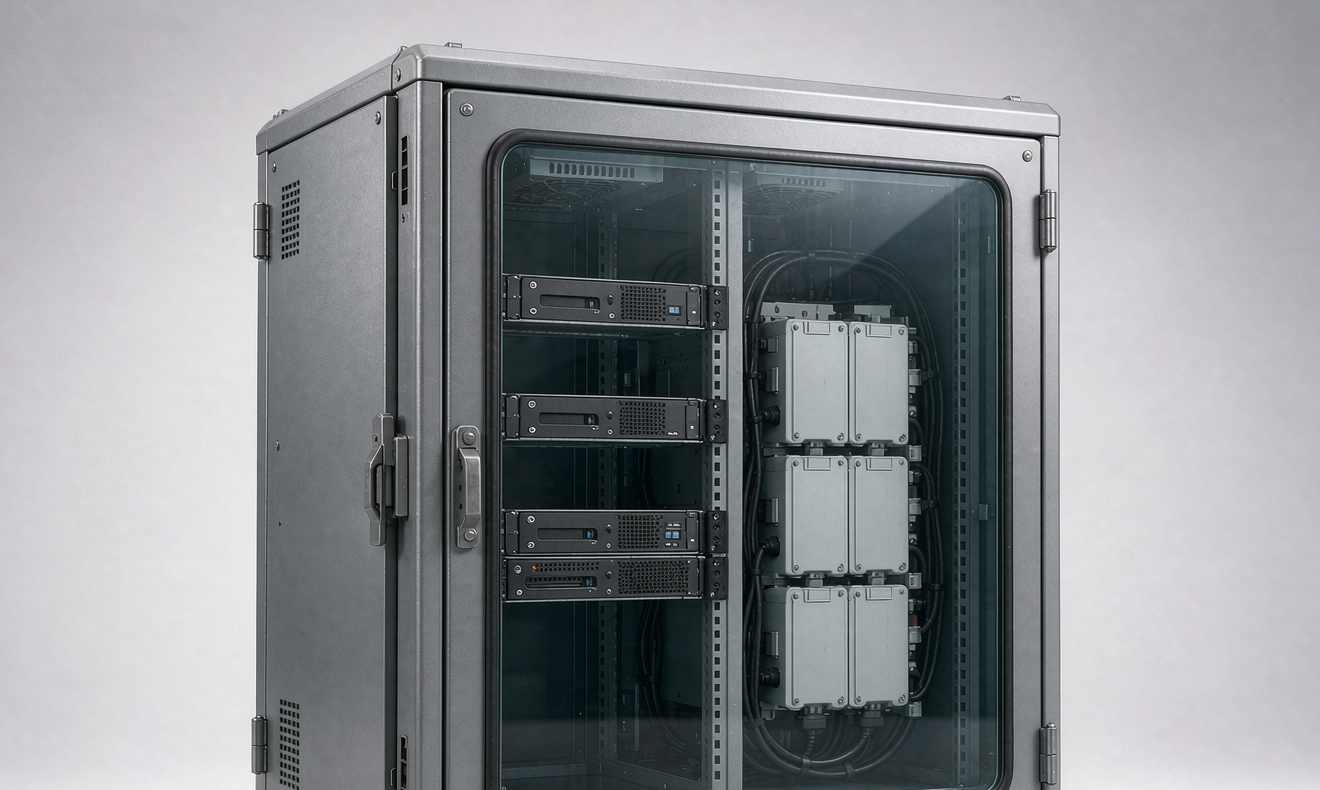
Why an Edge Cabinet Needs a Purpose-Built Battery Solution
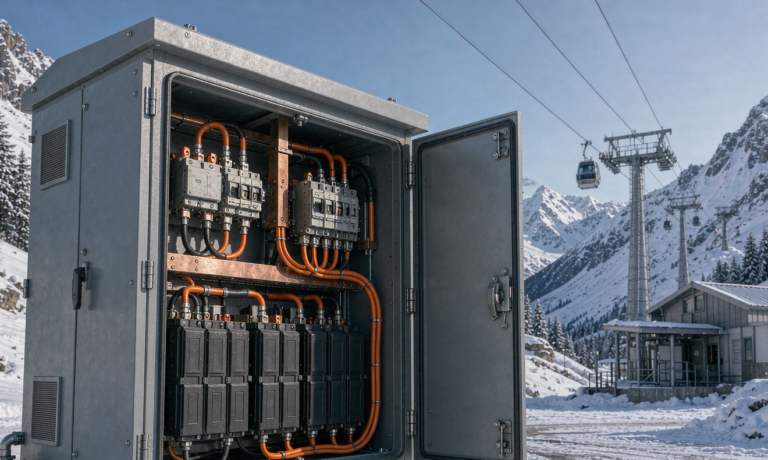
A traditional data center has climate control, a maintenance team, and redundant feeds. An edge cabinet has none of that. It may sit outdoors in a NEMA 4X box at minus 40 Celsius in January and plus 55 Celsius in direct sun, with no air conditioning and no technician within a hundred kilometers. The load is also different: a server that idles at 150 watts can burst to 600 watts during a firmware update or a video-analytics spike. A battery solution designed for a steady office UPS will either under-perform or cook itself in that profile.
From an engineering standpoint, the cabinet battery has three jobs at once: bridge short outages, ride through load bursts, and stay safe while unattended for years. That is why we treat edge cabinets as their own application class rather than shrinking a data-center pack. A custom battery solution lets us tune cell count, thermal design, and the BMS to the exact enclosure and climate, instead of forcing a generic module into a space it was never meant to occupy.
The cost argument is also different at the edge. A failed data-center pack is an annoyance; a failed edge pack is a silent site outage that nobody notices until customers complain. Engineering the pack for the cabinet up front is far cheaper than a truck roll six months later.
Cell Chemistry and Pack Design for a Sealed Box
For unattended sealed enclosures, lithium iron phosphate (LiFePO4) is the only chemistry I recommend. It is thermally stable, tolerant of partial state of charge, and far less prone to thermal runaway than nickel-manganese-cobalt. When a cabinet is locked and unmonitored, that margin matters more than energy density. We build to IEC 62619 for industrial cells and UL 1973 for stationary storage, and every pack is screened against IEC 62133 for safe transport and handling.
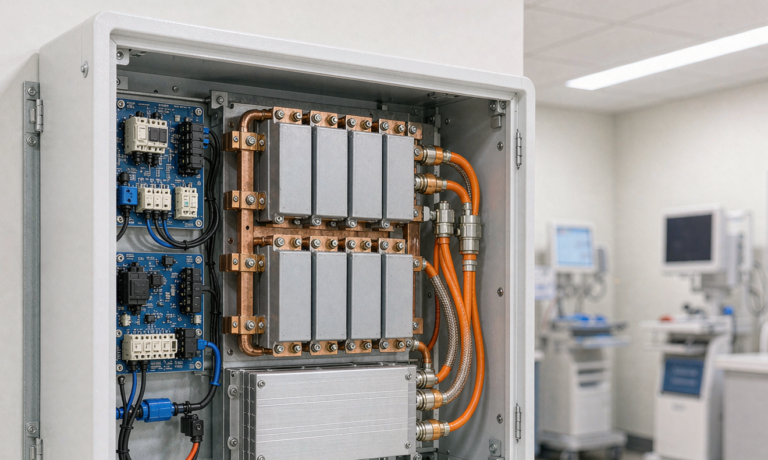
The battery pack design starts from the cabinet’s available volume, not from a catalog module. In a shallow wall-mount cabinet we use prismatic cells in a vertical stack with side cooling plates. In a floor-standing cabinet we can fit larger modules with a shared fan loop. Either way, the goal is a pack that fits the cabinet’s real geometry while leaving clearance for the heat the electronics already shed. We also leave service margin: cells are sized so the pack still meets runtime at end of warranty, not just on day one.
Cable routing is part of the design, not an afterthought. We keep high-current busbars short and away from the server’s intake air, and we use compression terminals that will not loosen under years of thermal cycling. A pack that is electrically perfect but mechanically sloppy will fail the same way a bad pack does.
Thermal Management Inside a NEMA 4X Enclosure
Heat is the silent killer of edge cabinets. The enclosure is sealed against dust and rain, which also seals in heat. On a hot day the internal air can sit 15 to 20 Celsius above ambient, and a discharging pack adds its own watts. We model the worst-case afternoon sun plus full load, then design for it, not for the comfortable laboratory number on the datasheet.
Below freezing, lithium cells lose available capacity and charge acceptance. Our packs include a self-heating film or a warm-plate loop that pulls a few watts from the grid to keep cells above their charge window before an outage hits. Above 45 Celsius we apply a discharge derating curve so the pack never exceeds its safe temperature, trading a little runtime for a long life. A good BMS solution enforces these limits automatically, so the cabinet behaves safely even when nobody is watching, and the field team never has to remember to flip a switch.
Runtime Sizing and the Hidden Load Profile
The biggest sizing mistake is treating the nameplate as the real load. A server rated at 200 watts may average 90 watts and spike to 500 during a backup event. Cooling fans, a small display, and a PoE switch all add steady draw that is easy to forget. We log the actual cabinet load for a week before specifying the pack, then size to the 95th-percentile profile with a margin for the burst.
For most edge sites, a 2 to 4 hour bridge is the sweet spot: long enough to clear a utility fault or let a generator spin up, short enough to keep the pack affordable and cool. If the site is truly off-grid or generator-less, we extend to 8 hours and add solar input on the same bus. The battery application solution is always matched to the outage reality, not a generic chart pulled from a catalog, because every cabinet lives in a different climate and a different load world.
BMS, Telemetry, and Remote Monitoring
An edge cabinet you never visit needs to tell you when it is sick. Our BMS reports state of charge, cell voltage spread, temperature, and cycle count over the cabinet’s existing network link, so the network operations center sees a weak pack months before it fails. We set alarms on cell imbalance and on any temperature outside the design band, and we route those alarms to the same dashboard the site’s other gear already uses.
The BMS also does the safety work: over-current disconnect, over- and under-voltage lockout, and balanced charging across series cells. For a sealed, unattended box this is not optional. A battery solution without a capable BMS is just a fire waiting for an excuse. We validate the protection logic against IEC 62133 and document the trip points for the customer’s compliance file, because auditors at telecom and utility sites always ask for that paper.
Integrating Solar and Hybrid Inputs
Many edge cabinets sit where the grid is weak but the sun is strong: a rural cell site, a highway sensor node, a remote pumping station. In those cases the cleanest design is a hybrid bus where the lithium pack is charged by both the grid and a small solar array. The BMS or a companion charge controller manages the priorities so the battery is always topped before an outage.
Solar changes the engineering in a good way: the pack cycles more gently because it is topped daily, and the depth of discharge stays shallow, which stretches calendar life well past the warranty. The trade is a slightly larger pack and a charge controller that must survive the same enclosure the battery does. For off-grid edge sites, that trade almost always pays back within two years versus running a generator.
Deployment, Compliance, and Field Lessons
Getting the pack to the site is its own challenge. We ship cells and modules under UN38.3 certification, with the required transport labels and state-of-charge limits, so carriers accept them without delay. For telecom-grade sites we design to Telcordia GR-487 and NEBS expectations: vibration resistance, seismic tolerance, and controlled flammability. Ingress protection of IP55 or better keeps the pack dry through driving rain and hose-down cleaning.
Field lesson one: do not mount the pack directly above the heat exhaust of the server. We learned that the hard way on an early deployment where the pack sat in the server’s hot plume and aged twice as fast. Field lesson two: label the disconnect. A cabinet that nobody visits still needs a clear, physical way to isolate the battery during service. Field lesson three: provision the network port for the BMS before the cabinet is sealed, because pulling a cable afterward means breaking the enclosure seal. Simple things save sites.
How long should an edge data cabinet battery last?
For most grid-connected edge sites, target a 2 to 4 hour bridge to clear faults or start a generator. Truly off-grid sites often need 8 hours plus solar. Runtime is sized from the real load profile, not the equipment nameplate, so a site with bursty compute may need a larger pack than its average draw suggests.
Can I use the same battery solution for indoor and outdoor cabinets?
Not without changes. Outdoor NEMA 4X cabinets face wide temperature swings, sun load, and condensation that an indoor rack never sees. The same cells can work, but the thermal design, ingress rating, and self-heating strategy must be re-engineered for the enclosure, or the pack will under-perform in the first winter.
What certifications does an edge cabinet battery pack need?
At minimum, IEC 62619 and UL 1973 for the cells and pack, IEC 62133 for safe handling, and UN38.3 for transport. Telecom sites usually add Telcordia GR-487 and NEBS-aligned vibration and flammability requirements, and some regions require local markings on top of the international standards.
How do I size the battery for a power outage at a remote site?
Log the cabinet load for a week, take the 95th-percentile draw including bursts, then size the pack for your target bridge hours with a safety margin. A custom battery solution matched to that profile beats any off-the-shelf UPS battery, especially once you add solar for a hybrid site.
Is LiFePO4 safe in an unattended sealed enclosure?
Yes, when paired with a proper BMS. LiFePO4 is the most stable lithium chemistry, and the BMS enforces temperature, voltage, and current limits automatically. For a cabinet nobody visits, that combination is exactly what makes it safe, and the telemetry tells you early when a cell starts to drift.
Further Reading
References