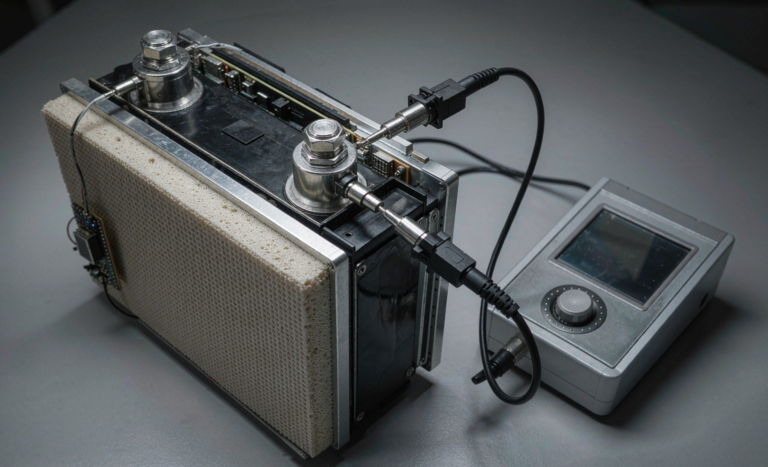
Semi-Solid State Battery Deployment for Aerospace
I have now taken three different aerospace programs from “the pack works on the bench” to “the pack flies revenue missions every day,” and every single one of them taught me the same lesson in a different way: integration is a hardware problem, deployment is a paperwork, discipline and data problem. Integration gets one aircraft off the ground with a semi-solid state battery installed and functioning. Deployment gets a fleet off the ground, repeatedly, legally, predictably and profitably — with a maintenance program, a spares pool, a configuration baseline and a health-monitoring dataset that will still be defensible five years from now.
This article is the deployment half of the aerospace series. If you have read the earlier pieces on semi-solid state battery design, testing, safety and integration for aerospace, treat this as the part that starts the day after the first flight. If you have not, the short version is that a semi-solid state battery earns its place in an aircraft by giving you more usable energy per kilogram and a friendlier failure mode, and then loses a good part of that advantage if the program does not plan for certification evidence, configuration freeze, mission-profile definition, airworthiness limitations and fleet data.
Everything below is written from the seat I actually sit in: I am Karl Huang, a senior lithium battery engineer who has signed conformity statements, argued with certification engineers about test setups, written maintenance task cards, and been on the phone at 2 a.m. when an operator discovered a pack that passed every ground check and still misbehaved at altitude.

1. What “Deployment” Actually Means in Aerospace
The word is used loosely in our industry, so let me define it the way I define it on a program. Deployment is the state in which four artifacts exist simultaneously and agree with each other.
- An approved type design. The pack as built, with a defined part number, a defined bill of materials down to cell lot, a defined BMS firmware build, and a conformity record that ties the two together.
- An approved instructions-for-continued-airworthiness set, including the Airworthiness Limitations Section (ALS) — the part operators cannot deviate from without formal approval.
- A maintenance and inspection program with tasks, intervals, thresholds and action statements that a line technician can execute with the tools actually present at the station.
- A fleet health monitoring system that records per-flight data for every pack, every flight, indefinitely, and produces trends that justify moving from fixed-interval maintenance to condition-based maintenance.
If any one of those four is missing, you do not have a deployment. You have a demonstrator with a flight permit. That distinction sounds pedantic until you watch an operator discover, six weeks after entry into service, that their insurance, their regulator and their maintenance provider each assumed someone else had defined the pack removal criteria.
There is also an economic definition, and it matters just as much. In the UAV and drone battery world we accept that packs are consumables: you buy them, you cycle them, you retire them. In crewed aerospace and in high-value uncrewed platforms, the battery is a rotable — a serialized asset with a life ledger, a maintenance history and a residual value. The entire financial model of an eVTOL or high-altitude platform depends on how many hours you get out of that rotable before it hits its life limit. Deployment is where that number gets made.
2. The Certification Basis: Where the Battery Sits in the Evidence Stack
Programs that are new to aerospace consistently underestimate how far down the stack the battery evidence goes. Your lithium battery pack is not a part you buy; it is a system with its own development assurance, its own environmental qualification, its own software, and its own failure-condition classification feeding a system-level safety assessment.
The documents you will actually be judged against
- RTCA DO-311A — Minimum Operational Performance Standards for rechargeable lithium battery systems. This is the core battery standard in the western certification world, and it covers overcharge, overdischarge, external short, cell imbalance, thermal runaway containment, and the associated pass/fail criteria at cell, battery and installation levels.
- RTCA DO-160G — environmental conditions and test procedures for airborne equipment. For a battery, the sections that bite are temperature and altitude, temperature variation, humidity, operational shock and crash safety, vibration, explosion proofness, fluids susceptibility, power input, voltage spike, and the electromagnetic and lightning sections. Choose your categories deliberately — “typical” categories chosen by a supplier with no aviation experience are one of the most common causes of a failed campaign.
- RTCA DO-178C for BMS software and RTCA DO-254 for complex programmable hardware such as an FPGA-based cell supervisor. Your design assurance level is not your choice; it comes out of the system safety assessment.
- SAE ARP4754A for development assurance and SAE ARP4761 for the safety assessment process — functional hazard assessment, preliminary system safety assessment, system safety assessment. The battery’s catastrophic failure conditions end up with probability budgets on the order of 10⁻⁷ per flight hour for commuter-category and rotorcraft-type aircraft, and tighter for large transport-category airplanes. That number, not the spec sheet, is what drives redundancy, containment and monitoring architecture.
- Cell-level standards such as IEC 62660 and IEC 62133-2 as the foundation, plus UN 38.3 for transport — and remember that the UN 38.3 test summary has been publicly mandatory since 2020, so your supplier hiding behind “proprietary” on that document is a red flag, not a negotiation.
- Aircraft-level installation rules in the applicable airworthiness part — the storage battery design and installation paragraphs of Part 23, 27 or 29, or their equivalent, plus the Special Condition for VTOL aircraft in Europe and the FAA’s special-conditions route under 14 CFR 21.17(b) with the powered-lift operating rules layered on top.
What the assessor is really asking
When a certification engineer reviews your battery evidence, they are not asking “is this a good battery.” They are asking four questions, in order: Can this battery cause or contribute to a catastrophic failure condition? If the failure occurs, is the effect contained? Is the monitoring sufficient that the crew or the system knows before it becomes a hazard? And is the maintenance program capable of finding degradation before it becomes a failure?
A semi-solid state battery does not get a discount on any of those four questions because of its chemistry class. It gets credit only for demonstrated behaviour. I have sat in meetings where a team assumed reduced liquid electrolyte content would let them skip containment testing, and the answer from the authority was a single sentence: show me the test data.
3. Configuration Freeze — Design Freezes Earlier Than Anyone Wants
This is the section I would make mandatory reading for every program manager. In consumer and industrial work, continuous improvement is a virtue. In aerospace deployment, continuous improvement is a liability, because every change to the configuration invalidates part of your evidence and reopens a qualification discussion.
The configuration baseline for a flight lithium battery pack in my programs includes at minimum: cell manufacturer, cell part number and cell lot; electrode coating batch and formation protocol; electrolyte fill mass and its tolerance; weld schedule for every interconnection; module stack pressure and the hardware that maintains it; thermal interface material part number and bond-line thickness; BMS hardware revision; BMS firmware build with a recorded checksum; harness routing; and the torque values applied at every fastener, with the tool calibration status recorded.
That last item sounds trivial and it never is. I have personally watched a program lose three weeks because a technician used an uncalibrated driver on a busbar and no one could prove what torque had been applied. In aerospace we do not just torque and mark — we torque, mark with torque seal, record the tool serial number, and inspect the mark at defined intervals.
The change decision tree I use
When a change is proposed after testing has started, I run it through the same decision tree every time:
- Does it touch an item in the safety assessment? If yes, it is a re-assessment, not a delta test.
- Does it change the thermal, electrical or mechanical path? Thermal interface swap, vent geometry change, busbar cross-section change, connector change — each of these invalidates something. Thermal interface change alone typically requires re-running the thermal and, in many cases, the containment evidence.
- Does it change the BMS firmware? Firmware is a certified article. Even a bug fix that only affects a diagnostic message can require a regression campaign against the software qualification evidence.
- Is it a like-for-like component substitution? There is no such thing in a certified battery. “Same voltage, same footprint” is not an equivalence argument; it is the start of a new qualification.
The uncomfortable corollary: once you pass containment testing, freeze. Improvements go into the next block, not into this one. I tell program teams to plan a block upgrade cycle at the outset — Block 1 flies with today’s cells, Block 2 in service eighteen to thirty months later picks up the next generation — because that structure gives the engineering team somewhere to put their good ideas that is not the middle of a certification campaign.
Supply continuity is a design parameter
Deployment planning and supply planning are the same activity. You need a multi-year cell supply commitment at defined specifications, last-time-buy provisions, and a written plan for what happens when the cell goes obsolete. Dual sourcing sounds prudent and costs real money: two sources means two qualification campaigns, typically nine to eighteen months and seven figures, plus ongoing comparative testing to prove the second source behaves identically. My advice for most programs is single source with a funded last-time-buy buffer, unless the second source is being qualified for a genuinely different reason such as regional content requirements.
4. The Design Mission Profile: Your Most Important Deployment Document
If I could require one document before any aerospace battery program left the design phase, it would be the design mission profile. Not a datasheet, not a brochure range figure — a signed, quantified description of what the aircraft will actually do to the battery, every day, in the weather it will actually fly in.
What goes into it
- Energy per mission in kWh at the pack terminals, with the split between takeoff/transition, climb, cruise, descent and landing, and the reserve.
- Power profile in C-rate with durations: the takeoff and transition pulse is where an eVTOL pack sees its highest sustained discharge, commonly in the 2C to 5C band for 30 to 120 seconds, while hover power for a lift-plus-cruise configuration can be materially higher than cruise power.
- Regeneration events — descent and landing recovery on some configurations, and the voltage and temperature windows in which the pack will accept it.
- Turnaround time and charge rate. When the business plan says a fifteen minute gate turnaround including boarding, and the charger has to deliver 80 percent state of charge in that window, that is a 3C to 6C charge requirement, and the limiting factor is heat removal, not the cell’s theoretical capability.
- Consecutive missions before a cool-down. This is the number that kills packs. Five high-rate cycles back to back with five minutes between them is a completely different thermal design problem than five cycles spread across a day.
- Ambient envelope, including solar load on a hot ramp, and the cold-soak case at a northern station overnight.
- Calendar and cycle life target, expressed both ways. Programs I work with typically write service life targets in the region of 1,000 to 3,000 equivalent full cycles to 80 percent of beginning-of-life capacity, but warranty is usually written against flight hours or calendar time, whichever comes first — and those two numbers must be consistent with the mission profile or you are writing a warranty you cannot afford.
Three mission profiles, three completely different deployment problems
Urban air mobility and eVTOL is a high-power, high-cycle-count, time-critical problem. Deployment lives and dies on turnaround charging, thermal management between flights, and dispatch reliability. A pack that cannot be ready in the turnaround window is an aircraft that cannot fly, regardless of how good the energy density was.
High-altitude pseudo-satellite platforms invert almost everything. One cycle per day, deep depth of discharge, months of unattended operation, ambient pressure of a few kilopascals, and thermal control in an atmosphere too thin to convect with. The failure mode here is not peak power; it is cumulative degradation plus the inability to intervene.
Small and medium UAV operations — the segment where a conventional drone battery is still the dominant product — are a logistics problem. Dozens of packs per aircraft, hot-swap on the pad, charging cabinets, field charging from generators, and a very high cycle count per airframe. In this world the deployment discipline is inventory discipline: serialization, cycle counting, charge-state policy for storage and transport, and a clear retirement rule.
5. Installing the Pack in an Aircraft: Deployment-Specific Items Beyond Integration
My integration article in this series covers the electrical, thermal and mechanical interfaces in detail. Here I want the items that only show up once you are putting serial aircraft together, because they are the ones that generate findings during conformity inspections.
Structure, vibration and retention
Rotary-wing and powered-lift installations have a vibration environment that a ground vehicle never sees: a broadband floor plus discrete tones at blade-pass and rotor-order frequencies. DO-160G vibration categories for rotorcraft installations are severe, and the consequence of getting it wrong is not just a fatigue failure — it is fretting at a terminal, a loosened fastener, or a cracked weld that turns into an intermittent open circuit at the worst possible moment.
Deployment practice that I insist on: the battery mounting is a designed load path to structure, not a bracket; every critical fastener has a second locking feature; harnesses have strain relief at both ends and are supported at intervals that survive the spectrum; and every removable connector is inspected for fretting debris and contact resistance growth on a defined interval.
Retention under emergency landing loads is a separate analysis from normal flight loads. The pack has to stay where it is under defined inertial load cases in the certification basis, and the analysis has to be signed by someone who is accountable for it.
Thermal runaway containment and vent routing
Containment is demonstrated by test, and then it must be preserved by design discipline. The vent path is part of the certified configuration: its cross-section, its length, its routing, its outlet location and the absence of any feature that could block it. I have seen a service bulletin issued because a maintenance team installed a protective cover over a vent outlet during washing. The vent is not an accessory.
The routing must take the effluent outside the occupied volume and, ideally, overboard. Pressure vessel and cabin air recirculation paths have to be considered explicitly, and the detection system — off-gas, volatile organic compound, carbon monoxide, or pressure rise — has to have a response-time budget written against the time the containment demonstration gives you.
Altitude: low pressure and the cooling penalty no one budgets
Two altitude effects catch teams out. The first is dielectric: clearances and creepage distances that are comfortable at sea level are less comfortable at reduced pressure, and partial discharge behaviour changes. The second is thermal: convective heat transfer scales roughly with air density, so an installation that dissipates its charge heat comfortably on the ground can be materially worse at eight kilometers where density is roughly half. If your cooling is air-based, size it at altitude with the true density, not at sea level with a margin.
Electromagnetic effects
A high-power battery and its charger are electrically noisy neighbours. The BMS must not disturb avionics, and it must survive the aircraft environment: conducted and radiated susceptibility, indirect lightning effects, high-intensity radiated fields, and electrostatic discharge. Bonding and grounding of the pack enclosure, shield termination practice on high-current cables, and filtering on the charger input are all part of the certified installation. I have chased a navigation anomaly to a charger front end that was perfectly compliant on the bench and perfectly hostile on the aircraft.
6. Energy Reserve, Dispatch Rules and the “Minimum Dispatch Energy” Number
Operators want a percentage. Regulators want a demonstration. The right answer is a computed energy quantity, and it should be one of the first numbers your deployment program publishes.
Work backwards from the worst case. You need the energy to complete the planned flight, plus the energy to execute the defined contingency — a diversion, a go-around, a balked landing, an extended hold — plus the energy to land safely, plus a margin for degradation and for the difference between your capacity estimate and reality. In the European Special Condition for VTOL aircraft, the energy reserve concept is explicitly part of the certification basis, and in uncrewed operations the equivalent requirement is usually written into the operational authorization. Either way, the output must be a number in kilowatt-hours at the pack terminals, at end of life, at the worst temperature you will operate in.
Then translate that into a dispatch rule the flight crew or the ground system can check. Practically, that means:
- A minimum dispatch state of charge that is a function of the planned mission energy, not a flat number.
- A minimum pack power capability, because an aircraft is power-limited at takeoff, not energy-limited. A pack at 60 percent state of charge with degraded cells can fail the peak-power case while passing every state-of-charge check. I always require a standardized load pulse at pre-flight and a comparison against the pack’s own baseline.
- A minimum temperature window for dispatch, because a cold pack has reduced power capability even when the energy is there. Preconditioning is a dispatch item, and preconditioning takes time, which is a schedule item.
- An isolation-resistance check before dispatch, with a threshold derived from the pack voltage and a stated margin above the applicable standard’s minimum.
The message I repeat to operators: state of charge is a fuel gauge, not an airworthiness statement. Power capability and isolation integrity are airworthiness statements.
7. Airworthiness Limitations and the Maintenance Program
Every new aerospace battery program I have joined has had the same argument: the engineering team wants condition-based maintenance immediately, and the regulator wants fixed intervals until the data supports anything else. The regulator is right.
Tasks are derived through a structured process — MSG-3 logic or the equivalent — and for a new chemistry, the honest answer for most tasks is hard time or a conservative fixed interval, with a plan to earn on-condition credit as fleet data accumulates. That plan has to be written down at entry into service, with the specific dataset and the specific statistical argument that will be used to justify the interval extension. Otherwise you are asking for an extension with no evidence trail, and you will be denied.
The thresholds I put in task cards
- Capacity. Estimated capacity below a defined percentage of beginning-of-life capacity — and the estimate must be made under a defined, repeatable condition, not opportunistically.
- Internal resistance. Trend the direct-current internal resistance measured with a standardized pulse at a defined state of charge and temperature. My working thresholds across programs: roughly 1.15 times baseline schedules deeper investigation, roughly 1.3 times plans removal within a defined window, and roughly 1.5 times removes from service. Aerospace programs often tighten these, because the consequence of a power shortfall at takeoff is not a delayed delivery.
- Cell balance. Maximum cell-to-cell voltage spread at a defined state of charge after a defined rest. Growth in this number is usually the earliest visible sign of a developing problem.
- Isolation resistance. Measured at a defined test voltage, with a threshold well above the applicable standard’s minimum, and trend it — a falling trend is more informative than a single pass.
- Physical condition. Vent path clear and unobstructed, enclosure integrity, connector condition, torque seal intact, no signs of ingress, no foreign object debris, labels legible.
- Configuration conformance. Firmware build matches the approved configuration, calibration constants are current, and the parameter set matches the type design. On one industrial fleet audit I found a quarter of the fleet running an unapproved reporting interval because a field update had been applied informally. On aircraft, that kind of drift is an airworthiness finding, not an inconvenience.
The re-torque visit nobody plans for
Joint embedding and relaxation are worst in the first tens of operating hours. I schedule a fastener re-torque at the first interval — typically around the first fifty operating or flight hours — and again at a defined later interval, with calibrated tools and with the values recorded. Every program that skipped this has found a loose connection later, usually as an intermittent fault that costs far more to diagnose than the inspection would have cost to perform.
8. Line Station Reality: Turnaround Charging, Hot Packs and Ground Handling
Deployment succeeds or fails at the line station, and the line station is a hot, busy, time-pressured place where the technician has ninety seconds to make a decision.
Turnaround charging. If the plan requires a high-rate charge between flights, the charger, the connector, the cooling path and the pack’s acceptance window all have to be designed for it together, and the charge must be thermally managed. Repeated high-rate charging of a pack that has not cooled is the fastest way I know to consume the cycle life you priced into the business case. Design the cool-down into the turnaround, and if the schedule cannot absorb it, size the pack so the depth of discharge per mission is shallower.
Hot pack handling. A pack that arrives above its normal operating band — from a hard mission, a hot ramp, or an aborted charge — needs a defined procedure: where it goes, how long it stays, what instrumentation watches it, and who is allowed to declare it serviceable again. A physically separated, non-combustible quarantine location with detection is not optional, and the distance from other assets should be derived from your containment test evidence, not from a rule of thumb.
Ground support equipment. Chargers are aircraft-adjacent equipment with their own maintenance, calibration and configuration control. I have seen a fleet grounded not by a battery fault but by a charger firmware mismatch that silently reduced charge current. Treat chargers as maintained, calibrated, configuration-controlled assets with their own logs.
Damaged and suspect packs. Define, in writing, before entry into service, what happens to a pack that has been in a hard landing, an over-temperature event, an overcharge, or physical impact. The answer is almost always: quarantine, do not charge, do not fly, contact engineering. Give the line station the authority and the physical space to say no.
9. Spares, Pooling and Transporting Batteries by Air
Spares planning for a fleet of high-value packs is an inventory problem with unusually long lead times and unusually strict shipping rules.
Size the pool from removal rate, not from fleet size. The three inputs are the expected removal rate per flight hour, the repair or replacement turnaround time, and the dispersion of the fleet across stations. Then add a depth allowance for a new chemistry: for a first-generation product, I plan a deeper pool than the model says, because early-life removal rates are always worse than the reliability prediction until the fleet teaches you otherwise.
Storage policy matters. Packs in long-term storage should sit at a moderate state of charge in a cool, dry, monitored space, with a periodic check and a rotation policy. Storing at full state of charge in a hot warehouse is a slow, invisible way to destroy assets before they ever fly.
Transport is where programs trip on regulation. Lithium cells and batteries are dangerous goods. The UN 38.3 test summary must exist and be available. Air shipment of lithium-ion batteries generally requires a state of charge not exceeding thirty percent, which is in direct tension with the desire to ship a “ready to install” spare — resolve it by shipping at the compliant state of charge and documenting the receiving charge procedure, rather than by arguing with the regulation. Damaged or defective batteries are in a separate and much more restrictive category, and moving one without the correct approvals is the kind of mistake that ends careers.
10. Fleet Health Monitoring: The Data Loop That Makes Deployment Improvable
Deployment is the only phase where you get paid back for the instrumentation you specified. The point of fleet monitoring is not dashboards; it is the ability to make a defensible statement about the health of a specific serialized pack, and about the fleet as a population.
What to record per flight
- Pack voltage, current and temperature at defined flight phases, not just a summary.
- Minimum cell voltage under the peak load event, at a stated temperature.
- Maximum cell temperature and the maximum cell-to-cell temperature spread.
- State of charge at start and end, charge energy delivered, charge duration and peak charge temperature.
- Regeneration acceptance events, including any refused regen.
- Every fault, warning and alert code with a timestamp and the parameter values at the moment it fired.
How to use it
Trend three things: energy throughput and equivalent full cycles; time-at-temperature as a histogram, because the Arrhenius behaviour of calendar ageing means your hottest hundred hours may matter more than your coolest thousand; and internal resistance measured with a standardized reference pulse. Cross-check the coulomb counter against an open-circuit-voltage estimate at defined rest points, and investigate any divergence beyond roughly fifteen percent — a drifting fuel gauge is a dispatch reliability problem in itself.
Keep the full history, not a rolling window. When a removal criterion is disputed in year four, or when an authority asks whether a failure was isolated or systemic, the only thing that settles it is the original record. For the same reason, retain removed units — bagged, labelled, with the batch code — for at least the warranty period. I have turned more than one contested claim into a same-day closure simply because the part was still on the shelf.
11. What Semi-Solid State Changes, and What It Absolutely Does Not
A semi-solid state battery brings real advantages to an aerospace deployment, and I want to be precise about where they land.
Energy density. Cell-level figures in current semi-solid products sit meaningfully above conventional high-nickel liquid-electrolyte cells. In an aircraft, that converts into one of three things: more range, more payload, or — the one I usually argue for — a larger energy reserve for the same mission. Reserve is what buys you operational robustness, and it is the option operators undervalue.
Reduced free electrolyte. Less liquid electrolyte generally means less fuel available to a propagation event, which can make containment easier to demonstrate. But “can” is doing all the work in that sentence. You still run the containment test, you still design the vent path, you still fit detection. No authority grants credit for chemistry class.
Stack pressure and dimensional tolerance. This is the deployment-specific gotcha. Semi-solid cells generally want a controlled stack pressure — typically far below the multi-megapascal figures discussed for sulfide all-solid-state designs, but real and finite. On a bench, that pressure comes from a fixture. In an aircraft, that fixture is structure: it has to maintain pressure across vibration, thermal cycling, altitude pressure change and years of service, without adding mass you cannot afford. Design the pressure-maintaining structure as a structural part with its own fatigue and inspection story, not as a packaging detail.
Rate capability and low temperature. Ionic transport in a semi-solid system is more sensitive to temperature and rate than in a conventional liquid cell. That shows up exactly where aerospace is hardest — the high-rate takeoff pulse, and the cold-soaked pack at a northern station in winter. Preconditioning becomes a dispatch item with a time cost.
Supply maturity. A newer chemistry means a thinner supply base, less field data, and a spares pool you should plan deeper. It also means the fleet data you collect is unusually valuable: you are building the reliability dataset that the entire industry will use to justify interval extensions later. Collect it properly.
12. A Deployment Readiness Checklist I Actually Use
Before I will sign off on entry into service, I want every one of these answered in writing:
- Type design and configuration baseline frozen, with the cell lot and firmware checksum recorded and a change-control process that everyone has agreed to.
- DO-311A and DO-160G evidence complete against declared categories, with the categories chosen deliberately and recorded.
- BMS software and any complex hardware qualified to the assigned design assurance level, with the safety assessment traceable to the failure conditions.
- Design mission profile signed by engineering, operations and the customer, including the consecutive-mission and turnaround cases.
- Minimum dispatch energy computed in kilowatt-hours at end of life and worst-case temperature, with the power-capability check defined alongside the state-of-charge check.
- Vent path and containment preserved in the installation, with the outlet location documented and protected from servicing damage.
- Altitude thermal and dielectric cases closed with real density and real pressure, not sea-level assumptions with margin.
- Maintenance program with tasks, intervals, thresholds and action statements, plus the written plan for how interval extensions will be justified with fleet data.
- Re-torque inspection scheduled in the first operating hours, with calibrated tools and recorded values.
- Line station procedures written for turnaround charging, hot pack quarantine, damaged pack handling and charger configuration control.
- Spares pool sized from removal rate and turnaround time, with storage state-of-charge policy and dangerous-goods shipping procedures in place.
- Fleet health monitoring capturing per-flight records for every pack, with full-history retention and a defined retention policy for removed units.
Twelve items. Every one of them has bitten a program I have worked on. None of them is exotic.
Frequently Asked Questions
How is deployment different from integration for an aircraft battery?
Integration gets one aircraft flying with the pack installed and working: electrical, thermal, mechanical and data interfaces all closed. Deployment gets a fleet flying repeatedly and legally: approved configuration, airworthiness limitations, a maintenance program a technician can execute, spares and transport procedures, and a health-monitoring dataset. Integration is mostly engineering; deployment is engineering plus evidence plus operations.
Does a semi-solid state battery get easier certification than a conventional lithium battery pack?
Not automatically. A semi-solid state battery can make containment easier to demonstrate because there is less free electrolyte to feed a propagation event, but the evidence requirement is identical: you run the containment, overcharge, overdischarge and short-circuit testing in the battery standards and you pass on the numbers. Chemistry class earns you nothing with an authority; test data earns you everything.
Why can’t we keep improving the design after testing starts?
Because the certified article is a configuration, not a concept. Changing the cell lot, the weld schedule, the thermal interface material, the vent geometry or the BMS firmware changes something the safety assessment and the test campaign were built on. In practice, once containment testing has passed, further changes cost more in re-qualification than they deliver in performance. Plan block upgrades instead of continuous change.
How should we write the dispatch rule: state of charge or something else?
Both state of charge and power capability. An aircraft is power-limited at takeoff, not energy-limited, so a pack can pass a state-of-charge check and still fail the peak-power case if its cells have degraded or it is cold. Add a standardized load pulse at pre-flight, compare against that pack’s own baseline, and enforce a dispatch temperature window with preconditioning time built into the schedule.
What are sensible removal thresholds for cells in aerospace service?
Programs differ, but my working shape is: measure direct-current internal resistance with a standardized pulse at a defined state of charge and temperature, then investigate at roughly 1.15 times the pack’s baseline, plan removal at roughly 1.3 times, and remove from service at roughly 1.5 times. Aerospace programs frequently tighten these. Also trend capacity against beginning-of-life, cell-to-cell voltage spread after rest, and isolation resistance.
How do we handle fast turnaround charging between flights?
Design the charger, connector, cooling path and pack acceptance window as one system, and design the cool-down into the turnaround. Repeated high-rate charging of a pack that has not shed its previous mission’s heat is the fastest way to consume the cycle life you priced into the business case. If the schedule cannot absorb the cool-down, size the pack for a shallower depth of discharge per mission.
What rules apply to shipping spare packs by air?
Lithium batteries are dangerous goods. The UN 38.3 test summary must exist and be available, and it has been publicly mandatory since 2020. Air shipment of lithium-ion batteries generally requires a state of charge not exceeding thirty percent, so ship compliant and document the receiving charge procedure rather than trying to ship a fully charged ready-to-fly spare. Damaged or defective batteries are in a separate, far more restrictive category and should only move under the correct approvals.
When does a custom battery solution make sense for an aerospace program, and when should we buy a catalogue product?
For small uncrewed platforms with standard voltage and no certification burden, a catalogue drone battery or lithium battery pack is usually the right answer and will be cheaper and faster. A custom battery solution earns its cost when the pack’s voltage and string count have to sit inside a defined aircraft window, when the mechanical envelope, vent routing, mounting load path or connector position are dictated by the airframe, when containment and venting have to be demonstrated as an integrated installation, or when the BMS alarm hierarchy and data model have to match a specific aircraft or operational concept. In certified crewed programs, that is almost always the case.
How long should we retain health data and removed packs?
Retain the full per-flight history for every serialized pack for the life of the asset, not a rolling window, and retain removed units — bagged, labelled, with the batch code — for at least the warranty period. When an authority asks whether a failure was isolated or systemic, or when a removal criterion is disputed years later, the original record and the physical part are the only things that settle it.