Sodium-Ion Battery for Railway Crossing Signals
I am Karl Huang, Senior lithium battery Engineer at Horizon Power. For the past decade I have specified stationary batteries for safety-critical infrastructure, and one application keeps surprising younger engineers: the railway level crossing. A crossing warning system is fail-safe by design, which means the instant grid power disappears, the battery must take over and keep the flashing lights and the gate mechanism alive. In this guide I explain why a sodium-ion battery has become my default recommendation for crossing protection, how I size it, and which standards actually matter when a cabinet sits metres from the rails.
Why Crossing Protection Needs a Different Battery
A level crossing is not a typical load. The warning system is engineered so that loss of normal power drives it into the safe state: lights flash, bells ring, and the gate descends to block the road. That safe state is the active state, and it must be powered. For decades this role fell to valve-regulated lead-acid (VRLA) blocks, but lead-acid hates the real trackside duty cycle: long float standby, occasional deep discharge, wide temperature swings, and almost no maintenance visits. I have opened too many cabinets to find sulphated cells that quietly lost half their capacity.
A sodium-ion battery changes the math. It tolerates partial state of charge without damage, shrugs off cold that cripples lead-acid, and offers a calendar life measured in decades rather than a few years. For an asset that must simply work every single time the grid blinks, that reliability profile is exactly what I want.
Sodium-Ion Chemistry Basics for Trackside Use
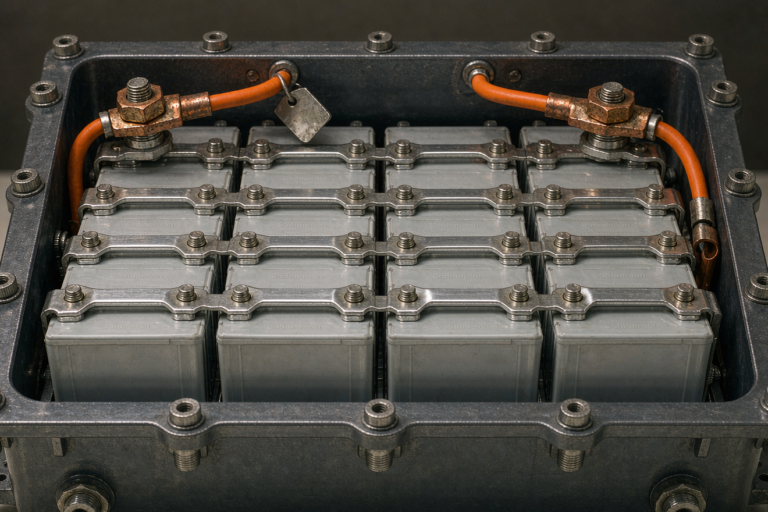
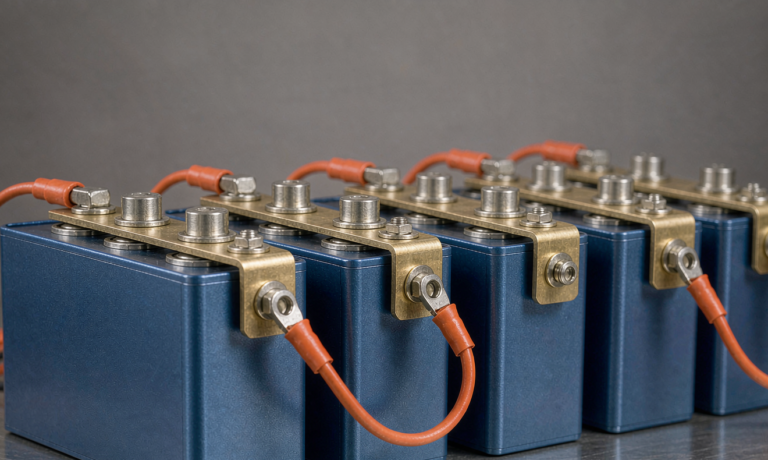
Modern sodium-ion cells are prismatic, with a nominal voltage around 3.0 to 3.2 volts per cell, slightly lower than the 3.6 to 3.7 volts of a lithium-ion cell. In a stationary crossing cabinet that lower cell voltage is irrelevant; what matters is behaviour under stress.
- Energy density: cells reach roughly 100 to 160 watt-hours per kilogram, and packs land near 70 to 120 Wh/kg. That is below lithium iron phosphate (LFP), but a crossing cabinet is stationary, so mass and volume are not the binding constraint.
- Cycle life: 2000 to 4000 cycles at 80 percent depth of discharge, which translates to many years of monthly self-test discharges.
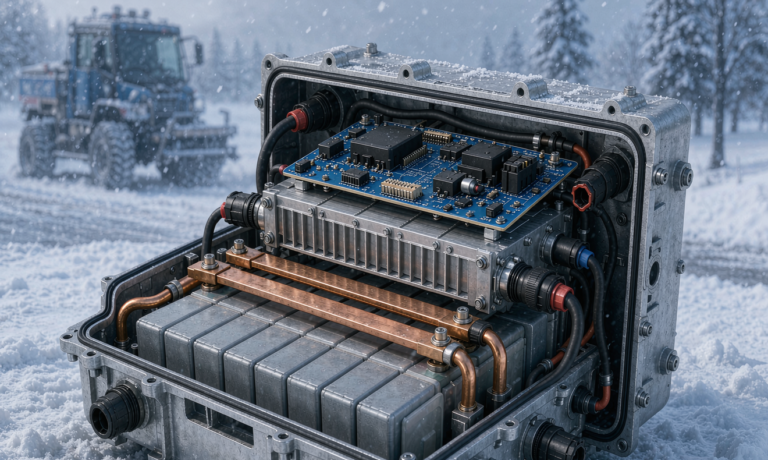
- Low-temperature performance: sodium-ion typically retains 85 to 92 percent of capacity at minus 20 degrees Celsius and can accept charge down to roughly minus 10 degrees Celsius. Lead-acid and even LFP lose far more capacity in the same cold.
- Calendar life: 10 to 15 years in float-like service, versus 3 to 5 years for VRLA.
- Thermal behaviour: the chemistry is stable, with no risk of metallic lithium plating at low temperature the way some lithium cells suffer, which simplifies the safety case for wayside siting.
Compared with lead-acid, which I consider obsolete for this duty, and NMC lithium, which is unnecessary and harder to qualify trackside, sodium-ion hits a sweet spot of cost, cold tolerance, and longevity.
Sizing the Battery: Load Profile and Backup Duration
Sizing starts with the load, not the chemistry. A typical single-track crossing draws from several subsystems:
- LED warning lights: approximately 20 to 40 watts per lane array.
- Gate motor: a short peak of 200 to 600 watts during the few seconds the gate moves.
- Controller and logic: 50 to 150 watts continuous.
- Wayside communication radio or LTE modem: 20 to 60 watts.
- Cabinet heater in cold climates: 50 to 150 watts when active.
In practice the average sustained load lands between 250 and 450 watts. The critical figure is backup duration: railroads usually specify 4 to 8 hours of hold time, and remote lines can demand 24 hours where crew response is slow.
Here is the math I use. Assume 400 watts average over 8 hours, which is 3.2 kilowatt-hours of usable energy. Sodium-ion tolerates deep discharge, so I apply a depth-of-discharge factor of 0.9, a system efficiency of 0.9, and an end-of-life derate of 0.85. The nominal pack size becomes 3.2 divided by (0.9 times 0.9 times 0.85), or about 4.65 kWh. I round up to a 5 kWh pack. At a 48 volt bus that is roughly 100 amp-hours. If a heater runs continuously at minus 30 degrees Celsius, add its draw to the energy budget before sizing, because cold is precisely when the grid is most likely to fail.
Fail-Safe Architecture and Transfer Switching
The battery is the backup, but the handover must be instantaneous and unambiguous. I specify a static transfer switch that moves the load from AC mains to the battery string in under 20 milliseconds, well inside the tolerance of the crossing controller. An OR-ing diode or ideal-diode stage prevents any backfeed onto the dead mains.
Remember the fail-safe principle: the controller is wired so that loss of power commands the active warning state. The battery therefore powers lights and gate descent, not a quiet standby. The charger holds the pack at a partial state of charge appropriate for sodium-ion, which actually reduces aging compared with a permanent full float. I also mandate a monthly automatic discharge test that confirms delivered capacity stays above 95 percent of rating and raises an alarm otherwise.
Standards and Environmental Qualification
A cabinet beside the rails lives in a harsh, regulated world. The specifications I qualify against include:
- EN 50155 and IEC 60571 for electronic equipment used in railway applications, covering operating temperature, humidity, and shock.
- IEC 61373 for vibration and shock, the environmental class that wayside enclosures are judged against even when mounted off the vehicle.
- EN 50121 for electromagnetic compatibility along the railway.
- UL 1973 for stationary battery safety in North America, paired with IEC 62619 for industrial battery safety internationally.
- IEC 62133 as the baseline cell safety reference, and UN38.3 for transport of the pack to site.
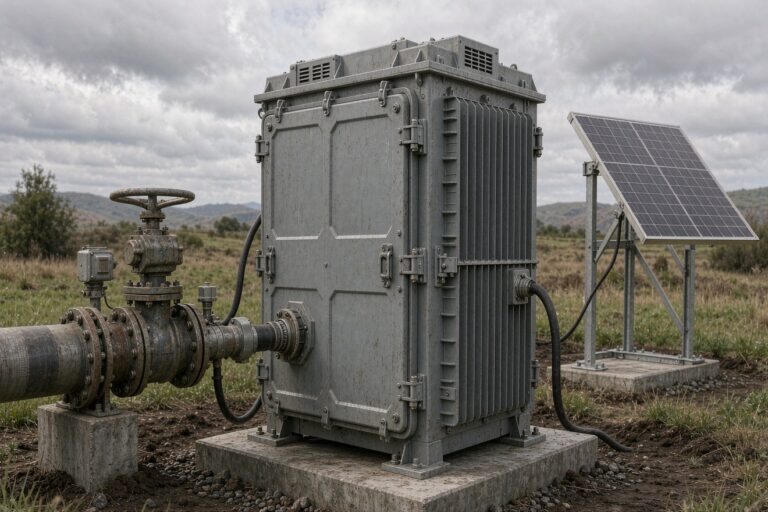
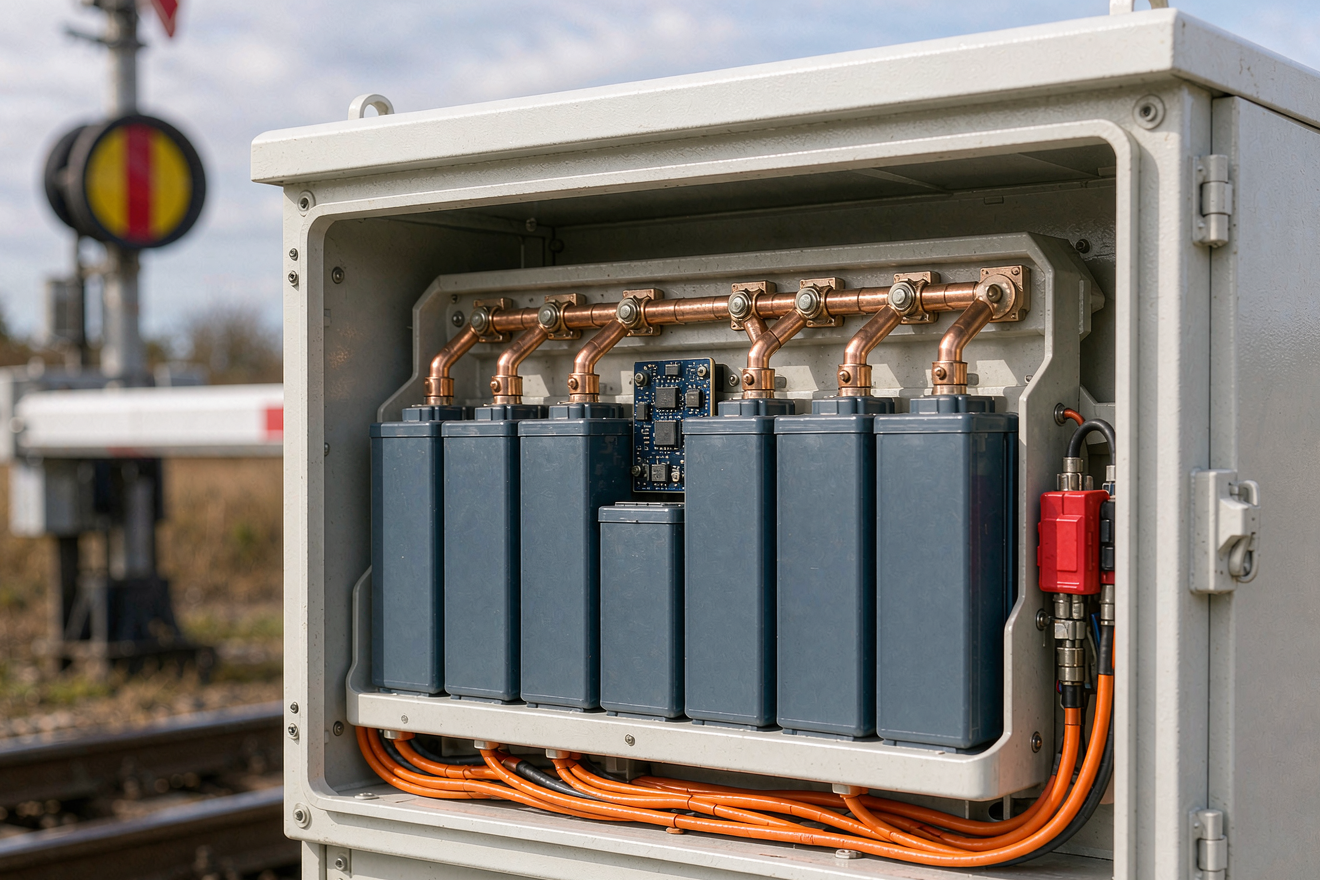
- An enclosure rated NEMA 3R or 4X, typically IP65, with a pressure-equalising breather to manage condensation.
I specify an operating envelope of roughly minus 30 to plus 60 degrees Celsius for the battery and minus 40 to plus 70 degrees Celsius for the protected electronics, which covers the continental climates where these crossings sit.
Lifecycle, Maintenance and Remote Monitoring
The whole point of choosing sodium-ion is to stop visiting the cabinet. State of health is tracked by combining coulomb counting with periodic impedance spectroscopy near 1 kilohertz; I declare end of life at 80 percent of original capacity or roughly 1.5 times the initial impedance, whichever comes first. Telemetry leaves the site over Modbus or SNMP with dry contacts to the operations centre, so a degrading pack is flagged before it ever affects a train.
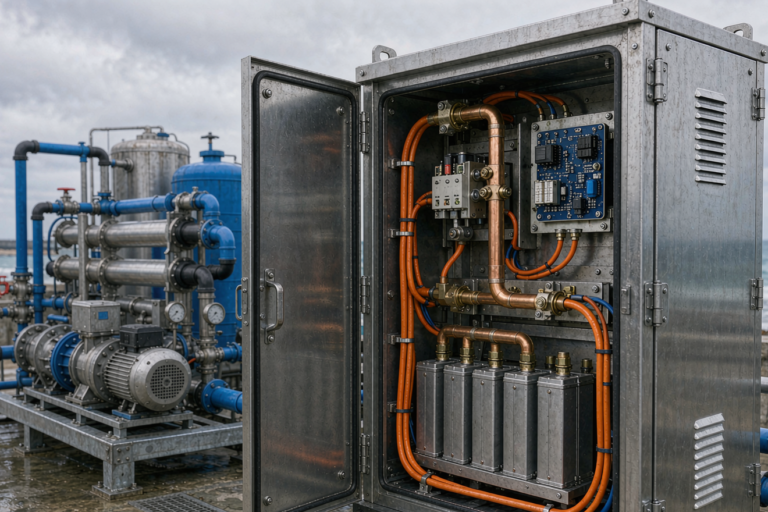
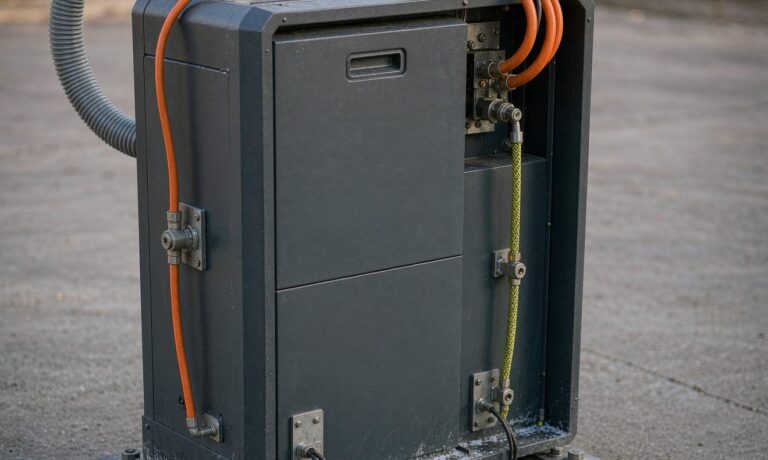
Against VRLA, the total cost of ownership flips decisively. A sodium-ion crossing battery lasts 10 to 15 years with essentially no maintenance, versus 3 to 5 years and periodic testing for lead-acid, and it uses abundant materials with no cobalt and a lower fire risk during recycling. At Horizon Power we deliver this as a custom battery solution: an integrated cabinet with cells, battery management system, temperature-controlled enclosure, heater, and transfer switch pre-assembled and site-ready.
Frequently Asked Questions
How long must a railway crossing battery provide backup power?
Most railroads specify 4 to 8 hours of hold time, with remote lines sometimes requiring 24 hours where maintenance response is slow. I size the pack to the longest plausible outage plus a margin, not to the average event.
Why choose sodium-ion over lead-acid for crossing signals?
Lead-acid sulphates and loses capacity during the long float standby that crossings actually experience, and it needs periodic maintenance. Sodium-ion tolerates partial charge, survives cold, and lasts 10 to 15 years with no site visits, which is the reliability profile a fail-safe system demands.
Can sodium-ion batteries charge in cold weather?
Yes. Sodium-ion typically accepts charge down to about minus 10 degrees Celsius and retains 85 to 92 percent of capacity at minus 20 degrees Celsius, where lead-acid and many lithium packs lose far more. A cabinet heater still helps the electronics, but the cells themselves stay usable.
What standards apply to trackside battery cabinets?
I qualify against EN 50155 and IEC 60571 for railway electronics, IEC 61373 for vibration and shock, EN 50121 for EMC, UL 1973 and IEC 62619 for battery safety, IEC 62133 as the cell baseline, and UN38.3 for transport, inside an IP65 NEMA 3R or 4X enclosure.
How is the fail-safe state maintained during a power outage?
The crossing controller is wired so that loss of AC power commands the active warning state: lights flash and the gate descends. A static transfer switch moves the load to the battery in under 20 milliseconds, and an OR-ing stage blocks any backfeed onto the dead mains.
What is the expected service life of a sodium-ion crossing battery?
In float-like trackside service I expect 10 to 15 years. End of life is declared at 80 percent of original capacity or about 1.5 times initial impedance, and remote monitoring flags degradation long before it affects operation.
Further Reading
References