Sodium-Ion Battery Maintenance for Microgrids
I have spent the better part of two decades specifying, commissioning and then living with battery plants that nobody visits very often. A drone battery pack comes back to me every few weeks; a microgrid battery sits in a container on a remote site for years, and the only feedback I get arrives as a data log. That difference changes what “maintenance” means.
When a site operator asks me what sodium-ion battery maintenance looks like for a microgrid, they usually expect a checklist that looks like their LFP checklist with a few numbers changed. That is not what I hand them. Sodium-ion is close enough to lithium iron phosphate that the same tools, the same safety discipline and the same torque wrench apply, but far enough away in three specific behaviours — a sloping open-circuit voltage curve, a genuinely wider low-temperature window, and a tolerance for deep discharge down to zero volts — that a copy-pasted LFP maintenance regime will both over-serve and under-serve the asset. Over-serve it by forcing unnecessary full-charge routines; under-serve it by assuming the state-of-charge estimate stays honest through a long float period.
This guide is what I actually put in a site operations manual: what to inspect, what to trend, which alarms are worth a truck roll, and where the maintenance burden of a sodium-ion battery in microgrid service genuinely differs from the lithium plant next door.
What microgrid duty does to a battery
Before any schedule makes sense, write down the duty cycle. In my experience a microgrid battery rarely has one job, and the jobs pull in opposite directions.
- Solar self-consumption and peak shaving — one to two shallow-to-moderate cycles per day, 20–80% state of charge window, high cumulative throughput. This is calendar-plus-cycling ageing and it is the gentlest duty.
- Backup with long float — the pack sits at 95–100% state of charge for weeks or months, then discharges once. This is the harshest duty for almost every chemistry, sodium included, because high state of charge plus temperature is where calendar ageing lives.
- Islanded genset hybrid — short, sharp charge and discharge bursts, often at 0.5C to 1C, with the generator dictating the charge window rather than the battery. This produces thermal cycling and connector movement, which is where the field failures actually start.
- Black start — a handful of events per year, but each one is a full-power transient on a cold pack, and it must work first time every time.
I ask for the last twelve months of site data before I write a maintenance plan, because the ratio between those four modes determines everything downstream. A plant that floats at 98% state of charge in a 35 °C container needs a different calendar from one that cycles 20–80% every day.
Why sodium-ion is not simply LFP with a different label
The chemistry differences that matter to a maintenance engineer are few, and they are specific.
The open-circuit voltage curve slopes
Lithium iron phosphate has a famously flat plateau around 3.2–3.3 V per cell. That flatness is why LFP state-of-charge estimation leans so heavily on coulomb counting, and why LFP packs drift when they never see a full charge. Many sodium-ion cells — particularly layered oxide cathodes — present a noticeably sloping open-circuit voltage curve across most of their usable window. In principle that makes voltage-based state-of-charge estimation easier.
In practice I do not let operators rely on it. The slope is not constant: it changes with temperature, and it changes as the cell ages and its internal resistance grows. A voltage-derived state of charge that was accurate at commissioning can be five to eight percentage points optimistic three years later on a pack that spends its life at partial state of charge. Treat the slope as a diagnostic aid — a way to sanity-check the coulomb counter — not as a replacement for it.
What this changes in maintenance: I still schedule a full charge and a rest-and-recalibrate routine, but the cadence is gentler than LFP because the drift is slower and voltage gives you a cross-check. Quarterly recalibration is comfortable for most microgrid duties; monthly is unnecessary unless the pack never leaves the float window.
The low-temperature window is real, but it is not free
This is the genuine advantage and the reason some of my clients chose sodium-ion in the first place: sodium-ion cells can accept charge at temperatures where LFP must refuse it. LFP charging below 0 °C risks lithium plating on the anode and is normally hard-prohibited by the battery management system. Sodium-ion does not suffer the same plating mechanism, and the cells I have qualified accept charge down to roughly −20 °C at a reduced rate.
Two qualifications matter for a microgrid:
- The permitted charge rate falls steeply. At −20 °C you are typically looking at 0.1C to 0.2C, not the 0.5C the pack will take at 25 °C. If the microgrid controller does not know that, it will command a rate the battery management system then refuses, the charge window closes early, and the site runs on diesel for the rest of the night. I make the temperature-derated charge curve an explicit, documented input to the energy management system.
- Capacity retention at low temperature is better than LFP but not free — expect roughly 85–90% of room-temperature usable capacity at −20 °C on the cells I have tested, against roughly 70–75% for a comparable LFP cell. That is a real improvement, and it is why sodium-ion earns its place in cold-climate telecom and northern microgrids. It is not a reason to delete the thermal management from the design.
The maintenance consequence is that a cold-climate sodium-ion plant still needs its heating, its insulation and its condensation control. I have attended a site where the battery was specified precisely because it was “good in the cold,” the enclosure heater was then value-engineered out, and eighteen months later I was looking at a control board with corrosion on it — not because of the cold, but because of the condensation that came with cold-soak and warm-day cycling.
Zero-volt storage changes your spares strategy
Sodium-ion cells can be discharged to zero volts and stored or transported in that state without the copper-dissolution and capacity-loss damage that would destroy a deeply discharged lithium cell. A few manufacturers have built transport and storage claims around this.
For microgrid maintenance this is quietly valuable. A spare lithium module has to be held at 30–50% state of charge and topped up on a schedule, which means someone has to own that task on a site that may not have a technician at all. A spare sodium-ion module can, subject to the manufacturer’s written confirmation, be held at zero volts until it is needed. I still verify this in writing for the exact part number before I design the spares plan around it, because it is a cell-design-dependent claim and not universal. Where it holds, it removes an entire recurring maintenance task.
Expect lower round-trip efficiency and higher internal resistance
Sodium-ion cells in the current generation typically run a lower nominal voltage — around 3.0 V against 3.2 V for LFP — and somewhat higher internal resistance. Cell-level energy density of roughly 100–160 Wh/kg trails good LFP at 140–180 Wh/kg. On a system level, the round-trip efficiency I have measured on sodium-ion microgrid cabinets lands in the 88–93% band, against 92–96% for a comparable LFP system measured the same way.
That gap is not a defect, but it is a number the maintenance team must trend, because a falling round-trip efficiency is one of the earliest and most honest signals of an ageing or drifting pack. Record the baseline at commissioning, measure it the same way forever after, and treat a two-to-three point drop as a question to investigate rather than noise.
The maintenance schedule I put in the site manual
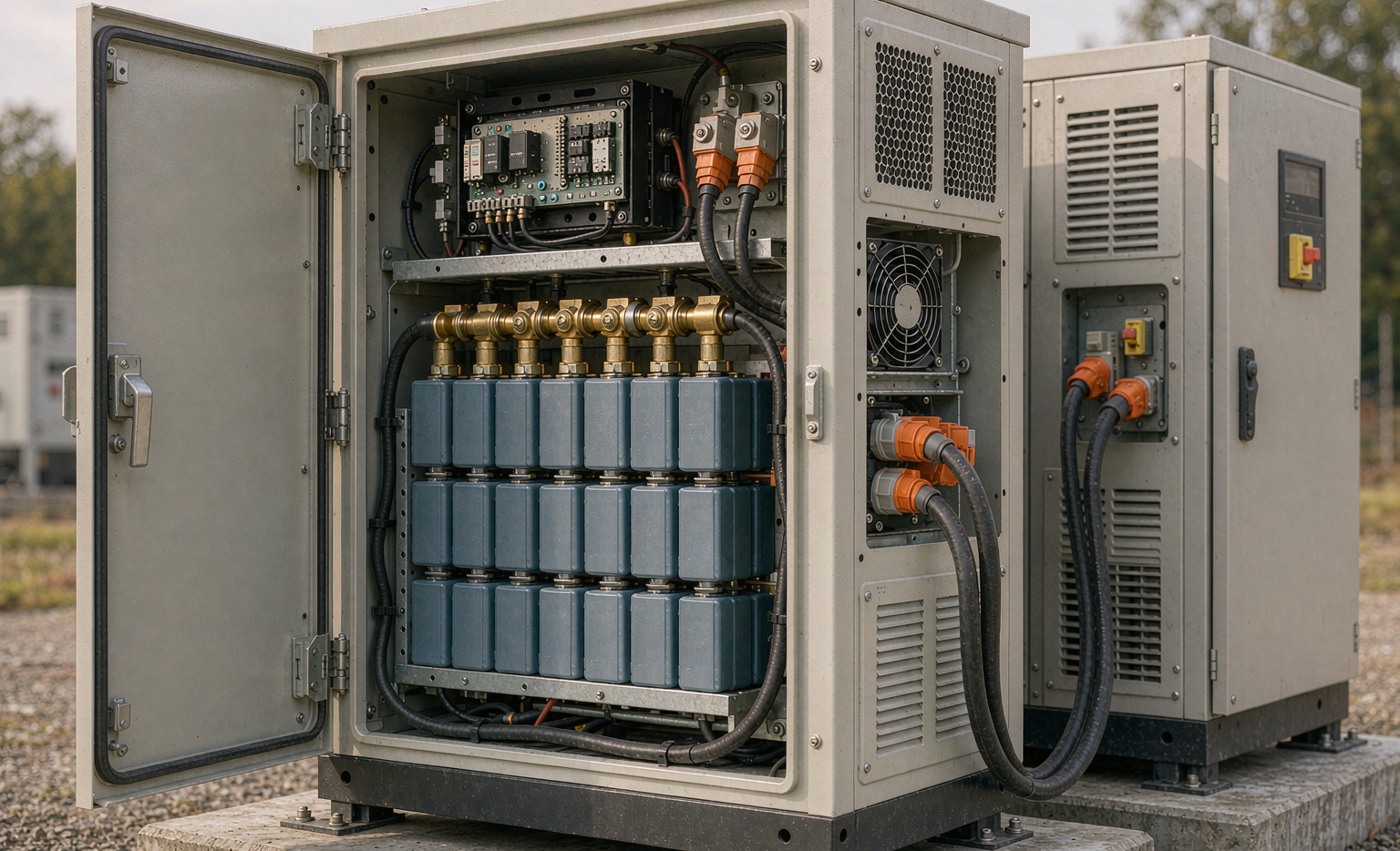
What follows assumes a containerised or enclosure-mounted industrial sodium-ion system, grid-interactive and/or islanded, with remote monitoring. Most of it is done remotely; the annual visit is the one that needs a truck.
Remotely, every day
- Confirm telemetry is alive. A monitoring gap is a maintenance event in its own right — I have twice found a serious cell fault that had been quietly present for weeks behind a broken data connection.
- Check for standing alarms: over-temperature, under-temperature, insulation fault, contactor fault, cell voltage out of band.
- Note pack state of charge at the same clock time each day. A slow downward trend at the same operating point is the earliest sign of rising self-discharge or a cell going soft.
Remotely, weekly
- Cell voltage spread at rest: minimum to maximum cell voltage in the pack, in millivolts. Record it. A spread that was 25 mV at commissioning and is now 60 mV is telling you something even if it is still inside spec.
- Module temperature spread: difference between hottest and coldest module sensor, at comparable state of charge and load.
- Any balancing activity log entries. Continuous, heavy balancing is not normal once a pack is run in; it points at a weak cell or at a pack that never reaches full charge.
Remotely, monthly
- Round-trip efficiency over a representative full cycle, at the same measurement point.
- Auxiliary energy consumption — thermal management, controls, communications. A sudden rise usually means a fan or a compressor working against a blocked filter or a failing thermostat.
- Firmware and log review: any protective limit events, any derates you did not command.
- If the site floats for long periods, schedule a controlled full charge and a rest-and-recalibrate cycle now rather than waiting for the quarterly slot.
Quarterly
- Full state-of-charge recalibration: charge to the manufacturer’s full-charge definition, rest at least two hours at stable temperature, then discharge at a controlled constant current and compare delivered amp-hours to nameplate. Do this at a stable ambient temperature; comparing a winter measurement to a summer one is meaningless.
- Review the internal resistance or conductance trend for every module, if the battery management system reports it. Look for the outlier, not the average.
- Review event logs for near-misses: protective limits approached but not tripped.
Annually, on site
This is the visit that catches what telemetry cannot. In order:
- Visual inspection. Look for corrosion at terminals and on the control board, vermin ingress, insect nests in vents, water staining, evidence of condensation, and discolouration on any busbar or lug. In coastal and tropical microgrids, corrosion and biology cause more downtime than the electrochemistry does.
- Air path. Clean or replace intake filters. Check fan operation and listen for bearing noise. Verify that nothing has been stored against the enclosure that blocks airflow — I have found everything from plywood sheets to fuel drums.
- Torque verification. Re-torque accessible power terminals to the manufacturer’s value with a calibrated torque wrench, and mark each one. On the failure databases I keep, connection problems account for roughly 45–55% of “battery is faulty” service calls, against well under a third attributable to the cells themselves. This single step is the highest-value hour on site.
- Insulation resistance. With the pack isolated and following the manufacturer’s procedure, megger each string at the specified test voltage — typically 500 V for systems up to 500 V nominal, 1000 V above that — and record the values. Do not rely on the battery management system’s own insulation monitoring device alone; it is a protective function, not a measurement instrument.
- Thermal imaging. Under load, image every accessible connection, fuse and contactor. A connection 15 K above its neighbours is a work order, not an observation.
- Capacity verification. A controlled constant-current discharge at 0.2C to 0.25C, measured at the point of common coupling, compared against the manufacturer’s warranted capacity at that temperature and rate.
- Fire and safety systems. Test detection, ventilation interlocks, signage, disconnect labelling, and — critically — confirm the emergency disconnect points are accessible and that the site’s emergency procedures still match what was installed.
What the numbers should look like
Operators always ask me for thresholds, so here are the ones I use as starting points, to be replaced by the manufacturer’s own figures wherever they are more specific.
- Capacity: a healthy new sodium-ion system delivers 95–100% of nameplate on a 0.2C discharge at 25 °C. Below 90% in the first year, escalate to the manufacturer immediately — that is not wear-in, that is a defect or a configuration problem.
- Cell voltage spread at rest: under 50 mV is comfortable for a healthy pack; 50–100 mV warrants investigation and a balancing review; above 100 mV, isolate and investigate before the next full cycle.
- Internal resistance: trend the spread across modules. A single module more than 20–25% above the pack median is the outlier to chase, regardless of the absolute value.
- Round-trip efficiency: a drop of more than two to three percentage points from the commissioning baseline, measured identically, is a question to answer.
- Module temperature spread: more than 8–10 K at rest is usually an airflow or sensor problem before it is a cell problem.
End-of-life and warranty: read the fine print before year five
Sodium-ion cycle-life claims for current-generation cells cluster around 3,000 to 6,000 cycles to 70–80% of original capacity, with polyanionic cathodes at the better end of that band and some Prussian-blue-analogue designs lower. That is comparable to LFP, and it is a cycled-life number — which is why the warranty wording matters more than the headline cycle count.
What I check in the warranty and then monitor against:
- Dual capacity limits. Most industrial warranties say “70% of original capacity after 10 years OR 4,000 cycles, whichever comes first.” On a microgrid doing 300 equivalent full cycles a year, the cycle limit arrives in year thirteen; on one doing 500, it arrives in year eight. If the throughput allowance is lower than your actual duty, the years in the headline are irrelevant.
- Operating window exclusions. Charging outside the permitted temperature-current envelope, or sustained operation above the rated ambient, is normally excluded. Make sure the data logger can prove you stayed inside the envelope — that record is the warranty claim.
- Whether the warranty is prorated and what a replacement module costs in year nine.
- Firmware and spare support lifetime. The worst outcome on a remote microgrid is not a failed module; it is a failed module whose replacement part was discontinued four years ago. Ask for the last-time-buy notification period in writing.
Compliance and transport: the paperwork moves
Maintenance on a microgrid eventually involves shipping something — a failed module back, a spare out. Sodium-ion has recently been given its own place in the dangerous goods framework, with dedicated UN numbers assigned for sodium-ion cells and batteries rather than being shipped under the lithium entries. Confirm the current UN number and packing instruction against the live IATA addendum and the manufacturer’s UN 38.3 test summary for your exact part number before you book anything; do not reuse a lithium-class shipper’s paperwork from last year.
For the fixed installation itself, the listing framework is the one North American authorities having jurisdiction already understand: UL 1973 for the battery, UL 9540 for the system and UL 9540A thermal runaway propagation test reports for site approval. In other markets, IEC 62619 remains the industrial reference, and sodium-specific national standards — China’s GB/T 44265 for sodium-ion batteries used in electrical energy storage is the one I see referenced most often in supply chains right now — are filling the gaps while the international committee work catches up. A sodium-ion specific international safety standard is still in development; do not let anyone tell you a mature, published, sodium-only IEC safety standard already exists.
One maintenance-relevant consequence: if your site approval was granted on the basis of a UL 9540A report for a specific module part number, then swapping in a different-generation module during a repair can invalidate the basis of that approval. Check with the authority having jurisdiction before a mid-life module substitution.
When a standard catalog product is the wrong answer
Microgrids are where standard products most often stop fitting. I recommend a custom battery solution when at least two of these apply:
- The enclosure envelope is fixed by the site — a shelter, a container with limited door width, a rooftop plant room — and catalog module dimensions will not work.
- The real ambient temperature range permanently sits outside the catalog window, or the site is at altitude where convective cooling is weaker than the datasheet assumed.
- The battery management system must speak a specific protocol to an existing energy management system or SCADA plant, and closed-loop control is required rather than a conservative open-loop fallback. Mismatched protocols do not trip an alarm; they silently cost you 10–20% of usable capacity.
- The duty cycle is unusual enough that the standard warranty terms will not be met — very high cycle counts, very long float, or frequent black-start duty.
- A specific certification is required by the grid operator, a classification society, or a national program that the catalog product does not carry.
When we go custom, the technical package I need up front is the same one I ask for on any project: the load profile with both continuous and inrush power, required autonomy hours, the measured ambient temperature envelope, the available charge window, a dimensional drawing of the installation envelope, the target certifications, and an honest annual volume. That last one sets whether custom engineering is economically sensible at all.
FAQ
How often does a sodium-ion microgrid battery need a full charge for calibration?
Quarterly is comfortable for most cycling duty. Sodium-ion’s sloping open-circuit voltage curve gives you a usable cross-check against the coulomb counter, so the drift accumulates more slowly than on a flat-plateau lithium chemistry — but it does accumulate. If the pack spends weeks at a time at high state of charge without cycling, move to monthly.
Can I really store a spare sodium-ion module at zero volts?
Many sodium-ion cells tolerate deep discharge to zero volts without the damage a lithium cell would suffer, and some manufacturers build storage and transport claims around it. Get it in writing for your exact part number before you plan around it, because it is design-dependent. Where it does apply, it removes the periodic top-up charge that a lithium spare would require.
Does the better cold-weather performance mean I can skip enclosure heating?
No. Sodium-ion will accept charge at temperatures where LFP must stop — typically down to about −20 °C at a much reduced rate — and it retains roughly 85–90% of room-temperature capacity at that temperature against about 70–75% for LFP. But the permitted charge rate drops steeply, and the enclosure still has to control condensation, which is a bigger long-term threat to the electronics than the cold itself.
What is the single most valuable maintenance task on a remote site?
Torque verification on power terminals during the annual visit, with a calibrated wrench and a witness mark on every fastener. Thermal cycling loosens connections, and in the failure data I keep, connection issues account for roughly half of all “failed battery” callouts while the cells themselves account for well under a third.
Can I mix sodium-ion modules with my existing LFP modules?
Not directly on the same DC bus. Different nominal voltages, different voltage curves and different internal resistances mean the two chemistries will not share current predictably, and the battery management systems are designed around one chemistry’s limits. If you must have both on one site, they belong on separate DC buses behind their own management systems, coupled on the AC side.
Why does my round-trip efficiency reading keep changing between seasons?
Because efficiency is temperature- and rate-dependent, and because AC-side and DC-side measurement points give different answers. Measure at the same point of common coupling, at the same current rate, and as close to the same cell temperature as you can manage. A two-to-three point swing with the seasons is normal; a two-to-three point drop at the same conditions is a fault to investigate.
What capacity should I expect from a healthy system in year one?
On a controlled 0.2C discharge at around 25 °C, 95–100% of nameplate. There is a small amount of early-life capacity walk-down as the hard-carbon anode’s solid-electrolyte interphase stabilises over roughly the first 50–100 cycles, and that is normal and expected — but anything below 90% in the first year warrants a call to the manufacturer rather than a note in the log.