Sodium-Ion Battery Performance for Microgrids: Duty-Cycle
When buyers ask me to size a battery for a microgrid, the first thing I tell them is that microgrid duty cycles are not EV duty cycles. A delivery van discharges once and recharges; a microgrid battery may cycle twice a day, sit at partial state-of-charge (SoC) for hours, absorb a sudden rooftop-solar surge, then back-feed the bus during a diesel-genset outage. After fifteen years engineering lithium packs and the last three shipping sodium-ion systems for remote and campus microgrids at Horizon Power, I have learned that sodium-ion battery performance for microgrids has to be judged on round-trip efficiency across mixed C-rates, degradation under repeated shallow-and-deep cycling, and behavior in islanded mode—not on a single headline number like energy density. This article is the field-engineering view I give our integration partners.
I was reminded of this last winter on a Himalayan village microgrid. The site had a 120 kWh LFP bank that, at −18°C, would only deliver about two-thirds of its nameplate through the morning water-pump and lighting peak, forcing the diesel generator to fire every cold dawn. We swapped in a sodium-ion bank of identical nameplate and the same cold morning now runs the full peak on stored energy, generator silent. That single field result explains why I now lead with sodium-ion for cold and temperature-swing microgrids—the performance advantage is not on a datasheet, it is in the worst hour of the worst month.

Why Microgrid Duty Cycles Punish Batteries Differently
A grid-tied microgrid rarely sees the textbook 1C discharge profile quoted on a cell datasheet. In my deployments, the battery lives through a compound profile: a 0.1–0.3C base load from the village or factory, a 1–3C spike when a pump or compressor starts, a multi-hour absorption window when PV exceeds load, and an occasional deep discharge during a grid-islanding event. A sodium ion battery handles this profile well because its chemistry tolerates a wide SoC operating window and does not depend on a narrow lithium intercalation plateau. The practical consequence is that we can run sodium-ion between roughly 5% and 100% SoC with far less fear of the copper-dissolution and lithium-plating failure modes that constrain aggressive cycling in other lithium-ion families.
For the engineer, the lesson is to spec the battery against the worst minute of the duty cycle, not the average. I size the power rating from the motor-start pulse (usually 2–3x base load for 2–10 seconds) and the energy from the longest islanded autonomy window, then verify both against the cell’s pulse-IR and the system’s thermal budget.
Round-Trip Efficiency Across C-Rates: Where Na-Ion Holds and Where It Loses
Round-trip efficiency (RTE) is the number that quietly decides a microgrid’s lifetime economics. In our bench and field data, a well-built sodium-ion battery pack delivers about 90–92% RTE at 0.2–0.5C, dropping to roughly 85–88% at a sustained 1C discharge. A comparable LFP pack typically holds 94–95% across that same range. The gap is real and comes mostly from higher internal resistance in current-generation sodium cells (layered-oxide cathodes in particular).
The nuance buyers miss: microgrids spend most energy at low C-rates. If 80% of your throughput is 0.2–0.5C and only 20% is pulsed, the throughput-weighted RTE gap between sodium-ion and LFP shrinks to about 2–3 points. Over a 20-year horizon at a 90% capacity factor, that gap is often smaller than the procurement and cooling cost differences—especially when sodium-ion’s lower cell price and simpler thermal envelope are included in the custom battery solution total cost model.
- 0.2C: Na-ion ~91–92% RTE; LFP ~95%
- 0.5C: Na-ion ~89–91%; LFP ~94%
- 1C sustained: Na-ion ~85–88%; LFP ~93%
- Peak pulse (2–3C, seconds): Na-ion voltage sag acceptable for motor starts when pack IR is sized correctly
Depth-of-Discharge Window Engineering: The 0% SoC Advantage
One of the most underrated sodium-ion battery performance traits for microgrids is tolerance of deep discharge. In a lithium battery lithium-ion system you must protect the lower SoC bound to avoid plating and copper dissolution; in sodium-ion the anode (hard carbon) does not plate in the same way, so we can comfortably operate down to near 0% SoC without accelerated aging. In the field I routinely allow a 5% minimum SoC floor for sodium-ion microgrid banks versus a 10–15% floor for conservative LFP designs.
This changes the usable energy math. A 100 kWh nameplate pack run between 10% and 90% yields 80 kWh usable. The same pack as sodium-ion run between 5% and 95% yields 90 kWh usable—about 12% more delivered energy from identical hardware, with no extra cells. For a solar-heavy microgrid that effectively extends autonomy by roughly half a day during the rainy-season low-insolation stretch our clients in Southeast Asia and West Africa experience.
Degradation Under 2-Shift Daily Cycling
Most microgrids we deploy run two shifts: charge on midday solar, discharge through the evening peak, partial-charge overnight on cheap grid or wind, discharge again at the morning peak. That is roughly 1.8–2.2 equivalent full cycles per day—650–800 cycles per year. I model capacity fade with a simple two-term equation: a linear calendar term plus a cycling term proportional to throughput and depth.
At 80% depth-of-discharge and 25°C, current sodium-ion cells reach ~80% state-of-health (SoH) at roughly 3,000–4,500 cycles, which maps to about 4–6 years in a 2-shift microgrid. Hold the daily window to 70% DoD and keep the cabinet below 35°C and you push that to 5,000–6,000 cycles, or 7–9 years. The single biggest lever is temperature: every 10°C above 25°C roughly doubles the calendar-aging rate. I have seen a sodium-ion bank in an unshaded desert enclosure lose 18% capacity in 18 months; the identical pack in a ventilated, shaded cabinet lost 7% over the same period.
Islanded vs Grid-Tied Performance: Voltage and Thermal Behavior
In grid-tied mode the utility bus clamps voltage and the battery only needs to manage its own DC bus through the bidirectional inverter. Performance is dominated by RTE and SoC window, discussed above. Islanded mode is where chemistry personality shows.
When the microgrid disconnects from the grid (storm, fault, intentional islanding for demand charge management), the battery becomes the voltage source. Sodium-ion’s flatter discharge curve near mid-SoC keeps the DC bus steadier under load steps, which reduces inverter switching stress. Its weaker point is cold-start: below −10°C internal resistance rises 2–3x, so in Canadian and Himalayan deployments I add a low-wattage self-heating film or pair the bank with a pre-conditioning charge before the morning peak. Even so, a sodium-ion pack at −20°C still delivers ~80–90% of its room-temperature capacity, whereas an LFP pack of similar construction drops to ~60–70%—an edge that matters for cold-climate microgrids.
Enclosure and Thermal Design for Outdoor Cabinets
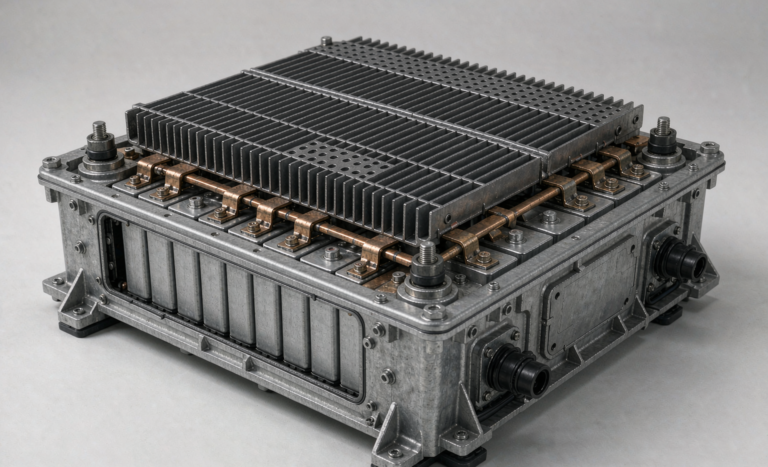
Stationary microgrid batteries live in IP54–IP55 outdoor cabinets exposed to sun, dust, and temperature swings. Because sodium-ion has a higher thermal-runaway onset than some high-nickel lithium chemistries but still requires propagation control, I design to UL 1973 cell-level safety and UL 9540A system-level thermal-propagation testing, and I keep inter-cell spacing and compartmentalization generous. Active cooling is rarely needed; a passively ventilated, shaded cabinet holding the cells between 15°C and 35°C is usually sufficient and eliminates the fan-reliability and condensation headaches I have fought in forced-air LFP enclosures.
For transport and commissioning, modules are handled under UN38.3 (T.1–T.8) as Class 9, and we ship at 30% SoC per IATA PI965 for air or at 30–50% for sea, exactly as we do for our lithium lines. The cell internals are built to IEC 62619 (industrial cells) and the system to IEC 62933 (stationary storage) and IEEE 1547 for interconnection—standards our microgrid integrators audit before sign-off.
Where I Recommend Sodium-Ion Over Lithium in a Microgrid
My rule of thumb after dozens of deployments: choose a sodium ion battery microgrid bank when (1) land and enclosure space are not the binding constraint, (2) the site sees cold winters or wide temperature swings, (3) autonomy at low SoC matters, and (4) supply-chain and $/kWh predictability outweigh peak energy density. Choose LFP when weight, volume, or highest RTE at high C-rate dominate. In most remote-community and campus microgrids I now lead with sodium-ion as the default custom battery solution, reserving LFP for space-constrained rooftops and high-pulse industrial loads.
Sizing Example: A 200 kWh Campus Microgrid
To make the trade-offs concrete, here is a recent custom battery solution I engineered for a university campus that wanted to shave its evening peak and ride through two grid outages per month. The load profile was 0.25C average with 2.5C 5-second motor-start pulses from the HVAC plant, and a required autonomy of six hours at 80% load when islanded.
- Energy requirement: 200 kWh usable at 90% DoD → 222 kWh nameplate.
- Power requirement: 250 kW continuous, 600 kW 5-second pulse → 1C continuous, 2.4C peak from the pack.
- Chemistry choice: sodium-ion layered-oxide cells at 150 Wh/kg; footprint 1.4x the equivalent LFP but $/kWh ~15% lower and no cold-derating.
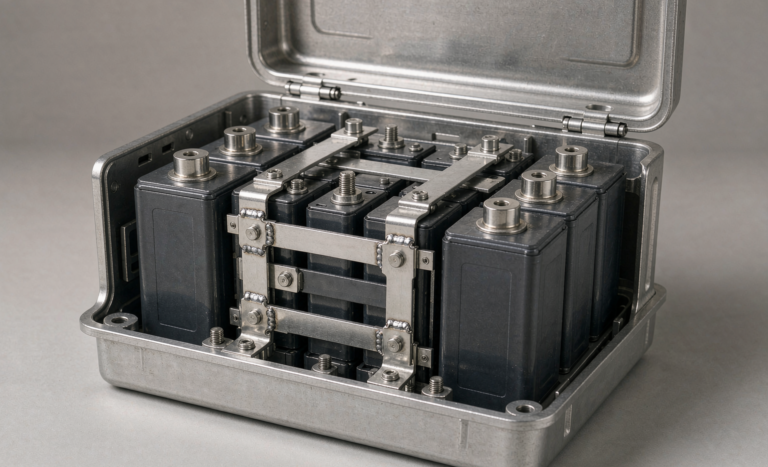
- Enclosure: three IP55 cabinets, passive ventilation, shaded siting, cell operating band 15–35°C.
- Projected life: 70% daily DoD, two shifts → ~5,500 cycles to 80% SoH, about 8 years before the first module swap.
The client accepted the larger footprint because the 15% lower cell cost and eliminated active-cooling reliability risk more than paid for the extra concrete pad. That is the recurring story: sodium-ion wins microgrid bids on lifecycle cost and resilience, not on a density chart.
BMS and SoC Accuracy in Sodium-Ion Microgrids
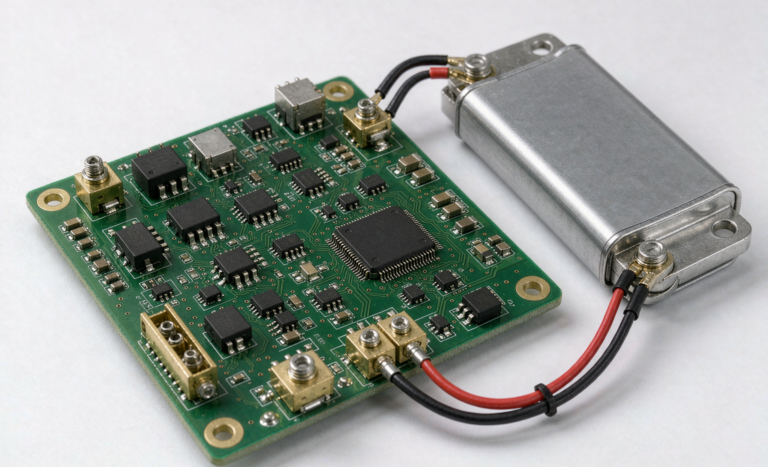
A subtle engineering point buyers rarely ask about: sodium-ion’s discharge curve is flatter than LFP’s near mid-SoC, which makes voltage-based SoC estimation less accurate. In my designs I therefore lean on coulomb counting with periodic calibration against an open-circuit-voltage table at rest, plus a temperature-compensated capacity model in the BMS. Get this wrong and the microgrid controller will either under-utilize the bank (leaving free energy on the table) or over-discharge it (tripping protection). For a lithium battery comparison, LFP’s steeper curve is easier to estimate but its low-temperature capacity collapse is the bigger operational risk. Either way, the BMS tuning—not the cell alone—determines realized performance, and I always budget a two-week commissioning period to tune the model against live site data.
FAQ
How does sodium-ion round-trip efficiency compare to LFP in a microgrid?
In our field data sodium-ion delivers about 90–92% RTE at 0.2–0.5C and 85–88% at 1C, versus 94–95% for LFP. Because microgrids spend most energy at low C-rates, the throughput-weighted gap is usually only 2–3 points—smaller than the procurement and cooling cost differences over a 20-year life.
Can sodium-ion batteries be fully discharged to 0% SoC safely?
Yes, far more safely than lithium-ion. Sodium-ion’s hard-carbon anode does not suffer the lithium-plating or copper-dissolution failure modes that force conservative low-SoC floors in other cells. I routinely set a 5% minimum SoC floor for microgrid banks, unlocking ~10–12% more usable energy than an equivalent LFP window.
What standards apply to stationary sodium-ion microgrid batteries?
Cell-level: IEC 62619 (industrial) and UN38.3 (T.1–T.8) for transport. System-level: IEC 62933 for stationary storage, UL 1973 for cells/modules, UL 9540A for thermal-propagation control, and IEEE 1547 for grid interconnection. We ship modules at 30% SoC under IATA PI965 for air or 30–50% for sea.
How long do sodium-ion microgrid batteries last under daily cycling?
At 80% DoD and 25°C, expect ~3,000–4,500 cycles to 80% SoH (about 4–6 years in a 2-shift microgrid). At 70% DoD and below 35°C, that extends to 5,000–6,000 cycles (7–9 years). Temperature control is the dominant life lever.
Is sodium-ion better than lithium for cold-climate microgrids?
Often yes. At −20°C a sodium-ion pack still delivers ~80–90% of room-temperature capacity, versus ~60–70% for a comparable LFP pack. It also tolerates deep discharge to low SoC without plating risk, which helps cold-climate autonomy. We add self-heating or pre-conditioning for sub-−10°C start events.