Solid Electrolyte Membrane Casting for Semi-Solid Batteries
Most buyers judge a semi-solid state battery by its chemistry sheet, but after fifteen years on the coating line I can tell you the cell usually lives or dies at an earlier step: the solid electrolyte membrane casting process. That thin composite film, somewhere between twenty and eighty microns thick, has to hold ionic conductivity above 1 mS/cm, survive calendering and lamination, and stay hermetic for a decade of cycling. I am Karl Huang, a senior lithium battery engineer, and in this article I want to walk through how we actually cast these membranes, where the yield loss comes from, and what a serious buyer should ask before ordering a custom battery solution built around a semi-solid cell.
What the Membrane Actually Has to Do
In a conventional lithium battery a porous polymer separator does one job: it keeps the anode and cathode apart while lithium ions swim through a liquid electrolyte. In a semi-solid state battery we ask one film to do three jobs at once. It must carry the ions, it must physically block any electronic short between electrodes, and it must act as a mechanical spacer that survives stack pressure. When I test a finished membrane the first number I look at is ionic conductivity, and the target is usually 1.0 to 2.0 mS/cm at 25 degrees Celsius. Below 0.5 mS/cm the cell cannot sustain a 1C discharge without a voltage sag that ruins the energy report.
The second number is thickness uniformity. A membrane that averages forty microns but swings between thirty-two and forty-nine will plate lithium in the thin zones long before the average number suggests a problem. So when people ask me why membrane casting matters, my answer is simple: it decides whether the cell is consistent, not just whether it is functional.
Why We Cast Instead of Laminate
There are two ways to build the electrolyte layer. One is lamination, where you press a pre-formed dry film onto the electrode. The other is casting, where you deposit a wet slurry or melt onto a carrier and dry it in place. For thin semi-solid films I prefer casting for three reasons. First, adhesion to the electrode is formed while the film is still mobile, which eliminates the air pockets that plague laminated interfaces. Second, we can grade the additive loading along the thickness, putting more ceramic near the separator-facing side. Third, casting adapts to a range of composite chemistries without re-tooling the press.
Lamination still wins for some high-ceramic-content systems where the film is nearly solid and cannot be deposited wet. But if you are running a semi-solid state battery pilot line, casting gives you a wider process window and a lower scrap rate on startup.
Doctor-Blade and Slot-Die: Two Lines, Two Trade-offs
On the line we use two casting methods. Doctor-blade casting drags a fixed gap over the slurry pool and works beautifully in the lab, where a five-micron change in gap is easy to dial in by hand. It is cheap, fast to set up, and ideal for the first hundred cells of a new semi-solid state battery design. Its weakness is edge beading: the slurry piles up at the two edges, so the outer ten millimeters of every sheet are scrap.
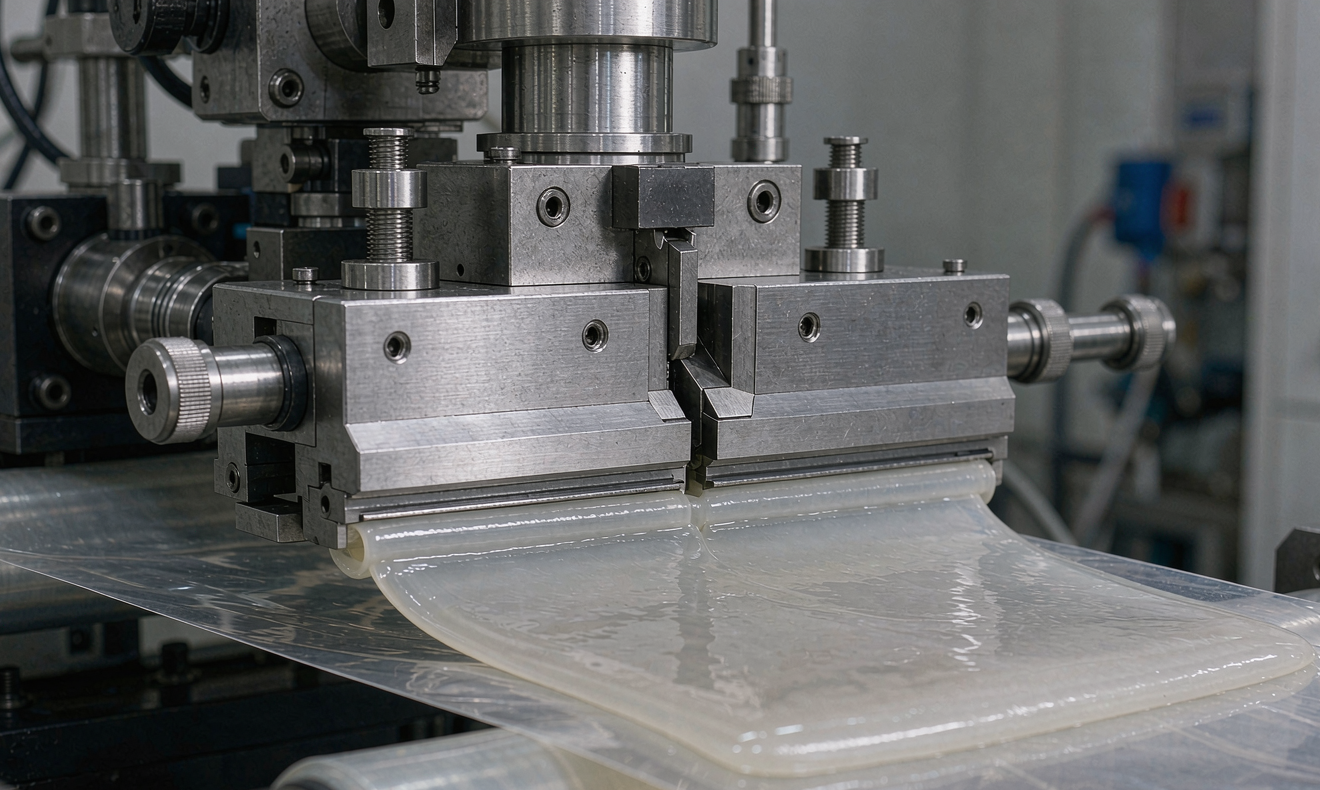
Slot-die casting feeds the slurry through a controlled slot and is what we use for production. Gap settings run from fifty to two hundred microns, line speeds from one to ten meters per minute, and the wet thickness is set by the pump rate divided by the web speed. A slot-die head holds thickness to better than two percent across a three-hundred-millimeter web, which is why it is the only method that passes automotive-level consistency audits.
Thickness Control and the Two-Micron Rule
I keep one rule taped above my bench: if the membrane thickness varies by more than two microns across the sheet, stop and fix the head before you run another kilometer. Two microns sounds trivial, but a variation of that size changes the local current density enough to shift lithium deposition, and it shifts it unevenly. We measure thickness with a beta-transmission gauge every two hundred millimeters and log the profile; if the profile drifts, the cause is almost always a partially clogged slot or a pump pulsation.
- Target dry thickness: 30 to 50 microns for energy cells, 20 to 30 microns for power cells.
- Wet-to-dry shrink: 45 to 60 percent, depending on solids loading.
- Permitted deviation: plus or minus 2 microns within a sheet, plus or minus 3 percent lot to lot.
The reason we care so much is coulombic efficiency. A membrane with a tight thickness profile runs at 99.3 percent first-cycle efficiency in our data; the same chemistry with a sloppy profile drops to 98.1 percent, and that lost point compounds over two thousand cycles.
Drying Under One Percent Relative Humidity
Here is the part that surprises most visitors. The drying oven is not just a heater; it is a humidity-controlled chamber. Composite solid electrolytes are hygroscopic, and a membrane that absorbs moisture during drying will show a conductivity spike on the bench and a violent capacity fade in the field, because the absorbed water reacts at the anode. We hold the drying zone below one percent relative humidity, which in practice means a dew point below minus forty degrees Celsius.
The profile is a three-stage ramp: sixty degrees Celsius for solvent removal, ninety degrees for densification, and a final one-hundred-twenty-degree cure that cross-links the polymer phase. Skipping the first stage traps solvent and creates blisters; running the last stage too hot degrades the polymer and drops the film’s elongation below the point where it survives winding. For a semi-solid state battery cell that has to pass a nail-penetration test, that elongation margin is not optional.
Pinholes, Wrinkles, and In-Line Inspection
One pinhole in a membrane is a soft short waiting to happen, so inspection runs in line, not at the end. We use a laser profilometer for surface defects and an X-ray transmission scan for internal voids, both reading at production speed. Our acceptance limit is fewer than five defects larger than twenty microns per square meter. Anything above that and the roll is quarantined for rework.
The other defect class is mechanical: wrinkles and edge curl from web tension. A wrinkle compresses the membrane in one axis and stretches it in the other, so the compressed crease becomes a conduction hot spot. We hold web tension to within five percent and keep the carrier film flatness under two millimeters per meter. When a customer sends back a semi-solid cell that swelled in one corner, my first question is always whether the membrane was cast on a tensioned or slack web.
Calendering and Lamination Into the Cell Stack
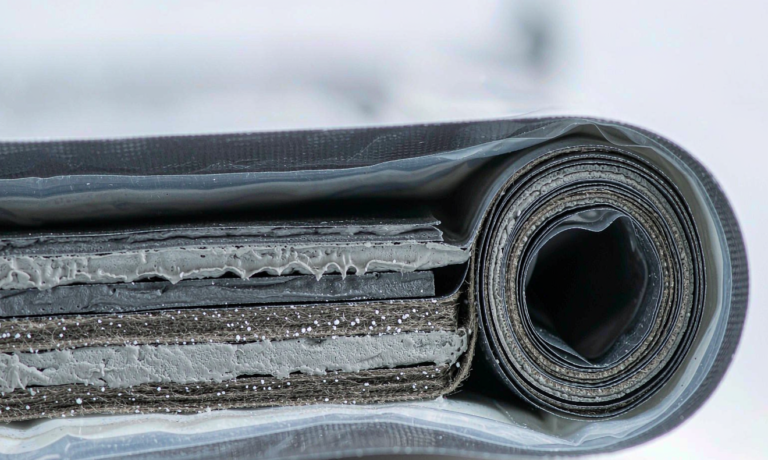
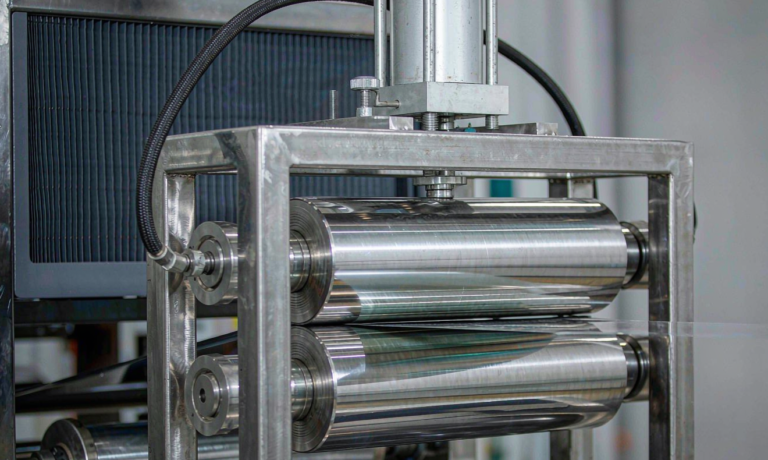
After drying, the membrane is calendered between steel rolls at a line pressure of 0.5 to 3 MPa to close residual porosity down to thirty to forty-five percent and to bond the composite into a coherent film. This is a delicate pass. Too little pressure and the film delaminates during handling; too much and you crush the porosity that the liquid phase needs to stay mobile, which raises impedance and kills rate capability.
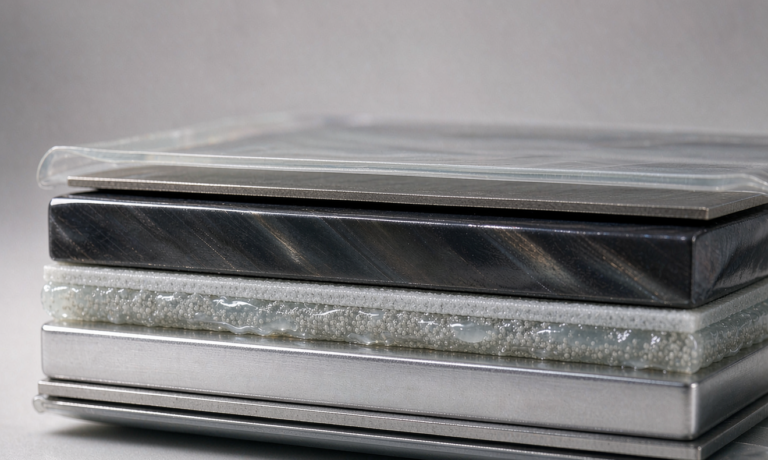
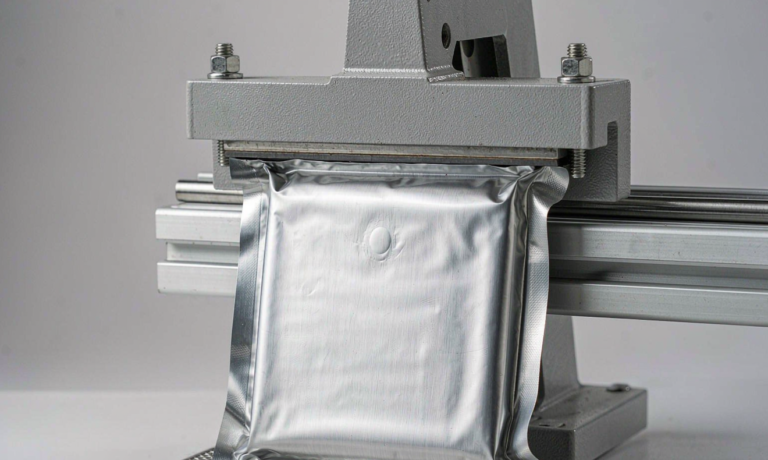
The calendered membrane then goes straight into the stacking line, where it is laminated between anode and cathode under heat and pressure. If you want the full picture of that step, my earlier article on cell stacking and lamination covers the temperature and pressure windows in detail. The key point here is that membrane casting and stacking are one continuous process: the surface energy you leave on the membrane decides how well the next station can bond it.
What This Means for Buyers of a Custom Battery Solution
When you shortlist a supplier for a semi-solid state battery, do not stop at the datasheet energy density. Ask three process questions. What is your membrane thickness tolerance within a sheet? What is your drying-zone dew point? What is your in-line defect rejection rate? A supplier who can answer those with numbers is running a controlled casting line; one who cannot is probably buying films from a third party and hoping the lamination holds.
For a custom battery solution this matters because the membrane is the hardest part to rework. You can swap a BMS, you can rewire a module, but you cannot easily replace a bad electrolyte layer once the cell is sealed. Getting the casting right upstream is the cheapest quality control you will ever buy.
Frequently Asked Questions
How thick should a solid electrolyte membrane be for a semi-solid state battery?
For energy-optimized cells we target 30 to 50 microns dry, and for power-optimized cells 20 to 30 microns. Thinner films lower ionic resistance and improve rate capability but are harder to cast without pinholes, so the choice is a trade between impedance and yield rather than a pure win.
What ionic conductivity should a cast composite electrolyte reach?
We aim for 1.0 to 2.0 mS/cm at 25 degrees Celsius. If a membrane measures below 0.5 mS/cm, the cell will sag under a 1C load, so we reject the roll rather than risk a weak cell reaching a customer.
Why is humidity control so critical during membrane drying?
Composite solid electrolytes are hygroscopic. If the drying zone rises above one percent relative humidity, the film absorbs water, which raises the bench conductivity reading but reacts at the anode during cycling and drives fast capacity fade. We keep the dew point below minus forty degrees Celsius to avoid this.
Can a cast membrane be repaired if it has a pinhole?
No, not economically. A single through-pinhole creates a soft short, and patching it disturbs the surrounding thickness profile. We cut out the affected section and scrap that length of web, which is why in-line inspection and tight slot control pay for themselves.
Does membrane casting work for sulfide and oxide composite systems?
Casting works well for polymer-rich and hybrid composites. For high-ceramic sulfide systems that are nearly solid, a dry lamination route is often better because the film cannot be deposited as a stable wet slurry without solvent damage to the sulfide phase.
How does membrane quality affect cycle life?
A tight, uniform membrane holds first-cycle coulombic efficiency near 99.3 percent in our data, while a poorly controlled profile drops to about 98.1 percent. That single point of efficiency compounds across thousands of cycles, so membrane quality is one of the strongest predictors of long-term cycle life.
Further Reading
References